South Window vs East Window for Houseplants
Choose a south window for sun-hungry plants, but keep foliage about 12 to 24 inches back or filter the glass. Choose east for foliage plants and cuttings that want gentler winter light. South windows usually bring stronger direct light, while east windows are commonly reported to give morning sun and less heat at the pane. That split matters for scorch, legginess, and cold stress near drafty glass.
| Decision factor | South Window | East Window | Winner |
|---|---|---|---|
| Winter light strength | Strongest direct light for the day | Morning sun, then softer light | South Window |
| Heat near the glass | Can create a hot microclimate | Usually cooler and less intense | East Window |
| Risk for tender foliage | Higher if leaves press the pane | Lower for plants that dislike direct sun | East Window |
| Best fit for sun-loving plants | Better for compact growth and stronger color | Works only for plants that want less direct sun | South Window |
| Best fit for medium-light foliage plants | Often too intense without a buffer | Usually the safer winter choice | East Window |
| Placement flexibility | Needs more distance, filtering, or rotation | More forgiving close to the glass | East Window |
South window vs east window in winter
South-facing windows are commonly reported to get the strongest winter light and can run hotter near the pane. East-facing windows give gentler morning sun and a cooler setup, which is usually safer for plants that dislike intense direct light. The right choice depends on the plant, the room temperature, and how close the foliage sits to the glass.
Why south windows are brighter and hotter
A south-facing window can be one of the hardest spots in the house for a houseplant. It pulls in the most direct light and can create a hot microclimate, especially when the room is already warm or the plant sits tight against the glass.
That extra light helps sun-loving species. It is also why a plant can look fine from across the room and still scorch at the sill.
Why east windows are the gentler winter option
East-facing windows bring in bright morning light without the same all-day exposure. That makes them a better winter choice for plants that want brightness but not a hard blast of direct sun.
For foliage plants, cuttings, and many variegated types, east light is often enough to support growth without pushing the leaves into heat stress.
What the light trade-off means for plant selection
The rule is simple: South Window works for plants that need stronger light and can handle more exposure. East Window works for plants that need brightness but can suffer from direct afternoon or midday sun, even in winter.
Room temperature changes the outcome too. A cool room with a south window can work well for sun-lovers; a warm room with dry air and a hot pane may push the same plant too far.
Window placement decision table
| Plant type | South-window suitability | East-window suitability | Move back from glass note | Winter scorch-risk rule |
|---|---|---|---|---|
| Snake plant (Dracaena spp.) | Yes. Stronger light can improve vigor and variegation. | Yes, if the room is bright enough. | Keep leaves off the pane; move back 12 inches if the glass runs hot or cold. | No, unless leaves touch glass or the plant is suddenly moved into direct sun. |
| Jade plant (Crassula ovata) | Yes. Needs plenty of light for compact growth. | Maybe, if the east window is very bright. | Set it back from hot or cold glass and keep the root zone dry between waterings. | Yes, if the plant is pressed to glass or kept too wet. |
| Ponytail palm | Yes. Suits a bright sill and sun-loving exposure. | Yes, if the light is still strong. | Keep the bulb and leaves clear of the pane. | No, unless the plant is cramped against glass. |
| Hoya | Maybe, with distance or a thin curtain. | Yes. Often a good winter spot. | Move back 6 to 12 inches if the east sill is very bright. | Yes, if leaves sit in direct hot sun for long periods. |
| Croton | Yes, after gradual acclimation. | Yes, if color is fading and the plant needs more light. | Start farther from the pane and move closer only if the leaves stay sound. | Yes, on sudden exposure to stronger light or dry heat. |
| Yucca | Yes. A strong winter window suits it well. | Maybe, if the room is bright and cool. | Keep it off the glass and rotate for even growth. | No, unless the plant is too close to hot or cold glass. |
| Bird of paradise | Yes. High light is a better match. | Maybe, if the room stays bright all day. | Give it space from the pane so leaves do not chill at night. | Yes, if the light is weak or the leaves touch cold glass. |
| Peace lily | No, unless filtered and far back. | Yes. Better than a south sill for winter placement. | Keep it several feet back from direct sun. | Yes, if the sun hits leaves directly. |
| Boston fern | No, unless the window is filtered and the plant is well back. | Yes, if humidity and moisture are steady. | Use a shelf or room position away from pane contact. | Yes, because dry winter air and direct sun dry fronds quickly. |
| Pothos | Usually no. Too much direct sun without filtering. | Yes. A good winter option for bright indirect light. | Keep it away from direct rays and drafty glass. | No, if it stays in indirect light. |
How does winter sun angle change the choice?
Winter changes the angle, not the clock. Shorter days and a lower sun angle mean south-facing light can still be strong, but it arrives differently than in summer. A sunny winter sill can still scorch because the glass concentrates light and heat at close range.
Shorter days and lower sun angle
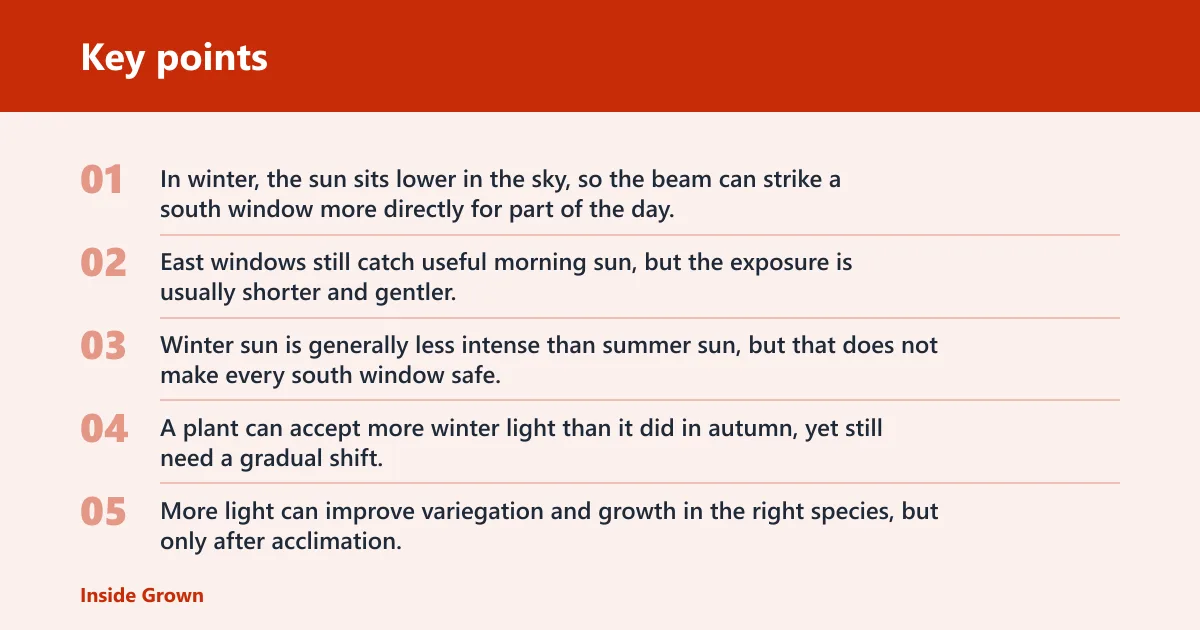
In winter, the sun sits lower in the sky, so the beam can strike a south window more directly for part of the day. That can make the sill feel hotter than the room behind it, even while the air in the rest of the room stays cool.
East windows still catch useful morning sun, but the exposure is usually shorter and gentler. That is why east often wins for plants that want bright light without prolonged direct rays.
When direct winter sun is weaker than summer sun
Winter sun is generally less intense than summer sun, but that does not make every south window safe. Light that would be fine in the room can still be too much at the pane, especially for leaves that were grown in lower light and have not been adjusted.
A plant can accept more winter light than it did in autumn, yet still need a gradual shift. More light can improve variegation and growth in the right species, but only after acclimation.
Why a sunny winter sill can still scorch
Scorch risk rises when leaves press directly against hot or cold glass. Cold glass / windowsill exposure can damage contact points on the leaf, and a warm daytime pane can dry the same tissue from the other side.
That is why the problem is not only the amount of light. Distance from the pane matters just as much.
How far should plants sit from the glass?
For many winter houseplants, 12 to 24 inches back from a bright south window is a safer starting point than sitting right on the sill. Plants that need less direct sun may need to sit even farther away or behind a curtain. If leaves touch glass, move them back immediately.
When to move plants back a foot or more
Move a plant back by a foot or more if the window runs hot at midday, if night temperatures drop hard near the pane, or if the plant has soft leaves that brown at the edges. This distance reduces direct blast, gives the room time to buffer heat, and lowers the chance of leaf contact.
Measure the current gap. Start by checking how close the leaves are to the glass. If foliage is within a few inches of the pane, shift the pot back before you see damage.
Test the light path. Watch where the sun lands in the morning and at midday. If the beam hits the full leaf surface for hours, use a shelf, curtain, or a deeper sill to soften the exposure.
Adjust in small moves. Change the position a little at a time over several days. Sudden jumps from shade to strong south light can trigger scorch even in sun-tolerant plants.
Recheck after cold nights. If the plant sits near a pane that gets very cold overnight, move it back farther than you would in a mild room. Cold glass can hurt leaves even when the daytime light is fine.
How to use curtains or shelf depth to soften exposure
A sheer curtain can cut the force of direct rays while still keeping the window bright. A deeper shelf works too, especially for east windows where the goal is bright indirect light rather than full direct sun.
Say your jade plant is sitting on a south sill and the lower leaves start to bronze after a bright spell. Move it 12 inches back and add a thin curtain to reduce stress without sending it into shade.
Which houseplants belong in each window?
South Window is the better fit for species that want stronger light and can take direct sun with acclimation. East Window is the safer fit for plants that want brightness, morning sun, or a softer winter setting. Some plants should be moved away from both windows unless the light is filtered.
South-window plants
Snake plant, jade plant, ponytail palm, yucca, and bird of paradise are the clearest South Window choices on this list. Snake plants can grow more vigorously in a south-facing window, and their variegation often holds better with more light. Jade plants need plenty of light for compact growth, while ponytail palm, yucca, and bird of paradise all do better with stronger exposure than a dim interior offers.
A common first-timer mistake is to put these plants on the sill and assume the glass itself is part of the light recipe. It is not. The pane can become the damage point if leaves touch it.
East-window plants
Hoya and croton are better matches for East Window in many winter homes. Hoya tolerates bright windowsill conditions without needing full south exposure, and croton often keeps better color with strong but gentler morning light after acclimation.
East light is also useful when the room is already warm. In that case, the softer sun reduces the chance of leaf stress while still giving enough brightness to support growth.
Plants that belong in neither window without extra distance
Peace lily, Boston fern, and pothos usually do better away from direct south rays. A shaded spot near a north-facing window is a low-light starting point for tolerant plants, and low light does not mean no light. These plants may still need a window, but not the full force of a south sill.
If you only have south exposure, move them back several feet or filter the glass. A windowless room needs a suitable grow light for a living plant.
Choose South Window if… / Choose East Window if…
Choose South Window if the plant is a true light lover, the room stays cool enough to offset the pane, and you can keep foliage off the glass. Choose East Window if the plant wants bright light without sharp direct sun, the room runs warm, or the leaves are prone to scorch or drop when exposed too fast.
- Choose South Window if you are placing snake plant, jade plant, ponytail palm, yucca, or bird of paradise and can keep the pot 12 to 24 inches back when needed.
- Choose South Window if you want stronger variegation or tighter growth on a plant that already tolerates direct sun.
- Choose East Window if the plant prefers bright indirect light, such as hoya, croton, pothos, peace lily, or Boston fern.
- Choose East Window if the south pane runs hot by day or cold at night and you cannot keep leaves away from the glass.
Do houseplants need more light in winter than in summer? Often yes, because the days are shorter and indoor light is weaker for more of the day. That does not mean every plant should move into stronger direct sun. It means you should match the winter window to the plant’s tolerance, then adjust the distance from the glass.
Frequently asked questions
Is a south-facing window too much sun for houseplants in winter?
Not always. A south-facing window can be the best winter spot for sun-loving plants, but it can be too much for foliage plants, cuttings, and anything that already shows scorch. The answer depends on the species, the room temperature, and whether the leaves sit right against the glass.
Are east-facing windows better than south-facing windows for winter houseplants?
Often yes for plants that want bright light without direct all-day sun. East-facing windows give gentler morning exposure and are usually safer for tender foliage. South-facing windows are better for plants that need stronger light and can handle more heat at the pane.
Which houseplants should go in a south window in winter?
Snake plant, jade plant, ponytail palm, yucca, and bird of paradise are the strongest South Window candidates here. These plants prefer brighter exposure, and some improve in color or growth when they get more light. Keep them back from the glass if the pane gets hot or cold.
Which houseplants prefer bright indirect light by an east window in winter?
Hoya, croton, pothos, peace lily, and Boston fern are often better fits for east windows in many homes. They want brightness, but they are more likely to scorch or dry out in stronger south exposure. East light gives a good balance of brightness and protection from harsh direct sun.
How far from a sunny window should houseplants sit in winter?
As a general rule, start with 12 to 24 inches back from a bright south window for sun-tolerant plants, and farther for plants that dislike direct sun. If the foliage touches glass, move it back at once. Curtains, shelf depth, and rotation can fine-tune the setup.
Should I move snake plants or jade plants to a south window in winter?
Yes, usually. Snake plants can grow more vigorously in a south-facing window, and jade plants need plenty of light for compact growth. Just acclimate them gradually and keep the leaves off the pane, because root problems and scorch can show up if the plant is wet or too close to glass.