Landscape Lighting Ideas for Modern Homes
For modern homes, a common rule of thumb is to use 3 to 5 lighting layers at most, with shielded fixtures, narrow beams, and dark gaps so the house reads as architecture, not decoration. Too many fixtures, broad spill, or exposed bulbs flatten clean lines and create glare that makes glass, stucco, and metal look cheap. This guide covers placement, beam spread, fixture styles, color temperature, and scene control for a restrained exterior.
Why modern homes need restrained lighting


Modern exteriors usually look best with fewer visible fixtures and more deliberate emptiness. Flat walls, sharp corners, and glass panels can turn busy fast if every surface gets light. The goal is to reveal form, not fill the yard with brightness.
Use light only where it helps the eye read the house: the entry, a wall plane, a tree canopy, a path edge, or one textured surface. Leave some areas dark so the lit parts have room to stand out. On minimalist homes, darkness is part of the composition.
Where negative space should stay dark
Keep broad lawn areas, blank side yards, and low plant beds dark unless they carry a navigation or security function. On boxy homes, lighting every corner makes the façade look flatter, not more dramatic. On glass-heavy homes, too much light can reflect back into the windows and create visual noise.
How to avoid making flat façades look busy
Use one or two lighting methods per elevation, not several competing ones. A wall wash on a wide stucco plane, or a pair of uplights on a single tree, usually does more than several small beams aimed at windows, trim, and planters. Shield fixtures so you see the effect, not the source.
How do you lay out modern exterior lighting for a modern home?
Start by dividing the site into entry, façade, and yard zones, then assign each zone one job. The entry guides arrival, the façade gives shape to the house, and the yard supplies only the amount of light needed for movement or a focal point. That keeps the exterior calm.
A common first-timer mistake is using identical fixtures for the driveway, garden beds, and front wall, which makes the whole landscape look flat. A 20-foot wall, a 3-foot planting bed, and a front step do not need the same beam, height, or brightness. Match fixture choice to the feature, then leave the rest dark.
Mark the entry zone. Identify the front walk, door, porch, and any steps or level changes. This zone needs the clearest light because it supports movement and arrival without turning the front of the house into a billboard.
Mark the façade zone. Decide which wall planes, columns, or cladding materials deserve emphasis. On modern homes, one strong wall treatment is usually better than several scattered spots.
Mark the yard zone. Choose one or two plants, a specimen tree, or a long planting strip, then stop. If the yard has no strong focal planting, it may be better to leave it mostly dark.
Assign each zone a job. Use task light for the entry, accent light for the façade, and ambient light only where the site needs soft background illumination. This keeps the scheme controlled and avoids overlap between fixtures.
Modern home lighting placement checklist
This checklist helps you decide what deserves light, what should stay quiet, and where fixture choice needs the most restraint. The best result usually comes from a small number of deliberate placements.
| Zone | Recommended fixture type | Typical beam angle | Suggested color temperature | Glare risk | What to avoid on flat or minimalist exteriors |
|---|---|---|---|---|---|
| Entry | Low-profile step lights, shielded path lights, recessed porch lights | Wide enough to guide movement; narrow enough to keep light off the face | 2700–3000K | Medium if fixtures are visible from the approach | Exposed lamps, bright flood beams, evenly spaced runway lighting |
| Façade | Wall wash or carefully aimed uplight | Wide for wash, narrow for a single accent point | 2700–3000K for warm minimalism; 3500–4000K only when clarity matters | High if beams hit glass or are aimed too high | Multiple hot spots, hard scallops, overlapping beams, light aimed at windows |
| Yard | Low-voltage LED uplights, a few path lights, step lights where needed | Narrow for trunks, wider for shrubs and low canopies | 2700–3000K for most homes | Medium to high if foliage is overlit | Lighting every plant, washing the whole bed, bright fixtures in open lawn |
Which fixtures work best for modern exteriors?
Low-voltage LED fixtures fit modern homes well because they are outdoor-rated, flexible, and easy to zone. They work across paths, patios, trees, and architecture, and they pair well with dimming and scheduling. That makes them easier to tune than fixed-output decorative fixtures.
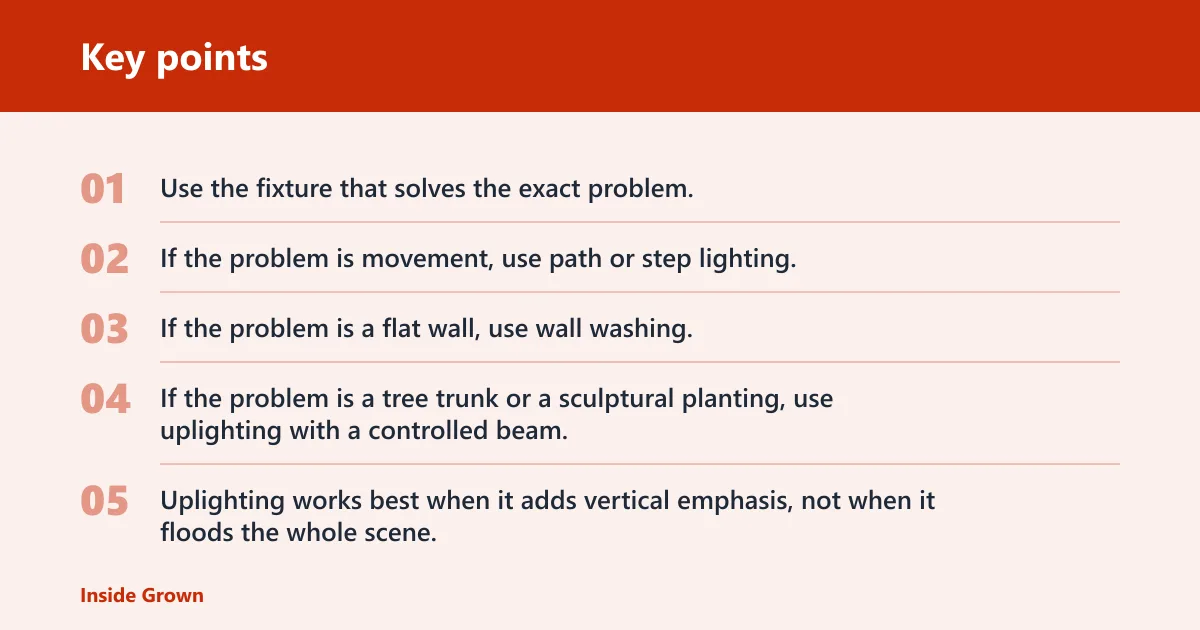
Use the fixture that solves the exact problem. If the problem is movement, use path or step lighting. If the problem is a flat wall, use wall washing. If the problem is a tree trunk or a sculptural planting, use uplighting with a controlled beam.
Low-voltage LED fixtures for flexible zoning
Low-voltage LED systems are a strong fit for modern homes because they keep wiring discreet and allow separate zones for the entry, façade, and yard. With a transformer and controls, you can schedule scenes for daily use, late-night dimming, or special occasions without changing the physical layout.
Uplights for trees and architectural accents
Uplighting works best when it adds vertical emphasis, not when it floods the whole scene. Use a narrower beam for trunks and a wider beam for shrubs or multi-stem plants. On architecture, keep uplights selective: one column, one textured corner, or one strong wall surface is usually enough.
Path and step lights for safe movement
Pathway lighting should guide movement on walks, driveways, and entries without creating a runway effect. Step lighting belongs in treads, risers, or nearby walls when there are level changes. On modern homes, choose low-profile fixtures so the hardware stays visually quiet in daylight.
How do you light architecture without glare?
Modern façades need light that stays controlled and off the eye line. Wall washing gives soft, even illumination on broad walls and stone surfaces. Wall grazing places light closer to the surface so texture becomes visible on stone, brick, and stucco. Both work, but they solve different problems.
Outdoor lighting should be shielded to reduce glare. That matters more on modern homes because the materials are often reflective and the lines are so clean. Hot spots, visible lamps, and overbright uplights interrupt the architecture instead of supporting it.
Wall washing for smooth surfaces
Use wall washing on wide modern walls, smooth stucco, and large stone planes when you want an even read across the façade. It softens harsh contrast and avoids the spotted look that narrow beams create on a flat surface. This is the safer choice when the wall itself is the feature.
Wall grazing for textured materials
Use wall grazing when the surface texture deserves attention. Brick, board-formed concrete, stone, and rough stucco can look more dimensional with light placed close to the wall. Grazing creates stronger shadow detail than a wash, so it works best when texture is the point and not every surface needs equal brightness.
Beam spread and mounting height choices
Keep beams tight enough to control spill, and place fixtures so the source is hidden from main sight lines. A beam that is too wide on a small wall creates a hot center and dim edges. A fixture mounted too high often throws light across windows or spills into the sky.
Suppose a 14-foot stone wall is lit with several tight uplights. The wall can end up with bright circles and dark gaps, which reads busy. One wall wash with controlled spread usually gives a cleaner result on that same surface.
What color temperature works best for modern exterior lighting?
Warm white, typically 2700–3000K, suits most contemporary curb appeal because it keeps hard lines from feeling harsh. Cooler light around 3500–4000K can help when clarity matters, such as on steps, entries, or security-sensitive areas. The best choice depends on the architecture, not a blanket rule.
Warm minimalism usually looks better with warmer light. Crisp contemporary homes with pale stone, metal trim, or sharp geometry can tolerate a slightly cooler tone if the scene stays restrained. The key is consistency. Mixed temperatures across one façade can look disjointed fast.
How to keep mixed temperatures from looking disjointed
Use one color temperature for the façade and a matching or close temperature for the path and entry. If a cooler setting is needed for safety at the steps, keep it local rather than spreading it across the whole front yard. That preserves visual unity.
How do you control modern exterior lighting?
A transformer and controls make the system practical. Use outdoor-rated connections, then divide fixtures into zones so the entry, façade, and yard can run at different levels. Timers, dusk-to-dawn control, dimming, and smart scenes let the lighting follow the way the house is actually used.
Low-voltage exterior lighting can be paired with smart scenes and schedules. That matters for modern homes because one setting rarely works for every hour of the evening. Bright early, dim later, off or minimal overnight is often cleaner than keeping everything on all night.
Transformer setup and zone control
Place the transformer where it can stay accessible but not prominent. Keep the connections outdoor-rated and organize the loads so path lights, uplights, and architectural lights can be adjusted separately. Zoning makes it easier to keep the house calm while still lighting what matters.
Timers, dusk-to-dawn control, and dimming
Use timers for predictable shutoff, dusk-to-dawn control for convenience, and dimming for evenings when full brightness is too much. A lower output often works better for modern exteriors because it preserves negative space and reduces reflected glare from glass or polished finishes.
Smart scenes for different uses
Smart scenes are useful when the house needs different lighting for arrival, entertaining, and late-night security. Keep the scenes simple. One for guests, one for normal evening use, and one low scene for overnight is usually enough.
How do you light a front yard to match a modern house?
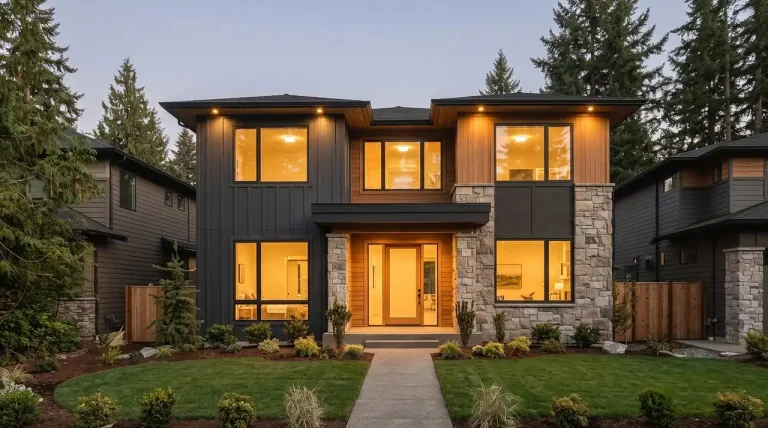
Keep the front yard edited down. Light the route to the door, one architectural plane, and one focal planting if there is one. That approach fits minimal, mid-century, boxy, and glass-heavy homes better than broad decorative lighting across every bed and shrub.
For mid-century homes, a few low, shielded path lights and a restrained tree uplight often fit the low-slung profile. For boxy homes, a wall wash across one main volume usually works better than multiple spotlights. For glass-heavy exteriors, keep fixtures low and angles narrow so reflections stay under control.
What to leave unlit
Leave secondary beds, side setbacks, and plain lawn areas dark unless they help with movement. Unlit space makes the lit areas feel intentional. On a modern house, that silence is often what makes the design look finished.
Frequently asked questions
How do I layout modern exterior lighting for a modern home?
Divide the property into entry, façade, and yard zones, then give each zone one job. Use path or step lights for movement, wall washing or selective uplighting for the house, and only a few accents in the yard. Leave some areas dark so the design stays clean.
How do I choose exterior lighting for a contemporary exterior?
Choose low-voltage LED fixtures with shielded sources, simple forms, and zoning options. Match the fixture to the surface: path lights for circulation, step lights for elevation changes, wall wash for smooth walls, and uplights for one tree or one strong architectural feature.
How do I design exterior lighting without making it look busy?
Limit the number of fixture types, keep beams controlled, and avoid lighting every plant or wall. Use dark gaps between lit areas so the house reads as a composition. If two fixtures do the same job, you usually only need one.
How do I place exterior lights around architecture and plants?
Put lights where they support shape: uplight a single tree, wash a wide wall, graze textured stone, or light a step edge. Avoid aiming beams at windows or scattering several fixtures across one small area. One clear idea per zone usually looks best.
What fixtures work best for low-voltage modern exterior lighting?
Low-voltage LED path lights, step lights, uplights, and wall wash fixtures are the core pieces. They are outdoor-rated, work well with dimming and zone control, and can be placed across paths, patios, trees, and architecture without overwhelming a modern exterior.