How Many Plants Per Drip Emitter Do You Need?
Use one emitter per small plant, two emitters for medium plants, and 2–4 emitters for larger plants or tight clusters. Match total flow to the root zone, not the plant count. Too few emitters leave dry pockets. Too many can waste water, push roots shallow, or soak one side of a container more than the other. This guide shows how soil, spacing, pot size, and emitter flow rate change that rule, with examples for singles, pairs, and clusters.
Quick decision path: plant size -> soil type -> spacing -> emitter count -> GPH -> placement. Small plants in loam can often start with one low-flow emitter; sandy soil usually needs tighter spacing or more emitters; larger plants and wider root zones usually need two or more emitters with overlap. For setup basics, see drip irrigation setup, pressure regulators, filters, backflow preventers, raised-bed watering, and emitter spacing charts.
What one emitter can water


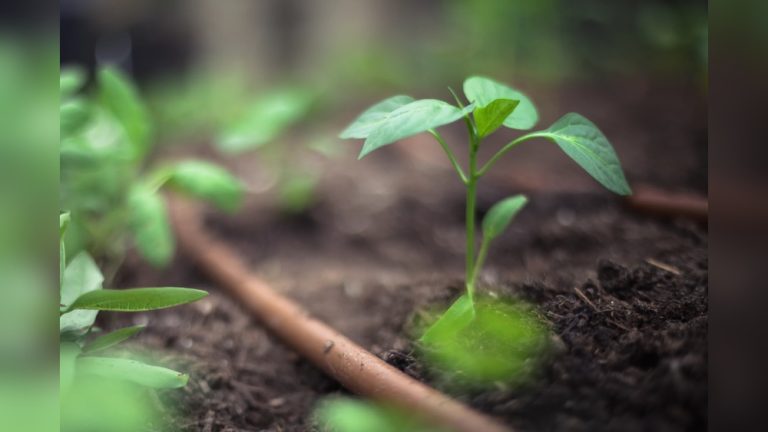
A single emitter works best when its wet zone can reach most of the active roots. That is easier in loam than in sand, and easier for herbs than for tomatoes or squash. As plant size and root spread increase, one emitter often stops being enough unless the flow rate is high and the soil holds water well.
For a compact herb or transplant, one 0.5 GPH emitter near the stem can be enough in loam. University extension guidance and irrigation manufacturer charts commonly place small vegetables and herbs in the 0.5 to 1 GPH range, while larger crops usually need more emitters or higher total flow. In clay, a smaller flow can spread farther sideways; in sand, water moves down fast and the wet zone stays narrow.
When one emitter can cover two plants
One emitter can water two plants when their root zones overlap and the spacing is tight enough that the wet pattern reaches both crowns. That is common with small greens, basil, or two seedlings set close together. It is much less reliable for two fruiting vegetables with separate root systems.
Place the emitter between the plants only when both are small and growing in similar soil. If one plant is much larger, it will usually take most of the water and leave the smaller one short. In that case, split the flow.
When to split coverage across a small cluster
Use multiple emitters when the cluster has mixed plant sizes, a wide spacing pattern, or a crop with a broad root spread. A cluster of lettuce can often share a tight grid. A cluster with peppers, herbs, and a cucumber should not share one point source because each plant drinks on a different schedule.
A common first-timer mistake is putting one strong emitter at the edge of a cluster and assuming the water will reach the far side. In sand, it may not. In clay, it may puddle before it moves outward.
Emitter sizing by plant and soil
Emitter size should follow plant size, root spread, and soil texture. Common garden choices include 0.5 GPH, 1 GPH, and 2 GPH. Smaller emitters give slower, tighter watering. Larger emitters wet more area faster, which helps larger plants and deeper feeders. Manufacturer data sheets and extension guides generally treat these as starting points, not fixed rules.
The basic rule is simple. Use 0.5 GPH for small plants or tight grids, 1 GPH for medium garden plants, and 2 GPH for deep feeders or large root zones. Soil changes that rule. Sand usually needs either more emitters or closer placement. Clay often needs fewer emitters or lower flow because water spreads sideways more easily.
0.5 GPH, 1 GPH, and 2 GPH in practice
A 0.5 GPH emitter can be a good fit for seedlings, herbs, and leafy greens in a tight layout. It helps avoid runoff in containers and keeps the wet zone controlled. A 1 GPH emitter can fit many medium vegetables and average raised-bed spacing. A 2 GPH emitter is better for deeper feeders such as tomatoes and zucchini, where the root zone needs more water volume.
If the emitter is too small for the plant, you may need too long a runtime to wet the root zone. If it is too large, water can move past the roots before the soil holds it. That is why one emitter size does not suit every crop.
Loam, sand, and clay changes
Loam gives the most forgiving balance. One emitter often wets a usable radius around a small plant, and two emitters can cover a medium plant without waste. Sand drains fast, so the emitter count often needs to go up, or the spacing needs to tighten. Clay spreads water sideways more, but it can slow infiltration, so larger emitters may pool unless they are spaced carefully.
On a slope, even a proper emitter can move water downslope before it spreads evenly. That usually means using more than one emitter or adjusting placement so the wet zone stays centered on the roots.
Placement patterns for roots and wet zones
Place the emitter at the stem base for a single small plant. For larger plants, place two emitters on opposite sides of the stem, a short distance from the crown, so the wet zones overlap under the root ball. For pairs, place one emitter between the plants only if their spacing is tight and their size is similar.
Emitter spacing matters too. A tight grid with 6-inch spacing suits leafy greens. A standard raised-bed layout often uses 12-inch spacing, which aligns with common manufacturer and extension recommendations for many vegetable beds. The point is overlap: wet zones should meet before the soil dries out between lines or emitters.
Drip emitter sizing table
The table below gives a practical starting point for common crops and container sizes. Use it as a layout guide, then adjust for soil, slope, and how fast the bed dries. In a drip system, the total emitter flow must fit the zone pressure and runtime plan. For a simple design check, total zone GPH = sum of all emitter GPH values on that zone; for example, eight 0.5 GPH emitters plus four 1 GPH emitters equal 8 GPH total. That total must be reasonable for the supply line, pressure regulator, filter, and available inlet pressure.
| Plant or container | Root spread | Soil | Recommended emitter count | Emitter size | Placement pattern |
|---|---|---|---|---|---|
| Leafy greens in a tight grid | Small, shallow | Loam | 1 per plant or 1 for 2 plants | 0.5 GPH | 6-inch spacing; between plants if paired |
| Leafy greens in sandy bed | Small, shallow | Sand | 1 per plant | 0.5 to 1 GPH | At plant base, closer spacing than loam |
| Basil, parsley, cilantro | Small to medium | Loam | 1 per plant | 0.5 to 1 GPH | At the stem base |
| Peppers | Medium | Loam | 2 per plant | 1 GPH each | On opposite sides of the plant |
| Tomatoes | Medium to large | Loam or clay | 2 per plant | 2 GPH each | One on each side of the stem |
| Zucchini | Large, spreading | Loam or sand | 2 to 4 per plant | 2 GPH each | Around the outer root zone |
| Strawberries | Small, shallow | Loam | 1 per plant or 1 for 2 plants | 0.5 GPH | Centered between crowns when spacing is tight |
| 1-gallon container | Very small | Potting mix | 1 | 0.5 GPH | Near the edge of the root ball |
| 5-gallon container | Medium | Potting mix | 1 to 2 | 1 GPH | One centered, or two opposite sides |
| 10-gallon container | Medium to large | Potting mix | 2 | 1 to 2 GPH | Opposite sides for overlap |
How many emitters per plant?
Use about one emitter for a small plant, about two emitters for a medium plant, and about 2–4 emitters for a large plant or a broad container. The deciding factor is not the stem count. It is how far the roots reach and whether the soil can spread water to the full root zone without dry gaps.
Single plants in beds
For single plants in a raised bed, start with one emitter for herbs and small greens, two emitters for peppers or tomatoes, and two to four emitters for squash or other large spreaders. In loam, those layouts often work well with 0.5 to 2 GPH emitters. In sand, move toward more emitters rather than higher flow alone.
A standard raised-bed drip layout uses 3 to 4 parallel drip lines in a 4-foot-wide bed, with line spacing approximately 12 inches apart, according to common extension and irrigation design references. For leafy greens, tighter 6-inch spacing can make sense because the wet zones need to overlap more closely.
Paired plants on one line
For two plants on one line, one emitter can work if the plants are small, the spacing is narrow, and the soil holds moisture well. If each plant has its own noticeable root ball, give each plant its own emitter. For larger paired plants, use two emitters per plant or a small cluster of emitters centered on both root zones.
Small groups in containers
In containers, the root mass is confined, so emitter placement matters more than in open soil. A small herb pot may need one emitter. A larger patio container with a mixed planting often needs two emitters spaced to cover opposite sides of the pot. When a container is wide, one emitter usually leaves a dry ring.
Can one emitter water two plants?
Yes, one emitter can water two plants when the plants are small, the spacing is tight, and the wet zone reaches both root balls. That is safest in loam and in short beds where the emitter can sit directly between the plants. It is less safe in sand, on slopes, or with mixed-size plants.
Safe overlap rules
Use one emitter for two plants only if both plants are roughly the same size and their roots are still close to the stem. The wet zone should overlap at the midpoint between them. If the soil dries quickly at the center line, add a second emitter or increase the flow slightly.
Suppose two lettuce plants are set 6 inches apart in loam. One 0.5 GPH emitter between them can work because the wet zone can spread to both crowns. If those same plants sit 12 inches apart in sand, the middle may dry too fast and each plant should have its own emitter.
When spacing is too wide
Spacing is too wide when one emitter must wet across a gap that is larger than the soil can hold evenly. In that case, the outer roots get moisture first and the far roots lag behind. That is a common issue with tomatoes, peppers, and cucumbers spaced widely in a bed.
Plants that should stay separate
Keep large feeders separate when one plant drinks much faster than the other. Tomatoes and zucchini often fit this rule. So do mixed beds where a shallow herb sits beside a thirsty fruiting plant. Different water needs make one shared emitter unreliable.
How many emitters fit on a line?
The practical limit depends on line size, total flow, and zone pressure. A 1/4-inch line is best for short runs and individual plants. A 1/2-inch poly tubing main line feeds beds from the faucet or timer and can support branching to 1/4-inch lines. The zone must be sized so total emitter flow fits the available pressure and runtime. In other words, allowable emitter counts depend on tubing length, inlet pressure, and the manufacturer’s pressure/flow specifications, not just on tubing diameter.
1/4-inch line capacity
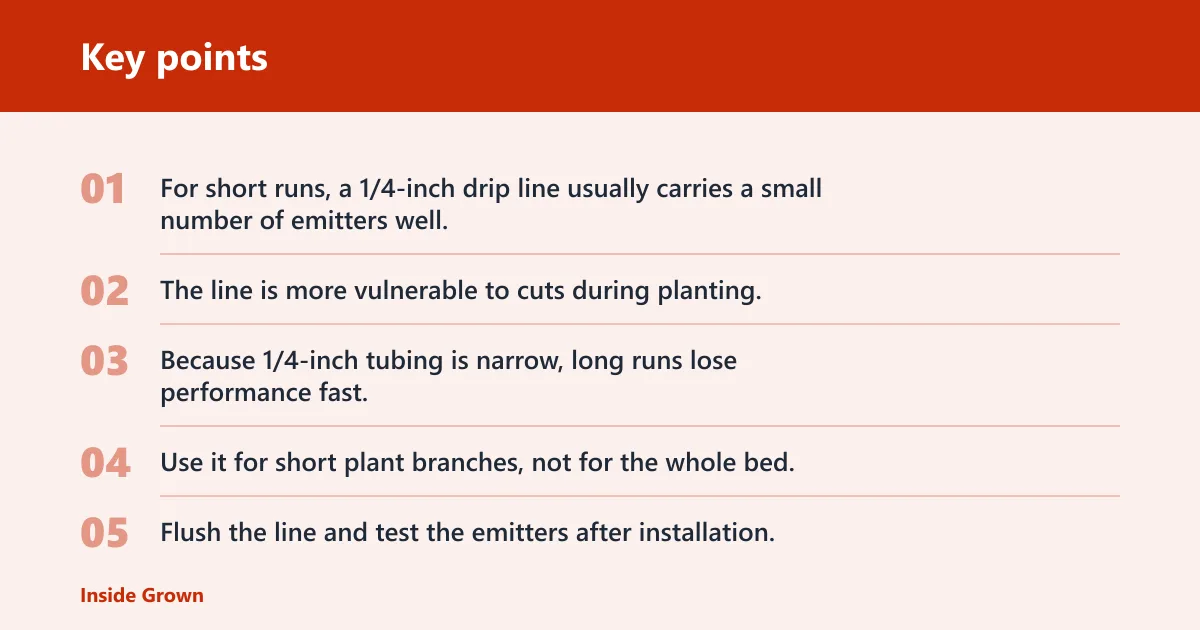
How many emitters per 1/4 line? For short runs, a 1/4-inch drip line usually carries a small number of emitters well, especially when the run is short and the emitters are low flow. It is often used with punched emitters. The line is more vulnerable to cuts during planting, and it needs pressure and filtration control.
Because 1/4-inch tubing is narrow, long runs lose performance fast. Use it for short plant branches, not for the whole bed. Flush the line and test the emitters after installation.
1/2-inch line capacity
How many drip emitters per 1/2 line? A 1/2-inch poly tubing main line can generally handle more emitters than 1/4-inch tubing because it is the supply line. The exact count depends on total flow, pressure, and line length. In practice, it feeds several 1/4-inch branches or inline emitters across a bed.
A simple way to size the zone is to add up the emitter flow on that zone and compare it with the line and regulator specs. For example, a 1/2-inch poly mainline can feed a bed with four 1/4-inch branches, each branch carrying two 0.5 GPH emitters, for a total of 4 GPH. If the same bed grows to 12 emitters at 1 GPH each, the total becomes 12 GPH and the zone may need to be split. That is why total flow, not simple emitter count, is the number that matters. A zone should be flushed and tested before you assume the layout works.
Zone flow and pressure checks
A drip irrigation zone needs a timer, a filter, and a pressure regulator. In garden setups, a 25 PSI pressure regulator is common, and manufacturer spec sheets and irrigation design guides often place garden drip systems in the 20 to 25 PSI range. A 150-mesh filter is also critical for small emitters because sediment and scale can clog them quickly; this mesh size is commonly recommended for drip emitters by irrigation manufacturers and water districts. The standard head assembly places the backflow preventer before the filter and regulator, because the backflow preventer must protect the water supply before water enters the irrigation equipment.
When the zone is fully open, check the farthest emitters first. If they sputter or seem weak, the total flow may be too high for the line or the pressure may be too low. That is especially likely with many 0.5 GPH emitters on a long run.
Emitter sizing table for raised beds
This table turns the question into a layout decision. Match crop size, root spread, and soil type to a starting emitter count, then adjust after flushing and testing the zone.
| Crop type | Soil texture | Starting rule | Preferred emitter size | Spacing note |
|---|---|---|---|---|
| Leafy greens | Loam | 1 emitter per plant or shared pairs | 0.5 GPH | 6-inch line spacing works well |
| Leafy greens | Sand | 1 emitter per plant | 0.5 to 1 GPH | Keep emitters closer together |
| Herbs | Loam | 1 emitter per plant | 0.5 GPH | Place at the stem base |
| Tomatoes | Loam | 2 emitters per plant | 2 GPH | Place on opposite sides of the stem |
| Squash | Loam | 2 to 4 emitters per plant | 2 GPH | Spread emitters around the outer roots |
| Mixed container | Potting mix | 1 to 2 emitters depending on pot width | 0.5 to 1 GPH | Use overlap across the pot surface |
Frequently asked questions
What size drip emitters to use?
For most home beds, start with 0.5 GPH for small plants, 1 GPH for medium plants, and 2 GPH for deep feeders. That choice changes with soil texture. Sand usually needs more emitters or closer spacing. Clay often does better with slower flow and careful placement.
What gph emitter should I use for vegetables?
For vegetables, 0.5 GPH works well for leafy greens and herbs, 1 GPH fits many medium garden crops, and 2 GPH suits deeper feeders like tomatoes and zucchini. If the bed dries quickly or the soil is sandy, move toward more emitters rather than a single larger point source.
How far apart should drip emitters be placed?
Place emitters close enough that the wet zones overlap. A 6-inch spacing works well for leafy greens in tight grids. A 12-inch spacing is common in standard raised-bed layouts. For larger plants, place emitters at the base or on opposite sides of the crown rather than using one far-away point.
How do I size emitters for raised beds?
Start with the crop, not the bed size. Leafy greens can use a tight grid with 6-inch spacing, while standard beds often use 12-inch spacing. Then match emitter count to root spread and soil. A 4-foot-wide bed commonly uses 3 to 4 parallel drip lines.
How many drip emitters do I need for each plant?
Use one emitter for a small plant, two for a medium plant, and 2–4 for a large plant or tight cluster. In loam, that rule often works with 0.5 to 2 GPH emitters. In sand, increase the count or narrow the spacing so the roots do not dry out between points.
Can one drip emitter water more than one plant?
Yes, if the plants are small, close together, and growing in soil that spreads moisture well. One emitter can serve two plants in loam when the wet zone overlaps both root balls. It is a poor choice for wide spacing, mixed plant sizes, or sandy beds that dry too fast.