How Many Sprouts Can You Grow in a Mason Jar?
A 1-quart mason jar usually holds about 1–2 tablespoons of small sprouting seeds, while bigger beans may need less; if the seed mass fills more than about one-quarter of the jar after soaking, split it into two jars. Overfilling cuts airflow, slows rinsing, and raises mold risk. This guide gives jar-size seed amounts, expected yield, and when to use more than one jar.
How many sprouts fit in a mason jar?
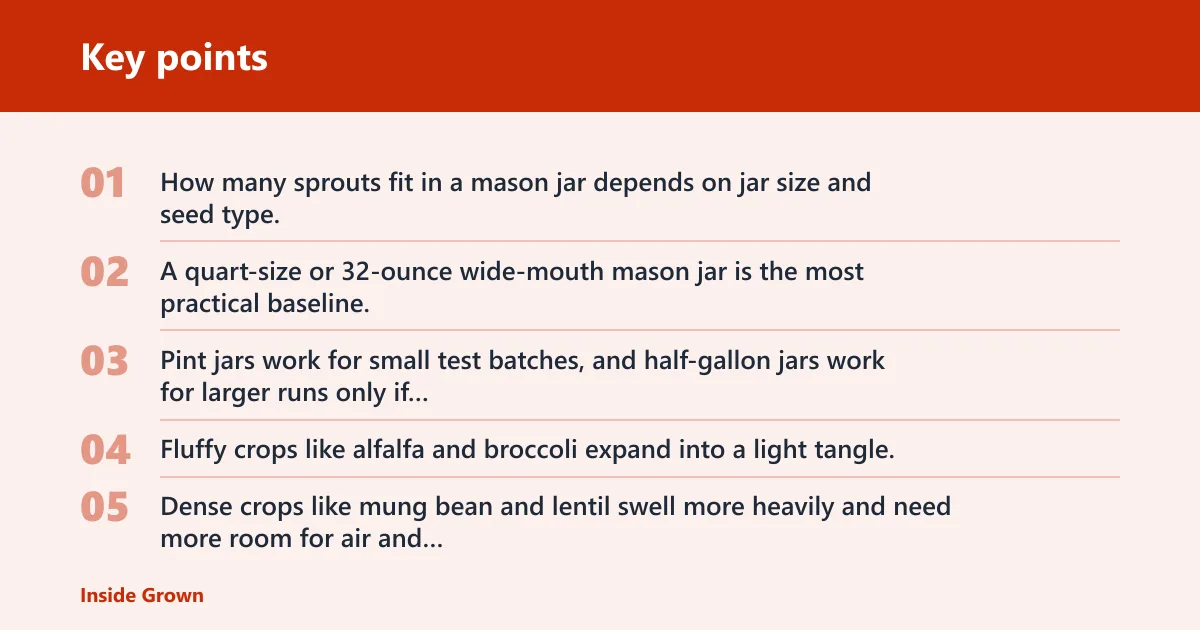


How many sprouts fit in a mason jar depends on jar size and seed type, not one fixed tablespoon amount. A quart-size or 32-ounce wide-mouth mason jar is the most practical baseline. Pint jars work for small test batches, and half-gallon jars work for larger runs only if you keep the seed layer loose.
Fluffy crops like alfalfa and broccoli expand into a light tangle. Dense crops like mung bean and lentil swell more heavily and need more room for air and drainage. If the soaked seed layer looks packed, split it before the next rinse.
When one jar is too full
If soaked seeds take up more than about one-quarter of the jar, the batch is likely crowded. Move half to a second jar right away. That gives the sprouts better airflow, more even rinsing, and less chance of slime or stalled germination.
Say your quart jar starts with 2 tablespoons of mung beans and the beans swell to a thick mass after soaking. That batch should move into two jars before the first rinse, because dense sprouts need more drainage space than airy seed types.
Quick rule for dense vs. fluffy sprouts
Use less seed for dense crops and a little more for airy crops in the same jar size. Mung bean and lentil should be started sparingly. Alfalfa, broccoli, and radish can take a slightly fuller starting layer, but the jar still needs visible open space after soaking.
What you’ll need
- A clean glass mason jar, ideally a quart-size or 32-ounce wide-mouth jar
- Fine mesh lid or cheesecloth
- Rubber band or screw band to secure the cover
- Drainage bowl or sprouting stand that holds the jar at an angle
- Sprouting-specific seeds from a clean source
- Cool, clean water
- Lidded storage container for the finished sprouts
Popular sprouting seeds include alfalfa, broccoli, radish, mung bean, and lentil. Use seeds sold for sprouting, not garden seed treated for planting. Clean equipment matters because damp seed left in a closed jar can spoil fast.
How do you grow sprouts in a mason jar?
How do you grow sprouts in a mason jar? Soak sprouting seeds overnight, drain them well, then rinse and drain them about 2–3 times daily until they reach the right size. Keep the jar angled so excess water escapes, and finish the sprouts in indirect light near the end for better color and texture.
- Measure the seed amount for your jar size and sprout type.
- Rinse the seeds once, then soak them overnight in fresh water.
- Drain the soak water completely through the mesh cover.
- Set the jar at an angle in a bowl or on a sprouting stand.
- Rinse and drain again morning and evening, or 2–3 times daily.
- Move the jar to indirect light near the end of growth.
- Harvest when the sprouts have the size and color you want, then dry them before storing.
Suppose a quart jar of broccoli seeds looks white and pale on day four. A day near a bright window with indirect light can help the leaves green up without cooking the batch. Direct sun is too harsh for a wet jar.
How much seed should you use?
How much seed should you use? Start with the jar size, then adjust by sprout type. A pint jar needs a much lighter seed load than a quart jar, while a half-gallon jar can hold more only if the crop stays loose and drains well. When in doubt, underfill rather than crowd the jar.
Pint jar starting amounts
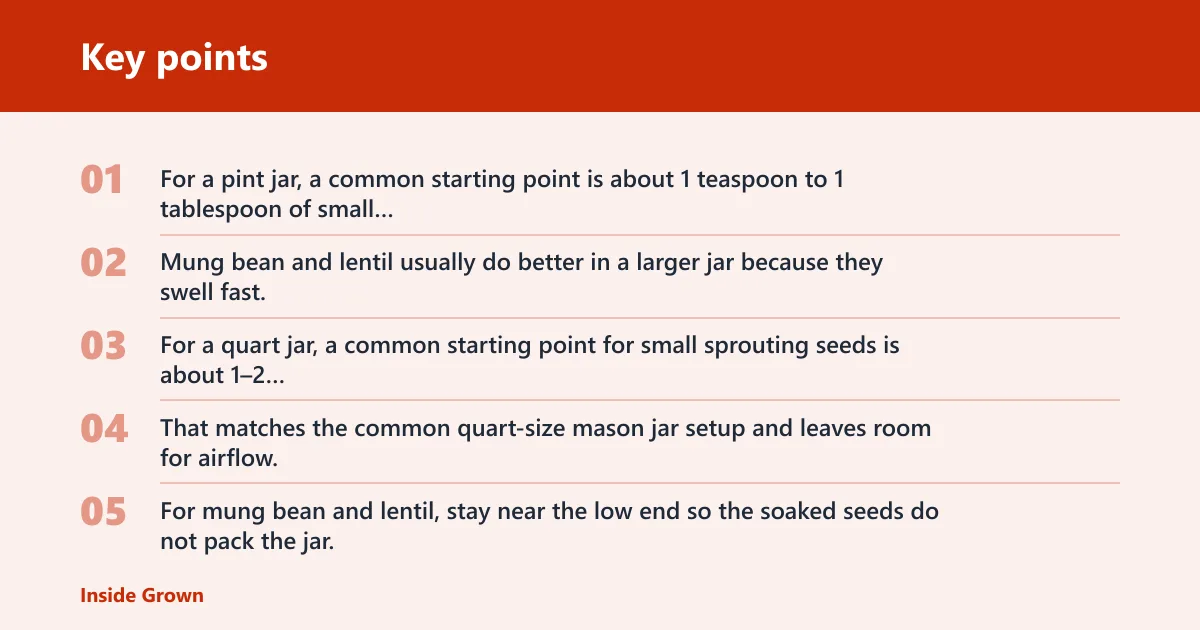
For a pint jar, a common starting point is about 1 teaspoon to 1 tablespoon of small seeds. Alfalfa and broccoli sit at the low end. Radish can use a little more. Mung bean and lentil usually do better in a larger jar because they swell fast.
Quart jar starting amounts
For a quart jar, a common starting point for small sprouting seeds is about 1–2 tablespoons. That matches the common quart-size mason jar setup and leaves room for airflow. For mung bean and lentil, stay near the low end so the soaked seeds do not pack the jar.
Half-gallon jar starting amounts
A half-gallon jar can often hold roughly twice the seed load of a quart jar, but only if the crop stays loose after soaking. Start with 2–4 tablespoons for airy seeds and less for larger beans. If the soaked layer looks dense, divide it into two jars.
How to scale up with more jars
To increase supply, start a new jar every day or two instead of packing one jar full. That gives you a steady harvest without crowding. Multiple jars also make it easier to separate fast crops like radish from slower ones like lentil.
Sprouts jar yield calculator
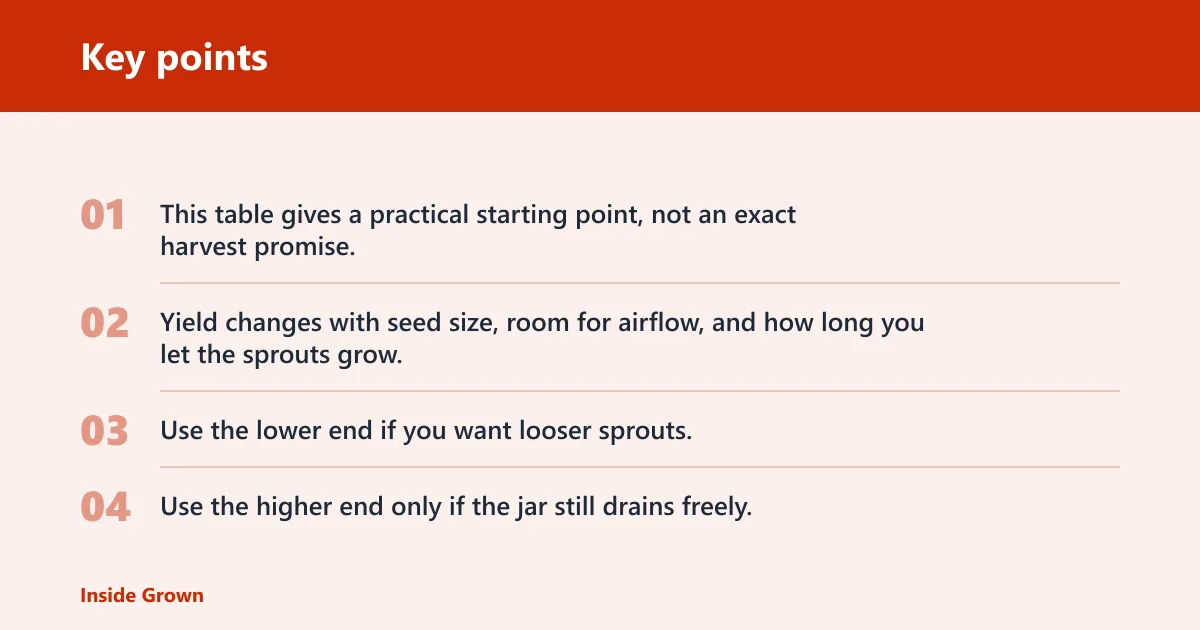
This table gives a practical starting point, not an exact harvest promise. Yield changes with seed size, room for airflow, and how long you let the sprouts grow. Use the lower end if you want looser sprouts. Use the higher end only if the jar still drains freely.
| Jar size | Sprout type | Safe starting seed amount | Expected finished yield | Overfill warning |
|---|---|---|---|---|
| Pint | Alfalfa | 1 teaspoon to 1 tablespoon | About 1 to 2 cups | Split if the soaked seeds cover the bottom in a thick mat |
| Pint | Broccoli | 1 teaspoon to 1 tablespoon | About 1 to 2 cups | Split if drainage slows after the first rinse |
| Pint | Radish | 1 teaspoon to 2 teaspoons | About 1 to 1.5 cups | Split if the seed layer looks crowded after soaking |
| Pint | Mung bean | 1 teaspoon to 1 tablespoon | About 1 to 1.5 cups | Too tight if beans press against the mesh lid |
| Pint | Lentil | 1 teaspoon to 1 tablespoon | About 1 to 2 cups | Split if the soaked seeds fill more than one-quarter of the jar |
| Quart | Alfalfa | 1 to 2 tablespoons | About 2 to 4 cups | Overfull if the mass stays compact after draining |
| Quart | Broccoli | 1 to 2 tablespoons | About 2 to 4 cups | Split if airflow is limited or the jar smells stale |
| Quart | Radish | 1 to 1.5 tablespoons | About 1.5 to 3 cups | Overfill if sprouts stop moving freely during rinsing |
| Quart | Mung bean | 1 tablespoon or less | About 2 to 3 cups | Split early; mung beans need the most headroom |
| Quart | Lentil | 1 to 1.5 tablespoons | About 2 to 3 cups | Split if the jar looks packed after soaking |
| Half-gallon | Alfalfa | 2 to 4 tablespoons | About 4 to 8 cups | Overfill if the seed bed is deeper than the jar can aerate |
| Half-gallon | Broccoli | 2 to 4 tablespoons | About 4 to 8 cups | Split if water pools at the bottom after draining |
| Half-gallon | Radish | 1.5 to 3 tablespoons | About 3 to 6 cups | Too full if the jar holds wet clumps |
| Half-gallon | Mung bean | 1.5 to 2 tablespoons | About 3 to 5 cups | Split if sprouts block the mesh lid |
| Half-gallon | Lentil | 1.5 to 3 tablespoons | About 3 to 6 cups | Split if the soaked batch looks dense and tight |
How often should you rinse sprouts?
How often should you rinse sprouts in a jar? Rinse and drain them 2–3 times daily for most batches, and use morning and evening rinses at minimum. Frequent draining keeps the seeds moist without letting them sit in stagnant water, which lowers spoilage risk.
Airflow matters because damp sprouts need oxygen as they grow. The jar should stay angled in a bowl or stand so extra water escapes. A jar left flat on the counter traps moisture and slows the batch.
If the jar smells sour, feels slimy, or the sprouts look gray, stop and discard the batch. Clean the jar, mesh, and stand before starting again. If the smell is only slightly stale and the seeds are still firm, increase draining time and rinse more thoroughly on the next cycle.
Common mistakes
Most problems come from too many seeds, too little drainage, or wet storage. Fix those three points first. A crowded jar can stall germination, and a jar that stays wet can turn slimy even when the seeds started out clean.
- Overpacking the jar: use less seed and split crowded batches early.
- Skipping angled drainage: keep the jar tilted so water can run out.
- Using poor-quality seed: choose sprouting-specific seed, not treated garden seed.
- Harvesting while wet: dry sprouts well before refrigerating.
- Storing too long: move finished sprouts to a lidded container in the fridge and use them soon.
A common first-timer mistake is starting lentils in a pint jar and treating them like alfalfa. The jar fills fast, the drainage slows, and the batch can stall. Use a bigger jar or reduce the seed amount before the soak.
Frequently asked questions
How much seed should you put in a quart mason jar?
Start with 1–2 tablespoons for small sprouting seeds in a quart jar. Alfalfa and broccoli usually sit near the lower end, while mung bean and lentil often need less than people expect because they swell and crowd the jar after soaking.
How long do sprouts take to grow in a mason jar?
Most sprouts are ready to eat in 5 to 7 days. Broccoli can be ready in about five days, and some sources note harvest windows as short as 3 to 5 days for faster crops. Seed type, temperature, and rinse schedule all affect timing.
What size jar is best for sprouting seeds?
A quart-size or 32-ounce wide-mouth mason jar is the best all-purpose choice for beginners. It gives enough room for airflow and makes rinsing easy. Pint jars work for small trial batches, while half-gallon jars suit larger crops only if you keep the seed load light.
How often should you rinse sprouts in a jar?
Rinse and drain sprouts 2–3 times daily, with morning and evening rinses as the minimum pattern. More frequent rinsing can help in warm rooms, but every rinse must end with complete drainage. Wet sprouts left sitting in water are the quickest path to spoilage.