
Are botanical garden membership passes worth it? Cost check
Botanical garden membership passes may be worth it if you visit a few times a year, or fewer times if parking, guest tickets, or reciprocal entry are included. If not, drop-in admission can cost less, and you end up paying for perks you barely use. This guide shows a simple break-even check for visit count, household size, parking, and guest use.
This guide is part of our Botanical garden guide series.
How to tell if a botanical garden membership is worth it

Use your visit frequency first
Start with the ticket price you would otherwise pay. If admission is about one full-price visit plus a few extras, a membership can pay for itself fast. If the garden is a once-a-season stop, day tickets are usually the safer buy.
The basic test is annual fee divided by your usual per-visit cost. Then add the perks you would actually use, not the ones that sound good on a brochure. A member card matters most when you go often, bring guests, drive, or visit sister gardens on trips.
Add parking, guest, and class value
Parking can change the math more than admission does. A free lot or garage spot is real value if the garden charges separately or if you already know you will drive every time. Guest passes and class discounts matter too, but only if you actually use them.
For families, child pricing and program discounts can make the decision swing the other way. For solo visitors, the break-even point is usually driven by admission and parking alone. For travelers, reciprocal access may be the biggest benefit by far.
Compare against day tickets and multi-visit tickets
Do not compare a membership only to single adult admission. If the garden sells a multi-visit punch card, a flex pass, or a discounted resident rate, those can be cheaper for low-frequency visitors. A membership is most compelling when the per-visit ticket price stays high and there is no cheaper bundle.
According to fwbg.org — FWBG includes admission to 400+ gardens nationwide.
Break-even worksheet: membership cost versus visit count
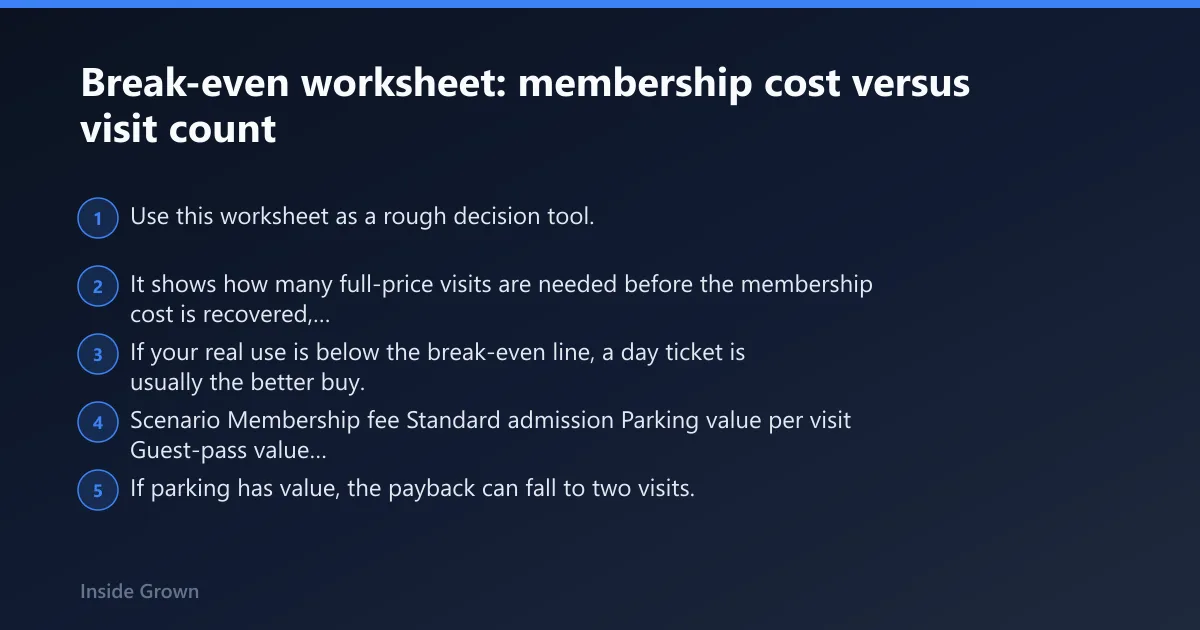
Use this worksheet as a rough decision tool. It shows how many full-price visits are needed before the membership cost is recovered, then adjusts that number when parking, guest use, or reciprocal access has value. If your real use is below the break-even line, a day ticket is usually the better buy.
| Scenario | Membership fee | Standard admission | Parking value per visit | Guest-pass value | Break-even visits |
|---|---|---|---|---|---|
| Solo visitor, no extras | $60 | $25.95 | $0 | $0 | 3 visits |
| Solo visitor, parking used | $60 | $25.95 | $15 | $0 | 2 visits |
| Couple, individual membership used by one adult only | $60 | $25.95 | $0 | $0 | 3 visits |
| Couple, dual membership | $75 | $25.95 | $0 | $0 | 3 visits |
| Family, family membership | $95 | $25.95 per adult equivalent | $0 | $0 | 4 visits |
| Family, parking used and one guest visit | $95 | $25.95 per adult equivalent | $15 | $25.95 | 2 visits |
Solo visitor break-even math
Using a non-member admission price in the mid-$20s per person, a $60 individual membership may pay back in roughly three visits if parking is not part of the equation. If parking has value, the payback can fall to two visits. That is why frequent local visitors often get the best return.
FWBG gives a second comparison point: individual membership is $60 per year, dual is $75, and family is $95. FWBG members get year-round admission and members-only events, plus admission to 400+ gardens nationwide. If a visitor uses the network at all, the value rises beyond the home gate.
Couple break-even math
For a couple, the decision depends on whether both adults need access. If only one person will go regularly, an individual membership may be enough. If both adults visit together, a dual membership usually beats buying two separate admissions after only a few outings.
Dallas Arboretum individual membership costs $115, while family membership costs $175. That gap matters if two adults plan to visit together more than a few times. The family option can make sense faster when the household is also using guest access, parking, or children’s programming.
Family break-even math
Families need a higher break-even count if they compare only one adult ticket against the annual fee. But that comparison is too narrow. Once children, parking, and guest use enter the picture, family memberships often recover value sooner than people expect.
Check whether children are included, whether named members are required, and whether household members must live at the same address. Some family tiers cover only immediate household members. Others limit entry to named adults and their children, with no transfer option.
What changes the math the fastest
Parking usually changes the math first. A free or discounted lot can be worth more than a guest pass if the garden is far from transit or city parking. Reciprocal admission can matter even more for travelers who plan to visit sister gardens on the same trip.
Member-only classes, camps, and events are harder to value because they depend on use. If you already buy those programs, a membership may trim your out-of-pocket cost. If you never attend them, they should not be part of your break-even number.

Do botanical garden memberships include guest passes or parking?
Sometimes, but not always. Guest passes may be single-use, limited by tier, or tied to advance reservation rules. Parking may be free, discounted, or completely separate from the membership, and vehicle limits are common. The useful question is not whether a perk exists, but how often you can actually use it.
Guest pass counts and rules
Guest passes are often the first perk people overvalue. A membership might include a fixed number of digital guest passes, one-use paper passes, or unlimited guest admission only for certain tiers. Some gardens require the guest visit to be linked to the member’s reservation or app account.
Brooklyn Botanic Garden digital guest passes are stored in the app, and BBG recommends advance tickets even with a digital membership card. That means “included” does not always mean “walk in anytime without planning.” A pass that requires booking is still useful, but it is less flexible than plain admission.
Parking benefits and vehicle limits
Parking benefits vary more than admission benefits. Dallas Arboretum offers free parking with pre-registered vehicles, which means the benefit depends on advance registration and the vehicle tied to the booking. A member who arrives in an unregistered car may not get the same treatment.
Some gardens only cover a lot, not a garage. Others restrict the number of vehicles per membership or require the member to be present in the car. If you drive in a second vehicle, use rideshare, or bring multiple cars for a family visit, read the parking rule before counting it as value.
When parking access is not included
Parking is often excluded from the base membership or limited to specific days and locations. Even where it is included, special events may trigger separate parking charges. If the garden is in a dense city, a membership without parking can still be worth it, but only if you would have paid for admission anyway.
Which membership tier gives the best value?
The best tier is the one that matches your household, not the one with the longest perk list. Individual memberships suit solo visitors. Dual memberships fit two adults who visit together. Family, supporter, and patron tiers only make sense if the extra benefits match real use, not aspirational use.
Individual versus dual memberships
An individual tier is usually the lowest-cost way to test whether a garden is part of your routine. It makes sense for one adult who visits often, attends classes, or uses reciprocal admission while traveling. Dual tiers are better when two adults truly plan to use the card.
Do not buy a dual membership just because it sounds convenient. If one person will use it most of the time, the extra fee may not be recovered. Household and named-member rules also matter; many gardens will not let one member share a card casually with friends.
Family, supporter, and patron tiers
Family tiers are the most sensible upgrade when children are included and the family visits often. Supporter and patron tiers are usually for people who want added benefits, recognition, or higher mission support. Those tiers can be worth it, but only after the base membership already makes financial sense.
FWBG lists individual membership at $60, dual at $75, and family at $95. That spread is narrow enough that a dual or family tier may be the better value if the household actually uses it. Higher price does not automatically mean higher return.
Household, named-member, and ID rules
Many memberships are tied to named adults, not a free-floating household. Some gardens check ID at entry or at members-only events. Others require the primary member to be present for guest admission or parking validation. If the card will move between adults, confirm that transfer is allowed before buying.
Do botanical garden benefits work at other botanical gardens?
Often yes, but only inside the participating network and only for the level of access the network allows. Reciprocal admission can be a major value driver for travelers, yet the scope may be regional or nationwide. Always check the participating organization list before counting it as part of the price equation.
How reciprocal admission networks work
Reciprocal programs let a member visit other gardens without paying full admission there, but the rules are not identical from one garden to the next. Some memberships include admission only, while others exclude discounts, parking, or special exhibits at the partner site. The network name matters more than the marketing phrase.
FWBG includes admission to 400+ gardens nationwide. Dallas Arboretum membership includes reciprocal admission to more than 300 botanical gardens and arboretums worldwide. Those are strong travel benefits, but the user still has to check whether the destination garden participates and whether the local tier qualifies.
Regional versus nationwide coverage
A regional network helps if most trips stay within one part of the country. A nationwide network matters more if travel is scattered across states or if the member gardens are part of a larger reciprocal system. Worldwide coverage sounds broad, but the actual usable list still needs a lookup before travel.
How to check participating gardens
Use the garden’s reciprocal partner list, then confirm the destination’s current policy. Some organizations limit reciprocal access during holidays, special exhibits, or peak weekends. Others only honor standard daytime admission. A quick lookup before the trip prevents a wasted stop at the gate.
- Find the membership network name on the garden’s site or receipt.
- Check the participating organization lookup for the destination garden.
- Confirm whether your tier qualifies for admission only or for extra discounts too.
- Look for blackout-style limits, advance tickets, or member exclusions.
- Save the confirmation before travel if the garden allows digital entry proof.
What member-only access is actually useful?
Early entry, special tours, and members-only events are useful when you already like being in the garden at quieter times. They matter less if your schedule only allows weekend visits or if those events cost extra anyway. The best member-only perk is the one you will realistically use, not the one that sounds exclusive.
Early entry and special hours
Early access can be a real benefit for photographers, parents with young children, and visitors who want cooler morning conditions. Dallas Arboretum members get early morning access at 7am. That kind of window can be worth money if it changes when you visit and how long you stay.
Early hours are not the same as all-day free rein. Some gardens allow members in earlier but still require timed tickets for peak days or special shows. If the benefit is tied to a particular gate, entrance, or date, count that friction before treating it as a free perk.
Tours, classes, and member events
Members-only events can be valuable if they replace paid programming you were already considering. FWBG members get members-only events, which adds value beyond admission alone. Still, classes and special tours are usually scheduled, capacity-limited, and subject to sign-up rules.
Family programs may have separate pricing, and children may not be included in every adult membership tier. Camp discounts can help, but only if the garden offers camps that fit your calendar. If your household never attends programs, do not count them in the break-even math.
When special event tickets still cost extra
Many gardens exclude festivals, concert nights, holiday light shows, and after-hours programming from base admission benefits. That means a member may still need a separate ticket. A membership can reduce the entry cost for ordinary visits while leaving premium events untouched.
How digital membership cards and app passes work
Digital membership cards are convenient, but they are not always friction-free. Some are phone-based cards in a wallet app. Others live inside a garden app and store guest passes there too. If the app fails, you may still need an ID or a backup confirmation email.
Phone-based entry and wallet support
Some gardens support wallet-based cards, while others use an app ticketing system. Brooklyn Botanic Garden digital guest passes are stored in the app. That setup works well at the gate, but only if the phone is charged, the account is active, and the correct pass has been loaded.
App requirements and setup
App setup can take a few minutes the first time and longer if the member profile, guest names, or reservation system needs to be linked. BBG recommends advance tickets even with a digital membership card, which is a useful reminder that digital access still depends on planning. Read the setup steps before the first visit.
Backup options if your phone fails
Keep a screenshot, membership number, or confirmation email if the garden allows it. Some gates can look up the membership manually. Others cannot. If the membership card lives only in an app, a dead battery can turn a free visit into a paid one at the front gate.
What hidden costs or restrictions come with a garden membership?
The hidden costs are usually not extra money. They are friction. Reservation requirements, parking registration, app setup, guest limits, and event exclusions can all reduce the value of a membership that looked strong on paper. If you dislike planning ahead, a day ticket may actually feel better.
Photo and event restrictions
Professional photography is often restricted or requires separate permission. Commercial shoots, portrait sessions, and tripod use may need advance approval or a paid permit. Special event days can also exclude standard member admission, so a membership does not automatically cover every garden activity.
Advance ticket requirements and blackout-style limits
Advance tickets are common even for members during busy weekends or holiday displays. Some gardens impose blackout-style limits for premium dates or special exhibits. If you mainly visit during those windows, the membership discount may be smaller than expected.
Free-day visitors and discounted-day visitors
If you already go on free admission days or discounted resident days, a membership has to beat those savings too. That is a higher bar than the usual full-price comparison. In that case, guest passes, parking, and reciprocal access need to carry more of the value.
When does a botanical garden membership stop being worth it?
A membership stops being worth it when your actual visits fall below the break-even point, when parking and guests are not used, or when the garden’s free and discounted days already cover most of your trips. It also loses value if the app, reservation, or blackout rules make you skip visits you would have taken.
The clearest warning sign is simple. If you would buy only one or two tickets all year, the annual fee is usually too high. If you travel enough to use reciprocal gardens, bring guests, or drive every visit, the equation changes quickly in the membership’s favor.
Frequently asked questions
Are botanical garden membership passes worth it?
They are worth it when your annual visits and perks add up faster than single-ticket spending. A good rule is three to four visits for solo visitors, fewer if parking, guest passes, or reciprocal admission are actually used. If you visit only once or twice, day tickets usually cost less.
How many visits do you need to break even on a garden membership?
Most solo visitors break even around three visits if admission is near full price. Couples and families may break even sooner if both adults or several children would otherwise pay at the gate. Add parking and guest value only if those benefits are part of your normal use.
Do membership benefits work at other botanical gardens?
They can, if your garden participates in a reciprocal network and your tier qualifies. Some networks are regional, others reach nationwide or worldwide, but each destination garden can still set its own limits. Always check the participating organization list before counting travel savings.
How do digital membership cards and passes work?
Many gardens now use phone-based cards, app storage, or wallet support. Some also keep guest passes inside the app. That is convenient, but you may still need advance tickets, a charged phone, or a backup confirmation if the gate cannot verify your membership on the spot.