Do botanical gardens have stroller and wheelchair access?
Many botanical gardens may work for strollers and wheelchairs, but it is worth checking three things first: paved or hard-packed paths, slope, and whether the main route is step-free. Skip that check, and you can end up at a gate, on steep gravel, or cut off from half the collection. This guide shows how to judge stroller-friendly, wheelchair-friendly, and partial-access gardens quickly before you go.
This guide is part of our Botanical garden guide series.
Do botanical gardens have stroller and wheelchair access?


Often, yes, but access is usually partial rather than across the full property. Main entrances, visitor centers, conservatories, and the best-kept display areas are the most likely to work for strollers and wheelchairs. Historic sections, lawns, steep grades, and natural ground are where access often breaks down.
What usually makes a garden easier or harder to enter
Paved main paths are usually easier for both strollers and wheelchairs. Step-free entrances, curb cuts, and accessible restrooms near the visitor center make a visit much simpler. By contrast, gravel, mulch, mud, long slopes, and uneven stone can turn a short visit into a hard one.
Many botanical gardens are at least partly accessible, but that does not mean the whole site is easy to cross. Older gardens often grew around historic features never built for universal access. A garden can have a fully accessible entry building and still leave several outdoor collections hard to reach.
How to tell whether a garden is stroller-friendly or wheelchair-friendly
Do not treat stroller access and wheelchair access as the same thing. A route that works for a compact stroller may still be too steep, narrow, or bumpy for a manual wheelchair or scooter. Wheelchair users also need turning space, stable surfaces, and enough width at pinch points.
Stroller-friendly usually means wide, step-free, and predictable. Wheelchair-friendly usually means the same, plus better control on slopes and tighter turns. If a garden relies on steep ramps, loose gravel, or repeated curb transitions, strollers may handle more easily than wheelchairs in some spots, while the reverse can also happen when a stroller has tiny front wheels that catch on cracks.
Picture a 4-wheel stroller on a smooth, 6-foot-wide path leading to a conservatory. That route may feel straightforward. Now picture a manual wheelchair on a short gravel spur with a moderate slope and no handrail. The second route can fail even if the first one looks fine on a map.
What accessibility features to check before you go
Check the official accessibility page before you leave, then confirm the entrance, parking, restrooms, mobility-device policy, and whether the main indoor buildings are actually step-free. Those details change a “maybe” into a usable plan.
Accessible parking and distance to the entrance
Accessible parking is most useful when it is close to the main entrance, not just somewhere on the property. Some gardens also rely on offsite garages or overflow lots, which adds distance and may require a shuttle, crossing point, or sloped walk. If you are traveling with visitors who tire easily, that extra distance matters.
For a quick check, ask three questions: Where are the accessible spaces? How far is the nearest step-free entrance? Is there a drop-off point closer than the parking lot?
Step-free entrances and accessible restrooms
Step-free entry is the key detail at the gate. A garden may have a beautiful entrance plaza and still require stairs at a side door or ticket area. Accessible restrooms should also be checked for location, because a restroom on the far side of a conservatory is not very helpful if the route there is steep or closed.
Also ask whether family or companion-use restrooms are available. For mixed-age visits, that can matter as much as standard accessible stalls.
Loaner wheelchairs, mobility device rules, and tram access
Some gardens loan manual wheelchairs, but availability can be limited. Loaners are often first-come, first-served, may require an ID or deposit, and may run out on busy days. If you need one, call before arrival rather than assuming it will be available at the front desk.
Trams and shuttles can help, but they are not a universal fix. A tram may be wheelchair accessible and still have capacity limits, route limits, or restrictions on what it can carry. Operator assistance may also be required. If the route is the only way to reach key areas, confirm that the vehicle can handle your mobility device and your timing needs.

Can you bring a stroller, wheelchair, or scooter?
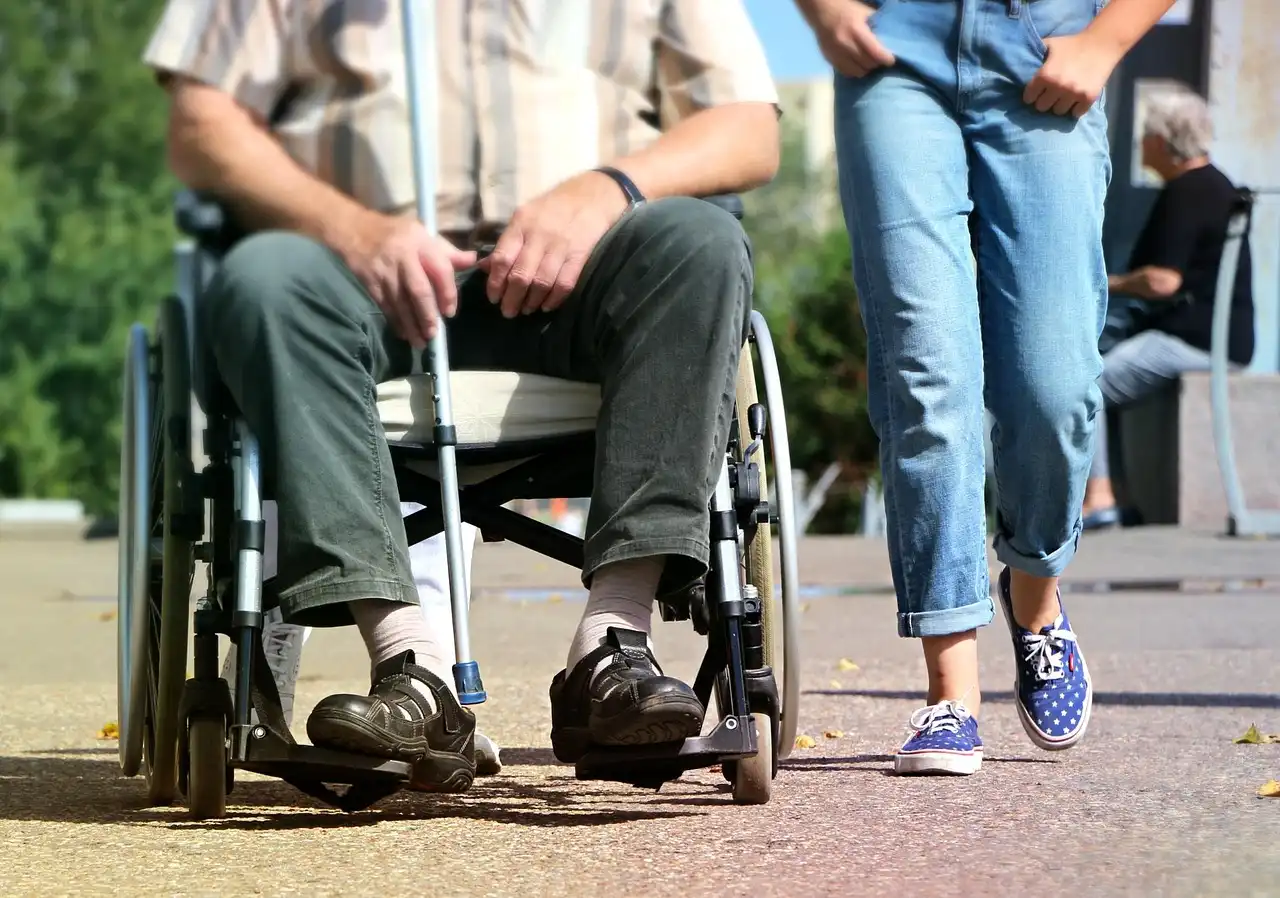
Usually yes for strollers and wheelchairs, but policies vary for scooters and other powered devices. Most gardens allow some mix of personal mobility aids, yet narrow paths, fragile plantings, historic surfaces, and transit vehicles can create restrictions. Check the garden’s policy before assuming your device will work everywhere.
Stroller policies and where strollers may be difficult
Strollers are often allowed on main paths, in visitor centers, and in family-friendly display areas. They may be hard to use on gravel, steep grades, narrow bridges, crowded conservatories, or paths with frequent steps and curbs. In gardens with heavy foot traffic, a stroller can also be slower than a walker or cane user would need.
Lightweight strollers usually handle turns and narrow sections better than large jogging or double strollers. If the garden has a tram or shuttle, ask whether strollers must be folded before boarding.
Wheelchair access, including manual chairs and accessible routes
Wheelchair access is best when the garden provides an accessible route from parking or drop-off to the entrance, then to major exhibits and restrooms. Some gardens also provide loaner manual wheelchairs. At New York Botanical Garden, manual wheelchairs are available free of charge during regular daytime hours, on a first-come, first-served basis, and an ID is required to borrow one.
That same example shows why details matter. NYBG says portions of the older grounds may be inaccessible, but its Conservatory and Mertz Library are fully accessible for wheelchairs, scooters, and walkers. One property can contain both strong access and real barriers.
Power-driven mobility devices and where they may not be allowed
Power-driven mobility devices need special checking because not every path or vehicle can accommodate them. At NYBG, power-driven wheelchairs are permitted, and some power-driven scooters may also be permitted. But NYBG also says its trams cannot accommodate scooters or other power-driven mobility devices.
That split is common elsewhere. A device may work on the grounds but not on a shuttle, or on the tram but not on a narrow boardwalk. Self-balancing electric vehicles often create even more questions, so call ahead if you plan to use one.
Which areas are usually the hardest to access?
The hardest areas are often the oldest, steepest, or most natural ones. Historic sections, lawns, gravel paths, muddy areas, and steep grades can block strollers and wheelchairs even when the front gate is accessible. Indoor upper levels and vehicle-only stops can also limit movement.
Historic sections, slopes, lawns, gravel, and natural terrain
Historic gardens may use older surfaces and route patterns that were never built for modern accessibility. That includes narrow garden rooms, cobblestones, steps, and paths that follow the original topography. Natural ground can add roots, ruts, sand, or wet soil, all of which are harder on wheels.
Accessible America lists botanical gardens with paved accessible paths and accessible restrooms, which is a useful reminder that some venues do a lot right. But the garden map still matters. One paved loop does not guarantee access to every collection.
Indoor rooms, upper levels, and elevators
Indoor access is often better than outdoor access, but not always. Conservatories, visitor centers, libraries, and lecture halls may be fully accessible while upper-level galleries depend on an elevator. If the elevator is out of service, the visit can change quickly.
At NYBG, the Conservatory and Mertz Library are fully accessible for wheelchairs, scooters, and walkers. That is the kind of venue-specific detail worth confirming wherever you go.
Tram-only or shuttle-only access points
Some garden features sit far enough away that a tram or shuttle is the only realistic route. That helps until the vehicle has limits. A wheelchair-accessible tram can still have one-wheelchair capacity, route restrictions, or a boarding process that requires staff help. If the vehicle is full or unavailable, the destination may become unreachable.
Use this one-page botanical garden accessibility checklist
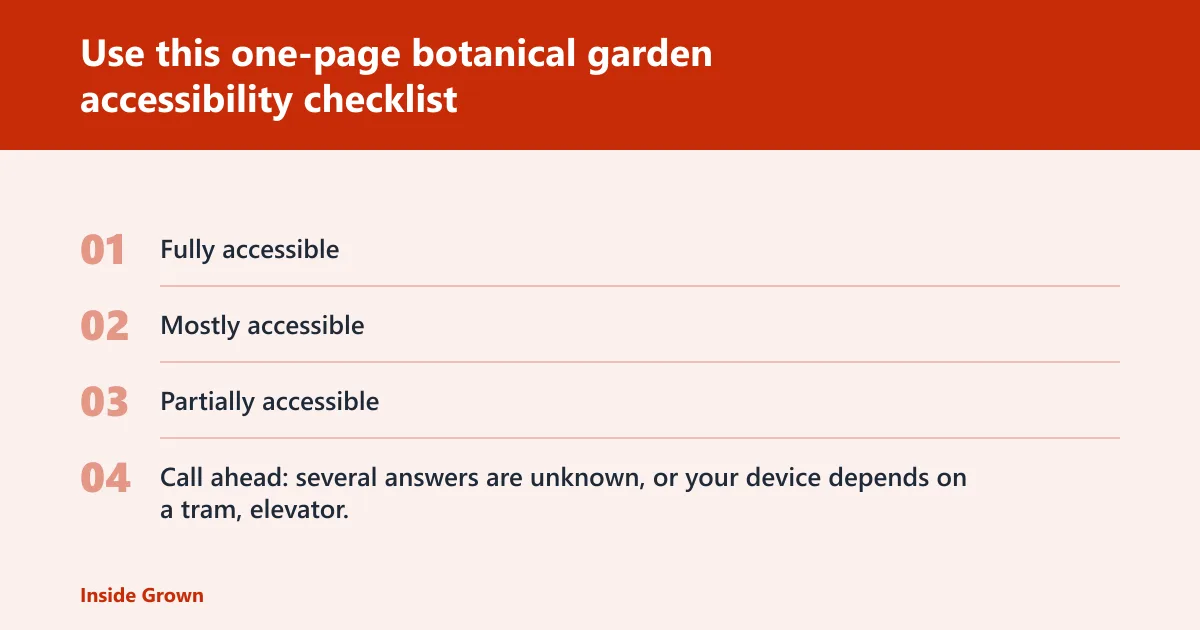
Use this checklist before you buy tickets or leave home. It helps you separate a fully accessible garden from one that is only partly workable for your group.
| Yes/no check | What to confirm | Why it matters |
|---|---|---|
| Parking | Accessible spaces near the main entrance or a clear offsite option | Long distances and steep approaches can exhaust visitors before the visit starts |
| Entrance width | Step-free entry and enough width for stroller or wheelchair clearance | Narrow gates and steps block entry immediately |
| Path surface | Paved or hard-packed route on the main loop | Loose gravel and mulch are harder for small wheels and manual chairs |
| Slope | No major steep grades on the route you need | Grades can limit propulsion, braking, and safety |
| Restrooms | Accessible restroom near visitor center or conservatory | Restrooms far from the main route may be unusable in practice |
| Loaner wheelchairs | Manual wheelchairs available, plus rules for ID or deposit | Availability may be limited and first-come, first-served |
| Stroller policy | Strollers allowed on the routes you plan to use | Some conservatories or crowded rooms may limit them |
| Scooter policy | Power-driven mobility devices permitted where you need them | Rules may differ on paths, trams, or fragile ground |
| Tram access | Wheelchair-compatible vehicle and loading process | Capacity and device limits can prevent boarding |
| Indoor accessibility | Conservatory, library, or lecture hall access plus elevator status | Indoor highlights may be the easiest or only accessible part |
| Service animals | ADA-defined service animals allowed; pets not allowed | Policy differences matter for legal access and safety |
| Staff contact questions | Current closures, surface conditions, and temporary detours | Weather and maintenance can change access on short notice |
Scoring key
- Fully accessible: most checks are yes, including parking, entrance, paths, restroom, and key indoor spaces.
- Mostly accessible: the main route works, but one or two features are limited or require a workaround.
- Partially accessible: the garden has usable sections, but major areas have surface, slope, or vehicle limits.
- Call ahead: several answers are unknown, or your device depends on a tram, elevator, or loaner equipment.
How to use the checklist for mixed-access visits
If you are visiting with kids, an older adult, or someone who tires easily, score the route you actually plan to use, not the whole property. A garden may be “mostly accessible” for one loop and “call ahead” for another. That distinction keeps the trip realistic.
Suppose a family plans to visit with a toddler in a lightweight stroller and a grandparent who uses a cane. The stroller may handle a gentle paved loop, while the cane user needs benches, shade, and a shorter route. In that case, the best answer is not a yes or no. It is a route-specific plan.
Should you call ahead before visiting?
Yes. Call ahead if you need a wheelchair, plan to use a scooter, rely on an elevator, or need to know whether a tram is running. Staff can confirm current closures, temporary surface issues, restroom access, and whether the day’s conditions fit your route.
Questions to ask before arrival
Ask whether the main route is step-free, whether the accessible restroom is open, whether loaner wheelchairs are available, and whether your scooter or stroller is allowed on every route you need. If there is a tram, ask about wheelchair capacity and whether scooters are carried at all.
For gardens with historic grounds or natural terrain, also ask about mud, slope, and any closed sections. The answer may change after rain or maintenance. That is especially important when the accessible route depends on a single elevator or a single shuttle line.
What visitor services can confirm
Visitor services can usually tell you where to park, which entrance to use, whether service animals are allowed, and whether a conservatory or library is accessible. At NYBG, service animals are permitted in compliance with the ADA, and NYBG defines service animals as dogs trained to work or perform tasks. Pets are not the same thing.
If the property has accessible public transit nearby, ask about the nearest stations and whether the walk from the station is usable for your group. At NYBG, the accessible public transit stations are the Bedford Park Blvd. B/D and Botanical Garden Metro-North Station, and accessible parking is near the Main and Mosholu Entrances. Details like that can save a lot of unnecessary walking.
Frequently asked questions
Do botanical gardens have stroller and wheelchair access?
Many do, but often only on certain routes. The easiest areas are usually the main entrance, visitor center, conservatory, and paved display loops. Historic sections, gravel paths, slopes, and lawns can still limit access, so the real answer is often partial access rather than a full yes.
Are botanical gardens wheelchair accessible?
Some are, but wheelchair accessibility is rarely uniform across the whole property. Look for step-free entrances, accessible parking, usable restrooms, and a clear accessible route to major collections. If the garden uses trams, elevators, or loaner wheelchairs, confirm current status before arrival.
Can you bring a stroller to a botanical garden?
Usually yes, especially on paved or hard-packed paths. Strollers can be difficult in narrow conservatories, crowded indoor rooms, gravel sections, and steep grades. Lightweight strollers are easier to manage than large or double models, especially if the garden has tight turns or long walks between exhibits.
Do botanical gardens rent wheelchairs?
Some do, but not all. When wheelchairs are available, they are often manual, free of charge, and limited in number. Gardens may use first-come, first-served rules and require an ID or deposit, so calling ahead is the safest way to avoid a surprise.
Are scooters allowed in botanical gardens?
Sometimes. Power-driven mobility devices may be allowed on paths but restricted on trams, narrow bridges, fragile ground, or indoor sections. Three- and four-wheeled scooters may be accepted at some gardens, but others limit where they can go, so check the venue’s policy before you bring one.
Which areas of a botanical garden are usually inaccessible?
The hardest areas are often historic sections, steep slopes, lawns, loose gravel, and natural ground with roots or uneven soil. Upper floors can also be a problem if an elevator is missing or out of service. Tram-only zones become inaccessible if the vehicle cannot take your device.