How to Read a Basic Soil Test Report
Read a basic soil test by sorting the report in this order: pH first, then nutrient shortages, then organic matter and salinity. Values outside the lab’s crop range need action, while texture and sample notes give context. Ignore that order, and you can waste fertilizer, leave deficiencies in place, and keep plants stunted or unproductive. This guide shows which fields to fix first, what the numbers mean, and which lines are just lab context.
What you’ll need
- The full lab report, including the legend or interpretation sheet
- A pen or notes app
- Your previous soil test, if you have one
- The crop, lawn, or garden type the lab used for calibration
- The sample notes, including depth and any field or bed labels
How do I read a soil test report?
Start at the top and read in order: sample depth, crop or garden type, units, then the lab’s rating words. A standard garden sample often uses 10 to 15 subsamples mixed into one composite, and a common garden sampling depth is 6 inches. Report formats vary by lab, so the legend matters.
- Check the sample depth and crop type first.
- Find the units beside each number: ppm, lbs/acre, meq/100g, percent, or an EC value.
- Read the lab’s rating words, such as low, medium, or high, before reacting to the raw number.
- Separate lab notes from field results; method notes are context, not action items.
- Compare the report to the same lab’s previous test if you have one.
Say your vegetable bed was sampled only 2 inches deep instead of 6 inches. The numbers can still be real, but they may not describe the root zone you intended to test. That changes the reading before you add anything.
How do I read pH first?
What does pH tell me on a soil report?
Read pH before nutrient numbers because pH controls how available those nutrients are. Soil pH is the measure of acidity or alkalinity on a 0 to 14 scale, with 7 as neutral, and it uses a logarithmic scale. Most extension guides place many garden crops near a slightly acidic to neutral range, often around 6.0 to 7.0, depending on the crop and lab calibration.
When do I use buffer pH or lime requirement?
Buffer pH is different from active pH; it estimates how much lime the soil may need, not just how acidic the soil is right now. University extension guidance uses buffer pH or a lime requirement index to estimate reserve acidity. If the active pH is outside the lab’s crop range, fix that first and recheck before chasing individual nutrients.
- Find the active pH on the report.
- Compare it to the lab’s crop or lawn range.
- Check buffer pH or lime requirement if the report includes it.
- Use lime when pH is too low; use sulfur only when the lab or a trusted local guide recommends it.
How do I interpret P and K?
What do phosphorus and potassium mean on a soil test?
Phosphorus and potassium matter, but the lab’s sufficiency range matters more than the raw number alone. Both are often reported as ppm or lbs/acre, and some labs label them as exchangeable or extractable. Phosphorus supports root development and energy transfer. Potassium supports stress tolerance and disease resistance.
What is the critical level for P and K?
Low, medium, and high are calibration words, not universal truths. Extension calibration work uses a critical level concept where the crop is unlikely to gain much more yield response once the soil is at or above that level. That is why a number that looks low on one lab’s report can mean something different on another lab’s sheet.
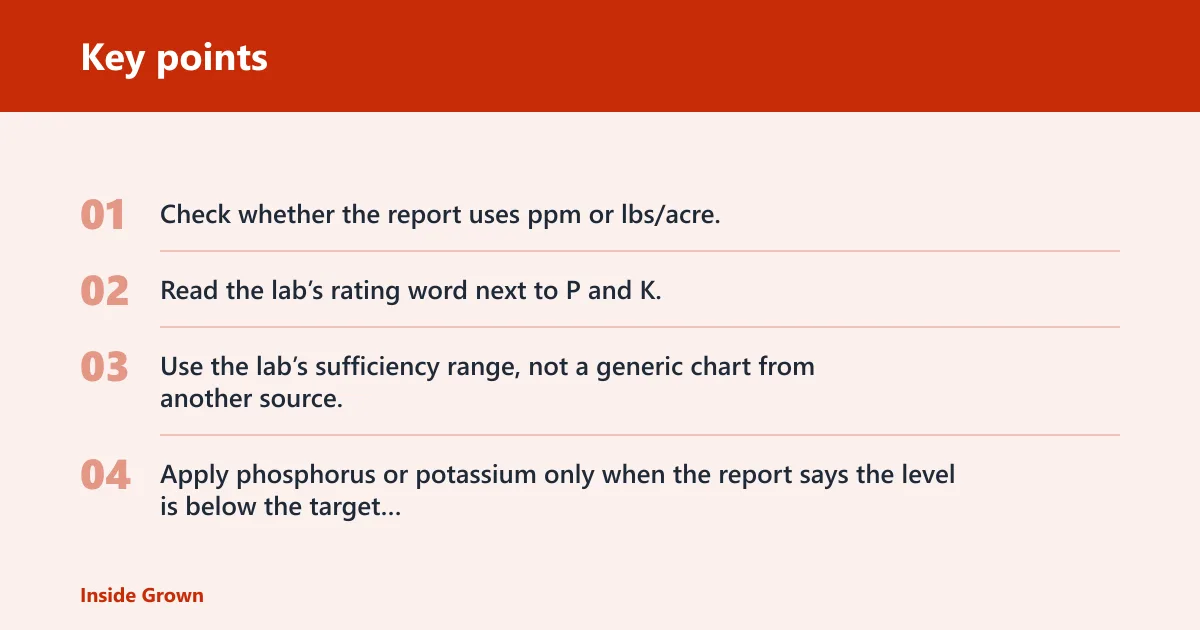
- Check whether the report uses ppm or lbs/acre.
- Read the lab’s rating word next to P and K.
- Use the lab’s sufficiency range, not a generic chart from another source.
- Apply phosphorus or potassium only when the report says the level is below the target band.
Suppose a report shows phosphorus as “medium” and potassium as “low.” Treat them differently. Potassium gets the first correction, while phosphorus may need no change if the lab already places it inside its sufficiency band.
What do the low, medium, and high ratings mean?
Low, medium, and high are shorthand for a lab’s calibration system. They tell you whether the crop is likely to respond to an amendment, not whether the number is universally good or bad. The same raw value can move between ratings when the lab changes crop class or extraction method.
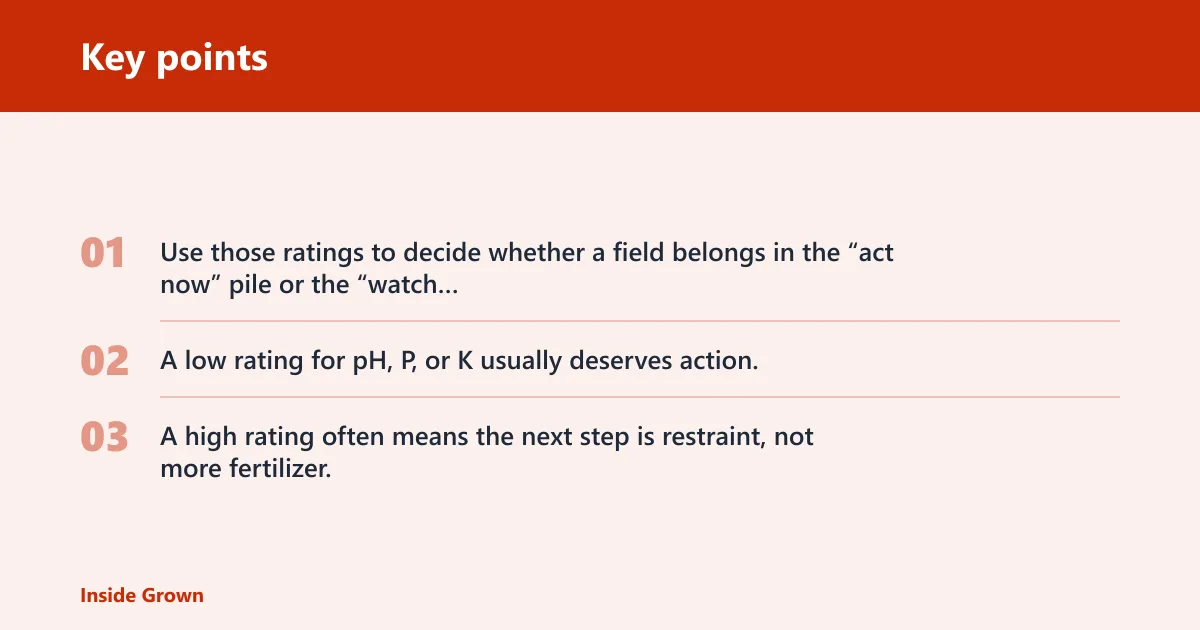
Use those ratings to decide whether a field belongs in the “act now” pile or the “watch and compare” pile. A low rating for pH, P, or K usually deserves action. A high rating often means the next step is restraint, not more fertilizer.
What do cation exchange capacity mean on a soil test?
What does CEC tell me about my soil?
CEC describes nutrient-holding capacity. It is usually reported in meq/100g or a similar unit. A higher CEC can hold more cations; a lower CEC can lose them faster with rain or irrigation. That is why CEC helps explain how aggressively a soil needs split fertilizer applications or steadier amendment timing.
How do organic matter, base saturation, calcium, magnesium, and micros fit in?
Organic matter is reported as a percent. It affects water holding, nutrient retention, and sometimes nitrogen recommendations. Base saturation is the share of exchange sites occupied by calcium, magnesium, potassium, and sodium; it can help explain soil chemistry, but it is usually context unless the lab flags a clear problem. Calcium, magnesium, and micronutrients are usually supportive context unless the lab flags a clear problem.
For sandy soils and other low-holding soils, read CEC alongside texture rather than alone. Soil texture and sandy-soil CEC context help explain why the same fertilizer rate can behave differently from one field to another.
What you’ll do with the report
| Act now | Interpret with context | Usually ignore |
|---|---|---|
| pH — if outside the lab’s crop range, correct acidity or alkalinity first. If low, add lime; if high, use sulfur only when recommended. | Buffer pH — use it to estimate lime need, not active acidity. If buffer pH shows reserve acidity, follow the lime recommendation on the report. | Lab code — method identifiers and internal sample codes do not change the action. If it is only an ID or batch label, skip it. |
| P — use the lab’s rating word and sufficiency range. If low, apply the recommended phosphorus rate; if medium, hold unless the crop is sensitive. | K — read the lab’s sufficiency range and units. If low, correct it; if high, avoid extra potash unless a crop need exists. | Formatting notes — page layout, logo, and report color are not soil data. If it does not change the recommendation, ignore it. |
| EC — act when the report flags excess dissolved ions or salinity. If EC is elevated, pause fertilizer additions and check irrigation and drainage. | CEC — use it to judge nutrient-holding capacity, not as a single goal. If CEC is low, split fertilizer into smaller applications. | Duplicate units — if the same value is repeated in two columns, follow the interpretation column. If the lab already translated it, do not convert it again. |
| Micros — address only when symptoms or a clear lab flag point there. If plants are yellowing or distorted and the lab flags a low micronutrient, follow the recommendation. | OM — use it as a context field for structure and nutrient cycling. If OM is modest, it may explain why fertilizer response is uneven. | Extra fields — anything that does not change the next amendment can wait. If it does not alter pH, lime, fertilizer, or salt decisions, leave it for later. |
| Ca — act when the lab specifically recommends a calcium amendment or pH correction tied to calcium balance. If the lab ties calcium to lime need, follow that rate. | Mg — use context from the report before deciding on dolomitic lime or another source. If Mg is low relative to calcium, compare it with the lab note before acting. | Recommendation units — units are important for application math, but not a soil-quality signal by themselves. If the number is only a unit label, ignore it. |
| Base saturation — act only when the lab ties it to a clear amendment choice. If calcium or magnesium is unusual and the lab flags it, follow the printed correction. | Ca and Mg balance — read them with CEC and base saturation, not alone. If both are adequate, they usually stay in the context column. | Sample IDs — location tags, barcode values, and internal codes do not tell you what to amend. If it is just tracking data, ignore it. |
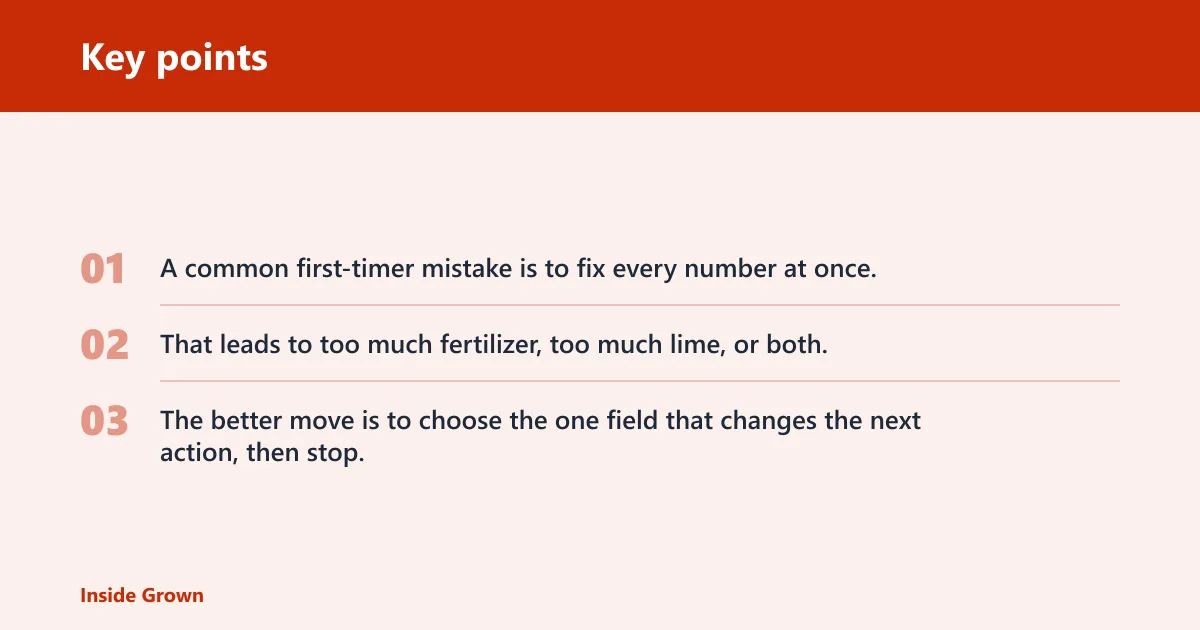
A common first-timer mistake is to fix every number at once. That leads to too much fertilizer, too much lime, or both. The better move is to choose the one field that changes the next action, then stop.
Which soil test numbers matter most first?
Order the report by action, not by page position. pH and buffer pH come first because they affect how the whole root zone works. P and K come next because they are common amendment decisions. CEC, organic matter, base saturation, and micros give context and help explain why the same fertilizer rate behaves differently in another soil.
Soluble salts or EC move up the list when the report flags excess dissolved ions, over-fertilizing, or salinity. Micronutrients usually stay low priority unless deficiency symptoms exist or the lab clearly flags one. That is the point of triage: some lines need action now, some need interpretation, and some can wait.
How much lime do I need from my soil test results?
Why does buffer pH matter for lime?
Use the lime recommendation printed by the lab, not a guess from pH alone. Buffer pH is the key field here because it estimates reserve acidity and helps calculate how much lime the soil needs. University extension recommendations use buffer pH or a lime requirement index because two soils can share the same active pH but need different lime rates.
- Find the lab’s lime recommendation in the recommendation section.
- Use the unit given, often pounds per 1,000 square feet, tons per acre, or a similar rate.
- Apply the rate exactly as printed for the tested area.
- Do not substitute a fertilizer rate for a lime rate.
- Recheck in the next normal season after the amendment has had time to react in the soil.
For home gardens, split a large lime recommendation into the product’s labeled application rate for the bed size, then retest later instead of doubling the rate at once.
What should I do with the numbers?
Translate the report into one of three decisions: add lime, add a specific nutrient, or do nothing yet. Use the recommendation units before buying anything. Most labs report amendments in pounds per 1,000 square feet, lbs/acre, or another area-based unit, which can be used to turn the report into an application rate.
- List the fields that change action now: pH, buffer pH, P, K, and EC.
- Match each field to the lab’s recommendation box.
- Buy only the amendment that matches the printed rate and area.
- Apply the labeled amount, then keep the rest of the report for later comparison.
- Retest in the next normal season after the amendments have had time to work.
Suppose a report shows low pH, medium phosphorus, and normal EC. The first fix is lime, not a full fertilizer blend. That keeps the next soil test easier to read because you changed one major factor at a time.
How is a garden soil test different from a construction soil report?
What should I look for in a construction-intent report?
Garden and agronomic soil tests measure fertility, pH, salinity, organic matter, and nutrient availability for plants. Geotechnical or construction soil reports focus on engineering properties such as bearing strength, compaction, moisture behavior, and foundation suitability. If the query is about construction, do not use a fertilizer interpretation as a substitute for a structural soil report.
How do I avoid mixing the two types of reports?
Look at the lab name, the field list, and the units. A plant-use report will usually mention pH, P, K, OM, CEC, and recommendations for lime or fertilizer. A construction report usually centers on load-bearing or site-prep language. When the document is engineering-focused, the next step is often a civil or geotechnical professional, not an amendment calculator.
Common mistakes
Mixed sample zones are one of the biggest problems. A shaded strip, a compacted path edge, and a compost-rich bed corner should not be blended into one composite. Keep similar areas together so the report describes one soil, not three.
Sampling depth causes another error. If the lab expects 6 inches and the sample came from 2 inches, the result can overstate nutrients or organic matter near the surface. Comparing results from different labs can also mislead you because extraction methods and calibration ranges are not identical.
Micronutrients are often overread. If there is no symptom and no lab flag, they are usually context, not a buying decision.
Frequently asked questions
What do pH, P, and K mean on a soil test?
pH shows acidity or alkalinity on a 0 to 14 scale, with 7 as neutral. P and K are common nutrient fields, usually in ppm or lbs/acre. Phosphorus supports root development and energy transfer; potassium supports stress tolerance and disease resistance.
What is a good soil test report?
A good report matches the crop or garden type and gives clear recommendation units. For lawns, pH between 6.0 and 7.0 is generally suitable, and organic matter targets vary with soil texture and crop use. For other crops, use the lab’s own range.
What does cation exchange capacity mean on a soil test?
CEC tells you how much nutrient-holding capacity the soil has. Higher CEC soils hold cations better, while lower CEC soils lose them faster. Soil texture and sandy-soil CEC context explain why low-CEC soils often need smaller, more frequent nutrient applications. Use CEC to plan fertilizer timing, not as a stand-alone target.
How often should I retest soil after making changes?
Retest after the amendment has had time to work, especially after lime or a major nutrient correction. A practical schedule is to retest at the next normal season for your garden, using the same lab and the same 6-inch depth. That keeps comparisons consistent. Extension guidance generally recommends waiting long enough for the amendment to react before judging the new result.