How to Know If a Landscaper Is Licensed
A licensed landscaper should match the work and location you need: verify the state or local license number, legal business name, general liability insurance, workers’ compensation if employees will be on site, and permit history before you sign. If you skip that check, you can pay for work that is illegal, unsafe, uninsured, or hard to enforce in court. This guide shows which records to check, what each result means, and when the work may legally be covered by a different license, permit, or subcontractor.
What license the job may require
Licensing rules vary by state and by the type of landscaping work, so the first check is always local and official. A basic lawn-care business may need only registration, while grading, irrigation, retaining walls, drainage, or structural hardscape work can trigger licensing or permit requirements, depending on local rules.
Landscape contractor vs. general contractor
A landscape contractor license may cover planting, sod, landscape installation, and some site work, but it does not automatically cover every project outside planting beds. If the job changes drainage, moves soil in a way that affects slopes, builds retaining walls, or adds structural features, the project may fall under different licensing rules or may require a licensed subcontractor.
Some states separate residential and commercial work, or limit what a landscape contractor may do without another classification. The record on the state board should show the license class and scope, and that scope should match the estimate you received.
Projects that can trigger permits or specialty licenses
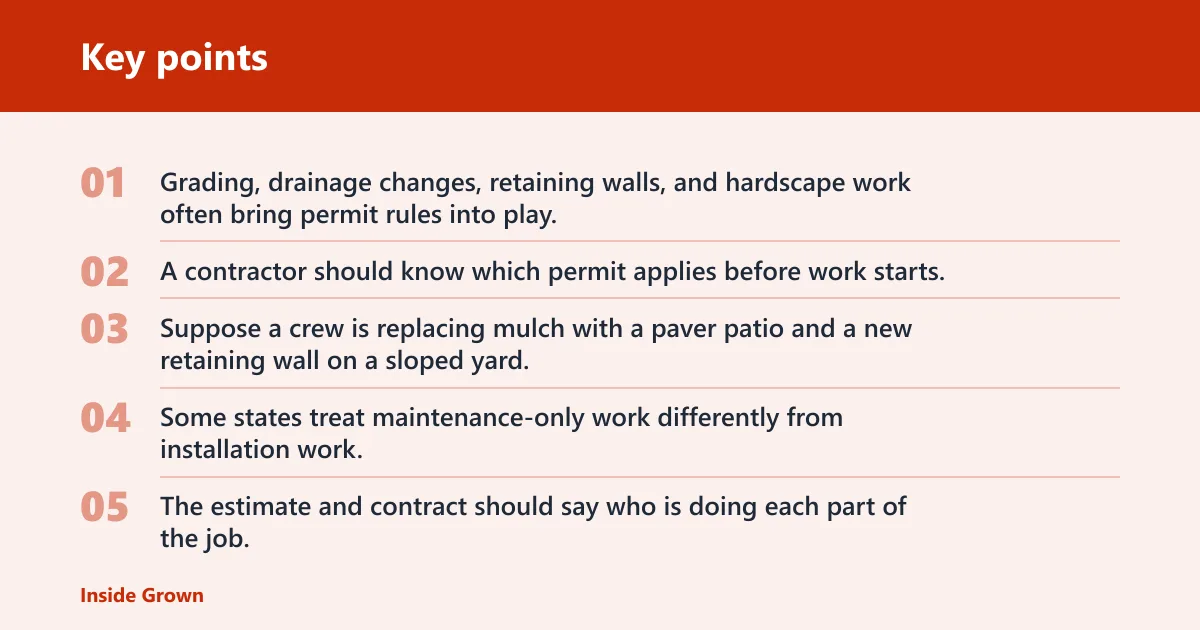
Grading, drainage changes, retaining walls, and hardscape work often bring permit rules into play. Local building departments may also require separate approvals for irrigation, electrical components, gas lines, or work that affects stormwater flow. A contractor should know which permit applies before work starts.
Suppose a crew is replacing mulch with a paver patio and a new retaining wall on a sloped yard. That is not a simple planting job. The work may need a permit, and the wall or drainage portion may require a different license class or a licensed subcontractor.
State variation by job type
Some states treat maintenance-only work differently from installation work. Mowing, trimming, and routine cleanup may need only registration, while planting, irrigation, drainage, grading, retaining walls, electrical lighting, gas or fire features, and structural hardscaping can trigger licensing, specialty trade rules, or permit requirements. The common legal pattern is simple: the more the work affects structure, utilities, or the ground itself, the more likely a specialty license or permit is needed.
A licensed subcontractor arrangement is often acceptable when the prime landscaper’s scope covers the outdoor design, planting, or site management, while a separate licensed trade covers irrigation, masonry, electrical, gas, or drainage. The key is whether the written contract clearly assigns responsibility and whether the permit, if required, is pulled under the proper name and license.
When a subcontractor may be the right setup
Some landscapers lawfully handle the garden work and bring in licensed subcontractors for irrigation, masonry, electrical, or drainage components. That arrangement is common when the prime contractor’s license does not cover every trade in the project. The estimate and contract should say who is doing each part of the job.
If the contractor says a subcontractor will “handle the hard part,” ask which trade license that subcontractor holds and whether the prime contractor is still responsible for the overall project. A vague answer is a warning sign.
How to verify the license
The official state contractor licensing board database is the main source for checking whether a landscaper is licensed, rather than a logo, a truck decal, or a verbal promise. Search by license number first, then by business name and, if needed, the personal name tied to the license. That search should show status, class, expiration, and any discipline.
Ask for the license number. Request the exact number as it appears on the board record, plus the legal business name. A reputable contractor should provide both right away.
Search the board database. Use the official state licensing board website and search by license number first. If the number is missing, search the business name and the owner’s personal name, because some states index records that way.
Check the status fields. Confirm that the license is active, current, and in the right class for your project. Look for expiration date, renewal date, and any restriction notes.
Review discipline and complaints. Read the disciplinary history, complaint status, suspension date, or revocation record if the board lists it. Unresolved violations matter even if the license still appears in the database.
Match the name chain. Compare the legal business name on the record with the estimate, contract, invoice, and insurance certificate. If a DBA or trade name is used, it should link cleanly to the registered legal name.
How to read mismatches
Does the license number exist but the business name does not match? That can mean the contractor is using a DBA, a related company, or an older entity name. It can also mean you are looking at the wrong license. Do not treat a mismatch as harmless until the legal names line up in writing.
A valid record should also show the project scope. If the license covers planting and maintenance but not retaining walls or irrigation, the contractor may be underlicensed for part of your job even if the number itself is real.
What a valid record should show
A valid state board record should generally show active status, a current renewal date, the correct license class, and no unresolved suspension or revocation. It should also identify the legal name tied to the license so the estimate, contract, and invoice can be matched to it. If the board tracks complaints, review that field too.
What license should a landscaper have depends on the work. For basic landscape installation, the right class may be a landscape contractor license. For drainage, structural hardscape, or significant grading, the work may require a broader contractor license, a specialty trade license, or a permit-backed setup with licensed subs.
Business name and DBA checks
The legal business name on the board record should match the tax and licensing records, even if the contractor markets under a shorter trade name. If the invoice shows “Green Yard Pros” but the license record shows “Green Yard Pros LLC,” that may be fine only if the DBA or trade name is registered and traceable to the same entity.
Never assume a mismatch is just branding. Ask for the registered business name, any DBA filing, and the name that will appear on the permit application if one is needed.
How to check insurance and bonding
At minimum, ask for active general liability coverage, and ask about workers’ compensation if employees will be on site. If the state tracks bonded status, confirm the bond through board records rather than relying only on a sales sheet or an expired certificate.
General liability insurance
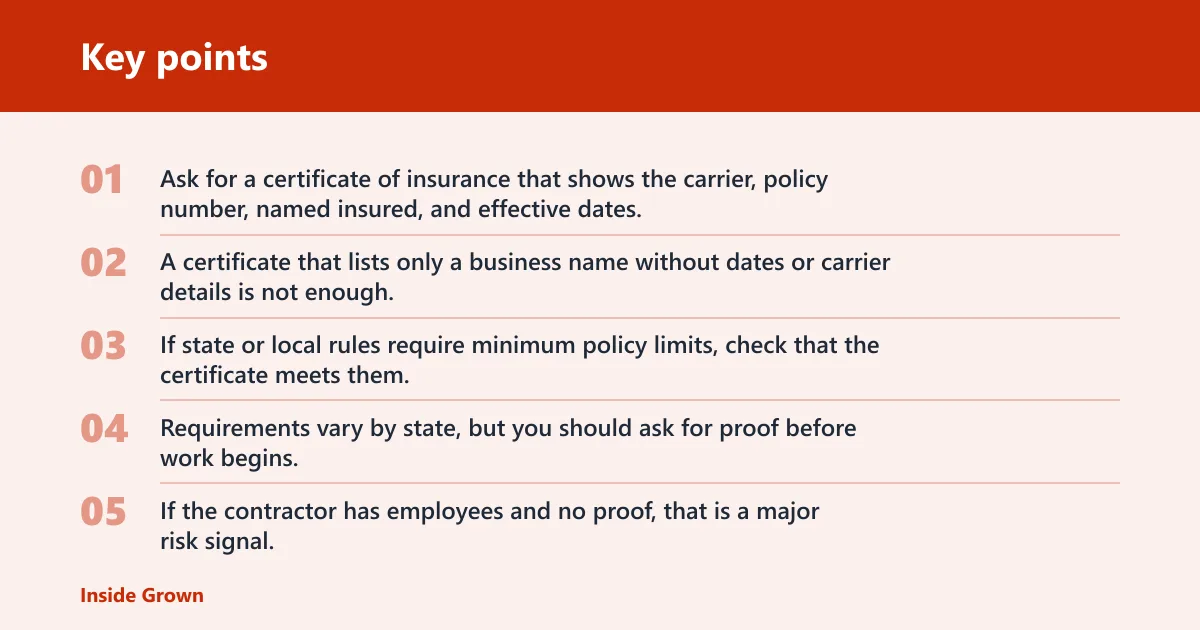
General liability insurance is the policy that may help cover property damage if a crew cracks a wall, breaks a window, or damages irrigation lines. Ask for a certificate of insurance that shows the carrier, policy number, named insured, and effective dates. A certificate that lists only a business name without dates or carrier details is not enough.
If state or local rules require minimum policy limits, check that the certificate meets them. The homeowner should verify the dates directly, because an old certificate can look official while the policy has already lapsed.
Workers’ compensation coverage
Workers’ compensation insurance covers employee injuries and matters when crews are on site, especially for roof-adjacent work, heavy lifting, trenching, or machine use. Requirements vary by state, but you should ask for proof before work begins. If the contractor has employees and no proof, that is a major risk signal.
Some states treat solo owners differently from firms with employees. If the contractor says workers’ comp is “not needed,” ask which rule applies and whether any subcontractors will be on the job. A subcontractor without coverage can still create exposure for the project.
Bonded contractor status
A license bond or surety bond can provide a consumer claim path if the contractor violates license rules or leaves a job unfinished, but the bond is not the same as insurance. The state may track the bond amount and active status in the license record. Verify the bond through the board if the state offers that field.
Bonded status does not replace liability coverage or workers’ compensation. It is a separate layer, and it may not cover the full cost of a dispute.
License verification checklist
Use this checklist before you sign. It turns a general “are they licensed?” question into a document-by-document check.
| What to ask for | Where to verify it | What a valid result looks like | What to do if the result is missing, expired, mismatched, or disciplinary |
|---|---|---|---|
| License number and license class | Official state contractor licensing board lookup | Active status, correct class, current expiration date | Stop and confirm whether the project requires a different license or a licensed subcontractor |
| Legal business name and DBA | Board record, state business registry, contract, invoice | Names line up or the DBA is clearly linked to the legal entity | Ask for the registered name and proof of the DBA filing before proceeding |
| Disciplinary history or complaints | Board disciplinary record or complaint status field | No unresolved suspension, revocation, or open violation tied to the work | Ask for a written explanation and consider a different contractor if the record shows active discipline |
| General liability insurance | Certificate of insurance, carrier verification if possible | Active dates, named insured, carrier, and policy number match the contractor | Do not start work until current proof is provided and the dates are valid |
| Workers’ compensation coverage | Insurance proof, state workers’ comp records if available | Coverage is active when employees will be on site | Require proof before work begins and do not assume a waiver applies |
| Bonded status | Board record or bond registry if the state tracks it | Bond is active for the correct license | Ask for updated proof or a different contractor if the bond is inactive |
| Permit responsibility | Local building or permitting office | Project scope matches permit rules and the contractor names the needed permits | Delay work until permit responsibility is clear and any needed trade licenses are identified |
What to do if the record does not match
If verification fails, pause the job before money changes hands. An expired, suspended, or missing license can mean the contractor cannot legally perform the work, cannot pull the right permit, or may leave you with limited recourse if something goes wrong. Fix the record problem first.
Stop on a bad match. If the license is expired, suspended, or missing from the board, do not accept verbal explanations alone. Ask for the exact issue in writing.
Resolve the name issue. If the business name does not match, request the legal entity name, DBA filing, and the name that will appear on the contract and permit. If those do not align, walk away.
Verify the insurance again. If the insurance certificate is missing carrier details, active dates, or the named insured, ask for a corrected certificate directly from the insurer or the agent. Do not rely on an old PDF.
Confirm the trade setup. If the contractor says another company will handle drainage, walls, or irrigation, ask for that subcontractor’s license and insurance too. The setup should be documented before work starts.
A common first-timer mistake is accepting “licensed” as a yes-or-no answer. Suppose the estimate lists a trade name, the license board lists a different legal entity, and the insurance certificate names a third company. That needs clarification before any deposit is paid.
Red flags before you hire
What red flags show a landscaper may not be licensed? The strongest warning signs are refusal to give a license number, a board record that cannot be found, insurance proof that does not match the company name, and vague answers about permits, subcontractors, or who is responsible for damage. Cash-only demands and no written contract add more risk.
- Refuses to provide a license number or says the number is “not needed.”
- The state board record is expired, suspended, revoked, or missing.
- The business name on the estimate does not match the license record.
- The contractor will not provide a current certificate of insurance.
- Workers’ compensation is unclear even though employees will be on site.
- The contractor gives vague answers about drainage, grading, retaining walls, or permits.
- No written contract, or a request for cash only with no paper trail.
If the project is already underway and the contractor turns out to be unlicensed, call the local building department or licensing board before more work is done. Ask whether the work can be paused, whether a permit is required, and whether a licensed contractor must take over the remaining scope.
Frequently asked questions
Does a landscaper need to be licensed?
Not always. It depends on the state and the scope of work. Basic mowing or planting may require only registration, while installation, grading, drainage, irrigation, retaining walls, or structural hardscape work can trigger a contractor license, a permit, or a separate specialty license.
What license should a landscaper have
The right license depends on the work in front of you. For planting and landscape installation, a landscape contractor license may fit. For drainage, retaining walls, or structural hardscape, the contractor may need a broader contractor license or a licensed subcontractor to cover part of the job.
How do I verify a landscaping contractor license number?
Use the official state contractor licensing board database and search by license number first. Then check active status, expiration, class, and disciplinary fields. Make sure the legal business name on the record matches the estimate, contract, and invoice, or is clearly tied to a registered DBA.
What if a landscaper says they are licensed but I cannot verify it?
Do not proceed until the record is found and the details match. A missing result can mean the number is wrong, the license is expired, or the business is operating under a different name. Ask for the legal entity, current certificate, and board record before signing anything.
Do I need to hire a licensed landscaper for drainage or hardscaping work?
Often, yes, or at least a contractor whose license covers the work and permits involved. Drainage changes, grading, retaining walls, and structural hardscape projects may need a permit and possibly a different license class or specialty subcontractor. Check local building rules before the job begins.
What insurance should a licensed landscaper have
Ask for active general liability insurance and, when employees will be on site, workers’ compensation coverage. Confirm the carrier, policy dates, and named insured on the certificate of insurance. If the state requires minimum limits or bond coverage, verify those through the board or the insurer.
What red flags show a landscaper may not be licensed
The clearest red flags are no license number, a board record that cannot be verified, expired or suspended status, mismatched business names, missing insurance proof, and vague answers about permits or subcontractors. Cash-only terms and no written contract add more risk and should slow the hiring decision.