Questions to Ask Before Hiring a Landscaper: 12 Checks
Ask each landscaper a solid set of questions, and only move forward if they can answer in writing what’s included, what’s excluded, who handles permits, and how change orders are priced. Skip that, and homeowners end up with surprise fees, thin plantings, drainage problems, and a finished yard that looks nothing like the quote. This checklist shows which answers to listen for, which gaps signal risk, and how to compare bids before you sign.
This guide is part of our Landscaping services guide series.
Which questions matter most before you hire a landscaper?
Start with the parts that can cost you most: licensing, insurance, scope, permits, pricing, timeline, and who owns cleanup and follow-up. Ask questions to compare answers, not charm. A polished pitch means little if the quote leaves out drainage, disposal, or plant replacement.
Match the questions to the project type
A design-build landscaper will usually answer differently than a maintenance-only provider. For design-build work, focus on plans, materials, hardscaping, lighting, and permits. For maintenance, focus on visit frequency, pruning standards, seasonal tasks, and who handles replacement of dead plants.
Use the same core questions for every bid. Then add project-specific questions so one company cannot hide missing scope behind broad language.
How to narrow the first round
Before an onsite estimate, ask whether the company does hardscaping and lighting, what brands or fixture types it uses, how it handles sustainability in designs, and whether it can provide references or a portfolio. Those answers quickly show whether the company fits the job or only wants part of it.
How do you read a landscaper’s answer?
A strong answer names the work, the limits, and the paperwork. It identifies who does what, when permits are needed, and what happens if weather or excavation changes the plan. A weak answer is vague, rushed, or built on promises without written details.
What a strong answer sounds like
Good answers are specific. “We carry general liability and workers’ compensation, we pull the permit for retaining walls, and the proposal includes haul-away, grading, and final cleanup” is useful. “Don’t worry, we handle everything” is not.
Strong answers also name exclusions. That matters because a clear exclusion is easier to price than a surprise. If a landscaper says the quote excludes irrigation repair, stump grinding, or soil correction, that is useful information, not a problem by itself.
How to compare two bids that sound different
Compare scope line by line, not just totals. One bid may include design, materials, install, disposal, and warranty support. Another may only cover labor. Lower pricing can be misleading when half the job sits outside the quote.
What should you ask about licensing, insurance, and permits?

Ask for the exact license details, proof of insurance, and a written statement on who pulls permits. A licensed landscaper should be able to show the local licensing requirements, explain what the license allows them to do, and confirm the job appears to fit within that scope.
What proof to request
Request the license number, the issuing jurisdiction, and a copy of the current certificate if one exists in your area. For insurance, ask for proof of general liability and, where applicable, workers’ compensation. Missing documents matter because no insurance and no contract both put the homeowner at risk.
General liability is the protection you want if the crew damages a fence, window, patio, or irrigation line. Workers’ compensation matters if someone gets hurt on site. If a company dodges these questions, stop there.
Permits are not a guess
Ask which project types need municipal permits and who handles the filing. Retaining walls, some grading changes, electrical lighting work, and certain drainage or hardscape projects may require approval. The proposal should say whether the company pulls the permit or expects the homeowner to do it.
Never accept “that usually isn’t a problem” as an answer. Ask for the permit line item or the written note that no permit is needed, with the reason.
What services and site conditions should the estimate cover?
The estimate should separate the main cost categories, such as design, planting, hardscaping, lighting, maintenance, cleanup, haul-away, and disposal. It should also address drainage, soil, slope, and sun exposure. If those site conditions are ignored, the design can fail even when the planting list looks good.
Scope items that often go missing
Ask whether grading is included. Ask about debris hauling, soil amendments, bed edging, mulch depth, and final site cleanup. These details are easy to omit and expensive to add later. The quote should also name what stays outside the scope.
If a bid mentions “landscape installation” without listing materials, labor, disposal, and finish work, ask for a revised version. Broad labels hide cost shifts.
Design-build versus maintenance-only
A design-build company should explain drawings, plant maturity expectations, material choices, and sequencing. A maintenance-only provider should explain schedule, crew frequency, trimming standards, seasonal upkeep, and replacement rules. Do not compare those bids as if they are the same service.
How should pricing, deposits, and change orders work?
Ask for estimated costs before any work begins, then ask how the deposit, progress payments, and final payment are structured. A fair bid should state what can trigger extra charges and how change orders are approved. A hefty deposit upfront is a red flag.
What the payment terms should say
The contract should state the deposit amount, when progress payments are due, and whether final payment follows walkthrough, punch-list completion, or both. It should also say whether materials are billed at purchase or after delivery. Ambiguous payment timing invites disputes.
Change orders need a paper trail
Ask how material changes, hidden roots, buried debris, poor drainage, or excavation surprises are priced. The response should explain who approves the change, how the cost is calculated, and whether work pauses until written approval is given. Verbal approval is a weak substitute.
Once digging starts, scope creep can grow fast. If the answer is “we’ll figure it out later,” expect a bigger bill later.
How do timeline, weather delays, and completion dates get handled?
Ask for a start date, phase milestones, and an estimated completion date. The timeline may be approximate due to weather conditions, supply delays, or site surprises. A good landscaper says how updates will be delivered when the schedule shifts.
What to ask about delays
Rain, frozen ground, heat, and plant availability all affect sequencing. Ask whether weather pauses the crew, shifts the phase order, or changes the finish date. The best answer explains the plan without pretending weather can be controlled.
Also ask who tells you about delays and how far in advance. A homeowner should not learn about a missed start date from an empty driveway.
What milestones should appear
Useful milestones can include site layout, demolition, grading, installation, planting, lighting, irrigation tie-ins, cleanup, and a final walkthrough. Those markers help separate a real schedule from a vague promise.
What should references, photos, and warranties prove?
References and photos should show the landscaper has handled jobs like yours recently, or at least similar work in similar local conditions. Ask for before-and-after photos, recent local jobs, and client references. Then ask what follow-up care, plant replacement, and warranty coverage include.
How to judge a portfolio
Old glossy photos are less useful than recent work from nearby sites. Look for projects with similar slope, soil, shade, or drainage issues. Ask what changed between the first photo and the finished result.
References should be current enough to call on the phone if needed. Ask whether the company returned for punch-list work, and whether the client felt the final result matched the original scope.
What warranties should clarify
Plant replacement rules matter most. Ask how long until planting reaches maturity, whether dead plants are replaced, and whether the warranty excludes drought, neglect, or improper irrigation use. A maintenance plan should also say who handles seasonal upkeep after install.
Two-column landscaper interview scorecard
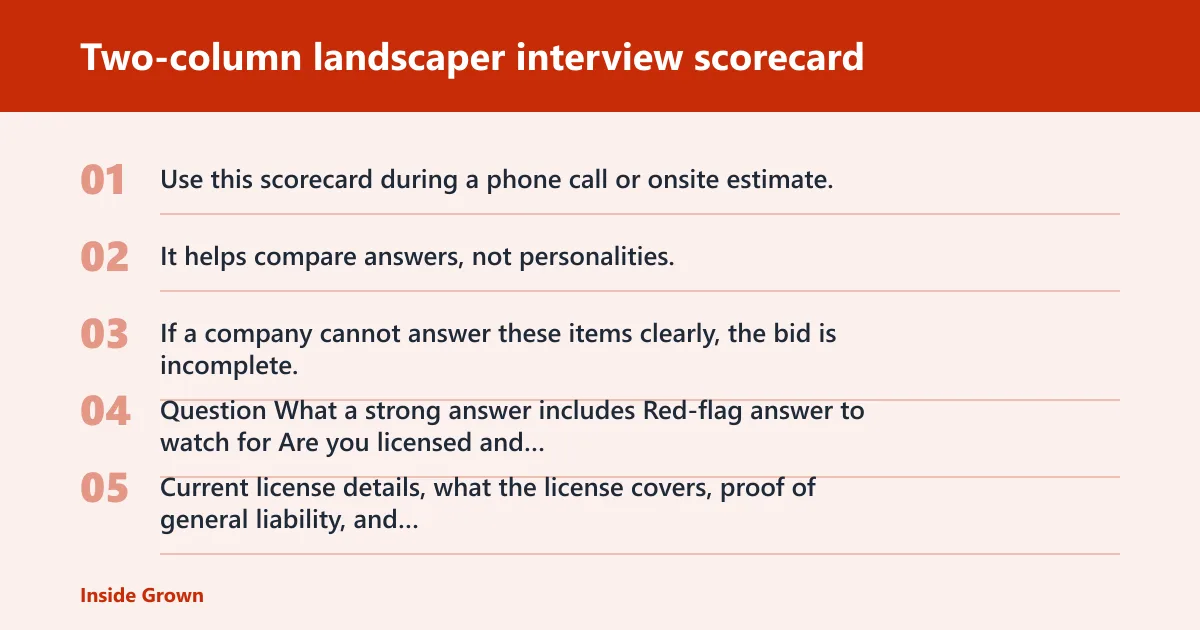
Use this scorecard during a phone call or onsite estimate. It helps compare answers, not personalities. If a company cannot answer these items clearly, the bid is incomplete.
| Question | What a strong answer includes | Red-flag answer to watch for |
|---|---|---|
| Are you licensed and insured? | Current license details, what the license covers, proof of general liability, and workers’ compensation if employees are on site. | “We’ve never had a problem” or refusal to provide documents. |
| What services do you offer? | Clear list of design, planting, hardscaping, lighting, maintenance, cleanup, and disposal, with exclusions named. | Broad wording like “full service” with no line-item detail. |
| Can you show references or a portfolio? | Before-and-after photos, recent local jobs, and references from similar projects. | Only stock images, old work, or vague claims of happy customers. |
| What is the estimated timeline for the project? | Start date, phase milestones, completion estimate, and a note that weather may change the schedule. | “Soon” or “about a week or two” with no phase detail. |
| What is the payment structure? | Deposit, progress payments, final payment terms, and written change-order process. | Large upfront demand or verbal-only payment terms. |
| Do you obtain the necessary permits? | Specific permit responsibility, project types that need approval, and the municipality named in writing. | “You probably won’t need one” without checking. |
Frequently asked questions
What questions should you ask when hiring a landscaper?
Start with licensing, insurance, scope, permits, pricing, timeline, references, and contract terms. Then ask how the company handles weather delays, change orders, cleanup, and plant replacement. Those answers show whether the bid covers the real job or just the visible parts.
Are you licensed and insured?
Ask for the exact license details, what the license allows, and written proof of general liability and workers’ compensation. If the landscaper cannot provide those documents, the risk shifts to the homeowner if property damage or injury happens on site.
What services do you offer?
The answer should separate design, planting, hardscaping, lighting, maintenance, cleanup, and disposal. A clear scope makes bids comparable. It also reveals whether the company is design-build, installation-only, or maintenance-only, which changes how the project should be priced.
What should be in a landscaping contract?
The contract should clearly state the scope, materials, exclusions, permit responsibility, timeline, payment structure, change-order rules, cleanup, and any warranty or plant replacement terms. It should also list documents and line items in writing so nothing important is left to memory or a phone call.
How do you handle unexpected issues or changes?
Ask who approves change orders, how new work is priced, and whether digging stops until you sign off. Good answers explain the process before any problem appears. Bad answers wait until after excavation starts, when the bargaining position has already shifted.
Do you obtain the necessary permits?
The landscaper should say which parts of the project need municipal permits and who files them. Retaining walls, some grading work, and electrical lighting can require approval. If the company is vague here, expect delays or extra cost later.