How to Fix Leggy Houseplants and Encourage Bushier Growth
Fix leggy houseplants by moving them to brighter light, then cutting stems back just above a node. If node spacing is wide, take healthy cuttings and replant them for fuller growth. Ignoring stretch leaves bare stems, weak growth, and a plant that keeps opening up. This guide shows how to diagnose the cause and choose the right fix: move, prune, propagate, or combine all three.
Why houseplants get leggy



Leggy growth is usually a light problem. When a plant does not get enough light, it stretches toward the brightest source, making long internodes, smaller leaves, and a sparse top. That response is called etiolation, and older stems can stay leggy even after conditions improve.
How to spot etiolation
Look for a gap between leaves that is much wider than on earlier growth, pale foliage, and stems leaning toward one window. Etiolated spacing is often described as 2 to 4 times normal. Healthy pothos internodes are listed as 2 to 5 cm, so a much wider gap usually signals stretch rather than a naturally open habit.
A plant can also be leggy for structural reasons. Some climbing or trailing houseplants hold spacing between leaves even in good light, and that is not the same as a light-starvation response. The fix depends on whether the plant is recovering from poor light or simply growing in its normal shape.
When legginess is normal growth
Monstera and other climbing plants can show stretched internodes as they search for support and better light. That does not always mean you should top them hard. For these plants, node position, stem health, and the amount of foliage left on the plant matter more than a simple cutback rule.
What you’ll need
- Clean, sharp pruning shears or secateurs
- Disinfectant for tools if pests or disease are suspected
- A glass, jar, or similar propagation vessel
- Water for rooting cuttings
- Houseplant potting mix matched to the plant
- A pot with drainage holes
- Grow light, if window light is weak
- Labels or tape for keeping track of cuttings, if you are rooting several vines
Should you move it or prune it first?
Move the plant to stronger light first if the stretch is recent or the room has changed with the season. Prune after you correct the light problem, unless the plant already has enough healthy nodes and foliage to handle a cutback. If the stem is sparse and thin, a brighter spot should come before a hard cut.
Use node spacing to judge the cut
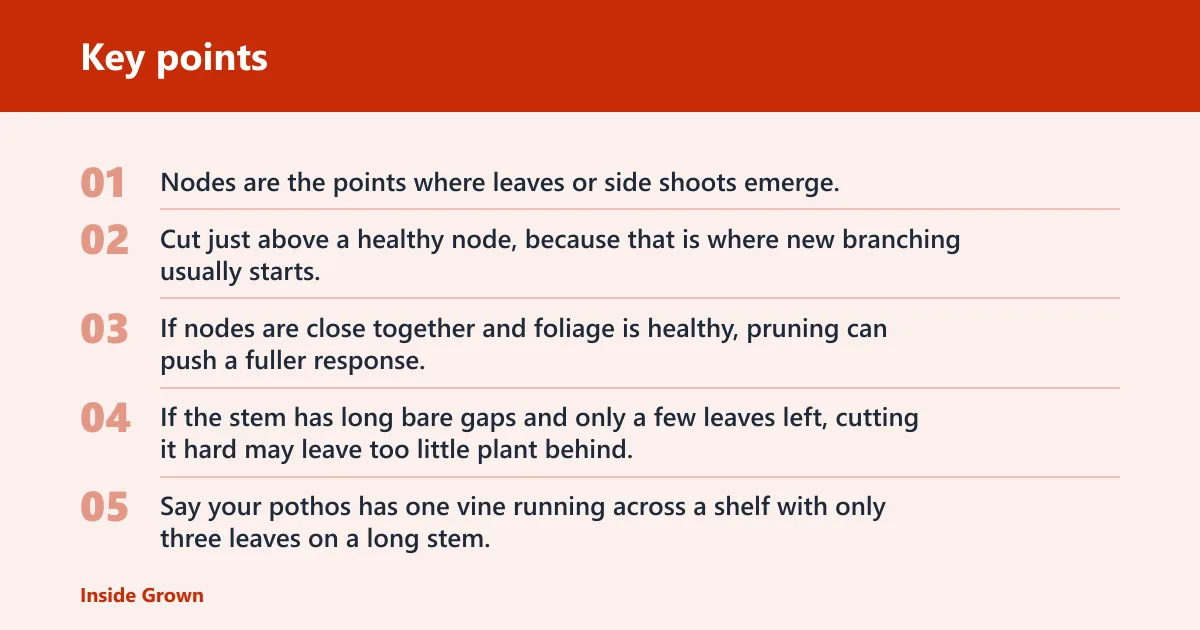
Nodes are the points where leaves or side shoots emerge. Cut just above a healthy node, because that is where new branching usually starts. If nodes are close together and foliage is healthy, pruning can push a fuller response. If the stem has long bare gaps and only a few leaves left, cutting it hard may leave too little plant behind.
Say your pothos has one vine running across a shelf with only three leaves on a long stem. Move it closer to an east window or add a grow light first, then wait for firmer growth before cutting. If the same vine already has several nodes with healthy leaves, a node-based prune is more likely to produce side shoots.
Watch for plant type limits
Pothos and philodendron usually respond well to trimming near nodes, and both are often propagated from stem cuttings. Monstera needs more judgment. A climbing monstera can be cut back, but the plant should keep enough leafy growth to keep recovering. If the stem is mostly bare, use light correction first and prune more conservatively.
How do you make a leggy houseplant bushier?
The fastest route to a fuller pot is usually a combination: cut above healthy nodes, root the removed stems, and plant the rooted pieces back into the same pot. That gives you more growing tips in the container instead of one tall vine. For many vines, the goal is density at the pot, not a single longer stem.
Cut above a healthy node
Use clean pruning shears or secateurs for a clean cut. If pests or disease are suspected, disinfect between plants before moving on. Make each cut just above a node so the remaining stem can push new side shoots from that point.
- Choose the cut point. Find a healthy node with leaves or a visible bud. If the stem is weak, keep more foliage on the plant rather than cutting deep into bare stem.
- Make a clean cut. Trim just above the node with sharp shears. Avoid crushing the stem, because ragged cuts heal more slowly and can slow regrowth.
- Leave enough plant behind. For bushier vine growth, the author says to cut 75% off, but only when the plant is healthy enough to recover. If the plant is thin or stressed, reduce less and let new light-driven growth build first.
Root the cuttings
A glass or propagation vessel is part of the basic kit. Place the cut vine in water under suitable light, or plant it in a suitable medium if you are rooting directly in mix. The propagation step uses about 5 inches of stem on each vine, and each vine should keep at least three leaves. Cuttings should be inserted so the node where the leaf was removed is below the soil.
- Trim each cutting. Keep about 5 inches of stem and at least three leaves on each vine. Remove the lower leaf if needed so the node can sit at the rooting point.
- Set the node in place. Put the node below the waterline in a glass or jar, or below the soil line in potting mix. That is where new roots form.
- Hold steady moisture. Keep the soil moist for a few weeks while cuttings root. Change water regularly if rooting in a vessel, and keep the cuttings in bright, indirect light.
Replant to fill the pot
Once rooted, move the cuttings into houseplant potting mix that suits the plant and its recovery stage. If the parent pot does not need a full repot, top-dress the surface or fluff the top layer so new roots have room. That helps the pot read fuller without disturbing the root ball more than needed.
Suppose a philodendron has one long bare stem and a second vine with healthy leaves. Prune the long stem back to a node, root the removed top in a jar, then plant that rooted cutting back beside the parent stem. The pot gains a second growth point without waiting for a brand-new plant.
Leggy growth decision table
This table matches five common scenarios to the next move. Use it to decide whether to move, prune, propagate, repot, or combine them.
| Scenario | Symptom pattern | Move? | Prune? | Propagate? | Repot? | Expected recovery |
|---|---|---|---|---|---|---|
| Low-light etiolation | Pale leaves, long internodes, growth leaning toward one window | Yes | After light improves | Only from healthy tips | No, unless roots are crowded | New growth often looks more compact in several weeks |
| Single vine on a healthy pothos | One vine is bare between leaves, roots and foliage still strong | Yes, if window light is weak | Yes, near a node | Yes | No | Branching often starts at the cut node after light is corrected |
| Sparse plant with too few nodes | Thin stems, few leaves left, bare gaps along the vine | Yes | Lightly or not yet | Yes, to rebuild fullness | Only if root bound | Fullness builds slowly as new rooted pieces establish |
| Winter stretch after a light drop | Growth loosens after shorter days, stems elongate after the season changes | Yes | After moving closer to light or adding a grow light | Optional | No | Shape improves as the next flush of growth stays tighter |
| Plant that should not be hard-pruned | Monstera or another climber with limited healthy foliage and open growth | Yes | Only selectively | Yes, from healthy nodes | Only if needed for roots | Recovery is slower; leaf retention matters more than fast topping |
How do you keep new growth compact?
Keep the light even, give the plant a consistent rotation schedule, and repot only when the roots need more room. A full-spectrum LED grow light can help when window light is not enough for compact growth. Do not overfertilize a stressed plant; wait until new plants are established before using a basic houseplant feed.
Set a rotation schedule
Turn the plant regularly so one side does not chase the window and stretch harder than the other. A rotation schedule helps even out growth toward one window and reduces one-sided legginess. This matters most in winter, when daylight drops and stems can lengthen again.
Add a grow light when windows are weak
If the brightest window still leaves wide spacing between nodes, add a full-spectrum LED grow light. Use it to supplement natural light, not replace it entirely unless the room is very dim. The goal is compact new growth, since old stretched stems will not shorten on their own.
Repot only when the roots need it
Repotting does not fix light-starved growth by itself. Use houseplant potting mix and a larger pot only when roots are crowded or the mix has broken down. If the plant does not need a full repot, top-dress or fluff the existing mix instead.
Common mistakes
A common mistake is pruning before correcting light. That can leave the plant with the same weak conditions and fewer leaves to power recovery. Another mistake is cutting too far back on a plant with too few nodes, which can stall regrowth instead of making it fuller.
- Using blunt tools. Clean, sharp pruning shears or secateurs make better cuts and reduce tearing.
- Skipping node placement. If you cut above the wrong point, the plant may not branch where you want.
- Leaving cuttings in dim light. Rooting is slower when the propagation vessel sits too far from good light.
- Overwatering the parent plant. Keep the mix evenly moist, not soggy, while cuttings root and the parent recovers.
- Expecting old stems to change shape. Etiolated stems often stay leggy even after light improves; new growth is the part that tightens up.
If pruning does not improve the shape and the plant keeps stretching, check three things in order: light, roots, and pests. Continued stretch after pruning usually means the real issue is still unresolved. A weak root system or hidden pests can also slow branching and keep leaves small.
Frequently asked questions
Why are my houseplants getting long and leggy?
Low light is the most common reason. Houseplants stretch toward a light source when light is low, which leads to long internodes, smaller leaves, and pale growth. If the room changed with winter, the stretch may be a seasonal response rather than a permanent problem.
Should I prune a leggy houseplant or move it to more light first?
Move it first if the plant has been in dim light or the stretch is recent. Prune after the light is corrected, unless the plant already has enough healthy nodes and leaves to support a cutback. Light fixes the cause; pruning shapes the result.
Can I propagate the cuttings from a leggy houseplant?
Yes. Pothos and philodendron usually root well from stem cuttings, and many other vines can too. Keep about 5 inches of stem, make sure each cutting has at least three leaves, and place the node below the water or soil line so roots can form.
How much can I cut back a leggy pothos or philodendron?
Hard pruning is often possible on healthy vines, and the author says 75% can be removed for bushier vine growth. Keep enough leaves and nodes on the plant to keep it recovering. If the stem is sparse or the roots are weak, cut less and propagate more conservatively.
When should I repot a leggy houseplant?
Repot when the roots need more room or the potting mix is broken down. Repotting is not the first fix for stretch. If the plant is otherwise healthy, top-dress or fluff the existing mix and focus on light, pruning, and propagation first.