
How to Bury Low Voltage Cable Safely
Bury low-voltage lighting cable in a 6-inch-deep trench, use direct-burial cable or conduit where it crosses driveways or other impact zones, and call 811 before you dig. Shallow or unprotected runs get cut by edging, shovels, and later yard work, and water intrusion can corrode splices. This guide shows the burial depth, cable protection, trenching, backfill, and splice steps that hold up over time.
Cable burial checklist



Use this checklist before you cut a trench. It keeps the route, the burial method, and the splice plan aligned with the soil and with future yard work.
| Check | What to confirm | Burial approach | Minimum safeguard |
|---|---|---|---|
| Route type | Open lawn, bed edge, path, driveway crossing, or root zone | Direct burial in open lawn; conduit at crossings and shallow transitions | Keep the run at a steady depth and avoid sharp bends |
| Soil condition | Loose, rocky, wet, or compacted | Conduit or deeper trench in rocky or high-moisture ground | Protect the jacket from abrasion during backfill |
| Splice count | None, one, or several underground joins | Fewer splices is better; use listed direct-burial connectors for every underground join | Seal each splice against ground moisture |
| Future-dig risk | Edging, planting, fence work, irrigation, or seasonal digging | Conduit where people are likely to dig later | Label terminations and map the route |
What you’ll need
- Direct burial low voltage cable rated for outdoor underground use
- Waterproof wire nut connectors that are silicone gel filled and direct burial rated
- Wire strippers
- Trencher, shovel, or edger
- Tape measure or marking paint
- Cable labels and a marker
- Conduit for crossings, shallow runs, or extra mechanical protection
- Landscape lighting transformer
How deep should you bury it?
For typical low-voltage lighting, start with about a 6-inch trench and adjust as needed for the route. Follow the manufacturer listing first, then go deeper where the cable crosses a driveway, edging, or another place that gets hit by tools or traffic. If the soil is rocky or the run will be dug near later, conduit is usually the safer choice.
Use the manufacturer listing first
Some cable and connector systems are listed for direct burial, which means they can be buried underground when used as specified. Follow the cable and connector instructions for depth, cover, and approved use. If the product listing conflicts with a local rule, use the stricter requirement.
Choose deeper runs near traffic and digging zones
A shallow run is easy to nick. If the cable passes under a path, near a bed edge, or where a shovel is likely to land, treat that section as a protection problem, not a speed problem. In those spots, conduit is often worth the extra work.
Add conduit where protection matters more than speed
Conduit helps where the cable needs a short, defended segment rather than a long buried stretch. Use it at driveway crossings, under stepping-stone paths, and at transitions where the cable comes up out of the ground and back down again.
Turn off the transformer, call 811 before you dig, and then build the trench so the cable stays dry, intact, and easy to service later. Low-voltage lighting is safer than line voltage, but it still needs careful routing, clean splices, and protection from future digging.
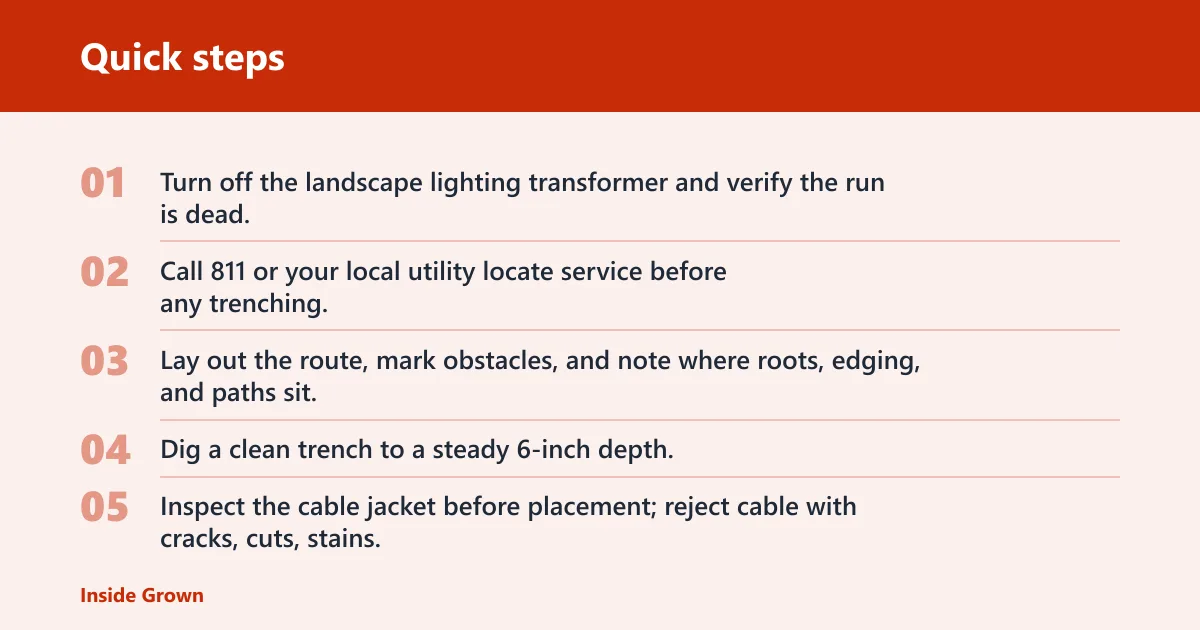
- Turn off the landscape lighting transformer and verify the run is dead.
- Call 811 or your local utility locate service before any trenching.
- Lay out the route, mark obstacles, and note where roots, edging, and paths sit.
- Dig a clean trench to a steady 6-inch depth, or deeper where the route needs more protection.
- Inspect the cable jacket before placement; reject cable with cracks, cuts, stains, rust at connectors, or other defects.
- Make any underground splice with listed direct-burial connectors rated for low-voltage lighting use.
- Test the lighting run before backfill.
- Backfill, then label the cable at terminations and record the route for future service.
Inspect before you place
Low-voltage cable insulation must be intact before installation. A nicked jacket or corroded connector is a weak point that can admit moisture or fail after the trench is closed. If the cable looks damaged, replace that section rather than burying a problem.
Test before backfill
Check the connection and confirm the lights work before you cover the trench. The instructions say to turn off both the timer and breaker before work, and the connection test should happen before the cable is buried. If a fixture is dim or intermittent, fix it now.
Say the run crosses a mulch bed, then about a 3-foot stepping-stone path, and then a lawn edge. Keep the lawn section direct-burial, sleeve the path crossing in conduit, and leave enough slack at each transition for service without stretching the splice.
Can you bury low voltage wire without conduit?
Yes, if the cable is listed for direct burial and the route does not face much physical abuse. Direct-burial low voltage cable is made for outdoor underground use, with a moisture-resistant jacket, and can be buried without extra weatherproofing when the product is specified that way. Conduit becomes more useful when the route is exposed to digging, compression, or abrasion.
When direct burial is enough
Use direct burial for open lawn runs, longer low-voltage lighting stretches, and places where the soil is stable and the route is not likely to be disturbed. Keep the trench depth consistent and avoid shallow hops over roots or rocks.
When conduit adds useful protection
Add conduit where the cable passes under paving, meets a driveway, crosses an edge that gets trimmed often, or rises and drops quickly between grade changes. Conduit also helps where future digging is likely, because it gives the cable a harder shell.
Where conduit helps most
Use it in short, high-risk sections. A full conduit run is not always necessary for low-voltage lighting, but a few protected sections can prevent a cut jacket or crushed cable later.
How to make waterproof low-voltage connections
Make every underground splice with a direct-burial-rated connector, not a standard indoor wire nut. Waterproof wire nut connectors for low-voltage lighting are silicone gel filled and made to seal against ground moisture. The goal is a secure conductor join that stays dry after burial.
Strip about half an inch cleanly
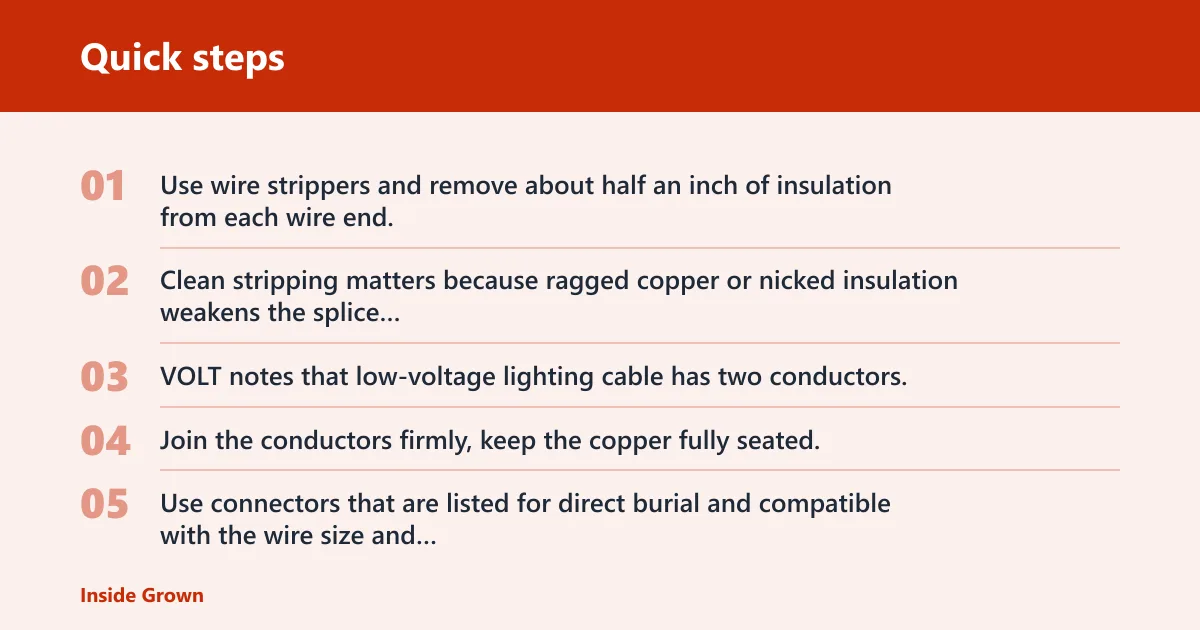
Use wire strippers and remove about half an inch of insulation from each wire end. Clean stripping matters because ragged copper or nicked insulation weakens the splice and can leave exposed metal near moisture.
Join conductors securely
VOLT notes that low-voltage lighting cable has two conductors, so polarity is not a concern in that guide. Join the conductors firmly, keep the copper fully seated, and avoid loose twists that can back out during backfill.
Use listed direct-burial connectors
Use connectors that are listed for direct burial and compatible with the wire size and cable type you are joining. A connector that is not rated for underground use is the wrong part for a buried splice, even if it seems to fit.
Keep moisture out at the splice
Place the splice where it will not sit in a puddle, and leave enough cable slack so the connector is not pulled tight. Moisture intrusion is a common failure point in buried low-voltage lighting, especially at transitions and repairs.
Cable burial decision table
This table turns the route, soil, splice count, and future-dig risk into a burial choice you can actually use.
| Situation | Direct burial cable | Add conduit | Minimum safeguard |
|---|---|---|---|
| Open lawn with few obstacles | Yes | No, unless the route changes later | 6-inch trench, intact jacket, labeled terminations |
| Driveway, path, or edging crossing | Use only for the open sections | Yes | Short conduit sleeve and careful backfill |
| Wet, rocky, or root-heavy soil | Possible, but higher risk | Often yes | Protect against abrasion and moisture at every splice |
| Several underground splices | Acceptable only with rated connectors | Helpful near each splice | Reduce splice count and test before cover |
| Area likely to be dug later | Only if well marked and protected | Recommended | Label the route and document the path |
Common mistakes
Burying damaged insulation can quickly lead to a future failure. Replace cut or cracked cable instead of covering it, and do not bury connectors that are not rated for direct burial.
Skipping 811 is another avoidable error. A trench that hits an existing utility line is far more expensive than a locate call.
Leaving shallow transitions unprotected is a common first-timer mistake. Picture a cable that is safe in the lawn but rises over a bed edge with no conduit; that short exposed stretch is the one most likely to be nicked by a spade.
Failing to label the run also causes trouble later. Mark cable numbers at terminations so the next repair or fixture change is faster and safer.
How do you keep buried low voltage wire from failing?
Use direct-burial cable, protect every underground splice with a rated waterproof connector, keep the jacket intact, and choose conduit at crossings or other abuse points. Failure usually starts where the cable is shallow, nicked, or left with moisture at a splice. Good marking and steady trench depth reduce those weak spots.
Label and document the route
Mark cable numbers at the transformer and at fixture terminations. That makes later troubleshooting easier, especially when several runs leave the same transformer or loop through the same bed.
Check the transformer setup
Choose a transformer with the right taps for the run. VOLT lists 12V and 15V taps on a 150W Clamp-Connect Low Voltage Transformer, 12V, 13V, 14V, and 15V taps on a 300W Multi-Tap Low Voltage Transformer, and 15V taps on a 100W Slim Line Low Voltage Transformer. Some models also include timer control or a photocell-compatible setup, which can help with routine operation.
For example, a homeowner may add four fixtures along a garden path and place one splice near a stepping stone. That splice should get rated direct-burial protection, and the stone crossing should use conduit, because foot traffic and garden work will keep returning to that spot.
Frequently asked questions
How deep to bury electrical cable?
For low-voltage lighting, a 6-inch trench is a practical starting point for open yard runs. Go deeper or add conduit where the route crosses a driveway, path, edging, or other place that gets hit by tools or traffic. Always follow the cable and connector listing first.
What is the best way to bury low voltage wire?
Turn off the transformer, call 811, dig a clean 6-inch trench, inspect the cable jacket, and use listed direct-burial connectors for every underground splice. Test the lighting run before backfill, then label the terminations so future service is faster and less invasive.
Do you need direct burial low voltage wire?
For underground lighting, direct burial cable is the right choice when the run will stay buried. It is built for outdoor underground use and a moisture-resistant jacket. Use conduit where the route needs extra protection, but do not substitute indoor cable for burial.
How do you make waterproof low voltage wire connections?
Strip about half an inch of insulation from each end, join the conductors securely, and use silicone gel filled waterproof wire nut connectors that are rated for direct burial. Keep the splice dry, avoid damaged copper, and test the circuit before the trench is covered.
Should low voltage cable be in conduit underground?
Not always. Direct burial cable can go underground without conduit when the route is low risk and the product is listed for burial. Conduit is a better call at driveway crossings, under paths, near edging, and anywhere future digging or abrasion is likely.