How Many Watermelon Plants Do You Need for a Family?
For a family, a good starting point is usually 2 to 4 watermelon plants for a small household and 4 to 6 for a larger one, but the better way to size the patch is by variety class and expected fruit per plant. University extension guidance generally puts watermelon yield at about 1 to 3 fruits per plant depending on cultivar, pollination, and growing conditions, so plant count should be tied to the type you grow rather than a single generic number. This guide shows how to translate fruit count and spacing into a practical family planting plan.
How many watermelon plants do you need?

Start with how many melons your household will actually eat, then divide by the number of fruits you expect from each plant. For family fresh eating, a lower count often works. For sharing, gift fruit, or to cover weak pollination, add one extra plant.
A practical planning formula is: desired melons ÷ expected melons per plant = starting plant count. If a family wants 6 melons over the season and expects 2 fruits per plant, the target is 3 plants. If the variety is larger-fruited, less productive, or less reliably pollinated, round up to protect the harvest.
Family of 4 quick answer: Most families of four do well with 3 to 4 watermelon plants for steady summer eating, or 4 to 5 plants if you want extra fruit for sharing or you are growing seedless types that need a pollinizer nearby. For a fast shortcut, use the family of 4 planting calculator approach: estimate what you want to eat, then add a buffer for uneven fruit set.
Watermelon fruit count is not fixed. Extension sources from land-grant universities commonly describe watermelon as producing roughly 1 to 3 marketable fruits per plant, with the final number shaped by cultivar, spacing, pollination, and vine vigor. That is why a planting plan based only on bed size can miss the actual harvest.
Decision checklist: seeded vs. seedless, compact vs. full-bed, direct sow vs. transplant
Use this checklist before you decide how many plants to start:
- Seeded or seedless? Seeded watermelons are simpler to plan. Seedless watermelons need a compatible seeded pollinizer nearby or fruit set can suffer.
- Compact or full-bed? Compact or personal-size types fit small spaces better. Standard large watermelons need a wider run and more root room.
- Direct sow or transplant? Direct sowing is common because watermelon roots dislike disturbance. Transplants can work, but they should be handled carefully and set out only after warm weather arrives.
- Add one extra plant? Add one if you want fruit for sharing, if pollination is uncertain, or if you are growing seedless watermelons and want a cushion against reduced set.
How many watermelon plants do you need for summer eating and sharing?
For summer eating and sharing, most households need more than one vine because watermelons do not all ripen at once. A small family often does well with about 2 to 4 plants, while a larger family usually needs about 4 to 6 plants if the goal is regular slicing plus a few melons to share.
Use a higher target when you want several harvest windows, want to send melons home with guests, or expect some fruit loss. Use a lower target when space is tight and the crop is for fresh eating only.
How much space does one plant need?
One watermelon plant usually needs a lot more room than a casual garden estimate suggests. Extension recommendations commonly place vines at about 3 to 6 feet of spread, with hills or plants spaced 2 to 3 feet apart and rows about 6 to 8 feet apart for standard types. In practical terms, that often means roughly 18 to 20 square feet per plant for full-size varieties, while compact or personal-size types can fit closer together.
Bed size matters as much as plant count. A plant that looks manageable at transplant can still cover paths, spill into neighboring beds, and shade nearby crops later in the season.
Watermelons need full sun, warm soil, and good drainage. University guidance typically calls for soil temperatures of at least 65°F for planting, plus fertile, well-drained soil with a slightly acidic to neutral pH. If the soil stays cold or wet, roots slow down and fruit quality usually drops.
How far apart should watermelon plants be spaced?
Place plants 2 to 3 feet apart within a hill and at least 6 feet apart in rows for standard types. That spacing gives the vines enough room to spread and leaves space for watering, mulching, and harvest access. Crowding reduces airflow and can make fruit set and disease control harder.
For small beds, count space in square feet instead of rows. If a standard vine needs roughly 18 to 20 square feet, a 4-by-8-foot bed is only practical for a limited number of plants after you account for access and vine run. For a tighter layout, see this mound spacing guide for the same spacing logic used in mound-style planting.
How much water does a watermelon plant need?
Watermelons generally need about 1 to 2 inches of water per week during active growth and fruiting, with consistent moisture especially important while vines are sizing fruit. University extension sources also recommend mulch or plastic mulch to help hold soil moisture and reduce stress during hot weather.
Water needs are one reason plant count and spacing matter together. Too many plants in too little space can increase competition for water, while too few plants in a very large bed may underuse the area.
Family watermelon planner table
| Household size | Weekly consumption | Expected fruits per plant | Recommended plant count | Garden-space requirement |
|---|---|---|---|---|
| 1 to 2 people | 1 melon every 1 to 2 weeks | 1 to 2 fruits | 2 plants | About 40 square feet |
| 3 to 4 people | 1 melon per week | 1 to 2 fruits | 3 to 4 plants | About 60 to 80 square feet |
| 5 to 6 people | 1 to 2 melons per week | 1 to 2 fruits | 4 to 6 plants | About 80 to 120 square feet |
| 7+ people or frequent sharing | 2 or more melons per week | 1 to 2 fruits | 6 or more plants | 120 square feet or more |
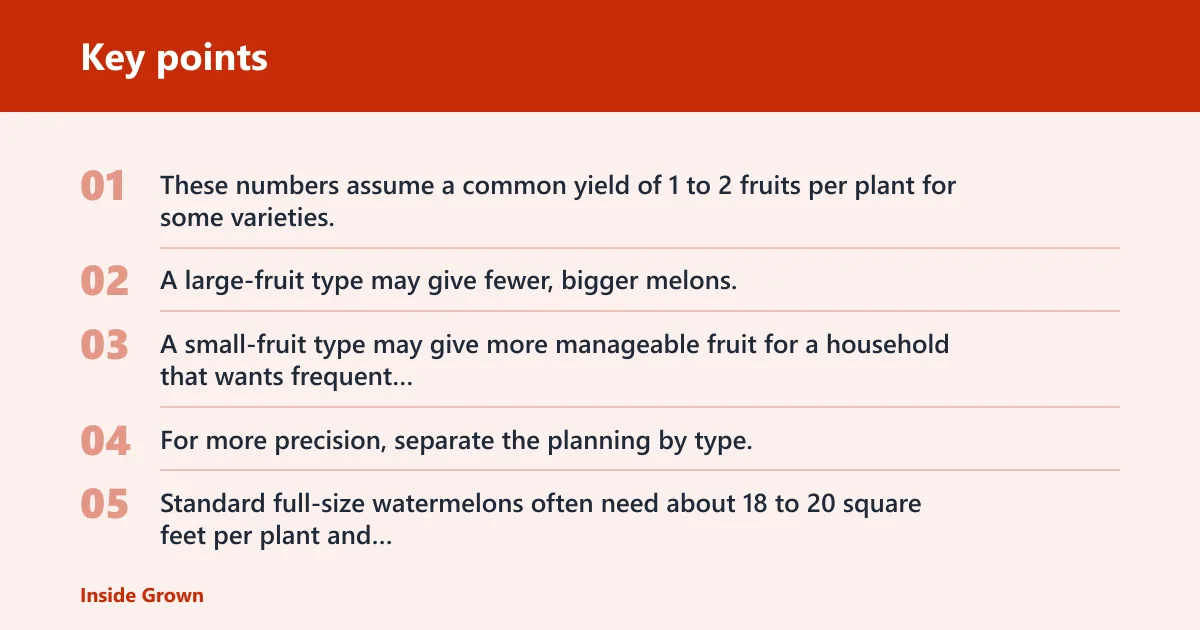
These numbers assume a common yield of 1 to 2 fruits per plant for some varieties, with fruit size changing by cultivar. A large-fruit type may give fewer, bigger melons. A small-fruit type may give more manageable fruit for a household that wants frequent cutting.
For more precision, separate the planning by type. Standard full-size watermelons often need about 18 to 20 square feet per plant and commonly finish 1 to 3 fruits per plant. Icebox or personal-size types can often be planted a bit closer, around 10 to 12 square feet per plant, and may still finish 2 to 4 smaller fruits under good conditions. Seedless types should be planned with a pollinizer in the bed, because the seedless plant itself does not provide viable pollen.
Suppose a family of 4 wants one melon a week for 6 weeks. If each plant is expected to produce 2 fruits, the family needs about 3 plants. If the variety is less productive, or pollination is inconsistent, adding a fourth plant helps protect the season’s supply.
How many watermelon plants fit in a small garden?
Small gardens usually fit fewer watermelon plants than the label spacing suggests. If you only have a narrow bed or a small patch, plan for 1 to 2 plants unless you are using a compact variety and can let the vines run into open space. Standard varieties can overtake a tiny plot fast.
Only compact varieties make sense in very limited space. Trellising can help manage direction, but it does not remove the plant’s basic need for root space, sunlight, and room for fruit support. Standard watermelons are poor candidates for containers unless the variety is bred for compact growth.
Which watermelon types fit your goal?
Seeded and seedless watermelons both can work for a family, but they solve different problems. Seeded types are usually simpler to start from seed and manage in a straightforward garden. Seedless types can be convenient for eating, but they are less forgiving in planning because germination and fruit set depend on the right pollinizer setup.
Small-fruit types fit tighter gardens better because they reduce storage strain and often work well when you want one melon at a time. Large-fruit types make sense when you want fewer, bigger melons and have room for long vines. Variety choice affects fruit size and days to harvest, which commonly falls around 70 to 100 days for many watermelon cultivars, depending on type and growing conditions.
Should I grow seeded or seedless watermelons for a family?
Seeded watermelons are usually easier when you want a straightforward family harvest from fewer plants. Seedless types can still work, but they need the right pollinizer nearby and can be less predictable in small gardens. For a simple first plan, seeded or small-fruit varieties are often the safer choice.
If your household wants easy serving at the table and you have room for pollinator support, seedless can fit. If you want the most dependable fruit set from a compact patch, seeded types usually keep the plan simpler.
A common first-timer mistake is choosing a huge watermelon variety for a narrow bed. The vines quickly outgrow the space, and the gardener ends up with fewer usable plants than the spacing chart suggested. In that case, a compact fruit type would have matched the garden better.
How do you keep fruit set reliable?
Watermelons produce male and female flowers on the same plant, and fruit set depends on pollination. That means the plant may bloom well and still fail to set fruit if pollinator access is poor or weather limits insect movement. Good pollination is part of plant count planning, not a bonus.
Keep flowering plants where bees and other pollinators can reach them. Avoid spraying during bloom unless the product label allows it and the timing is safe for pollinators. If fruit set is weak, the actual harvest may fall below your plant-count target.
Water and fertility also shape yield. Give plants 1 to 2 inches of water per week during active growth and fruiting. Use mulch or black plastic to hold moisture and warm the soil. Feed with higher nitrogen early, then switch to lower nitrogen after flowering so the plant does not keep making leaves at the expense of fruit.
Picture a gardener with room for only 2 plants who wants enough fruit for weekly family dinners. If both plants bloom well but one sets only a single melon because of poor pollination, the harvest may still be thin. In that case, choosing a compact variety and improving pollinator access matters as much as adding fertilizer.
Frequently asked questions
How many watermelon plants do I need for a family of 4?
A family of 4 usually needs 3 to 4 watermelon plants if the goal is steady summer eating. If each plant produces 1 to 2 fruits, that count gives enough room for a few harvests and some backup for poor fruit set. Add one more plant if you plan to share widely.
How many watermelon plants should I grow per person?
A practical starting point is about 1 plant for every 1 to 2 people, depending on variety size and how often you want melons. If each plant gives only 1 fruit, you need more plants than if each vine sets 2 fruits. Adjust upward for seedless types or weak pollination.
How much space does one watermelon plant need?
One watermelon plant can need up to 20 square feet, and standard rows should be at least 6 feet apart. In a hill, keep plants 2 to 3 feet apart. That space helps the vines spread, keeps fruit accessible, and reduces crowding around the roots and leaves.
How many watermelons does one plant produce?
One plant often produces 1 to 2 fruits, though fruit size depends on the cultivar. Some plants may carry more small melons, while others focus energy into fewer large ones. Pollination quality, weather, and growing space all affect how much the plant can actually finish.
How many seeds should I plant in each hill?
Plant 4 to 6 seeds per hill, then thin to 2 to 3 seedlings after sprouting. That gives you enough backup in case some seeds fail while still leaving room for the strongest vines. A 5-foot-wide hill is the usual planting shape for this method.
Can I grow enough watermelons from just one plant?
Yes, one plant can be enough for a very small household if the variety is productive and pollination is good. But one plant is rarely enough for a family that wants regular summer eating and sharing. For most households, 2 to 4 plants is a safer starting range.
Sources
- University of Georgia Extension — watermelon production and spacing guidance
- University of Florida IFAS Extension — watermelon planting, pollination, and fruiting guidance
- Texas A&M AgriLife Extension — watermelon water needs, soil temperature, and cultural practices
- North Carolina State Extension — watermelon growth, spacing, and harvest timing guidance