
How Many Swiss Chard Plants Fit in a Raised Bed?
A 4-by-8 raised bed can hold about 16 to 24 Swiss chard plants at 12- to 18-inch spacing. If you want smaller leaves and faster turnover, plant more tightly, but dense spacing lowers leaf size and demands closer watering and airflow. This guide turns spacing into bed-size counts and layout choices.
Swiss chard spacing basics



Swiss chard is easy to grow, and it often gives a long harvest window, but it does best when spacing matches the harvest you want. For full-size leaves, 12 inches is the common default, with 10 to 18 inches between plants depending on cultivar size and growing conditions. For earlier harvests and baby leaves, 6 to 12 inches can work.
The spacing number matters because leaf size, stalk thickness, and airflow all change with crowding. Tight spacing can give you more plants, but the tradeoff is smaller leaves and a greater chance of mildew in damp weather. In a fertile raised bed, a compact cultivar can handle closer spacing than a large, broad-stalked one.
Default plant spacing for full-size leaves
Use 12 inches between plants as a practical starting point for most raised beds. That spacing gives each plant room to size up for repeated outer-leaf harvests, while still letting you fit a useful number of plants into a 4-by-8 bed. If the variety grows large, move toward 15 to 18 inches.
For a square-foot layout, the common target is 1 plant per square foot. If you are using a tighter system, remember that 4 plants per square foot is the high-density benchmark, and that works best when you plan to harvest smaller leaves rather than full bunches.
When tighter spacing works for baby greens
Tighter spacing makes sense when you want young leaves, frequent cutting, or a short harvest window. Swiss chard seeds can be planted 2 to 4 inches apart before thinning, then the seedlings are narrowed once they have true leaves. That early crowding is for germination and selection, not long-term growth.
When you keep plants closer together, harvest size drops first. That is the main tradeoff. Say your goal is tender leaves for salads every week. A tighter row can fit more plants, but each plant will usually stay smaller than one given full 12- to 18-inch spacing.
How row spacing changes raised-bed planting
Row layout changes the count because bed width affects how many rows you can use. Swiss chard rows can be spaced 12 inches apart, and another common recommendation is 18 to 24 inches apart. In a raised bed, 16 to 18 inches between rows is a useful middle ground when you want access and room for leaves.
Bed width matters as much as bed length. A 4-foot-wide bed can usually support two productive rows with good access from both sides. A narrower 2-foot bed usually works better with a single row, especially if you want larger leaves and easier harvest.
How many plants fit in common bed sizes?
The count depends on bed area, row pattern, and how large you want the leaves to get. For full-size chard at 12-inch spacing, the number is close to the bed’s square footage. For tighter row planting, you can fit fewer or more plants depending on whether you are using one row, two rows, or a baby-leaf pattern.
2×4 and 3×6 bed counts
A 2-by-4 bed has 8 square feet, so a 12-inch grid can fit about 8 plants. A 3-by-6 bed has 18 square feet, so a 12-inch grid can fit about 18 plants. If you use an offset double row, the count drops in a 2-foot-wide bed and stays more flexible in a 3-foot-wide bed.
For baby-leaf planting, the same beds can hold more plants because the spacing is tighter. That works only if you plan to harvest young leaves and do not expect full-size stalks from every plant.
4×4 and 4×8 bed counts
A 4-by-4 bed can fit about 16 plants on a 12-inch grid. A 4-by-8 bed can fit about 32 plants on the same grid. If you switch to an offset double row, those totals fall because the bed is being used in long rows instead of a full square-foot grid.
A common first-timer mistake is to keep the same plant count after switching from a grid to rows. The layout changes the math. In a 4-foot-wide bed, two rows can be efficient, but the row spacing and plant spacing still need to be counted separately.
4×10 bed counts and when to trim the total
A 4-by-10 bed can hold about 40 plants on a 12-inch grid. If you are growing a large cultivar with broad stalks, trim that count back. Bigger plants need more room for leaf spread and airflow, especially if you want to keep harvesting outer leaves for several weeks.
If you want a steady household supply rather than a short burst of baby leaves, reducing the plant count often gives a better result. Fewer plants can mean larger leaves and simpler harvesting.
Swiss chard plant count calculator
Use the table below as a planning tool, not a rule. The layout numbers assume you are planting in straight, usable rows and want practical counts for a raised bed. If your cultivar is large, or if your bed is hard to reach across, reduce the total.
| Bed size | 12-inch grid | Offset double row | Baby-leaf spacing |
|---|---|---|---|
| 2×4 | 8 plants | 4 plants | 8 plants |
| 3×6 | 18 plants | 12 plants | 24 plants |
| 4×4 | 16 plants | 8 plants | 16 plants |
| 4×8 | 32 plants | 16 plants | 32 plants |
| 4×10 | 40 plants | 20 plants | 40 plants |
The 12-inch grid treats each plant as one square foot of space. The offset double row uses two rows in beds wide enough to carry them, with more open space between rows and slightly fewer total plants. The baby-leaf layout keeps the same bed footprint but relies on earlier picking, so you can keep plants smaller.
Reduce the count for large cultivars with broad stalks, especially if the variety is known for strong leaf spread. If you are growing for bunching harvests, the 12-inch grid is the cleanest starting point. If you are growing for frequent young leaves, the tighter layout is the one to use.
Can you plant Swiss chard closer together?
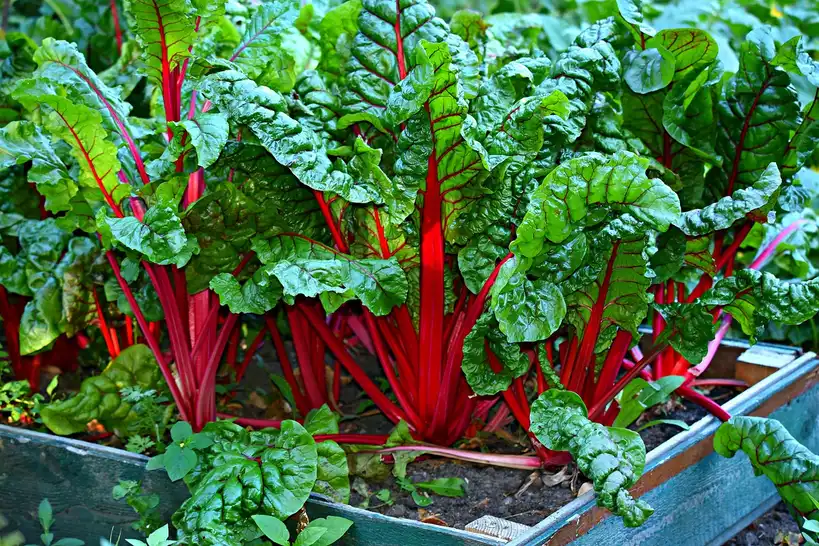
Yes, but only if you accept smaller leaves and more attention to moisture and airflow. Swiss chard can be planted as close as 10 inches apart in a well-fertilized raised bed, and some gardeners push tighter than that for baby leaves. The cost is reduced leaf size and less room for each plant to spread.
Tradeoffs between plant number and leaf size
Closer spacing gives you more plants in the same bed, but each plant competes harder for light, water, and root space. That usually means smaller leaves and thinner stalks. If your goal is a full bunch for cooking, wider spacing is the better choice.
Picture a 4-by-8 bed planted for weekly cooking. At 12-inch spacing, the leaves have room to size up. At tighter spacing, you may get more cuttings early, but each plant will hit a smaller ceiling.
Airflow and bolting risk in tighter plantings
Tight spacing can slow drying after rain or overhead watering. That matters because damp leaves and crowded stems can invite mildew. Good airflow does not stop every problem, but it helps keep the canopy drier and easier to manage.
Swiss chard is also more likely to stay productive when the root zone is not stressed. Consistent moisture matters here. Dry spells followed by heavy watering can make leaf growth uneven, especially in a crowded bed.
When square-foot density is worth it
Use a denser plan when you want baby greens, frequent cuttings, or you are short on space. The square-foot target of 4 plants per square foot is a useful upper end, but it fits best when you plan to harvest smaller leaves and do not need full-size bunches from every plant.
For family meals, a middle-ground layout is often easier to manage. It keeps enough plants in the bed for repeated cutting without forcing every plant into the tightest possible spacing.
When should you thin seedlings?
Thin Swiss chard after the true leaves appear. Sow seed shallowly, about 1/2 inch to 1 inch deep, then narrow the seedlings to the strongest plants before they begin to crowd one another. Early thinning protects root spacing and makes the bed easier to manage later.
Sow depth and germination setup
Swiss chard seeds should be planted 2 to 4 inches apart before thinning. Another planting guide uses 1 to 2 inches apart for sowing, with thinning later to the final spacing. Both approaches put the seed close enough to establish a full stand, then leave room for the best seedlings.
Keep the seedbed evenly moist during germination. Shallow sowing helps seedlings emerge, but the surface should not dry out. A light mulch can help after emergence, especially in warm weather.
Thin after true leaves
Once the seedlings have true leaves, thin them to the final spacing you chose for your harvest goal. One source calls for 12 inches between plants at this stage, while another recommends 8 to 12 inches. Use the wider end if you want larger leaves and stronger regrowth.
Use scissors instead of pulling seedlings. Cutting the extras at soil level avoids root disturbance for the plant you keep. That matters in a close row, where root tangles can be easy to disturb.
Keep the strongest seedlings and use scissors
- Wait for true leaves.
- Choose the strongest seedlings with the cleanest stems.
- Cut the extras at soil level with scissors.
- Leave the final spacing based on plant size and harvest goal.
- Water lightly after thinning to settle the soil.
Suppose a row comes up thick in a 3-by-6 bed. If you want bunch-sized leaves, keep the strongest plants and leave them 12 to 18 inches apart. If you want baby leaves, keep more plants, but be ready to harvest earlier and more often.
Growing conditions that affect spacing
Light, water, and soil fertility all change how close you can plant Swiss chard. Full sun is best, but partial sun is tolerated. A raised bed with fertile, well-drained soil can support closer spacing better than a bed that dries out quickly or stays waterlogged.
Sun exposure for raised beds
Swiss chard prefers full sun, but it can tolerate partial sun. About 4 to 6 hours of sun a day is enough. In hotter sites, some afternoon shade can help keep leaves from becoming stressed.
Do not treat shade as a fix for crowding. Less light can slow growth, so if the bed gets only partial sun, give each plant a little more room if you want full-size leaves.
Soil moisture and mulch
Keep the soil evenly moist. Water regularly, especially in warm weather, and add mulch to conserve moisture. Chard grows best when the root zone does not swing between dry and soaked.
That moisture balance matters more in tighter plantings. More plants in the same bed means more competition for water, so the surface should be watched closely after transplanting or thinning.
Fertile, well-drained soil
Swiss chard prefers fertile, well-drained soil. In a raised bed, that combination helps plants size up without standing in wet ground. If the bed is built for a heavy crop, the extra fertility can support a closer spacing, but the final count should still reflect the leaf size you want.
Swiss chard container spacing
Yes, you can grow Swiss chard in a container instead of a raised bed. A small container can work if it has good drainage and enough width. An 8-inch pot can hold 2 or 3 plants, depending on spacing and the size of the container.
8-inch pot fallback
Use small containers for baby leaves or for a few compact plants, not for a full bunching bed. The narrower the container, the more carefully you need to manage water, because the soil volume is limited and dries faster than a raised bed.
Wide rows on 8-inch centers are one way to keep the planting organized in a shallow container setup, but the pot still needs drainage holes and frequent watering.
How many plants a small container can hold?
An 8-inch pot can hold 2 or 3 plants if you are starting young seedlings and expect to harvest leaves early. If the variety is large, cut that number back. Containers are less forgiving than beds when roots fill the space.
Use the same spacing logic as you would in a raised bed. More plants means smaller leaves and faster water use. Fewer plants means a better chance of getting larger leaves from each plant.
Drainage and watering limits
Container chard needs careful watering because the root zone dries out fast. Check the soil often and water before it becomes dry at the top. Mulch can help, but it does not replace drainage. A container without drainage is the wrong fit for Swiss chard.
How many chard plants should I start for a family?
A practical household target is 2 to 3 plants per person if you want regular cut-and-come-again harvests. That lines up with the idea that one plant keeps producing outer leaves after each picking. If you want baby greens, start more plants and expect smaller leaves.
Start fewer plants if your family prefers larger bunches for cooking. Start more if you want small, frequent harvests for salads and quick sautés. A bed planted too tightly for a full-size harvest often gives you more plants than you can use at once, but each leaf stays smaller.
Frequently asked questions
How many Swiss chard plants fit in a raised bed?
Use the bed’s square footage as your starting point. A 12-inch grid fits about 1 plant per square foot, so a 4-by-8 bed holds about 32 plants. If you want larger leaves, cut that count back and leave more room between plants.
How far apart should Swiss chard plants be spaced?
For most raised beds, 12 inches between plants is the default. You can go to 10 inches in a fertile bed, or 15 to 18 inches for larger cultivars and bigger leaves. Tighter spacing works best only when you are harvesting young.
How many Swiss chard plants can I grow in a 4×8 raised bed?
A 4-by-8 bed fits about 32 plants on a 12-inch grid. If you use an offset double row, the count drops because the rows take up space. If you want baby leaves, keep the tighter layout and harvest early.
Can Swiss chard be planted closer together in a raised bed?
Yes, but closer spacing changes the harvest. You can plant chard as close as 10 inches apart in a fertile bed, and even tighter for baby leaves. Expect smaller leaves, less airflow, and more need to watch moisture and mildew.
How many Swiss chard plants fit per square foot?
For standard square-foot planting, use 1 plant per square foot. A denser plan can reach 4 plants per square foot, but that is best for smaller harvests and frequent cutting rather than full-size bunches. The closer spacing needs more management.
How wide should rows be for Swiss chard in raised beds?
Rows can be spaced 12 inches apart, and another common recommendation is 18 to 24 inches apart. In a raised bed, the best row width depends on access and plant size. Wider rows help larger leaves and easier harvesting.
Can I grow Swiss chard in a container instead of a raised bed?
Yes. Swiss chard can grow in containers if drainage is good and watering is regular. An 8-inch pot can hold 2 or 3 plants, depending on spacing. Smaller containers are better for baby leaves than for large, full-size stalks.
Does Swiss chard need full sun or partial shade?
Full sun is preferred, but partial sun is tolerated. A common rule of thumb is 4 to 6 hours of sunlight a day. If the site is shadier, give plants a bit more room and watch moisture so growth does not slow.
When should I thin Swiss chard seedlings?
Thin after true leaves appear. Start with seeds 2 to 4 inches apart, then cut the extras at soil level and leave the strongest seedlings at the final spacing you want. Scissors are the safer choice because they do not disturb nearby roots.