Are Botanical Gardens Good Places to Learn Plant Names?
Yes. Botanical gardens are one of the best places to learn plant names because you can compare labeled plants side by side and check each name against related specimens. Read more than one tag. If you trust a single label without checking family traits, you can carry the wrong ID home and remember it as fact. This guide shows how to read labels, spot naming patterns, and confirm plants more accurately in one visit.
Are botanical gardens good places to learn plant names?
A botanical garden gives you something a phone search cannot: multiple labeled plants in one place, often grouped by family, genus, or collection. Botanical garden plant labels often display scientific names and may also show family, common name, cultivar, and accession number. That makes the site useful for casual visitors and for anyone building more reliable plant-ID habits. Labels also support garden education, because they turn living collections into a public reference tool instead of a row of anonymous plants.
What you can learn in one visit
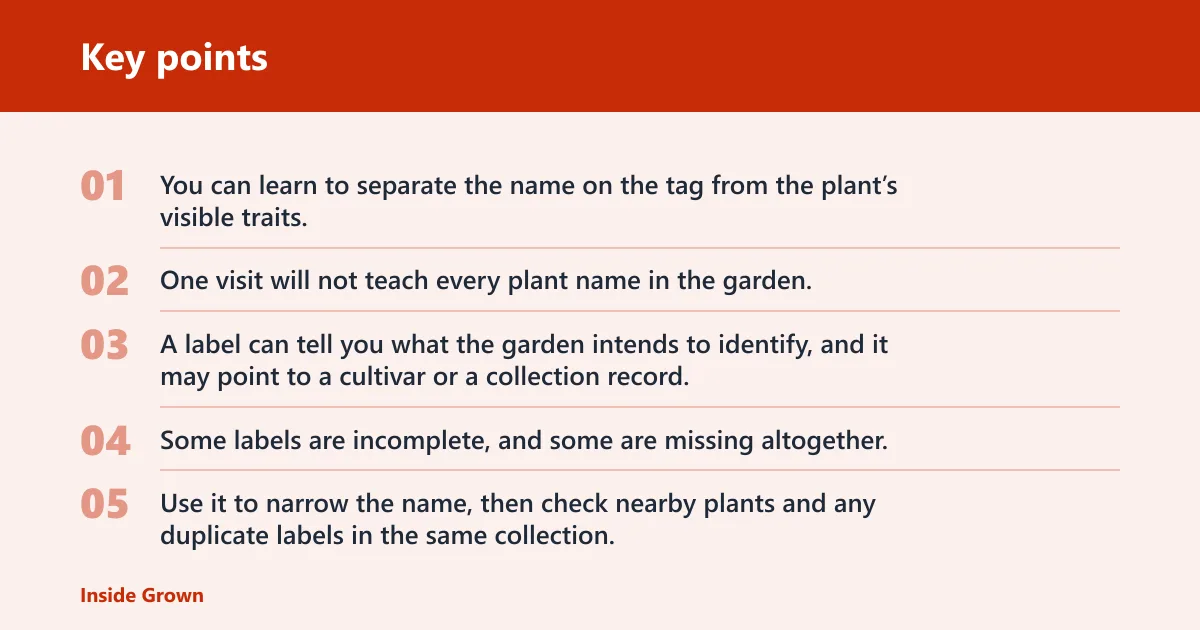
You can learn to separate the name on the tag from the plant’s visible traits. You can also learn how genus names repeat across related plants, how families cluster similar leaves or flowers, and how common names shift between signs. That gives you a solid start for field identification.
One visit will not teach every plant name in the garden. It can, however, teach a repeatable method: read the scientific name first, note the family, then compare nearby specimens before you decide what a plant is.
What a garden label can and cannot tell you
A label can tell you what the garden intends to identify, and it may point to a cultivar or a collection record. It cannot guarantee that every sign is current, especially in older plantings or beds that have been cut back for the season. Some labels are incomplete, and some are missing altogether.
That is why a label works best as a starting point, not as final proof. Use it to narrow the name, then check nearby plants and any duplicate labels in the same collection.
How botanical garden labels work
Botanical garden labels usually give you the plant’s scientific name, often the family, and sometimes a common name or cultivar. Because format varies by garden and collection, you need to read the parts separately instead of assuming every sign follows the same template. The label is a guide to identity, not a decorative caption. In many gardens, this is also part of the education mission: labels teach visitors how collections are organized and why names are recorded carefully.

Genus and species
Binomial nomenclature is the combination of a genus and a specific epithet. That means the first word groups related plants, and the second narrows the name to one species. Scientific plant names follow international rules, which lets botanists compare similar plants across regions and collections.
For example, two plants in the same genus may look close but differ in flower structure, leaf shape, or growth habit. Learning the genus first helps you notice those family resemblances before you focus on smaller differences.
Family, cultivar, common name, and accession number
The family groups related genera, so it helps you understand broader traits. A cultivar is a selected garden form, and it is not the same thing as a species name. A common name is useful for everyday speech, but it may change by region and language. An accession number is a collection record, not a species.
That mix is why label reading matters. If a tag says only a common name, you may know the plant’s usual name but not its exact botanical placement. If it includes family and accession information, you have more to verify.
Why label formats vary by garden
Some gardens design labels for public education. Others prioritize collection management, research, or conservation records. That means one garden may list genus, species, family, and accession number, while another gives only a common name and a short scientific label.
Do not assume a thin label means a weak collection. It may simply reflect the garden’s display style, space limits, or the age of the planting.
Why scientific names matter
Scientific names are more precise than common names, which is why they are used in research and reference collections. They help you compare related plants across languages and regions, and they reduce confusion when one plant has several local names or when one common name is used for multiple species.
Why botanical names are more precise than common names
A common name can point to different plants in different places. A scientific name gives you a specific taxon, so you can compare the same plant across books, garden labels, and herbarium records. That is especially helpful when two species look similar.
A scientific name is designed to be a shared reference worldwide, so a plant can be discussed accurately even when local common names differ. That practical consistency is what makes the name useful across languages and countries.
How name changes happen
Plant names can change when taxonomy is updated, when a species is moved to a different genus, or when older names are replaced by accepted ones. Gardens also deal with label lag: a plant may be correctly identified in records before the physical sign is updated.
That is why a name on a sign should be checked against nearby duplicates and, when possible, collection records. An outdated label is still useful, but you should treat it as a clue rather than a final verdict.
Can you use a botanical garden to practice plant ID?
A botanical garden can be a good place to practice plant identification because it lets you compare similar species side by side and revisit the same labeled plant more than once. That repeated exposure helps you move from memorizing names to noticing traits that separate related plants.
Comparing similar species side by side
When two or three related plants sit near each other, you can compare leaf arrangement, margin, flower shape, and growth habit without searching across a whole park. That is far better than trying to learn a name from one isolated specimen.
Say your goal is to tell two close species in the same genus apart. A side-by-side bed lets you check one visible trait at a time, instead of guessing from a single tag and a quick glance.
Using repeated specimens to spot family traits
Living plant collections often include multiple species from the same family or genus. That repetition helps you see shared traits, such as opposite leaves, compound leaves, or similar flower structure. Family clues make labels easier to read because they narrow the options before you search for the species name.
If three or more related specimens share the same family, you can start to notice patterns that a single plant would hide. That is enough to improve field identification right away.
When a living collection beats a field guide
A field guide is static. A living collection lets you compare flowering and nonflowering specimens, ornamental forms, and sometimes wild and medicinal plants in one place. Botanical gardens maintain living collections of diverse plants, and those collections support research and education for scientists and students.
That does not make a book useless. It means the garden is often better for seeing variation across a genus, especially when you need to compare real plants rather than drawings or photos.
Reading plant labels like a pro

Start with the scientific name, then check the family, then look for cultivar and accession details. Botanical garden plant labels are there for identification purposes, but the order matters because genus and species tell you more than a casual common name does. If a tag looks incomplete, compare it with nearby plants and other signs in the same bed.
Label parts to trust first
Trust the scientific name first, especially the genus and species. Then check the family, because it helps confirm whether the plant belongs with other labeled specimens nearby. Treat the common name as secondary unless the garden clearly states that it is the main display name.
A common mistake is glancing at the display label for “palm” and never checking the full scientific name beside it. That can be enough for a quick visit, but it is not enough if you want to learn botanical names accurately.
How to verify names on-site
Read the full label. Look for genus, species, family, common name, cultivar, and accession number. If one part is missing, note that gap before you make a conclusion.
Compare nearby specimens. Check about 3 related plants in the same area. The goal is to see whether the family traits and label pattern stay consistent across the collection.
Check for mismatches. If the leaf shape, flower form, or growth habit does not fit the label, treat the sign as provisional. Older plantings, seasonal cutbacks, and legacy labels can all create errors.
Use the accession tag carefully. Match it to the same plant on any nearby records or duplicate labels. The accession number helps identify the garden’s record for that specimen, not the species name itself.
What to do when a label looks wrong
First, do not force a conclusion from one sign. A label may be outdated, mislabeled, or hidden by seasonal cutbacks. If the plant appears to conflict with the tag, compare it to nearby specimens and check whether the garden has interpretive signage, a collection map, or a plant list.
If the mismatch remains, treat the name as uncertain. That is a better habit than carrying a bad ID home.
Botanical garden label cheat sheet
This table gives you a quick way to read labels in the field. Use it as a checklist, not as a fixed rule, because label style varies by garden and collection. For a beginner, the fastest path is simple: read the full name, confirm the family, and notice whether the plant matches nearby examples. For a serious hobbyist, add accession details, name changes, and cultivar status to that same routine.
| Label element | What it means | Why it matters | Common mistake | How to verify it on-site |
|---|---|---|---|---|
| Genus/species | The scientific plant name, usually written as a genus plus a specific epithet | It is the most precise basic ID on the tag | Assuming the first word alone is the full name | Read both words together and compare the plant to 3 related specimens |
| Family | The larger group that includes related genera | It helps you spot shared traits across several plants | Ignoring family because the species name seems enough | Check whether nearby labeled plants share similar leaf or flower traits |
| Cultivar | A selected cultivated form, often chosen for flower color, size, or habit | It separates a garden form from the wild species | Reading a cultivar as the species itself | Look for quotation marks or a distinct cultivar name on the label |
| Accession number | The garden’s internal record for that living plant or collection entry | It helps track the exact specimen in the collection | Thinking it is part of the botanical name | Match it with nearby records, duplicate tags, or collection notes |
| Common name | The everyday local name used by visitors and staff | It is easy to remember and useful for public education | Assuming the same common name means the same species everywhere | Check the scientific name beside it and note regional variation |
How garden collections support taxonomy
Botanical gardens help taxonomy because labeled specimens let people compare plants, test identifications, and study variation across groups. Living collections also support conservation, since gardens help conserve rare and endangered plant species while keeping educational specimens available to the public. Botanical garden plant labels are part of that system, because they connect the living plant to a permanent record that can be checked again later.
Living collections and reference value
A living collection is a curated set of diverse plants used for reference, education, and research. It may include ornamental, wild, and medicinal plants. That mix lets visitors and students compare forms that are hard to study in the wild, especially when flowering time or habitat limits access.
Because the plants are alive, you can return to the same specimen and compare it over time. That is useful for anyone learning how names connect to physical traits.
Herbaria and preserved specimens
A herbarium is the preserved-plant counterpart to the living collection. It gives researchers a stable reference for detailed verification when a garden label is uncertain or a plant has changed with age. Many botanical gardens pair living collections with herbarium records for exactly that reason.
When a label seems odd, the herbarium record can help confirm whether the name is current, synonymized, or tied to an older classification. That makes the two resources complementary.
Why educators and researchers use both
Botanical gardens offer educational experiences to botanists and students, and many gardens offer workshops and public access to collections. Guided interpretation, tours, and classes can cover local flora, propagation, and plant naming. Those programs help visitors move from label reading to actual identification practice. Botanical garden education programs also help visitors understand why collection records matter, not just what a label says.
Students and serious hobbyists get more value when they use both living collections and herbarium references. The live plant shows structure and habit; the preserved specimen helps verify details that the season may hide.
What beginners should focus on first
Beginners should start with the genus, the family, and the common name beside the scientific name. That gives enough structure to avoid guessing from color or shape alone. Do not try to memorize every label in the garden during one walk.
Instead, learn to recognize repeated patterns. If the same family appears on several signs, or the same genus appears in different beds, pause and compare them. That is the fastest route to better plant-name recall.
What serious hobbyists should verify next
Serious hobbyists should check the accession number, look for synonymy or outdated labels, and compare the plant against more than one specimen. They should also note whether the plant has a cultivar name, because that detail can change how the plant is discussed or propagated.
If the label looks current but the plant does not match, that is worth recording as an uncertainty rather than forcing an ID.
When to use garden tours or classes
Use a tour or class when you want faster context for the collection. Botanical garden education programs can explain how to read labels, why plants are grouped by family, and how collection records work. They can also point out local flora and propagation examples that are easy to miss on a self-guided walk.
For many visitors, a short program turns labels from isolated facts into a usable system.
Frequently asked questions
Do botanical gardens label plants with their scientific names?
Often, yes. Botanical garden plant labels usually display scientific names and may also include family, common name, cultivar, and accession number. The exact format varies by garden, so some signs are more detailed than others, especially in older or more casual display areas.
Can I use a botanical garden to practice plant identification?
Yes. A botanical garden is a strong place to practice because you can compare similar plants side by side and see repeated specimens from the same family or genus. That makes it easier to learn how labels connect to visible traits, while also spotting outdated or incomplete signs.
What should I look for on plant labels in a botanical garden?
Start with genus and species, then check the family. After that, look for cultivar, common name, and accession number. The scientific name tells you the most precise identity, while the other elements help you verify whether the label is current and whether the plant is a cultivated selection.
Why do plant names change in botanical gardens?
Plant names change when taxonomy changes, when species are moved to new groups, or when accepted names replace older ones. Botanical gardens can also have label lag, where the record is updated before the sign is changed. That is why a label should be checked against nearby specimens and collection notes.
What is the difference between a common name and a botanical name?
A common name is the everyday local name people use, and it can vary by region and language. A botanical name is the formal scientific name used in research and reference collections. The botanical name is usually more precise, which makes it better for comparison and verification.