Which Type of Soil Has the Biggest Risk for Cave-Ins?
Soil composition is a critical factor in determining the safety and stability of excavation sites. For anyone involved in construction, mining, landscaping, or any activity requiring trenches or earth removal, understanding which type of soil poses the greatest risk for cave-ins can be a matter of life and death.
Each year, cave-ins lead to serious injuries and fatalities, making soil classification a top priority for safety professionals and site managers. The Occupational Safety and Health Administration (OSHA) and other authoritative bodies require careful assessment of soil types before excavation begins—but what specifically makes one kind of soil more dangerous than another?
Beneath our feet, the earth is not uniform. Its composition varies dramatically from one site to another, with textures ranging from loose sand to dense clay or layered mixtures. These differences directly influence how soil behaves when disturbed. Whether you’re a contractor, safety officer, or a homeowner planning a backyard project, knowing which soils are most unstable—and why—can help you implement the right precautions, minimize risks, and ensure everyone goes home safe at the end of the day.
In this deep dive, we’ll explore the science, statistics, and real-world lessons behind soil cave-ins, with a sharp focus on the soil types that pose the highest risk.
Key Takeaways
- Type C soil—such as granular soils (sand, gravel)—has the highest risk of cave-ins due to lack of cohesion and structural integrity.
- Soil classification is essential for trench and excavation safety; incorrect identification increases the danger of collapse.
- Water content, vibration, and environmental factors can worsen cave-in risks, even in otherwise stable soil types.
- OSHA and other regulatory bodies have clear guidelines and soil type definitions that must be followed to prevent accidents.
- Real-world incidents often trace back to ignoring soil classification and safety measures.
- Implementing engineering controls and protective systems tailored to the soil type is crucial for minimizing cave-in hazards.

Credit: shillingexcavation.com
Understanding Soil Types And Their Properties
Soil may seem simple, but it is a complex combination of minerals, organic matter , air, and water. The manner in which these components combine determines the soil’s physical properties and, crucially, its stability during excavation.
Soil Classification Systems
The OSHA soil classification system divides soil into three main categories:
- Type A: Most stable, cohesive soils such as clay or silty clay.
- Type B: Medium stability, including silt, silt loam, and angular gravel.
- Type C: Least stable, granular soils such as sand, gravel, and submerged or previously disturbed soils.
Other systems, such as the Unified Soil Classification System (USCS), provide even more granular detail, but OSHA’s framework is the industry standard for excavation safety in the United States. The USCS, for example, uses designations like GW (well-graded gravel), SP (poorly graded sand), or CL (low plasticity clay), which can be important in engineering analyses but may be too detailed for daily field operations.
Understanding these distinctions is important not just for compliance, but for practical risk management. For example, a soil classified as SC (clayey sand) under the USCS might behave differently than clean sand (SP), even though both could fall into OSHA’s Type C category.
Key Soil Properties Affecting Cave-in Risk
- Cohesion: Soils with high clay content tend to stick together, making them more stable. Cohesive soils can often stand vertically for longer periods, providing time for workers to implement protective measures.
- Granularity: Sandy and gravelly soils lack cohesion, increasing the risk of collapse. The particle size and shape affect how well the soil “locks” together. Rounded grains in sand do not interlock well, while angular gravel may provide slightly more stability but still lacks cohesion.
- Moisture Content: Water acts as both a binder and a lubricant. Excess moisture can undermine stability. For example, clay can become slippery and lose strength when saturated, while sand can become quicksand-like.
- Layering: Layers of different soil types can create weak planes susceptible to failure. A trench cut through a thin clay cap over loose sand may appear safe, but the sand layer can fail unexpectedly.
- Disturbance: Previously excavated or disturbed soils are less stable than undisturbed soils. Compaction decreases, and air pockets can form, increasing the risk of collapse.
Soil Testing Methods
Before excavation, it’s essential to identify the soil type using standardized tests:
- Plasticity Test: Determines how moldable soil is—cohesive soils will form a ribbon when rolled. This quick test helps identify clay content and cohesion.
- Pocket Penetrometer: Measures unconfined compressive strength. This simple device provides a quantifiable measure to distinguish between soil types.
- Visual Inspection: Identifies grain size, layering, and moisture content. Experienced inspectors can often make initial judgments based on color, texture, and structure.
- Dry Strength Test: Evaluates how well soil holds together when dry. If the soil crumbles easily, it is likely non-cohesive.
Accurate classification is the first line of defense against cave-ins and is required by OSHA for trenches deeper than 5 feet (OSHA Excavations Standard). In practice, a combination of tests and observations provides the most reliable result. Some companies also use laboratory testing for critical projects, further reducing uncertainties.
Why Type C Soil Has The Highest Cave-in Risk
Type C soils are the most dangerous for excavations. Let’s examine why these soils are so prone to catastrophic collapse.
Characteristics Of Type C Soil
Type C includes:
- Granular soils: Sand, gravel, and loamy sand.
- Submerged soils: Soils that are saturated with water.
- Disturbed soils: Previously excavated or backfilled areas.
These soils lack natural cohesion. Their particles do not stick together, and they are easily displaced by water, vibration, or movement. Even minimal disturbance, such as the vibration from walking or light equipment, can trigger a collapse in these soils.
When exposed to air, loose granular soils often dry out quickly, further reducing any residual binding effect from moisture.
Structural Weaknesses
Unlike Type A or Type B soils, Type C soils:
- Have a shear strength less than 0.5 tons per square foot.
- Do not form stable vertical walls.
- Are highly susceptible to collapse under minor loads or disturbances.
This instability is why OSHA prohibits the use of vertical trenches in Type C soil without a protective system. Trench walls in Type C soils may slough off in small amounts or collapse all at once, giving little to no warning to those working inside.
The lack of warning is a significant factor in the high fatality rate associated with these soils.
Data-driven Risk Comparison
The following table illustrates the relative cave-in risk and properties of each OSHA soil type:
| Soil Type | Cohesion | Shear Strength (tsf) | Typical Examples | Relative Cave-In Risk |
|---|---|---|---|---|
| Type A | High | >1.5 | Clay, Silty Clay | Low |
| Type B | Medium | 0.5–1.5 | Silt, Silt Loam, Angular Gravel | Medium |
| Type C | Low/None | <0.5 | Sand, Gravel, Submerged Soil | High |
Real-world Impact
According to the Bureau of Labor Statistics, about 25 U.S. workers die every year in trench cave-ins, with the majority of fatalities occurring in Type C soils (BLS Trenching Data). This highlights the urgent need for strict adherence to safety protocols in these environments. The consequences are not limited to fatalities; hundreds of injuries, some life-altering, are reported annually.
Moreover, statistics show that smaller companies and less experienced crews are disproportionately represented in cave-in incidents, often due to underestimating the risks posed by Type C soils or skipping protective measures to save time or money. The cost of noncompliance, however, far outweighs any short-term savings.
Practical Example: Sandy Soil Collapse
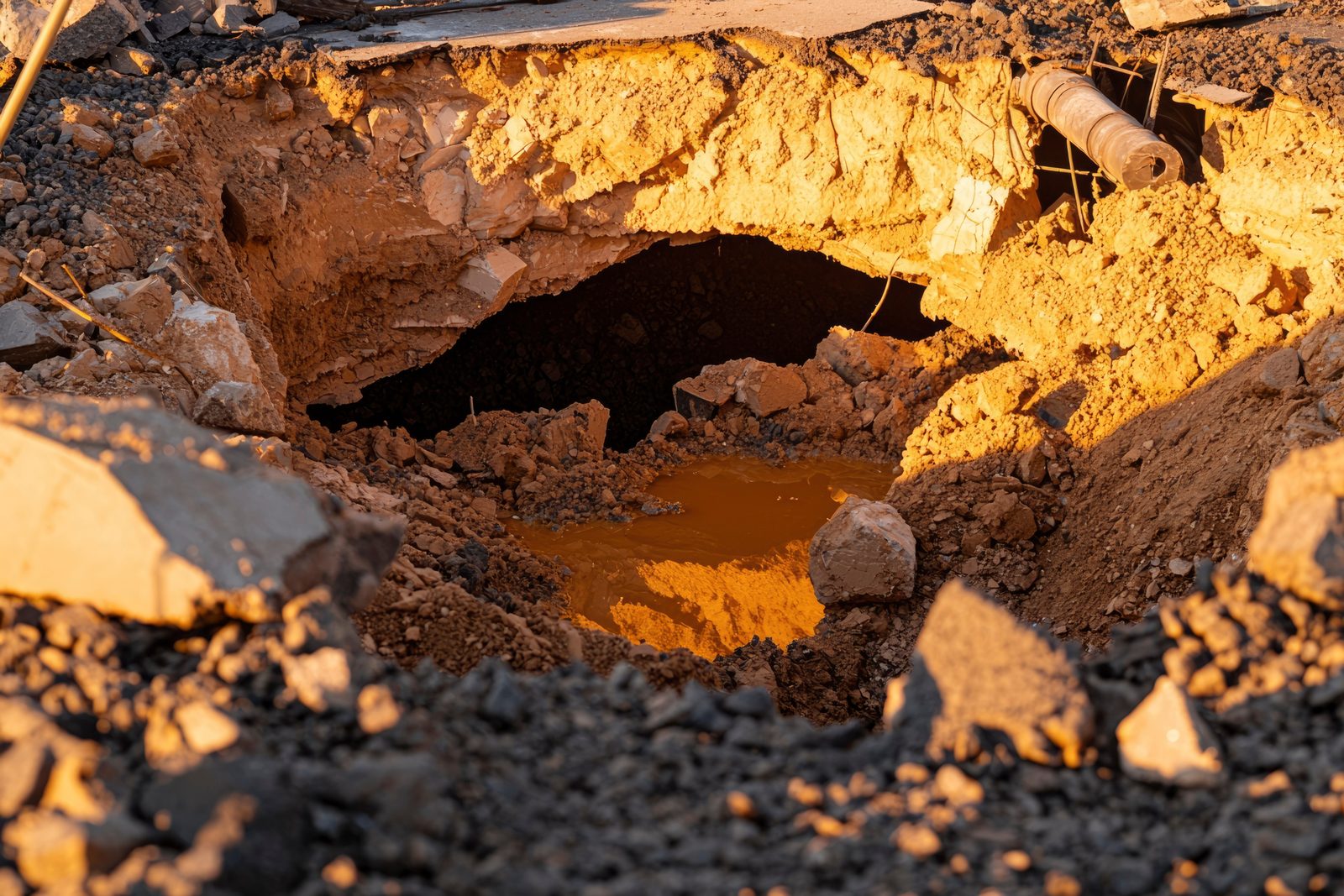
In 2018, a utility worker in Georgia was trapped and killed when a trench wall collapsed in loose, Type C sand. Investigators found that the soil had been recently disturbed and saturated from rain, compounding the risk. There was no protective system in place—an all-too-common scenario when the dangers of Type C soil are underestimated.
This tragedy underscores the importance of constant vigilance. In many cases, workers and supervisors misjudge the apparent stability of sandy soil, believing that if it has not collapsed right away, it is safe. However, the absence of immediate failure does not guarantee ongoing stability, particularly when additional loads or environmental changes occur.
Credit: gritinsurance.com
Factors That Increase The Risk Of Cave-ins
Soil type is only part of the equation. Several environmental and operational factors can significantly increase the risk of cave-ins, even in soils that might otherwise be considered stable.
Water Content And Drainage
- Saturation: Water fills the spaces between soil particles, acting as a lubricant and reducing friction. In Type C soils, this can trigger sudden collapse. For example, a heavy rainfall can instantly transform a previously stable excavation into a hazard zone.
- Poor Drainage: Accumulated water at the bottom of a trench increases pressure on the walls. This hydrostatic pressure can force the soil to move or collapse inward.
- Changing Weather: Heavy rain or rapid snowmelt can quickly transform a stable trench into a death trap. Even after precipitation has ended, the effects on soil moisture can linger for days.
A less obvious risk is groundwater seepage, which can be difficult to detect but may gradually weaken trench walls. Water not only reduces cohesion in granular soils but also increases the weight and pressure, accelerating failure.
Vibration And External Loads
- Equipment Movement: The use of heavy machinery near the edge of an excavation can destabilize soil. Excavators, dump trucks, and even smaller machinery can cause vibrations that propagate through the ground, shaking loose particles in Type C soils.
- Traffic: Passing vehicles, especially on adjacent roads, introduce vibrations that can trigger sloughing in loose granular soils. Even foot traffic can contribute to destabilization if repeated over time.
- Stockpiled Materials: Storing excavated soil (spoil piles) too close to the edge adds weight and increases the chance of collapse. OSHA recommends keeping spoil piles at least 2 feet away from the edge, but in practice, this is often neglected.
The effect of vibrations is especially pronounced in urban environments, where nearby construction or roadwork can contribute to unexpected trench failures.
Soil Disturbance And Layering
- Backfilled Areas: Previously excavated or filled soils lack the compaction and cohesion of undisturbed earth. Air pockets and inconsistent compaction create weak zones that are susceptible to collapse.
- Layered Soils: A stable upper layer above a weak, granular lower layer can create a false sense of security; the weaker layer can fail suddenly.
Contractors often encounter soils with variable composition, especially in developed areas or locations with complex geology. Without thorough assessment at multiple depths, dangerous weak layers may go undetected.
Temperature And Seasonal Effects
- Freeze-Thaw Cycles: These can break up otherwise cohesive soils, making them behave more like Type C. Ice expansion forces apart soil particles, reducing cohesion.
- Drying: Extremely dry conditions can reduce cohesion in silty or clayey soils, leading to unexpected collapse. Conversely, rapid thawing after a freeze can saturate soils, increasing risk.
Regions with marked seasonal changes must pay special attention to how these cycles affect soil stability, adjusting safety measures accordingly.
Case Study: Submerged Soil Failure
A construction site in Houston encountered a trench collapse after overnight rainfall. The soil, classified as Type B during dry conditions, became saturated and shifted to Type C overnight. The incident underscores the need for continuous monitoring and reassessment, especially in regions prone to sudden weather changes. Regular soil testing and inspection, particularly after any significant weather event, are critical for preventing such incidents.

Credit: coloradogeologicalsurvey.org
Protective Systems And Safety Measures For High-risk Soils
When working in soils with the highest cave-in risk, engineering controls and best practices are essential. OSHA mandates protective systems for trenches deeper than 5 feet unless the excavation is entirely in stable rock.
Sloping And Benching
- Sloping: Excavating the sides of a trench at an angle away from the excavation. This distributes the weight of the soil more evenly and reduces the chance of collapse.
- Benching: Creating steps or benches in the sides of the trench. This method is often used in conjunction with sloping to provide a more gradual transition and support.
- Type C soil requires a slope of 1.5: 1 (horizontal:vertical)—for every 1 foot of depth, the trench must be 1.5 feet wider on each side.
In some cases, site constraints may make sloping or benching impractical, such as in urban environments with limited space. In these situations, other protective systems must be used .
Shoring And Shielding
- Shoring: Installing supports (hydraulic, timber, or aluminum) to prevent soil movement. Shoring systems can be customized to fit the trench and can be adjusted as work progresses.
- Shielding (Trench Boxes): Pre-fabricated boxes placed in the trench to protect workers from cave-ins. These do not prevent a trench wall from collapsing, but they do shield workers in the event of a failure.
| Protective System | Application | Advantages | Considerations |
|---|---|---|---|
| Sloping | All soil types, especially Type C | Simple, no equipment needed | Requires wide area, not feasible in confined sites |
| Shoring | All types, commonly Type C | Allows vertical walls, adjustable | Installation time, cost |
| Shielding | Type C and unstable soils | Reusable, high protection | Must be properly sized and installed |
Inspections And Monitoring
- Daily Inspections: Required by OSHA before each shift and after any hazard-increasing event. Regular checks catch early signs of wall movement, water intrusion, or surface cracking.
- Competent Person: A trained individual must assess soil and safety systems. This person should have both experience and authority to halt work if unsafe conditions are detected.
- Continuous Reassessment: Conditions can change rapidly, especially with weather or adjacent work. Inspections should not be a one-time formality but an ongoing process throughout the life of the project.
Documentation of inspections and corrective actions taken is crucial for both safety and compliance.
Training And Safety Culture
- Worker Training: All workers must understand soil hazards and emergency procedures. Training should include hands-on practice with soil testing, protective system installation, and recognizing warning signs of instability.
- Incident Drills: Practice rapid response in case of cave-ins. Well-rehearsed emergency protocols can mean the difference between life and death.
- Reporting Systems: Encourage workers to report unsafe conditions without fear of reprisal. A culture that prioritizes safety over speed or cost is essential for long-term risk reduction.
Safety culture is built over time and reinforced by consistent management commitment and worker involvement.
Example: Effective Use Of Trench Boxes
In a 2020 infrastructure project in Chicago, workers encountered waterlogged Type C soil. By employing properly sized trench boxes and daily inspections, the project proceeded with zero injuries or cave-ins. This case demonstrates the effectiveness of engineering controls and rigorous adherence to safety protocols (NIOSH Trenching Safety Guide). The project also utilized a “buddy system,” where workers never entered a trench alone, ensuring immediate assistance in case of an emergency.
Soil Identification In The Field: Best Practices
Recognizing high-risk soils is not always straightforward. Field crews must use both technical tools and observational skills to ensure accurate classification.
Visual And Manual Tests
- Ribbon Test: Roll moist soil in your hands. If it forms a ribbon, it is likely cohesive (Type A or B); if it crumbles, it’s more likely Type C.
- Granularity: Rub soil between fingers. Gritty, non-cohesive feel suggests sand or gravel.
- Water Reaction: Squeeze moist soil; granular soils will not hold shape.
These tests are fast and cost-effective, making them ideal for preliminary assessments. However, they should be supplemented by instrument-based methods for final classification.
Instrument-based Testing
- Pocket Penetrometer: Measures compressive strength. Readings below 0.5 tsf indicate Type C.
- Torvane Shear Device: Used for cohesive soils to measure strength.
Instrument-based tests provide objective, repeatable data that can be documented for compliance and future reference. For larger or more complex projects, laboratory analysis of soil samples is often warranted.
Layer Recognition
- Look for Color and Texture Changes: Different layers may suggest varying stability. Darker soils may indicate organic content, while lighter colors often correspond to sand or silt.
- Identify Previous Excavation: Lighter, looser soil may indicate fill or backfill.
Recognizing these subtle differences can prevent misclassification and help guide the selection of appropriate protective systems.
Field Documentation
- Soil Logs: Record observations at multiple depths. Detailed logs can identify hazardous layers that may not be apparent at the surface.
- Photographic Evidence: Document trench walls and any visible water intrusion. Photos can be referenced during inspections and in the event of an incident.
- Ongoing Updates: Update logs after rain, vibration, or other changes.
Meticulous record-keeping is essential for both safety and regulatory compliance. Documentation can also serve as evidence in the event of inspections or litigation.
Example: Misclassification Leads To Collapse
A 2016 incident in California involved a misidentified trench. Workers assumed the soil was Type B due to a thin clay layer at the surface, but beneath was loose sand (Type C). The walls caved in, injuring two workers. This tragedy highlights the importance of thorough, multi-depth soil testing (CDC: Trenching and Excavation Safety). The incident also prompted the company to revise its training and testing protocols, incorporating more rigorous field testing procedures and third-party audits.
Legal Requirements And Regulatory Standards
Excavation safety is not just best practice—it’s the law. Regulatory bodies provide strict guidelines for soil classification, protective systems, and worksite procedures.
Osha Standards
- 29 CFR 1926 Subpart P: The primary standard governing excavation and trenching in the United States.
- Soil Classification: Must be conducted by a “competent person” as defined by OSHA.
- Protective Systems: Required for trenches deeper than 5 feet unless in stable rock.
OSHA’s requirements are designed to provide a minimum baseline of safety. In many cases, best practices and site-specific engineering may go beyond these minimums to address unique risks.
State And International Regulations
- Many states have additional rules and may require more stringent protective measures. For example, California has its own trenching and excavation standards that supplement federal requirements.
- International standards, such as those from the International Labour Organization (ILO), also emphasize soil assessment and worker protection (ILO Excavation Safety Guidance).
For multinational projects, compliance with the strictest applicable standards is often recommended, especially where worker safety is paramount.
Compliance And Penalties
- Violations: Failure to follow soil classification and protection standards can result in severe fines and criminal charges. In the U.S., OSHA citations can range from thousands to hundreds of thousands of dollars per incident.
- Incident Reporting: Employers must report fatalities and serious injuries promptly. Failure to do so can result in additional penalties and legal consequences.
Enforcement actions often include mandatory training and ongoing oversight for companies found in violation, in addition to financial penalties.
Example: Osha Enforcement Action
In 2026, a construction company in Texas was fined over $200,000 after a worker fatality in a Type C trench. The investigation revealed lack of soil testing, no protective system, and insufficient training. This case demonstrates the legal and financial consequences of ignoring soil cave-in hazards (OSHA News Release). In addition to fines, the company was required to implement a comprehensive safety program and submit to regular audits for compliance.
Engineering Innovations And Future Trends In Soil Safety
New technologies and methods are improving the identification and management of high-risk soils, making excavation safer than ever before.
Remote Sensing And Geotechnical Tools
- Ground Penetrating Radar (GPR): Detects subsurface variations and potential voids. GPR can identify buried utilities, changes in soil composition, and areas of saturation without invasive testing.
- In-Situ Sensors: Monitor soil moisture and movement in real time. These sensors can be embedded in trench walls or spoil piles to provide continuous feedback.
- Drones: Provide aerial imagery for site assessment and monitoring. Drones can quickly map excavation sites, detect water pooling, and document progress.
Advanced geotechnical investigations can also include seismic refraction, electrical resistivity, and soil resistivity testing, further refining the understanding of subsurface conditions.
Advanced Protective Systems
- Modular Trench Boxes: Lightweight, adjustable systems for rapid deployment. These boxes can be easily transported and assembled, making them ideal for projects with changing needs.
- Automated Shoring: Hydraulic systems that adjust in response to soil movement. Some advanced shoring systems can be remotely monitored and controlled, reducing the need for workers to enter hazardous areas.
Other innovations include “slide rail” systems for deep or wide excavations and composite materials that provide high strength with reduced weight.
Data Analytics And Safety Management
- Predictive Analytics: Algorithms analyze weather, soil, and worksite data to forecast cave-in risk. These systems can trigger alerts when conditions change or thresholds are exceeded.
- Mobile Apps: Enable on-the-spot soil classification and safety checklists. Mobile technology can also facilitate real-time reporting of hazards, inspections, and corrective actions.
Companies are increasingly integrating these digital tools into their health and safety management systems, improving oversight and response.
Training And Virtual Reality
- VR Simulations: Allow workers to experience cave-in scenarios in a risk-free environment. Simulations can reinforce the importance of safety protocols and help workers recognize hazards.
- E-Learning Platforms: Deliver up-to-date training on soil identification and protective systems. Interactive modules can be customized for specific job roles and updated as regulations change.
Virtual and augmented reality are increasingly used for both initial training and ongoing competency assessments.
Example: Smart Sensors Prevent Collapse
A major pipeline project in Alberta, Canada, used wireless sensors to monitor trench movement in Type C soil. When sensors detected abnormal shifting after a rainstorm, the site was evacuated and shoring was reinforced—averting a potential disaster. This real-world success demonstrates the life-saving power of modern technology (ScienceDirect: Soil Monitoring Innovations). The project team credited the technology with not only improving safety but also reducing downtime and project costs by enabling targeted interventions.
Frequently Asked Questions
What Is The Most Dangerous Type Of Soil For Cave-ins?
The most dangerous type of soil for cave-ins is Type C soil, which includes loose sand, gravel, and water-saturated soils. These soils lack cohesion and cannot support vertical walls, making collapse highly likely without protective systems in place.
How Can You Identify Type C Soil On A Job Site?
Type C soil is typically granular (sand, gravel) and does not hold its shape when squeezed or molded. Field tests like the ribbon test and pocket penetrometer (measuring strength below 0.5 tsf) can help confirm Type C classification. Always involve a “competent person” for accurate identification.
What Protective Systems Are Required For Excavating In Type C Soil?
For Type C soils, OSHA requires protective systems such as sloping (at least 1.5:1), shoring, or shielding (trench boxes). Vertical walls are not permitted without a protective system. The choice of system depends on space, project requirements, and soil conditions.
Can Weather Conditions Change Soil Classification And Cave-in Risk?
Yes, weather can dramatically affect soil stability. Rain, snowmelt, or flooding can turn more stable soils into Type C by increasing water content and reducing cohesion. Always reassess soil conditions after significant weather events.
Why Do So Many Cave-ins Still Occur Despite Regulations?
Cave-ins continue to happen due to misclassification of soil, failure to use protective systems, inadequate training, and pressure to cut corners for speed or cost savings. Strong safety culture, continuous training, and strict enforcement of standards are essential to reducing incidents.
Excavation safety hinges on understanding that not all soils are created equal. Type C soils—loose, granular, and waterlogged—are the most prone to cave-ins, demanding the highest level of respect and precaution on any job site. By embracing thorough soil testing, adhering to regulatory standards, and deploying proven protective systems, workers and employers can dramatically reduce the risk of tragedy. As technology and safety culture continue to advance, the goal of zero cave-in fatalities moves ever closer to reality.