What Temperature Is Too Cold for Houseplants?
For many houseplants, indoor temperatures below about 55°F at night or a room average under about 60°F are too cold; tropical types often need about 65°F or warmer, and wet soil can make cold stress start sooner. Cold damage slows growth, drops leaves, and can trigger root rot or blackened tissue after a few chilly nights. This guide gives practical temperature thresholds by plant type, draft exposure, and soil moisture so you can decide when to move plants or water less. For related care, see winter houseplant care, how to rewarm a chilled houseplant, and houseplant temperature guide.
When is it too cold?
Use three checks together: the room average, the night minimum, and the plant’s type. A room that stays near 16–22°C is usually safe for many houseplants, but a brief dip near a cold window, especially with wet soil, can be too cold even when the rest of the room seems fine. RHS guidance for many tender plants and houseplant extension notes both point to sustained cool nights as the bigger risk than a short daytime dip.
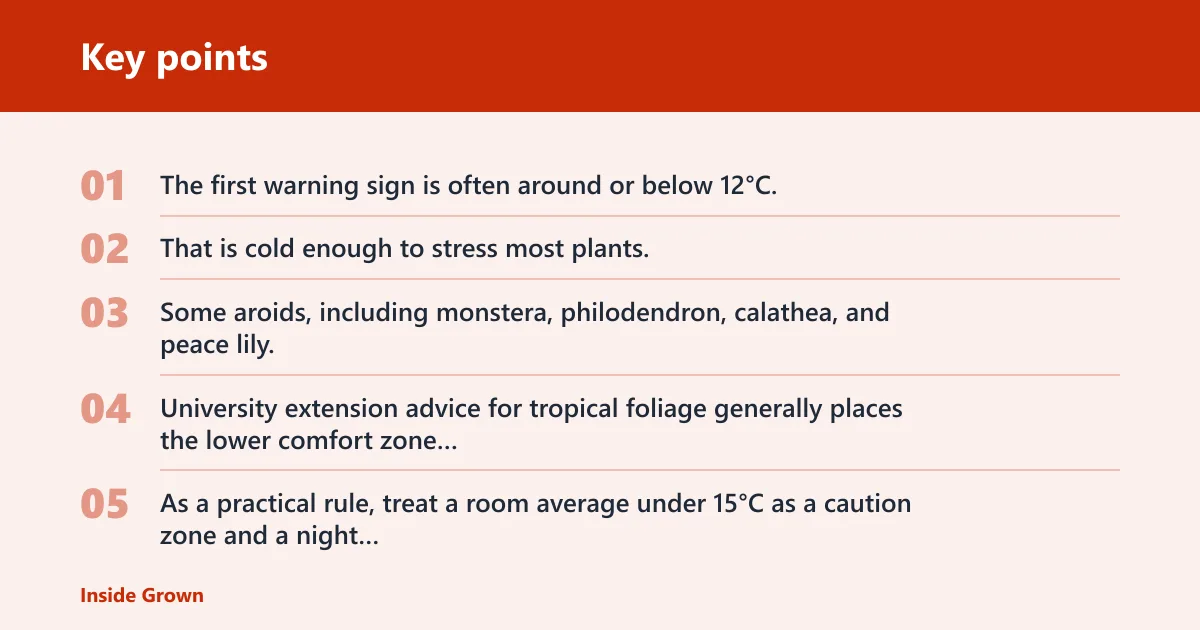
The first warning sign is often around or below 12°C. That is cold enough to stress most plants, and many tropical houseplants start to suffer below 10°C. Some aroids, including monstera, philodendron, calathea, and peace lily, begin to struggle below 13°C. University extension advice for tropical foliage generally places the lower comfort zone above these levels, especially where roots are held in damp media.
The quick temperature rule for most houseplants
As a practical rule, treat a room average under 15°C as a caution zone and a night minimum below 12°C as unsafe for many common indoor plants. For tropical foliage plants, a minimum around 10°C is the lower edge for short exposure, not a comfortable target. RHS winter guidance for tender houseplants and extension resources for tropicals consistently emphasize avoiding prolonged exposure near these low thresholds.
The ideal winter room temperature is 16–22°C. Houseplants generally do best between 18–29°C during the day and 15–24°C at night, and the broad indoor plant guideline is 15°C to 27°C. Those ranges are not equal in risk, the low end matters most when the plant sits in a draft or near cold glass.
When cold becomes an emergency
Cold becomes urgent when the plant is exposed to near-freezing air, frost, or a long stretch below its minimum temperature. Some healthy, dry plants can survive their listed minimums for a few hours, but wet soil and repeated night lows make the same temperature far more dangerous. University extension sources note that saturated potting mix reduces the root zone’s buffering capacity, so cold stress and root injury build faster in damp conditions.
Say your pothos sits on a sill that reads 8°C at dawn while the room across the room reads 17°C. The room average looks acceptable, but the plant’s leaves nearest the glass can still take damage overnight, especially if the potting mix is damp.
Houseplant cold matrix
This matrix gives a text-only decision rule for common houseplant groups. Use it with the room average, the night minimum, and whether the pot is wet. If the plant has been cold only briefly and stays dry, it has a better chance of recovery than the same plant kept cold for several nights.
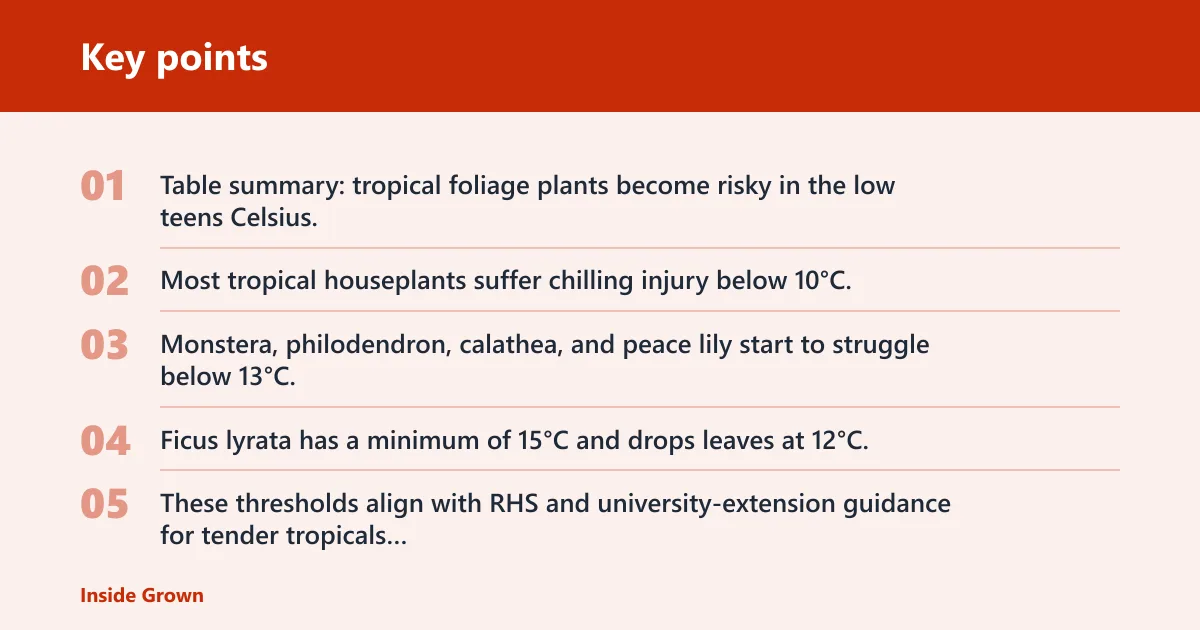
Table summary: tropical foliage plants become risky in the low teens Celsius, aroids and orchids generally need warmer nights than many people expect, and succulents and hardy houseplants tolerate cooler air but still lose protection when soil stays wet.
| Plant group | Caution | Too cold | Emergency | Wet soil effect | Symptoms within 72 hours | Best immediate move |
|---|---|---|---|---|---|---|
| Tropical foliage plants | 13–15°C / 55–59°F | 10–12°C / 50–54°F | Below 10°C / 50°F | Raise danger by 5–8°C / 9–14°F | Drooping, yellowing, curled leaves, soft patches | Move to 16–22°C, out of drafts; keep soil only lightly moist |
| Aroids and orchids | 13–15°C / 55–59°F | 10–13°C / 50–55°F | Below 10°C / 50°F | Raise danger by 5–8°C / 9–14°F | Bud drop, limp leaves, delayed yellowing, stalled growth | Move warmer; avoid watering until the mix starts drying |
| Succulents and hardy houseplants | 8–12°C / 46–54°F | 5–8°C / 41–46°F | Below 5°C / 41°F or frost exposure | Wet soil still raises root injury risk sharply | Wrinkling, translucent tissue, leaf drop, blackened spots | Move to a dry, bright spot above 10°C / 50°F |
| Rule of thumb: the colder and wetter the root zone, the sooner visible damage can appear, even if the room thermostat looks acceptable. | ||||||
Tropical foliage plants
Most tropical houseplants suffer chilling injury below 10°C. Monstera, philodendron, calathea, and peace lily start to struggle below 13°C. Ficus lyrata has a minimum of 15°C and drops leaves at 12°C, so it belongs in the more sensitive group even though it looks sturdy. These thresholds align with RHS and university-extension guidance for tender tropicals that should not be left in cool, drafty spaces for long.
Aroids and orchids
Phalaenopsis orchids have a 15°C minimum and bud drop starts at 13°C. Spathiphyllum has a minimum of 12°C and can recover from brief exposure, but repeated cold nights still increase the chance of leaf yellowing and stalled growth. These plants need warm nights more than people expect, and extension guidance commonly recommends keeping them above the low teens Celsius whenever possible.
Succulents and hardy houseplants
Snake plant, ZZ plant, and aspidistra tolerate brief dips to 5°C. Jade plant is unusually cold-tolerant among common houseplants. Even so, cold tolerance is not frost tolerance, and a wet pot in a cold room is far riskier than the same plant in dry soil.
Why cold damage looks delayed
Chilling injury starts before freezing. The plant’s cells and membranes are stressed first, then symptoms often show up 24–72 hours later. That delay is why a plant can look normal right after exposure and then decline after a day or two.
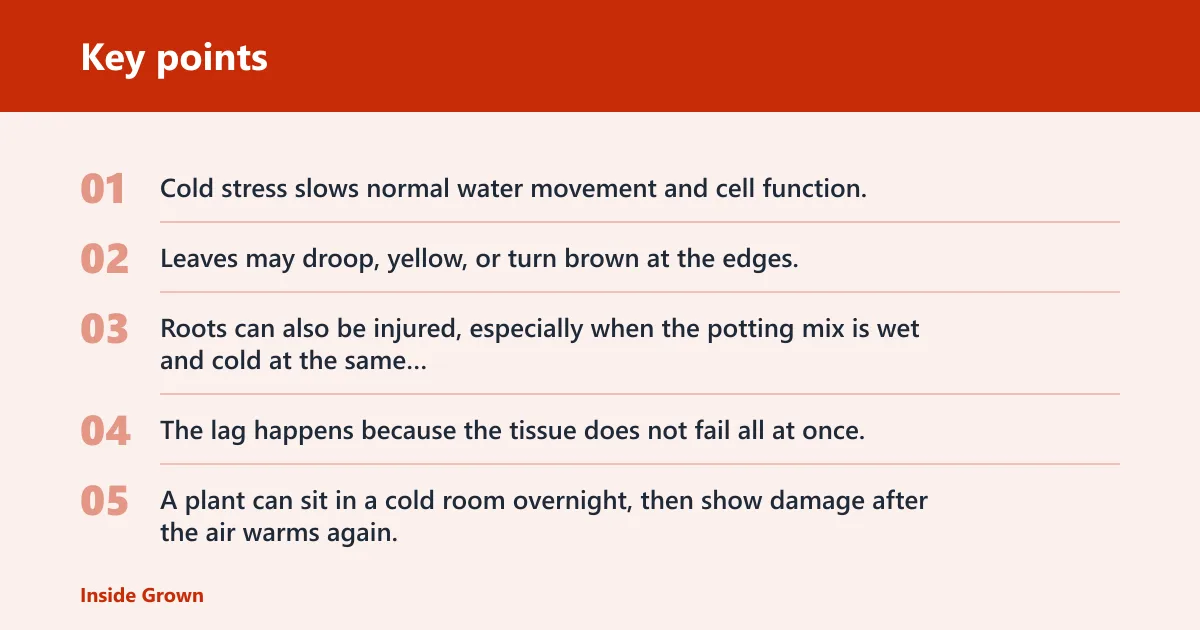
What chilling injury does to leaves and roots
Cold stress slows normal water movement and cell function. Leaves may droop, yellow, or turn brown at the edges; some tissues blacken if the damage is severe. Roots can also be injured, especially when the potting mix is wet and cold at the same time.
Why symptoms can take 24 to 72 hours
The lag happens because the tissue does not fail all at once. A plant can sit in a cold room overnight, then show damage after the air warms again. That is why night lows matter more than daytime averages when you are judging risk.
Why it can look like overwatering
Cold injury is often mistaken for overwatering because both can cause limp leaves, yellowing, and drop. The difference is timing and pattern: cold damage often follows a cold night, starts on the coldest side of the plant, and may appear after the temperature has already recovered.
A common first-timer mistake is to water again when leaves droop the morning after a cold snap. If the soil is still damp, that can worsen root stress instead of helping. Check the room temperature first, then check moisture, then decide whether the plant needs warmth or water.
Can a cold draft kill a houseplant?
Yes. A cold draft can kill a houseplant if it is strong enough, cold enough, or repeated enough, especially for tropical plants. Window-side and doorway exposure can chill one side of the plant far more than the room average suggests, and the damage can build over several nights.
Window-side and doorway risk
Cold drafts create localized damage from moving air. Door openings, stairwells, and leaky windows can push cold air onto a single leaf cluster while the rest of the room stays comfortable. That is why a thermometer across the room can miss the problem.
One-sided damage patterns
Cold draft injury often appears on the side nearest the air leak. Leaves may look fine on one side and mottled, curled, or brown on the other. If the symptom pattern is one-sided, cold exposure is more likely than a watering issue.
How to move a plant out of the draft
Move the plant several feet away from the draft source, not just a little to the side. Turn it only after it is out of the cold stream. If the soil is wet, let the pot dry partway before the next watering and keep the plant in warmer air.
What does a cold windowsill do?
A cold windowsill can be colder than the room air because glass and nearby surfaces lose heat quickly. In unheated rooms, the chill from the pane can put the leaves nearest the glass into a danger zone even when the center of the room feels mild.
Glass temperature versus room air
The air temperature in the room is only part of the picture. The surface next to the glass can sit several degrees colder than the rest of the room, and that gap is bigger at night. Place the thermometer near the plant, not across the room.
Why leaves nearest the pane go first
Leaves touching or nearly touching cold glass lose heat fastest. The first symptoms often show on that side: translucent patches, edge browning, or leaf drop. This is one of the clearest signs that the issue is cold exposure rather than a general care problem.
How unheated rooms change the risk
An unheated room can drop well below the house’s usual indoor range after sunset. That matters most for small pots and shallow-rooted plants, which cool faster. If the room falls under 12°C at night, treat the setup as unsafe for many common houseplants.
How wet soil changes the threshold
Wet soil makes chilling injury worse by 5–8°C. That means a plant that might tolerate a short cool spell in dry mix can be damaged sooner if the potting medium is already saturated, because cold roots handle oxygen and water movement less effectively. University-extension sources on root-zone stress note that cold, wet media reduce root function and increase the odds of rot and leaf collapse after a cold snap.
Why damp roots are more vulnerable
Cold, wet roots are under double stress. The root zone cools faster, dries more slowly, and is more likely to lose function after a chilly night. That raises the risk of root injury and later rot, even if the foliage looked fine at first.
How much colder becomes too cold
If a plant’s usual minimum is around 10°C, wet soil can make that danger point act more like 15–18°C in practice. That does not mean the plant will die at those numbers; it means the threshold for visible injury moves upward by several degrees.
When to wait before watering again
After a cold spell, wait until the potting mix begins to dry before watering again. Do not use cold water on a plant that has already been chilled. Warm the room first, then check the top layer of mix and the pot weight before deciding.
Which plants handle cooler rooms?
Some houseplants handle cooler rooms better than others. Snake plant, ZZ plant, and aspidistra tolerate brief dips to 5°C, and jade plant is unusually cold-tolerant among common houseplants. Even those plants still prefer steady indoor conditions, not repeated cold drafts or wet soil.
Snake plant and ZZ plant
These are among the better choices for cooler indoor spaces. They can handle short dips better than many tropical plants, but that tolerance should not be confused with long-term comfort. A cold windowsill and soggy mix can still cause damage.
Jade plant
Jade plant is more cold-tolerant than many common indoor plants. It still does best when the room avoids frost, drafts, and long wet periods. If the leaves feel soft or translucent after a cold snap, move the plant warmer and reduce watering.
Other cooler-tolerant choices
Aspidistra also tolerates cooler conditions well. Even so, each species has its own limit, and plants in clay pots, shallow pots, or drafty windows need closer monitoring. The general rule stays the same: check the coldest spot the plant actually occupies.
What temperature is too cold for indoor plants?
For many indoor plants, too cold starts around 12°C, and a room average under 15°C should make you watch closely. Tropical plants usually need warmer conditions, while hardy species can cope lower for a short time. The plant’s group matters more than a single number.
Houseplants generally do best in roughly the 15°C to 25°C range, with a winter target around 16°C to 22°C. If a plant sits near a window or door, use the coldest reading at leaf level rather than the thermostat across the room.
What temperature should house plants be in?
Most houseplants should be kept in a steady indoor range rather than a sharp day-night swing. A good target is 16°C to 22°C in winter, with the broader comfort range around 15°C to 25°C. That keeps most common houseplants out of the chill zone.
What temp is too cold for houseplants outside?
For outside exposure, the key issue is duration plus species. Many tropical houseplants start to suffer below 10°C, and brief outdoor time is only safer if the plant is dry and protected. Frost, wind, and transport in cold air can injure plants faster than indoor room averages suggest.
For moving plants from store to car or from car to home, treat the trip like a short exposure test. If the air is near or below the plant’s minimum, keep the trip short and shield the foliage from wind. A few minutes is very different from a cold night outside.
Frequently asked questions
What temperature is too cold for houseplants?
For many houseplants, temperatures below 12°C are too cold, and tropical types often begin to suffer below 10°C. Some aroids start struggling below 13°C. Night lows matter more than a daytime average, especially if the plant sits near glass, a vent, or a draft.
What temperature is too cold for potted plants indoors?
Potted plants indoors become risky when the room average drops below about 15°C or the night minimum falls under 12°C. Wet soil raises the danger faster than dry soil does, because chilled roots are more likely to be injured when the potting mix stays damp.
What temperature is too cold to water plants indoors?
If the room is below about 12°C, it is usually better to wait before watering most houseplants. Cold, wet soil raises injury risk, and roots move water poorly when chilled. Warm the room first, then water only if the mix has started to dry.
What temperature is too cold for houseplants outside?
For outside exposure, many tropical houseplants should not be left below 10°C, even briefly if the air is windy or the soil is wet. Hardy plants can tolerate cooler conditions, but frost changes the risk completely. Match the species to the exposure time.
Sources
- Royal Horticultural Society (RHS), guidance on houseplant winter care, tender plant minimum temperatures, and avoiding cold, drafty windowsills.
- University extension publications on tropical houseplant culture, chilling injury, and the increased risk from cold, wet potting media.
- University extension resources on root-zone stress, water movement in chilled media, and symptoms that appear after delayed chilling injury.