How to Save Vegetable Seeds for Next Year
Save seeds from open-pollinated, self-pollinating vegetables like tomatoes, beans, peas, and lettuce; F1 hybrids are usually skipped, and squash, corn, and many brassicas are often treated as crops that need isolation. If you save the wrong seed, next year’s plants can disappoint, cross, or fail to match the parent. This guide shows which vegetables are worth saving, which ones to skip, and how to dry, store, and label seed so it stays viable.
What you’ll need


- Paper envelopes or other dry seed containers
- Labels and a marker
- Trays or towels for drying
- A dry, warm indoor spot for finishing dry-down
- A fine sieve or strainer for cleaning fleshy seed
- Scissors or pruners for cutting pods and fruit
- Rubber bands or clips for keeping labeled envelopes together
Which vegetables are worth saving?
The best candidates are open-pollinated or heirloom varieties that grow true to type, especially self-pollinating crops. The Almanac recommends starting with tomatoes, peas, peppers, and beans. Garden space matters too: biennials take two seasons to reach seed, so they can be a poor fit for many small gardens.
Crop groups that make sense first
Tomatoes, beans, peas, and many lettuces are straightforward because they are easier to keep true and easier to harvest at the right stage. Garden Betty also groups corn, cucumbers, melons, summer squash, winter squash, basil, beans, and peas as annual vegetable crops, which makes them simpler to fit into one season when the variety itself is seed-worthy.
Crops to skip if space is tight
Biennials such as beets, chard, carrots, parsley, cabbage, kale, onions, and turnips need a second growing season before they set seed. The Almanac says biennial crops are not advised for seed saving. In a small plot, they tie up beds for too long and raise the odds of weather loss before seed matures.
Can you save hybrid seeds?
You can collect hybrid seed, but the offspring usually will not grow true to type. That makes hybrid seed a gamble, not a dependable way to keep the same fruit shape, flavor, or maturity time. For reliable seed saving, open-pollinated varieties are the better choice.
When a hybrid is still not a good bet
Hybrid seed packets are common in garden stores and supermarket produce sources, but they are built for the first crop, not the next generation. If the parent plant is a hybrid, the saved seed may split into mixed traits. That matters most when you want a specific tomato size, pepper heat level, or squash shape again.
How to tell what you have
Check the packet or plant tag for “open-pollinated,” “heirloom,” or “hybrid” wording. If the variety is unlabeled and came from supermarket produce, do not assume it will breed true. Save that seed only if you are comfortable with surprises and have room to sort out weak results later.
Seed-saving decision table
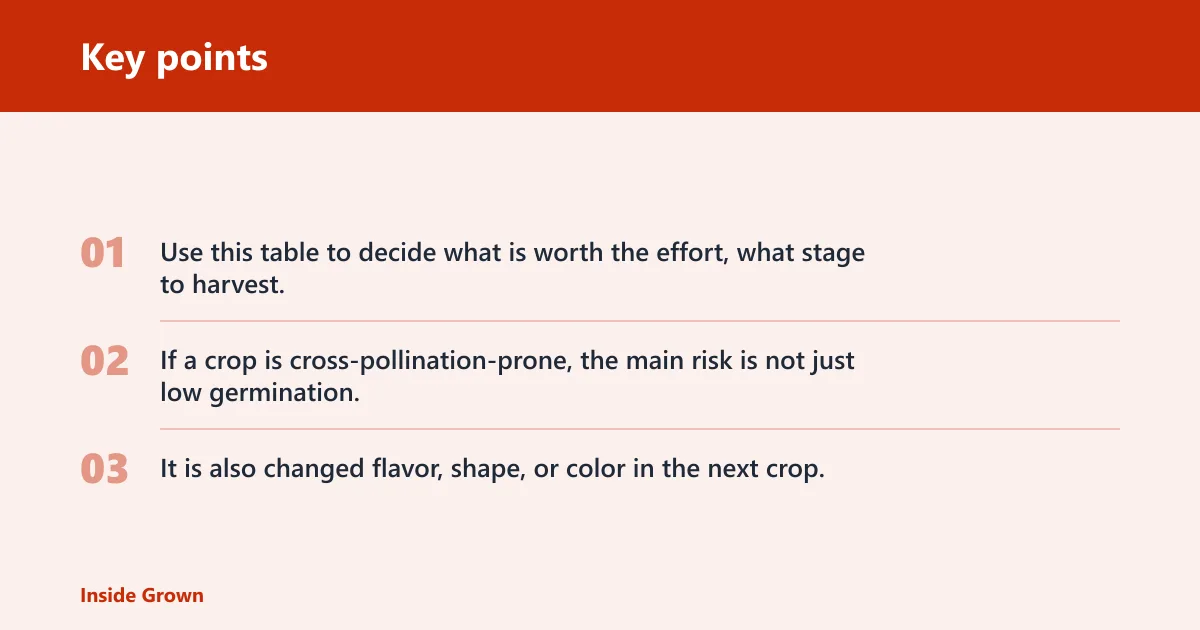
Use this table to decide what is worth the effort, what stage to harvest, and where failures usually start. If a crop is cross-pollination-prone, the main risk is not just low germination. It is also changed flavor, shape, or color in the next crop.
| Vegetable | Ease | Harvest stage for viable seed | Cross-pollination risk | Beginner? | Common failure mode |
|---|---|---|---|---|---|
| Tomato | Easy | Fully ripe, often overripe for eating | Low to moderate | Yes | Seeds saved from weak fruit or before full ripeness |
| Bean | Easy | Pods brown and dry on the vine | Low | Yes | Picking pods too green and drying them poorly |
| Pea | Easy | Pods brown on the vine | Low | Yes | Harvesting before seed fully fills the pod |
| Pepper | Medium | Fully colored fruit that begins to shrivel | Moderate | Yes, with care | Crossing with nearby varieties or picking too early |
| Lettuce | Easy | Flower heads dry and seed fluff appears | Moderate | Yes | Collecting before seed heads fully dry |
| Cucumber | Medium | Fruit turns fully yellow | High | Only with isolation | Cross-pollination and harvesting fruit too soon |
| Squash | Hard | Fruit fully mature on the vine | High | Usually no | Crossing with nearby squash types and immature seed |
| Melon | Hard | Very ripe fruit, often past eating stage | High | Usually no | Seed taken from fruit that was ripe to eat, not ripe for seed |
| Carrot | Hard | Second season flower umbels dry | Moderate to high | No | Needs a second year and often crosses with nearby carrots |
| Onion | Hard | Seed heads dry on the stalk | Moderate | No | Timing is off, or bulbs never overwinter well enough to flower |
How do you save and store vegetable seeds for next year?
Pick the healthiest, most productive plants first, then harvest seed at crop-specific maturity, dry it fully, and store it in a labeled container in a cool, dark place. Save seed from the plant that gives you the size, shape, and flavor you want to grow again. Mark those plants in advance with string or tape so you do not lose track.
1. Choose vigorous parent plants
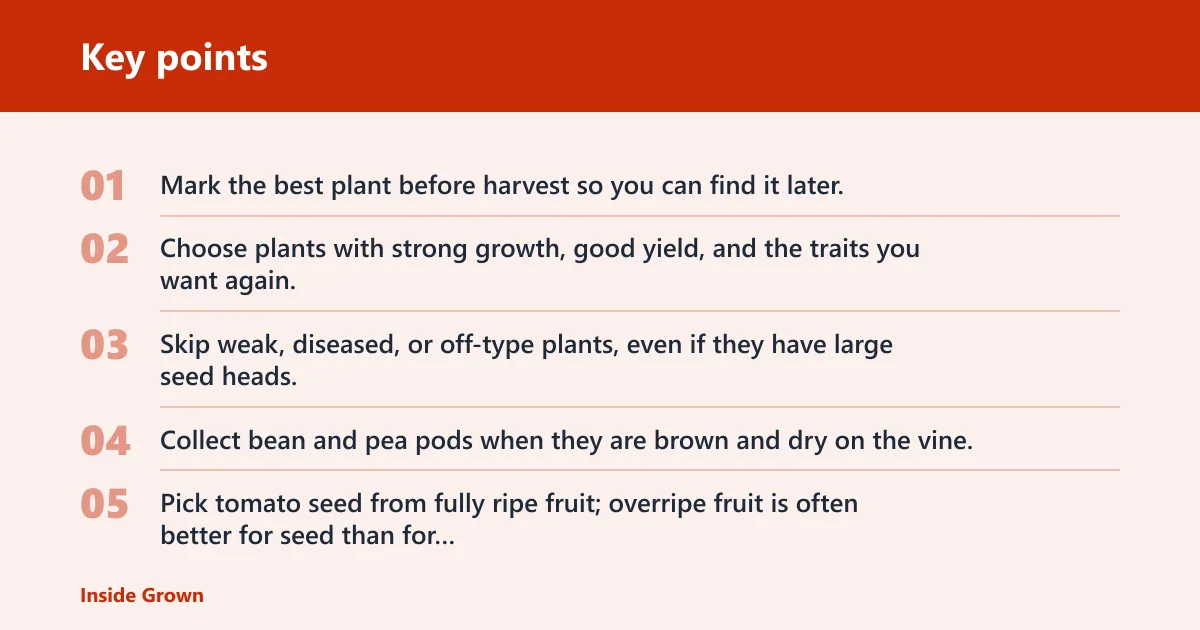
- Mark the best plant before harvest so you can find it later.
- Choose plants with strong growth, good yield, and the traits you want again.
- Skip weak, diseased, or off-type plants, even if they have large seed heads.
2. Harvest at the right maturity stage
- Collect bean and pea pods when they are brown and dry on the vine.
- Pick tomato seed from fully ripe fruit; overripe fruit is often better for seed than for eating.
- Wait for pepper fruits to reach full color and start to shrivel.
- For cucumber, wait until the fruit turns fully yellow.
Suppose a pepper plant is loaded with perfect-looking fruit, but the peppers are still glossy and firm. That is too early for seed saving. Let the fruit sit until it reaches full color and shows a slight wrinkle, then collect the seed from the best-shaped fruit on the healthiest plant.
3. Clean and dry the seed fully
- Scoop seed from fleshy fruit, then rinse away pulp and gel.
- Spread seed on towels or trays in a dry, warm indoor area.
- Leave seed until it is fully dry before storage; underdried seed risks mold and poor storage.
- If seed clumps, separate it and give it more dry time.
4. Pack, label, and store it
- Place fully dry seed in paper envelopes for short-term handling or another dry seed container.
- Seal each packet with the crop name and variety name.
- Add the harvest year, because unlabeled seed is often wasted seed.
- Keep the packets in a cool, dark place away from moisture.
Paper envelopes work well while seed is finishing dry-down. After that, a dry jar or other airtight storage container can help protect labeled seed from humidity if the seed is already fully dry. If a packet feels cool or soft, do not seal it away yet.
What goes wrong most often?
The biggest failures come from harvesting too early, skipping dry-down, ignoring cross-pollination, and storing seed in damp or unlabeled containers. The fix is usually simple, but it has to happen in the right order. If the seed is not mature and dry before storage, no container can rescue it.
Saving seed too early or too late
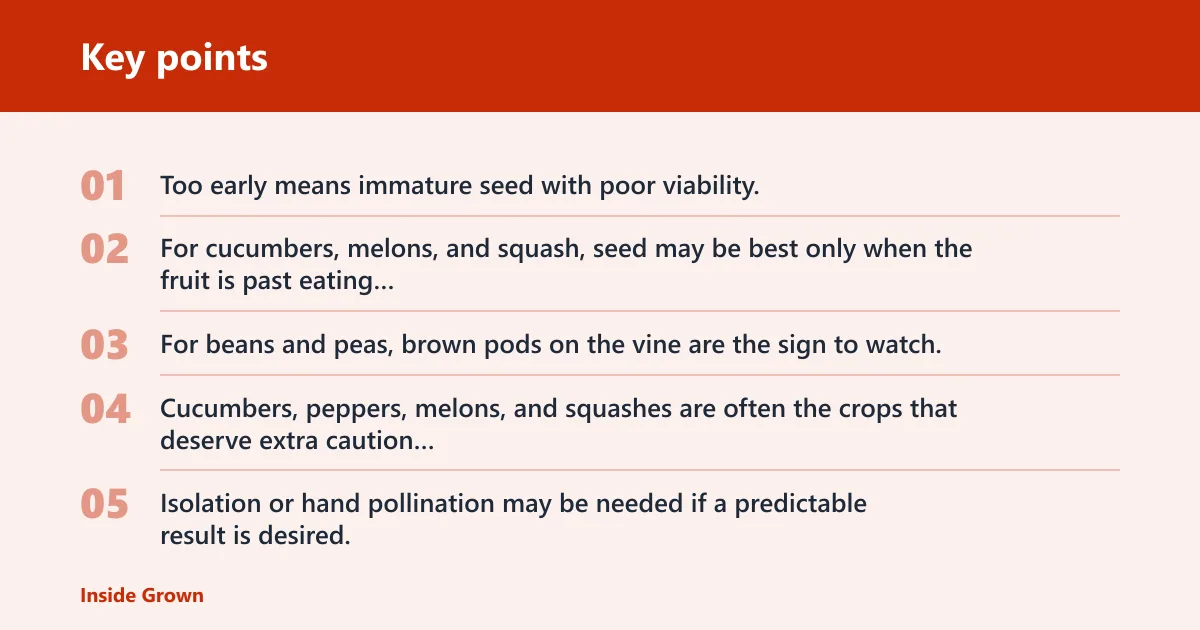
Too early means immature seed with poor viability. Too late means pod drop, rot, or shattering. For cucumbers, melons, and squash, seed may be best only when the fruit is past eating quality. For beans and peas, brown pods on the vine are the sign to watch.
Ignoring cross-pollination risks
Cucumbers, peppers, melons, and squashes are often the crops that deserve extra caution because of cross-pollination risks. Isolation or hand pollination may be needed if a predictable result is desired. A common first-timer mistake is saving seed from two squash varieties planted side by side, then wondering why the next fruit looks mixed.
If that didn’t work, separate next season’s flowering plants by distance, bag flowers before they open, or hand-pollinate one blossom at a time with a known parent. For peppers, keep different varieties farther apart if the goal is cleaner seed. For squash and melons, plan on stricter isolation or do not save seed from them at all.
Storing seed in damp or unlabeled containers
Moisture ruins storage faster than almost anything else. Use dry envelopes or jars only after the seed is fully dry, then label every container clearly. Cool, dark storage extends viability better than a warm shelf or a bright windowsill.
Frequently asked questions
How do I save vegetable seeds for next year?
Choose a healthy, productive plant, wait for the seed to reach crop-specific maturity, dry it completely on a towel or tray, and store it in a labeled dry container. The simplest workflow is harvest, clean, dry, label, and store in a cool, dark place.
Can you save vegetable seeds for next year?
Yes, if the crop is open-pollinated or heirloom and the seed is mature and fully dried. Hybrids can be saved too, but the next generation may not match the parent. For the most predictable results, start with tomatoes, beans, peas, peppers, or lettuce.
How do I store vegetable seeds for years?
Store only fully dry seed in labeled paper envelopes, then keep those inside a jar or other dry container in a cool, dark place. The less moisture and heat the seed sees, the better. Storage time varies by crop, so do not assume every seed stays useful for the same length of time.
How do I store leftover vegetable seeds for next year?
Move leftover seed from open packets into a labeled envelope or jar as soon as you can, then keep it dry and out of light. Write the crop, variety, and year on the container. If the packet was open in a humid space, inspect seed for clumping before you store it.
What vegetable seeds are easiest to save?
Tomatoes, beans, peas, and many peppers are the easiest starting point because they are self-pollinating and simpler to harvest at the right stage. Lettuce is also manageable once the flower heads dry. These crops give beginners a better chance of keeping traits close to the parent plant.
Which vegetables should I not save seeds from?
Do not rely on F1 hybrids for predictable offspring, and avoid biennials if you do not have room for a second season. Squash, cucumbers, melons, and peppers can be saved, but only with extra attention to isolation or hand pollination. Weak or diseased plants should be skipped even if they produce plenty of seed.