Can Houseplants Live in a Windowless Room?
Yes, some houseplants can stay alive in a room with no window, but only in very low light and with slow growth. If you want steady growth, you need a grow light. Without enough light, plants stretch, yellow, and decline. This guide shows which plants can survive, which can grow slowly, and when to add a grow light.
Foot-candle thresholds for survival versus healthy growth



Survival and growth are not the same
A plant can survive for a while in dim conditions without looking good or making new leaves. That is very different from healthy, ongoing growth. In a truly windowless room, the real question is not “Will it live?” but “Will it keep getting enough light to grow?”
Foot-candles help separate those outcomes. Office fluorescents often measure 30 to 50 FC at desk height, corridors and storage rooms often measure 5 to 15 FC, and a basement bathroom under a single ceiling fixture may read 15 to 25 FC. Below 50 foot-candles will not support plant life for very long. University extension guidance commonly places low-light interiors in the range where only the toughest houseplants can cope, while bright-indirect plants need substantially more light (University of Minnesota Extension; Penn State Extension; Clemson Extension).
The simple rule is blunt: if your room stays below office-bright levels, treat a grow light as the long-term answer. Some plants can coast for a while. Very few will do well there without help.
Windowless room light check
Use foot-candles, not guesswork. A windowless room usually has no direct sunlight and depends on overhead fluorescents or LEDs. If the room reads like a corridor, bathroom, or dim basement space, most houseplants will be on borrowed time unless you add artificial light. RSPCA and extension-service houseplant guides both stress matching the plant to the available light rather than hoping humidity or warmth can make up for missing sun.
Quick checks without tools
- Office-bright: You can read and work comfortably all day, and the overhead lights stay on for long stretches. This often lands around 30 to 50 FC.
- Corridor-dim: The room feels usable, but it is clearly darker than an office. Hallways and storage rooms often sit around 5 to 15 FC.
- Bathroom-dim: One ceiling fixture gives a small pool of light, and the corners stay shadowy. A basement bathroom under one fixture may read 15 to 25 FC.
Where overhead fixtures fit on the scale
Standard overhead light may keep a person comfortable, but that does not mean it is enough for a plant. Many houseplants need more light than a room lamp or ceiling fixture can provide. If the plant sits more than 8 or 10 feet from a window, growth usually slows hard or stops altogether. Extension recommendations for interior plants consistently note that plants near windows or under stronger supplemental light perform far better than those relying on ambient room light alone.
A common baseline for low light is 100 footcandles in some plant discussions, but that is too generous for deciding whether a windowless room can support growth. For practical use, treat 25 to 50 FC as the narrow zone where only the toughest plants can coast, and anything below that as a warning sign. Low-light tolerators such as ZZ plant and snake plant are widely described as tolerant of dim interiors, but even they do best with some supplemental light if you want regular growth (NC State Extension; Missouri Botanical Garden).
Windowless room decision table
Use this table before you buy a plant. It shows the difference between “can survive,” “will grow slowly,” and “needs grow light.” If the room falls in the wrong column, do not expect normal growth from a plant that likes brighter conditions.
| Room type | Overhead light level | Can survive | Will grow slowly | Needs grow light |
|---|---|---|---|---|
| Office with bright fluorescents | 30 to 50 FC | ZZ plant, snake plant, pothos, peace lily, Chinese evergreen, cast iron plant | Most of the plants above will grow slowly | For better growth, yes, especially for peace lily and Chinese evergreen |
| Corridor or storage room | 5 to 15 FC | ZZ plant, cast iron plant, snake plant | Very slow growth only | Most other houseplants need one |
| Basement bathroom under one fixture | 15 to 25 FC | ZZ plant, snake plant, cast iron plant, sometimes pothos | Pothos may creep along | Peace lily and Chinese evergreen usually need one |
| Truly dark interior room | Below 15 FC | Few plants for long-term use | Short-term coasting only | Yes, for nearly any real houseplant |
Key Takeaway: Once a room drops below office-bright levels, only the most shade-tolerant plants can keep going, and even they are usually coasting rather than thriving. For consistent growth, especially below 25 to 30 FC, supplemental light is the reliable fix. The closer a plant is to corridor-dim or dark-interior conditions, the more important it becomes to choose a low-light survivor or add a grow light.
Which plants can cope best?
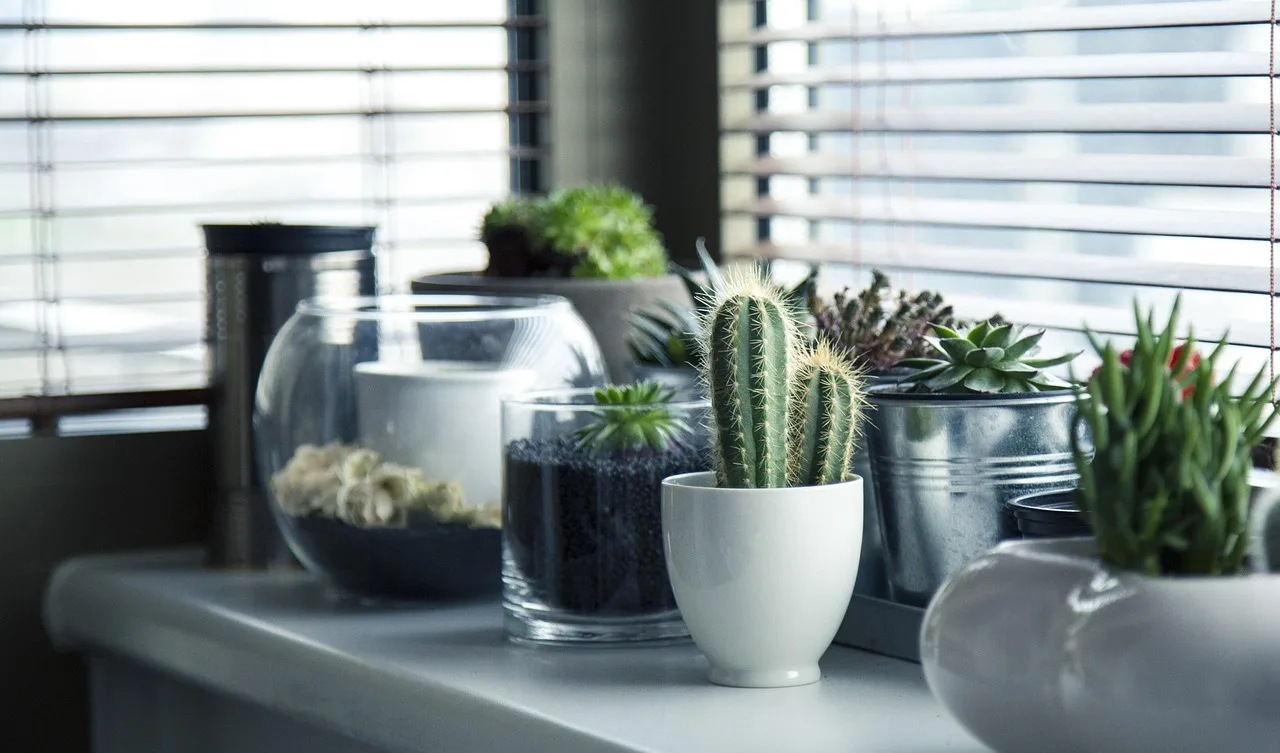
Start with the toughest candidates if you want the best chance of survival in a dim room. ZZ plant, cast iron plant, and snake plant are the strongest low-light picks. Pothos, peace lily, and Chinese evergreen can work too, but they are more likely to stall or suffer if the room is truly dark.
ZZ plant, cast iron plant, and snake plant
The ZZ plant is one of the strongest low-light candidates. It can grow under an interior low light level of 25 foot-candles for more than one year, and its rhizomes store water. In dim rooms, water it sparingly, usually every 3 to 4 weeks. Extension and botanical garden references consistently describe it as a strong interior plant for low-light spaces, though not a true no-light plant (Missouri Botanical Garden; University of Illinois Extension).
The cast iron plant is one of the best plants where only low light conditions exist. It is very slow-growing, tolerates low light and drought, and can work in dim corridors. In low light, it may need little or no fertilizer. That said, “tolerates low light” does not mean it thrives in darkness; it is best used where the goal is survival and durability rather than fast growth (Royal Horticultural Society; North Carolina Extension).
The snake plant is another common office and bedroom choice. It handles low light well, and forgetting water is less risky than overwatering. Let the soil dry completely before watering again. It is widely recommended for interior spaces with modest light, but brighter indirect light will improve growth and leaf color (Clemson Extension; Missouri Botanical Garden).
Pothos, peace lily, and Chinese evergreen
Pothos tolerates fluorescent light and dim spaces better than many trailing plants. It can trail from shelves or hanging baskets, and cuttings can be rooted in water. Water when the top inch of soil is dry. It is a better fit for the lower end of interior light than many variegated or flowering houseplants, but it still prefers more than a truly dark room (University of Florida IFAS Extension; Penn State Extension).
Peace lily can bloom in low light, but that does not mean it does well in a dark room for long. Keep the soil moist, not soggy, and expect stress if the room is truly dark. Chinese evergreen has variegated foliage and handles dim spaces and humidity, but root rot is a main risk if the soil stays wet. Both are commonly listed as lower-light indoor plants, but extension sources still place them in the “indirect light” category rather than deep shade (NC State Extension; University of Minnesota Extension).
These three are workable, not carefree. Pothos is usually the safest bet of the group in a dim office. Peace lily and Chinese evergreen need closer attention to watering and light.
Say your office has bright fluorescents and your desk sits in the middle of the room. A pothos can usually coast there with slower growth, while a peace lily may keep going but lose momentum if the fixture is weaker than the rest of the office. The same plant near a corridor entrance may not last nearly as well.
When is a grow light non-negotiable?
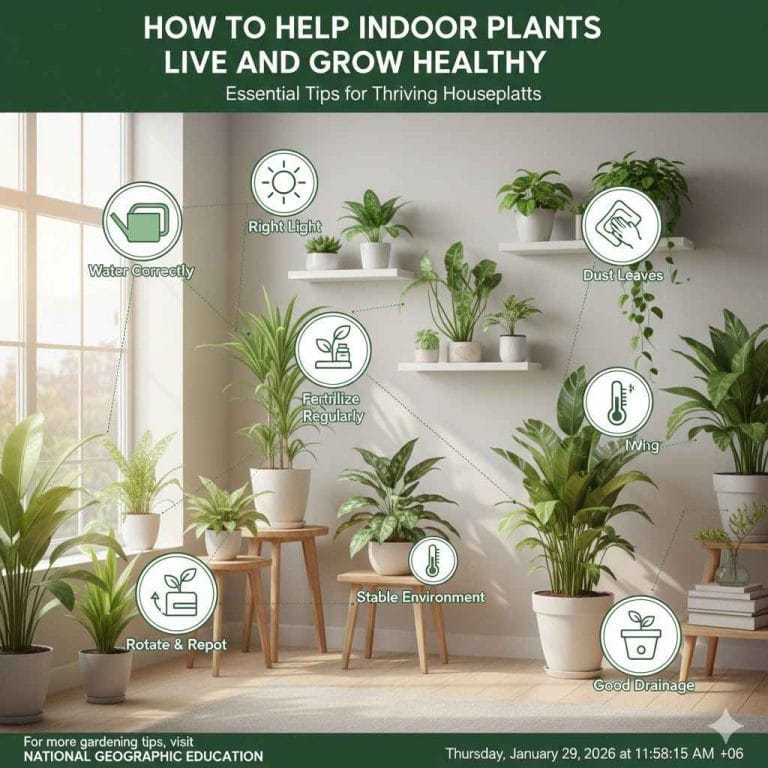
A grow light is non-negotiable when the room is below office-bright levels, when the plant is far from any window, or when you want normal growth instead of survival mode. Artificial light can replace missing daylight, but it has to be close enough and on long enough to matter.
How to place and run it
Fluorescent fixtures should be 6 to 12 inches from the foliage. A small grow fixture draws in the range of a household bulb, not a heater, so the main job is placement, not brute force. For home gardeners, it is best to have light on for as little as 10 hours and no more than 16 hours a day.
Use a timer. That matters more than occasional brightening from a room lamp or a random burst of daylight through an open door. A steady schedule gives the plant a usable day length, which is hard to achieve with only room lighting.
What a dim room does to plants
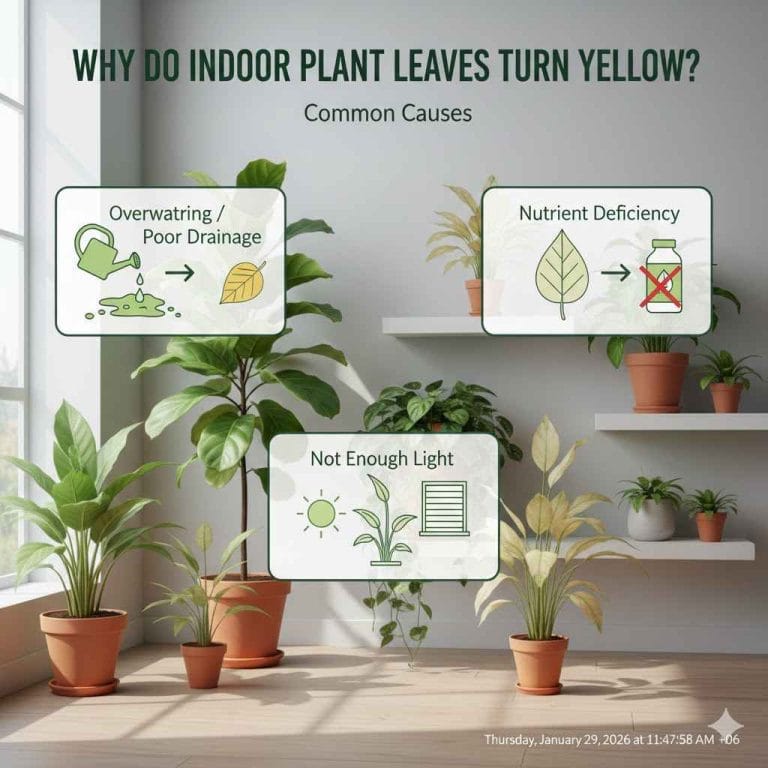
Low light slows water use, so the main failure mode is often overwatering. Soil that stays wet too long invites root rot, especially in peace lily and Chinese evergreen. If leaves yellow, stems stretch, or new growth arrives weak and spaced out, the plant is telling you it is light-starved.
Picture a hallway shelf with a snake plant and a pothos. The snake plant may coast for a long time because its leaves store water, but the pothos will start to trail weakly and lose density if the fixture never gets stronger. A grow light closes that gap fast.
Plants to skip in a windowless room
Skip plants that only tolerate life near a window or that need much brighter light than a windowless room can provide. A dim room is the wrong place for sun-hungry species, even if a label says “bright indirect light.” Those plants usually decline, then get overwatered in an attempt to rescue them.
Do-not-buy list
- Most succulents and cacti — buy a ZZ plant, snake plant, or cast iron plant instead
- Fiddle-leaf fig — buy a pothos or Chinese evergreen instead
- Croton — buy a peace lily or pothos instead
- Bird of paradise — buy a snake plant or ZZ plant instead
- Other plants sold for bright windows rather than interior light — buy any of the low-light staples above instead
A common first-timer mistake is buying a plant for the label, then placing it in a bathroom with one ceiling fixture and hoping humidity will make up for light. Humidity can help some species stay comfortable, but it cannot replace photons.
Room-specific advice
Offices: If the room is office-bright, the strongest low-light plants can survive and grow slowly. If desks sit far from the lights or the fixture is weak, add a grow light at the plant shelf instead of relying on the room alone.
Bathrooms: Higher humidity helps, but it does not fix poor light. A bathroom with 15 to 25 FC can suit ZZ plant, snake plant, or cast iron plant better than a thirstier plant that wants regular growth.
Hallways: These are usually the harshest spaces because light is low and uneven. Choose only the toughest plants here, and expect slow growth unless you install a grow light.
Frequently asked questions
Can plants survive without windows?
Yes, some plants can survive with no window if they get enough artificial light. ZZ plant, snake plant, cast iron plant, pothos, peace lily, and Chinese evergreen are the safest starting points, but survival and steady growth are different. In very dim rooms, a grow light is the practical fix.
Do houseplants need natural light or will artificial light work?
Artificial light can work if it is placed close enough to the foliage and left on a regular schedule. Natural light is not required for every plant, but standard ceiling light is often too weak. For long-term use, a grow light usually beats trying to rely on room lighting alone.
How much artificial light do plants need in a windowless room?
For home gardeners, a practical schedule is 10 to 16 hours a day, with the fixture close to the leaves. If the room is below office-bright levels, the plant may survive but grow slowly. Below 50 foot-candles, long-term plant life is hard to maintain without added light.
Which houseplants are best for an office with no windows?
ZZ plant, snake plant, pothos, cast iron plant, peace lily, and Chinese evergreen are the usual starting points. In an office that measures around 30 to 50 FC, they can survive, and several will grow slowly. If the desk area is much dimmer, add a grow light.
Can bathroom plants survive with no window?
Yes, but only certain plants cope well there, and humidity does not replace light. A bathroom under a single ceiling fixture may read 15 to 25 FC, which is enough for ZZ plant, snake plant, or cast iron plant to coast. Peace lily and Chinese evergreen usually need more light.
What happens if a plant is kept in a windowless room too long?
It usually stretches, drops lower leaves, and stops making healthy new growth. Soil may stay wet longer because the plant uses less water, which raises the risk of root rot. If you see weak stems, yellowing, or thin growth, the room is probably too dim for that plant.
How do I use a grow light in a room with no windows?
Place the light close to the foliage, usually 6 to 12 inches away for fluorescent fixtures, and run it on a timer for 10 to 16 hours a day. Keep the schedule steady. That setup is the most reliable way to replace missing daylight in a windowless room.