Are Heat Mats Safe for Houseplants in Winter?
Heat mats can be safe for houseplants in winter when the potting mix stays cool and the plant benefits from warmer roots, often around 70–80°F soil. Used too hot or too long, they dry mix fast, stress roots, and push weak growth. This guide explains which houseplants benefit, which ones to skip, and how to use a mat without damaging roots.
Are heat mats safe for houseplants in winter?


They can be, because the mat warms the root zone, not the whole plant. That helps when the room is cool and the soil stays colder than the roots want, but it also means the main risk is root stress from too much heat or faster dry-down.
For houseplants, winter safety depends on three things: the plant’s temperature preference, the room temperature, and whether the mat has a thermostat. In a cool basement, drafty room, or cold windowsill, a controlled mat can solve a real soil-temperature problem. In a warm room, it often adds little and can dry the mix more than it helps.
What a heat mat warms
A seedling heat mat gives gentle bottom heat to the potting mix. Common mats are 10 x 20 inches or 10 x 20.75 inches, so one mat often fits a standard seed-starting tray. Some larger mats hold two standard trays, which also makes them useful for several small houseplants or cuttings.
Heat is concentrated at the root zone. That matters because the leaves may still feel cool while the soil is warm enough to change watering needs, growth rate, and root activity.
When warm roots help
Warm roots help most when the plant wants active growth and the soil is too cool for that. Tropical houseplants, cuttings, and winter propagation setups are the clearest matches. Heat mats can also be useful in cool indoor growing setups where soil temperatures fall below about 70°F.
Seedling mats are built for wet propagation conditions, often with waterproof or water-resistant construction. IP67 appears on some top-reviewed mats, and that rating is a useful safety indicator when water, humidity, and regular misting are part of the setup.
When they can hurt
Heat mats can hurt when they raise the root zone too much or keep it warm after the plant no longer needs it. They can also speed evaporation, which leaves the upper mix dry while the lower mix still feels damp. That mismatch can stress roots and make watering errors easier.
They are a poor fit for succulents, cacti, dormant plants, cool-season plants, and any plant already sitting in a warm room. In those cases, added bottom heat usually solves a problem that is not there.
Which houseplants benefit most?
Tropical houseplants, cuttings, and cool-room setups tend to benefit most from winter bottom heat. Plants that prefer steady warmth or that are trying to root from stems or leaf cuttings respond better than plants that slow down in winter. The goal is warm roots, not hot soil.
Say your pothos cutting sits in a 62°F basement and the mix feels cool all day. A thermostat-controlled mat set to a moderate soil target can help rooting. By contrast, a ZZ plant in a 72°F living room usually does not need one.
Houseplant heat mat decision table
| Plant type or situation | Safe or unsafe recommendation | Exact setup notes |
|---|---|---|
| Tropical foliage plant in a cold room | Safe with control | Use a thermostat, set soil near 70–80°F, check moisture every 1–2 days at first, and stop when the room stays warm enough that the pot no longer feels cool. |
| Cutting in a propagation tray | Safe with control | Use a mat sized for the tray, keep gentle bottom heat only, run it as needed for rooting, and stop once roots are formed and the mix holds warmth without help. |
| Cold windowsill with drafty glass | Safe if monitored | Use a thermostat and a probe in the mix, aim for a steady root-zone target, and move the pot away from direct glass if leaves or soil still feel chilled. |
| Basement shelf below warm-room conditions | Safe with thermostat | Use a controller, keep the probe 1 to 1.5 inches into soil, and monitor for rapid dry-down because enclosed basement setups can warm faster than expected. |
| Ficus, philodendron, monstera | Usually safe | Use only if the room is cool and the plant is actively growing or rooting; keep the soil target moderate and stop if leaves stay limp or mix dries too fast. |
| Peace lily in a chilly room | Safe with caution | Use a thermostat and avoid high settings; stop if leaf edges curl, the pot warms too much, or watering frequency jumps sharply. |
| Snake plant in winter | Usually unnecessary | Skip the mat unless the room is truly cold; keep the plant drier, not warmer, and use heat only if the soil stays cold for long stretches. |
| Succulent or cactus | Usually unsafe or unnecessary | Do not use bottom heat in most cases; dry, warm air and a warm mix can push rot risk and faster dehydration. |
| Dormant or cool-season plant | Unsafe for routine use | Leave off the mat unless a specific propagation need exists; dormancy and cool-season growth usually call for restraint, not added root heat. |
| Already warm living room | Usually unnecessary | Skip the mat if the room already keeps the soil comfortable; use ordinary winter care instead of adding a device that can dry the mix. |
| Large pot with deep mix | Safe only with close monitoring | Place the pot fully on the mat only if the entire base fits securely; if not, use a larger mat or a tray setup so the root zone warms evenly. |
| Two small pots on one large mat | Safe with even placement | A 20 x 23 inch mat can hold 2 standard trays; keep pots centered and use a thermostat so one side does not run hotter than the other. |
What setup keeps roots safe?
A thermostat controller is the most important safety tool for houseplants. It lets you set an exact soil temperature and prevents a mat from running hotter than the plant can handle, which matters in basements, garages, and drafty rooms.
Without a thermostat, the same mat can be fine one day and too warm the next. That is why seed-starting habits do not transfer perfectly to established houseplants: seedlings are usually managed for a narrow germination window, while potted houseplants need longer-term root care.
Use a thermostat controller
Set the probe in the root zone, not on top of the mix. A common placement is 1 to 1.5 inches into the soil. That position tells the controller what the roots actually feel, which helps prevent overheating.
Some thermostats have wide ranges. For example, the iPower thermostat can set temperatures from 40°F to 108°F, which gives enough room to choose a moderate houseplant target instead of guessing.
Choose the right mat size
Match the mat to the pot or tray layout. A standard 10 x 20 inch mat is sized for one standard tray, while a 20 x 23 inch mat can hold 2 standard trays. For a single large pot, make sure the base sits flat and stable on the heated area.
If only part of the pot touches the mat, the root zone can warm unevenly. That can dry one side of the mix faster than the other. A larger mat or a tray can solve that better than stacking pots on a small pad.
Set the probe correctly
- Place the probe first. Push it 1 to 1.5 inches into the soil near the root zone, not against the pot wall. That location gives a more realistic reading of the mix temperature.
- Set a moderate target. Choose a soil temperature that keeps the roots warm without pushing the mix into high heat. Bob Vila recommends mats that can hold 75 to 85 degrees Fahrenheit in a tray, which is a useful ceiling for many warm-loving plants.
- Check the first day closely. Recheck the pot after a few hours and again the next day. If the pot feels warm to the touch, the leaves droop, or the mix dries quickly, lower the setting or stop using the mat.
Seedling mats are often built for 24/7 use during germination and may raise soil temperature about 5°F to 20°F above room temperature. That is normal for seed starting, but houseplants need more monitoring because their roots can stay in the pot long after the first warmth boost.
Do heat mats dry out pots faster?
Yes. Warmer soil loses moisture faster, and the top of the pot can dry before the root ball does. That means the plant may look thirsty even while parts of the mix are still damp, which is why overwatering and underwatering both become easier to do.
This effect is strongest in small pots, porous pots, and airy potting mixes. It is also stronger in dry winter air, where evaporation is already high.
Why mix dry-down speeds up
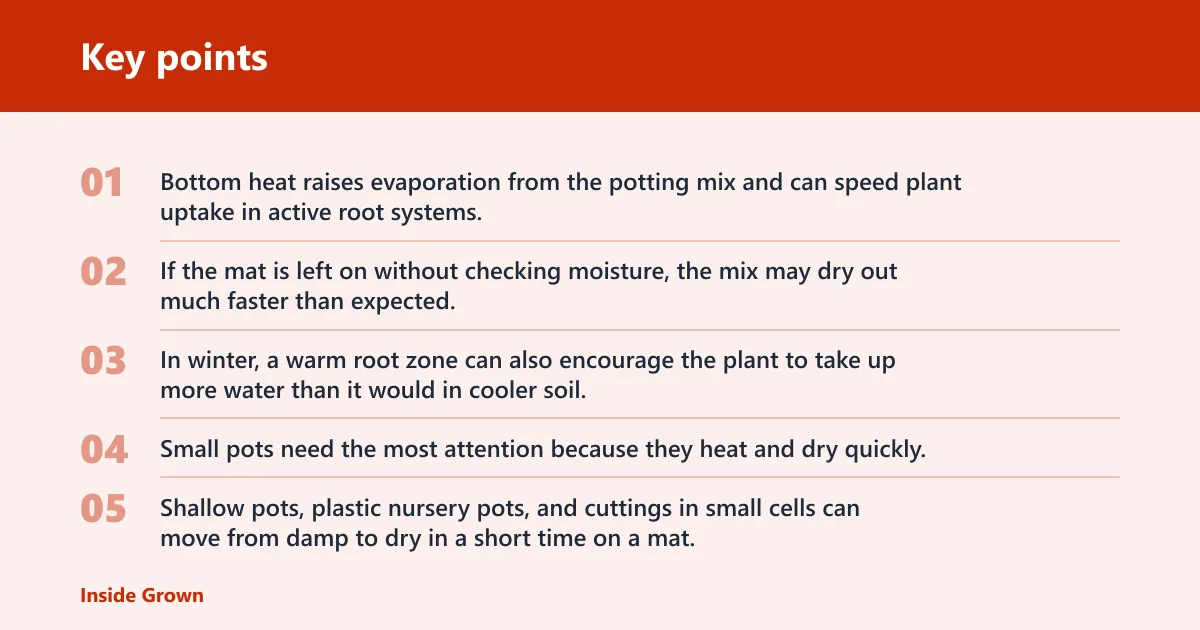
Bottom heat raises evaporation from the potting mix and can speed plant uptake in active root systems. If the mat is left on without checking moisture, the mix may dry out much faster than expected. That is one reason a thermostat and routine checks belong together.
In winter, a warm root zone can also encourage the plant to take up more water than it would in cooler soil. If the foliage is still in low-light winter conditions, that faster uptake may not match the plant’s overall growth needs.
Which pot sizes need more checks?
Small pots need the most attention because they heat and dry quickly. Shallow pots, plastic nursery pots, and cuttings in small cells can move from damp to dry in a short time on a mat. Large pots are slower, but they can hide wet pockets near the bottom if the heat is too low or uneven.
Picture a 4-inch pothos pot on a mat in a 68°F room. If the leaves droop and the mix feels dry at the surface after a short run, that is a sign to check deeper before adding more water or more heat.
When to stop using heat
Stop when the soil stays warm enough without help, when the plant has rooted, or when new growth starts to look soft and stretched rather than healthy. For established houseplants, the mat should solve a cold-soil problem, not become a year-round default.
Heat mats can be worth it compared with a slightly warmer room only when the room change is not practical. If a pot can be moved off a cold sill, away from drafts, or onto an insulating surface, those fixes may be simpler than keeping the mat on.
Which plants should stay off a mat?
Succulents, cacti, dormant plants, cool-season plants, and plants already in warm rooms usually should stay off a mat. Their roots do not need extra bottom heat, and the added warmth can create faster dry-down, weak tissue, or stress that is easy to miss at first.
That caution applies even when the plant seems healthy. A plant can tolerate heat for a while and still show gradual root stress later, especially if the room is already warm enough.
Succulents and cacti
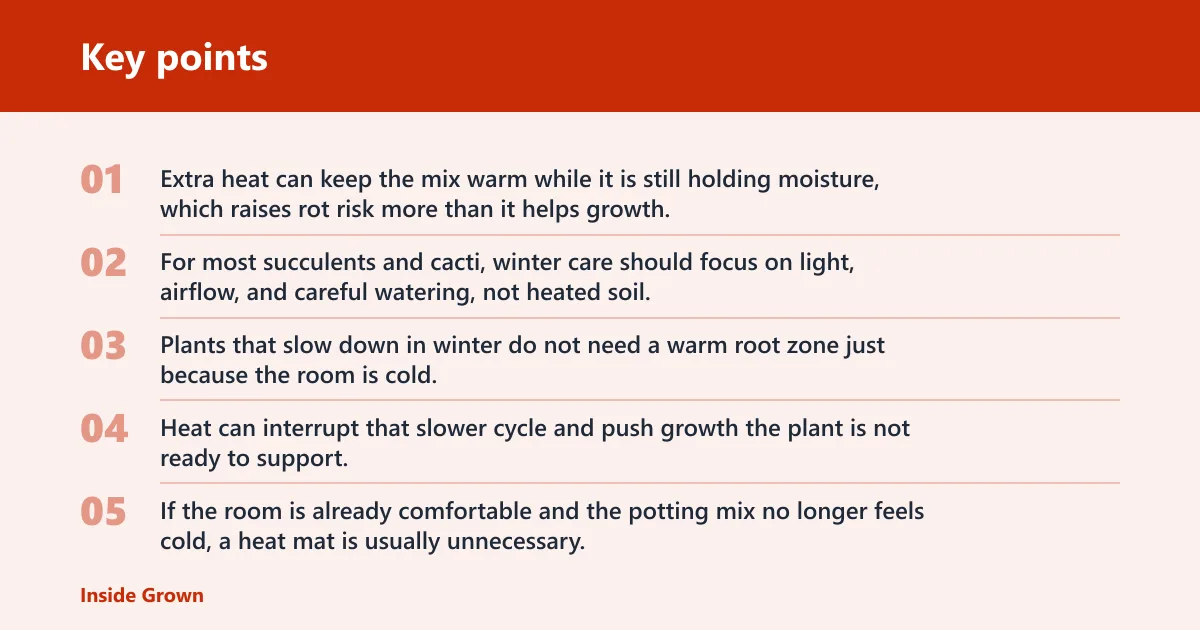
These plants generally prefer a drier setup, so a mat can work against the watering rhythm you want. Extra heat can keep the mix warm while it is still holding moisture, which raises rot risk more than it helps growth.
For most succulents and cacti, winter care should focus on light, airflow, and careful watering, not heated soil.
Dormant or cool-season plants
Plants that slow down in winter do not need a warm root zone just because the room is cold. Heat can interrupt that slower cycle and push growth the plant is not ready to support. That mismatch often shows up as weak stems or tired foliage.
A cool-season plant should usually be left alone unless it is being propagated and the cutting itself benefits from warmth.
Plants already in warm rooms
If the room is already comfortable and the potting mix no longer feels cold, a heat mat is usually unnecessary. The main gain from bottom heat disappears, while the drying risk remains. In that situation, ordinary winter care is usually the better choice.
A common first-timer mistake is leaving a mat on because it seems harmless. If the plant is not responding with better rooting or steadier growth, the mat may be doing more drying than helping.
Frequently asked questions
Can you use a seedling heat mat for regular houseplants?
Yes. A seedling heat mat can work for regular houseplants when the goal is warmer roots, not hotter air. Use one with waterproof or water-resistant construction, a standard size that fits the pot or tray, and a thermostat so the root zone stays in a safe range.
Do heat mats help houseplants in a cold room?
They can help a lot in a cold room because they warm the root zone even when the air stays cool. That is especially useful in basements, drafty rooms, and cold windowsill setups. The plant still needs enough light and careful watering, though.
Should houseplants stay on a heat mat all the time?
No, not all the time. Continuous use makes sense for seed germination, but established houseplants should only stay on a mat while the soil truly needs extra warmth. Stop once the room or mix stays warm enough without assistance, or if the plant shows stress.
How warm should a plant heat mat get?
A moderate soil temperature is the goal. Bob Vila recommends mats that can hold 75 to 85 degrees Fahrenheit in a tray, and many seed-starting mats are used in that general range. For houseplants, aim lower if the species prefers cooler roots or if the room is already warm.
Can a heat mat overheat roots or damage leaves?
Yes. Roots can overheat if the mat runs too hot or if the pot sits on it without a thermostat, and leaves can suffer later from stress, limp growth, or poor water balance. A mat warms the root zone, so the plant may react even when the leaves are not directly heated.