Is Garden Netting Safe for Pollinators?
Garden netting is generally safest for pollinators when it is used only before bloom or after fruit set, and it should be opened or removed during flowering so bees, butterflies, and moths can reach the crop. If you leave it closed through bloom, pollination can fail and harvests can drop. The safest decision comes down to four things: crop type, bloom stage, target pest, and how the cover is installed.
When garden netting harms pollinators


Garden netting is safe for pollinators only when it does not sit over open flowers that need insect visits. Timing, mesh opening, and how the cover is installed all affect safety. Material alone is not enough; a breathable cover can still block bees if it stays sealed during bloom.
When netting becomes a pollinator problem
The problem starts when flowers are inside the barrier and pollinators cannot reach them. That includes open blossoms on squash, cucumbers, melons, berries that need insect visits, and many flowering vegetables grown for fruit. If the cover traps bees already inside, the risk rises again at removal or when the edges are sealed too tightly.
Pollinators forage by crop stage, not by garden schedule. Bees, bumblebees, butterflies, moths, and hoverflies are active around blossoms, often during warm daylight hours, so a cover left in place through peak bloom can stop fruit set even if it looks harmless from a distance.
Which crops need insect access to flowers?
Insect-pollinated crops need pollinator access during bloom. Cucurbits are the clearest example. Many berries also set better with insect visits, and some crops produce better yield or shape when bees can reach the flowers. If the crop depends on insects, netting should come off or open before the first flowers fully open.
Self-pollinating crops are different. Tomatoes and peppers usually do not need bee visits for fruit set, so they can often stay covered longer if the cover is right for the pest and the mesh does not crush the plant. Even then, hidden blooms or volunteer flowers inside the cover should be checked before sealing it.
Which crops can stay covered longer?
Crops that do not rely on insect pollination can stay covered through longer pest windows. Brassicas before flowering, leafy crops, root crops, and self-pollinating vegetables are common candidates. The rule still changes once buds form or flowers open, because a cover that was useful last week can become a barrier this week.
As a simple rule: if the crop needs insects to set fruit, open the cover at bloom. If the crop does not depend on insects for fruit set, keep the cover on only while it is still useful against the target pest and the plant can grow without being compressed.
Garden netting safety checklist
This checklist helps you decide whether to cover, open, or remove netting. Use it before installation, again before sealing the edges, and once more before removal. A cover that blocks pests but traps a bee or hides a bloom is the wrong cover for that stage.
| Crop category | Safe-to-net window | Pollinator-risk note |
|---|---|---|
| Brassicas | Before buds form and after harvest | Useful for flea beetles and cabbage moths; remove if flowering stalks appear. |
| Brassicas in bud | Short term only, with daily checks | Buds can open under cover; once flowers appear, pollinators need access. |
| Cucurbits | Before bloom or after fruit set | Open during flowering so bees can reach squash and melon blossoms. |
| Berries | Before bloom or after most fruit is set | Flowering windows need bee access for fruit set on many berry crops. |
| Self-pollinating crops | Longer cover window is possible | Still inspect for hidden blooms and trapped insects before sealing or removing. |
- Check the crop stage. Look for buds, open flowers, and tiny hidden blossoms under leaves. If the plant is at bloom, plan to open the cover or remove it unless the crop does not need insect pollination.
- Match the target pest. Use netting only when pest pressure justifies it. Flea beetles, cabbage moths, squash vine borer, fruit flies, bird pressure, and debris each call for different exclusion needs and different timing.
- Inspect for insects first. Lift the cover edge and check for bees, butterflies, moths, hoverflies, and nesting insects before you seal anything. If insects are already inside, guide them out before closing the cover.
- Confirm the escape path. Make sure there is a zip opening, clip closure, or other access point that can be opened fast. You need a way to inspect daily and remove the cover at bloom without tearing the fabric.
What kind of netting is safest for bees?
The safest netting for bees is the one you remove during bloom on insect-pollinated crops. If you need a cover, choose a mesh opening that blocks the target pest without being finer than needed, and make sure the crop can still be inspected. Mesh size matters less than using the cover at the right stage and for the right pest.
Mesh opening size and bee passage risk
Bee passage risk rises as openings get smaller. Finer mesh is better for excluding small pests, but it also raises the chance of stopping bees, bumblebees, moths, and hoverflies from reaching flowers if the cover stays on. Coarser mesh may be enough where the goal is larger pests or debris rather than insect exclusion.
That is why mesh should be chosen for the pest, not for a product label. A tight barrier may help with flying insects, but it is not a pollinator-safe answer during flowering on crops that need insect visits.
Fine mesh versus coarse mesh
Fine mesh blocks smaller pests better. It also raises the chance of stopping bees, bumblebees, moths, and hoverflies from entering or leaving. Coarse mesh lets more air and insects through, which can help when the goal is birds or debris rather than insect exclusion.
The useful question is not whether a cover is “strong” or “premium,” but whether it is sized for the pest you are trying to exclude. A cover that is fine enough to stop small flying insects is also more likely to interfere with pollination if it remains over bloom.
Row cover, insect netting, and exclusion bags
Floating row cover and insect netting are not the same thing, even if they look similar at a glance. Row cover is often used as a light fabric barrier, while insect netting is usually a mesh screen with openings sized to exclude a target pest. Exclusion bags are smaller barriers used around individual fruit clusters or heads.
For gardeners, the practical distinction is simple: row cover is usually a pre-bloom barrier, insect netting is usually a pest-exclusion barrier, and exclusion bags are for small, reachable parts of a plant. None of them should stay closed over flowers that need pollinators.
When should you remove netting for bloom?
Remove or open netting before the first flowers fully open on insect-pollinated crops. For crops that need bees or other pollinators, the safe window is pre-bloom or after fruit set, not peak bloom. If the plant flowers under the cover, the barrier has already stayed on too long.
Pre-bloom and bud stage use
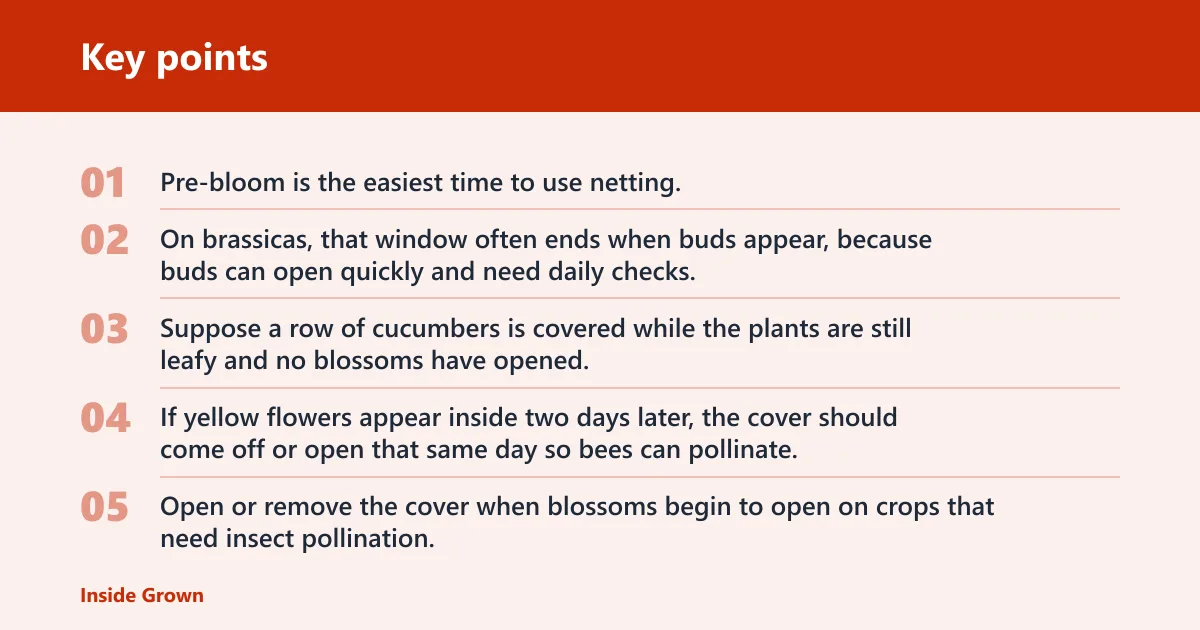
Pre-bloom is the easiest time to use netting. It can keep out flea beetles, cabbage moths, birds, and some flying pests while the crop is building leaves and stems. On brassicas, that window often ends when buds appear, because buds can open quickly and need daily checks.
Suppose a row of cucumbers is covered while the plants are still leafy and no blossoms have opened. That can be useful for early pest pressure. If yellow flowers appear inside two days later, the cover should come off or open that same day so bees can pollinate.
Bloom-time removal for insect-pollinated crops
Open or remove the cover when blossoms begin to open on crops that need insect pollination. That includes many cucurbits and some berries. Pollinators need direct access to blossoms for fruit set on these crops, and even a breathable cover can stand in the way.
A common first-timer mistake is to leave a cover in place because the crop “looks protected.” If flowers are open behind the mesh, the cover may protect the plant from pests while also protecting the flowers from bees. That trade-off usually lowers yield.
After fruit set on berries and cucurbits
After fruit set, some crops can be covered again if the flowers are done and the risk of pollinator loss is gone. That can help with birds, debris, or late pest pressure. Before you close it back up, check for late blooms and any insects resting inside the cover.
How should you install netting without trapping insects?
Install netting on hoops or frames with enough clearance above the foliage so blossoms do not press against the mesh. Seal the ground edge well enough to block pests, but leave an access point for inspection. If insects can get in but not out, the cover has failed as a barrier.
Hoops, frames, and clearance above foliage
Use hoops or a frame so the fabric does not rest directly on flowers. Clearance helps prevent bees from getting pinned against petals and lets you lift the cover for inspection without ripping stems. It also reduces rubbing that can damage tender buds and fruit.
Keep the cover high enough that the plant can grow for several days without touching the top. That matters most on fast-growing crops, where a tight cover can move from “protective” to “compressive” quickly.
Ground seals that still allow inspection
Seal the edges at ground level so pests cannot slip underneath, but design a point you can open without disturbing the whole structure. Clips, weights, or buried edges work only if you can still inspect the crop daily and make a clean opening when bloom starts.
If the edge is sealed so tightly that you cannot check the interior, you risk trapping bees, butterflies, and even beneficial insects already inside. That is why inspection comes before closure and before removal.
Zip openings, clips, and daily access
A zip opening or clip closure makes daily access practical. Open the cover long enough to look for flowers, eggs, and trapped insects, then close it again if the crop is still in a safe stage. A daily check is especially useful for brassicas in bud and for mixed plantings where one plant blooms before another.
Say a bed has brassicas on one end and strawberries on the other. The brassicas can stay covered before buds form, but the strawberries may need bee access during bloom. Separate covers, or a cover that can be opened on one side, prevents one crop’s pest plan from blocking the other crop’s pollination window.
What pests does netting help block?
Netting helps most when the target is a flying pest, seed-feeding bird, or debris. It is commonly used for birds, deer, and debris control, and it can also reduce pressure from flea beetles, cabbage moths, squash vine borer, and fruit flies when the timing fits the pest.
Flea beetles and cabbage moths
On brassicas, netting can help exclude flea beetles and cabbage moths before plants flower. That makes it useful early in the season, before any buds open. Once flowering starts, the same cover can get in the way of pollinators and should be opened or removed.
Squash vine borer and fruit flies
On cucurbits, early netting can block adult squash vine borer moths from reaching the plant. Fruit flies are another common target in some crops. In both cases, the safe window depends on whether flowers must stay open for pollination. If they do, you need a different barrier during bloom.
Bird pressure and debris control
Bird netting is often chosen for fruit, berries, and seed crops under bird pressure. Larger mesh can also reduce leaf litter or windblown debris. That use is different from insect exclusion, so do not treat one product as universal protection for pests and pollinators at the same time.
Pollinator-safe alternatives to netting
If flowers must stay covered, use a different tool. Floating row cover can work before bloom, exclusion bags can protect individual fruit, and hand pollination can replace insect visits on a small crop. Each option has a narrow use, but each avoids the mistake of sealing flowers away from bees.
Floating row cover by crop stage
Floating row cover fits best before bloom on crops that need early pest exclusion. It is light and commonly used for seedlings and young plants, but it still blocks pollinators if left over flowering crops. Remove it at bud swell or first bloom on insect-pollinated plants.
Hand pollination for covered flowers
Hand pollination can help when a cover must stay on briefly and the crop needs fruit set. It is most practical for small plantings, greenhouse-style beds, or a few protected flowers. Use it only as a short bridge, not as a full-season substitute for pollinator access.
Crop-specific exclusion bags and cages
Exclusion bags and fine cages work best for individual clusters, seed heads, or fruit you can reach by hand. They are useful when you want to stop insects without covering the whole bed. Check that the bag or cage still leaves room for the flower to open and the fruit to expand.
A small berry cage may be used for bird pressure after harvest has started. That may be fine if the fruit is already set. If the same cage goes on before bloom, it can keep bees out at the one stage when they matter most.
Frequently asked questions
Is garden netting safe for pollinators?
Yes, if it is used before bloom or after fruit set and opened during flowering on crops that need insect pollination. It is not safe when it blocks bees, butterflies, or moths from open blossoms. Timing matters more than whether the cover feels light or breathable.
How fine should netting be to keep insects out?
Use the finest mesh that matches the pest you are trying to stop, but no finer than needed. Finer mesh improves exclusion, but it also raises the chance of blocking pollinators. The right size is the one that controls the pest without staying over bloom.
Can pollinators get trapped in garden netting?
Yes. Bees, bumblebees, butterflies, moths, and hoverflies can end up trapped inside if they enter before the edges are sealed, or if blooms open under a closed cover. Check for insects before you close the cover and again before you remove it so you do not trap them in either direction.
When should I remove netting so bees can pollinate?
Remove or open the cover at the first open flower on insect-pollinated crops. For cucurbits and many berries, that timing is often the difference between fruit set and poor yield. On brassicas, remove it before buds open if you want to avoid blocking any later flowering.
What are safer alternatives to netting for pest control?
Floating row cover before bloom, exclusion bags for individual fruit, hand pollination for a small number of flowers, and short-term cages for seed heads are all safer choices when blossoms must stay reachable. Each option is more limited than full-bed netting, but each keeps pollinators in the plan.
How do I protect pollinators while using garden netting?
Use netting only when the crop does not need pollination, or only before bloom and after fruit set. Check for flowers and trapped insects before sealing the cover, give the plants room under hoops or frames, and open the cover during flowering. Those steps protect both the crop and the pollinators.