Is Brick Dust Safe for Vegetable Gardens?
Brick dust is generally not a safe default for vegetable gardens. Use it only if you can verify it came from clean, uncontaminated brick or masonry, and keep unknown dust out of edible beds. Used carelessly, it can add heavy metals, cement residue, or silica dust to soil and expose you during handling. Here’s how to judge contamination risk before any dust-like material goes near seedlings, soil, or harvested crops.
Brick dust and vegetable beds

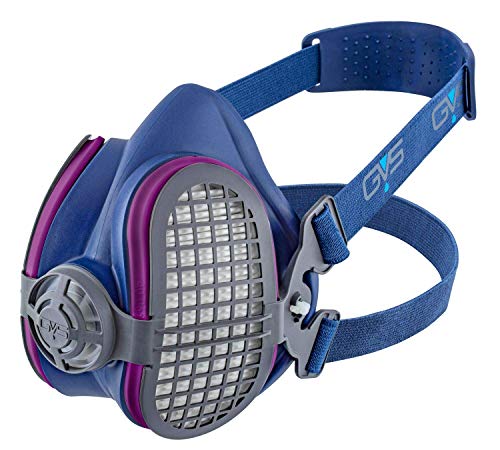
What brick dust
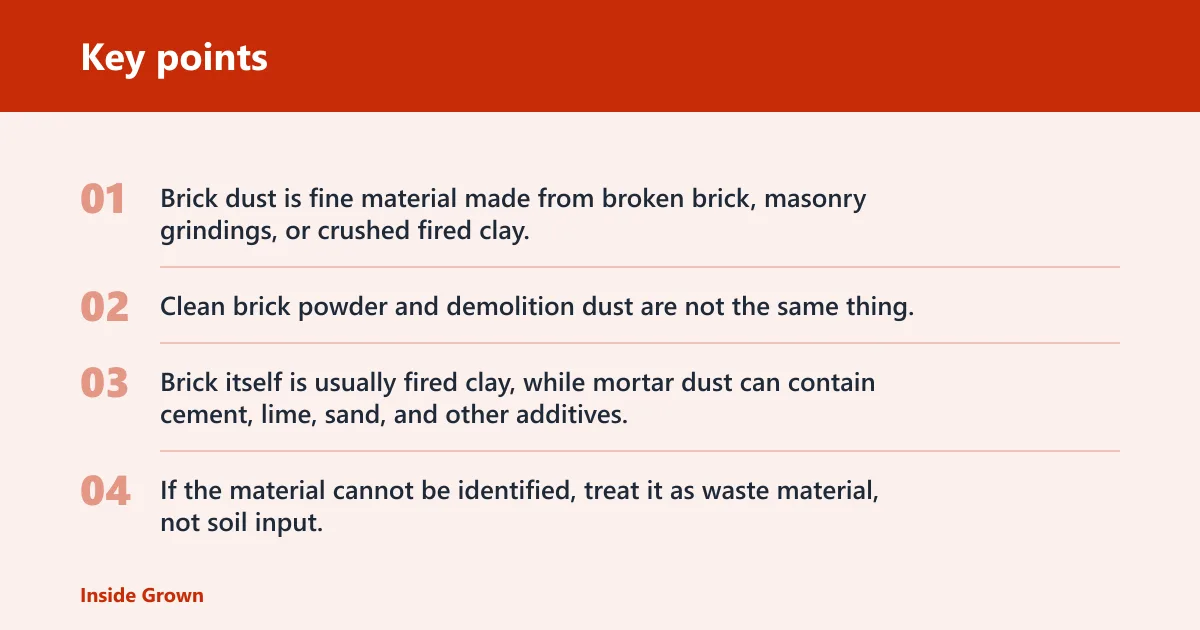
Brick dust is fine material made from broken brick, masonry grindings, or crushed fired clay. It may also pick up mortar, paint, sealers, or demolition debris during collection. That source matters more than the name on the bag, because the same dusty-looking material can range from relatively clean clay powder to mixed construction waste.
Why source matters more than the name
Clean brick powder and demolition dust are not the same thing. Brick itself is usually fired clay, while mortar dust can contain cement, lime, sand, and other additives. If the source includes old coatings, sealers, or mixed rubble, the question is no longer “is brick dust safe?” but “what else is in it?”
When it does not belong in edible soil
Brick dust does not belong in a vegetable bed by default. Unknown construction dust should stay out of food beds, seed-starting mix, and root zones, since the main concerns are inhalation during handling, possible soil contamination, and residue contact on crops. If the material cannot be identified, treat it as waste material, not soil input.
Is brick dust safe for vegetable gardens?
Only clean, known brick powder has a possible place near vegetables, and even then it is not a normal amendment for food beds. Unknown dust, mortar dust, and demolition dust should be kept out of vegetable soil. For edible beds, the answer is no unless the source is verified and the material passes a basic contamination check.
Clean brick powder versus contaminated construction dust
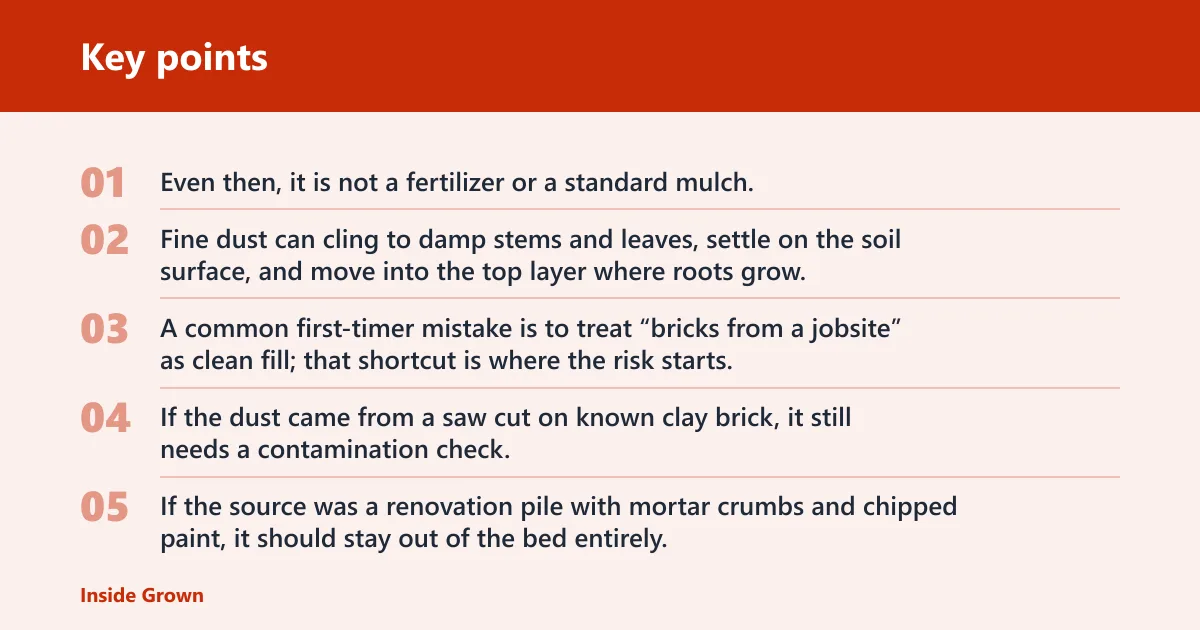
Clean clay brick powder is generally the least concerning version because it is closer to inert mineral fines than to mixed debris. Even then, it is not a fertilizer or a standard mulch. Contaminated construction dust is different: old mortar, paint, sealers, and demolition fragments can carry metals or other residues that do not belong in beds for lettuce, carrots, beans, or tomatoes.
Soil-contact risks for seedlings and roots
Direct incorporation into vegetable soil is the wrong default because seedlings and root crops sit in close contact with whatever is mixed in. Fine dust can cling to damp stems and leaves, settle on the soil surface, and move into the top layer where roots grow. That matters most in direct-seeded beds and shallow-rooted crops.
When to keep it out of food beds
Keep brick dust out of edible beds if the source is unknown, if the material came from demolition, if it has mortar attached, or if it shows paint, sealers, rust, or mixed rubble. A common first-timer mistake is to treat “bricks from a jobsite” as clean fill; that shortcut is where the risk starts.
Suppose a raised vegetable row has settled unevenly after heavy rain and someone plans to use leftover brick dust to level the hollow before planting. If the dust came from a saw cut on known clay brick, it still needs a contamination check. If the source was a renovation pile with mortar crumbs and chipped paint, it should stay out of the bed entirely.
What makes brick dust risky?
Inhalation risk during handling
The first hazard is breathing the dust, especially during sweeping, dumping, or mixing. Fine mineral particles can irritate the nose, throat, and lungs, and dusty demolition cleanup calls for careful handling rather than loose, open dumping. If the material clouds the air, the handling method is already too loose for food-bed work.
Possible mortar, paint, sealant, or debris contamination
The larger gardening concern is often what came along with the brick. Mortar can add lime and cement dust, old paint can add lead or other metals, and sealers or adhesives can leave unknown residues. Asbestos is not a brick-dust issue by itself; concern usually comes from associated demolition materials, not the fired clay brick.
pH and mineral changes in soil
Brick dust can shift soil chemistry if enough mortar or alkaline material is present. Mortar dust tends to raise pH more than clean brick powder, which can matter in beds that already run alkaline or that are being prepared for acid-sensitive crops. If the source is unknown, pH is only one question; contamination screening matters more.
Brick dust safety decision table
| Source of dust | Risk level for vegetable gardens | Recommended action |
|---|---|---|
| Reclaimed brick | Low to moderate, depending on coatings and attached mortar | Use only if cleaned, uncontaminated, and verified; avoid direct use in edible beds if any doubt remains |
| Mortar dust | Moderate to high | Keep out of food beds; test if you are considering any soil contact use |
| Demolition dust | High | Reject for vegetable beds unless you have lab results and a clean, known source |
| Clay brick powder | Low if source is clean; higher if mixed with debris | Use only for non-edible projects or after screening for contamination |
| Labeled commercial mineral dust | Varies by label and intended use | Follow the product label; do not treat it like reclaimed masonry dust |
Edible-bed checklist
- Known source?
- Any mortar, paint, or sealer?
- Demolition origin?
- Visible mixed debris?
- Lab test for metals if uncertain?
If you cannot answer “yes” to known source and “no” to the contamination questions, the material should not go into an edible bed. If the source is uncertain, treat the dust as a non-food material until it is verified.
How to check unknown dust before use
Pass/fail flow: start with the source, then check for visible contamination, then decide whether testing is needed.
- Pass: known clean brick powder with no mortar, paint, sealers, or mixed debris visible.
- Fail: any demolition source, attached mortar, paint flakes, sealers, rust, wire, tar, or mixed rubble.
- If uncertain: test the material or the receiving soil before any use near vegetables.
-
Inspect for contamination.
Look for mortar chunks, paint flakes, sealers, tar, rust, wire, or mixed debris. If any of those are present, do not use the material in an edible bed. A clean-looking pile is not enough when the source came from renovation or demolition.
-
Test what you cannot identify.
If the source is still uncertain, test the material or the receiving soil for pH and heavy metals. A lab can check common garden concerns such as lead, arsenic, cadmium, and chromium. Lab testing is the only way to verify an unknown source with any confidence.
-
Reject mixed construction waste.
Do not try to salvage dust that came from a wall tear-out, chimney removal, or old masonry cleanup. Even after visible debris is removed, the fine fraction may still contain residues that are not acceptable near food crops. If the source is mixed, the answer is no.
Suppose a bag of dusty rubble includes pale powder, red fragments, and gray crumbs from old mortar. That mix is a contamination problem, not a garden amendment. By contrast, a bag labeled as clean clay brick powder from a known source may be suitable for a non-edible path base after screening.
Practical screening targets
For edible beds, the most useful checks are simple: identify the source, look for visible contaminants, and test pH if the material will touch soil. If the source is unknown, heavy metal testing is the more important screen. A clean source with a normal pH still needs a contamination review before it goes near vegetables.
Where to buy brick dust
Buy only from sources that can identify the material clearly and state whether it is clean, commercial mineral/clay product or reclaimed masonry material. Clean commercial products are the safer category because they are sold as a defined input, while reclaimed or demolition material can contain mortar, coatings, or mixed debris. For vegetable beds, avoid any source that cannot prove the dust is clean and uncontaminated.
What should you use instead?
For paths, edging, or drainage layers, use materials that are sold for that purpose and clearly labeled for outdoor use. For edible beds, choose amendments with a known plant-food role rather than a masonry byproduct. If you need weed suppression, remember that pre-emergent herbicides work before weed seeds germinate, which makes timing critical for direct-seeded vegetables.
Safer options for paths and edging
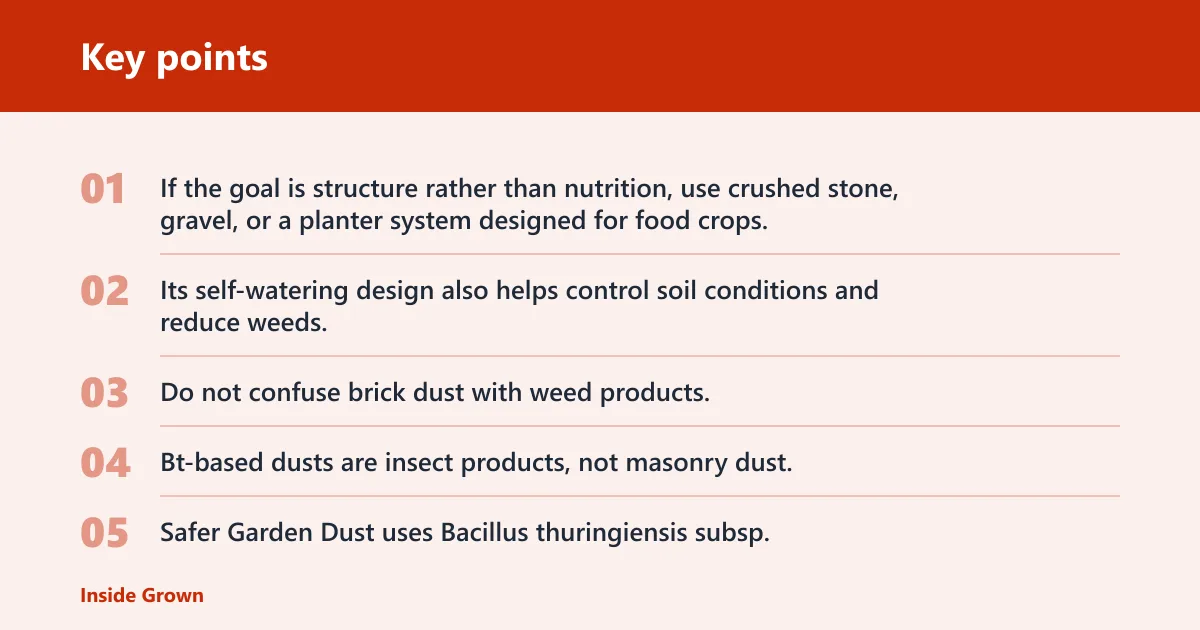
If the goal is structure rather than nutrition, use crushed stone, gravel, or a planter system designed for food crops. The EarthBox Root & Veg gardening system is food-safe, BPA-free, and recyclable, and it is designed for root crops like carrots, beets, and onions. Its self-watering design also helps control soil conditions and reduce weeds.
Pre-emergent and weed-control products are different
Do not confuse brick dust with weed products. Preen is described as made with 100 percent corn gluten, presented as a natural pre-emergent herbicide, and specifically designed for vegetable gardens. It prevents weed seeds from growing and is not effective on existing weeds, so timing matters if you direct-seed crops.
Bt, corn gluten, and labeled garden dusts are not brick dust
Bt-based dusts are insect products, not masonry dust. Safer Garden Dust uses Bacillus thuringiensis subsp. kurstaki, controls leaf-eating caterpillars and worms, is described as safe to use around children and pets, and is OMRI Listed for organic production. Its active ingredient is 0.4365%, with 99.5635% inert ingredients, and the label calls for 2 to 3 ounces per 50 feet of row plantings, applied when pests are first noticed and repeated every 7 to 10 days as needed. Bt also breaks down quickly in sunlight.
That kind of product belongs in a pest-management decision, not in the same category as reclaimed brick dust. If a label says Bt, it is a biological pesticide. If a label says corn gluten, it is a pre-emergent weed preventer. If it is construction dust, keep it out of edible soil unless it has been verified clean.
Can dust affect bees and beneficial insects?
Yes, but the mechanism matters. Plain mineral dust can physically coat insects and flowers, while pesticide dusts can expose pollinators to an active ingredient. Keep any dusty material away from blooms and from active bee traffic, and treat labeled garden products according to their own instructions rather than assuming all dust behaves the same way.
Physical coating versus pesticide exposure
A light layer of mineral dust on flowers can interfere with pollinator movement and feeding. A labeled pest product may add a chemical or biological exposure on top of that. For edible gardens, the safer practice is to keep dust applications away from open blossoms and to avoid any dusty work when bees are actively foraging.
Why labeled garden products need their own label review
Bt products, corn gluten products, and weed-preventer products have different purposes and different instructions. Read the active ingredient on the label before using anything near vegetables, bees, or children. A product meant to control caterpillars is not a substitute for mineral dust, and a weed preventer is not a soil amendment.
Frequently asked questions
Is brick dust harmful?
It can be. The main concern is not the word “brick” itself but what is attached to it or mixed into it. Clean brick powder is one thing; mortar dust, demolition dust, paint, sealers, and unknown debris are another. Unknown material should stay out of edible beds and off your lungs.
Is brick dust dangerous?
It can be dangerous during handling and if it contains construction contaminants. Fine dust can irritate the respiratory system, and contaminated sources can add unwanted residues to soil. If the source is unknown, reject it for vegetable gardens and keep it away from harvested crops.
Is 7 dust safe for vegetable gardens?
Do not confuse “7 dust” with brick dust. Garden products with names like that are usually insect-control products or other labeled treatments, and their safety depends on the active ingredient and label directions. Brick dust is a separate material and should not be treated like a pesticide or a garden amendment.
What is brick dust?
It is fine material from broken brick, masonry grinding, or crushed fired clay, sometimes mixed with mortar or demolition debris. That mixed source is why the name alone is not enough. For food gardens, the key question is whether the dust is clean, known, and free of contaminants.
Can brick dust be used in a vegetable garden bed?
Not as a default. Only clean, verified brick powder has any possible role near vegetables, and even then it is usually better kept out of direct soil incorporation. If the source includes mortar, paint, sealers, or unknown rubble, keep it out of the bed entirely.
What should I use instead of brick dust near vegetables?
Use materials made for the job: labeled garden products for pests or weeds, clean outdoor materials for paths, and food-safe planter systems for root crops. Bt products, corn gluten weed preventers, and systems like the EarthBox Root & Veg serve different purposes than masonry dust. Match the product to the task.