Which Property of Soil Depends on Particle Size?
Which property of soil depends on the size of particles? The answer is soil texture, a fundamental characteristic that defines how soil feels, drains, and supports plant life. This post explains soil texture, its determining factors, and why it matters for gardening, farming, and construction.
Simply put, soil texture is the property that depends on particle size. It classifies soil based on the proportions of sand, silt, and clay. This texture controls drainage, nutrient retention, and root penetration directly from the physical size of soil particles.
Key Takeaways
- Soil texture depends directly on particle size and influences all other physical soil properties.
- The three primary particle sizes are sand (largest), silt, and clay (smallest), each affecting drainage and fertility differently.
- Soil texture determines water holding capacity, aeration, and nutrient availability for plants.
- Knowing your soil textural class helps you select the right plants and amendment strategies.
- Soil texture is a stable property that does not change easily over time, unlike soil structure.
What Is Soil Texture and Why Does Particle Size Matter?
Soil texture refers to the relative proportions of sand, silt, and clay particles in a given soil sample. It is the single most important physical property because it governs how water moves, how roots grow, and how nutrients are stored.
Particle size directly influences the surface area available for chemical reactions. Smaller particles like clay have enormous surface area relative to their volume, which increases their ability to hold water and nutrients. Larger particles like sand have less surface area but create larger pore spaces for rapid drainage.
| Particle Type | Size Range | Key Properties |
|---|---|---|
| Sand | 0.05 – 2.0 mm | Large pores, fast drainage, low nutrient holding |
| Silt | 0.002 – 0.05 mm | Medium pore size, moderate drainage, fair fertility |
| Clay | Smaller than 0.002 mm | Very small pores, slow drainage, high nutrient retention |
This table shows how particle size directly determines the physical behavior of soil. According to the USDA Natural Resources Conservation Service, soil texture is the most stable soil property because it takes thousands of years to change through natural weathering processes.
Important: Soil texture should not be confused with soil structure. Texture is about particle size distribution, while structure refers to how particles clump together into aggregates.
How Does Particle Size Influence Water Drainage and Retention?
Water movement through soil is primarily controlled by pore space, which depends on particle size. Sand particles create large pores that allow water to drain quickly. Clay particles create numerous tiny pores that hold water tightly through capillary action.
A soil dominated by sand will feel gritty and drain rapidly, often leading to drought stress for plants. A clay-dominant soil feels sticky when wet and may become waterlogged. Silt offers a middle ground with moderate drainage and good water retention.
- Sand: Water drains within minutes to hours after rain.
- Silt: Water drains over hours to a day.
- Clay: Water may remain for days or even weeks.
- Loam, a balanced mix of all three, provides ideal drainage and retention.
- Soil texture also affects the rate of infiltration and runoff.
- Fine-textured soils (clay) have higher water holding capacity but lower available water for plants.
- Coarse-textured soils (sand) have low total water holding capacity but higher available water percentage.
Research from the University of California Agriculture and Natural Resources indicates that clay soils can hold up to 50% more water by volume than sandy soils, but plants may struggle to extract that water due to strong capillary forces.
What Are the Different Soil Textural Classes Based on Particle Size?
Soil scientists use a textural triangle to classify soil into 12 major textural classes based on the percentages of sand, silt, and clay. This triangle is a standard tool developed by the USDA to simplify field identification.
The classification ranges from sand (more than 85% sand) to clay (more than 40% clay) with many combinations in between. Each class has distinct properties for drainage, aeration, and nutrient availability.
- Sand – Coarse, gritty feel, drains very quickly.
- Loamy Sand – Slightly more silt and clay than pure sand.
- Sandy Loam – Balanced but still sandy, good for many crops.
- Loam – Ideal balance of sand, silt, and clay.
- Silt Loam – Smooth, floury feel when dry, moderate drainage.
- Clay Loam – Sticky when wet, high nutrient content.
- Clay – Very sticky, slow drainage, fertile but heavy.
- Silt – Rare as a pure class, feels like powder.
- Sandy Clay Loam – Combination with higher clay content.
- Silky Clay – Smooth and sticky mixed texture.
The USDA classification system is widely used internationally. The Natural Resources Conservation Service reports that loam is the most sought-after texture for agriculture because it balances drainage and fertility.
Why Is Soil Texture Important for Agriculture and Gardening?
Understanding which property of soil depends on particle size helps farmers and gardeners make informed decisions about irrigation, fertilization, and crop selection. Soil texture dictates how often you need to water and how much fertilizer is required.
For example, sandy soils require frequent watering with smaller amounts to avoid leaching nutrients below the root zone. Clay soils hold nutrients tightly but may need less frequent irrigation. Silt loams often support high yields with moderate inputs.
| Soil Texture | Watering Frequency | Fertilizer Needs |
|---|---|---|
| Sand | Every 2-3 days | Higher, more frequent applications |
| Sandy Loam | Every 4-5 days | Moderate, every 2 weeks |
| Loam | Every 5-7 days | Balanced, monthly application |
| Clay Loam | Every 7-10 days | Lower, may cause buildup |
| Clay | Every 10-14 days | Low, use slow-release forms |
This practical guide shows that knowing your soil texture reduces waste and improves crop health. The Food and Agriculture Organization notes that soil texture is a key factor in precision agriculture, helping reduce water use by up to 30% in some cases.
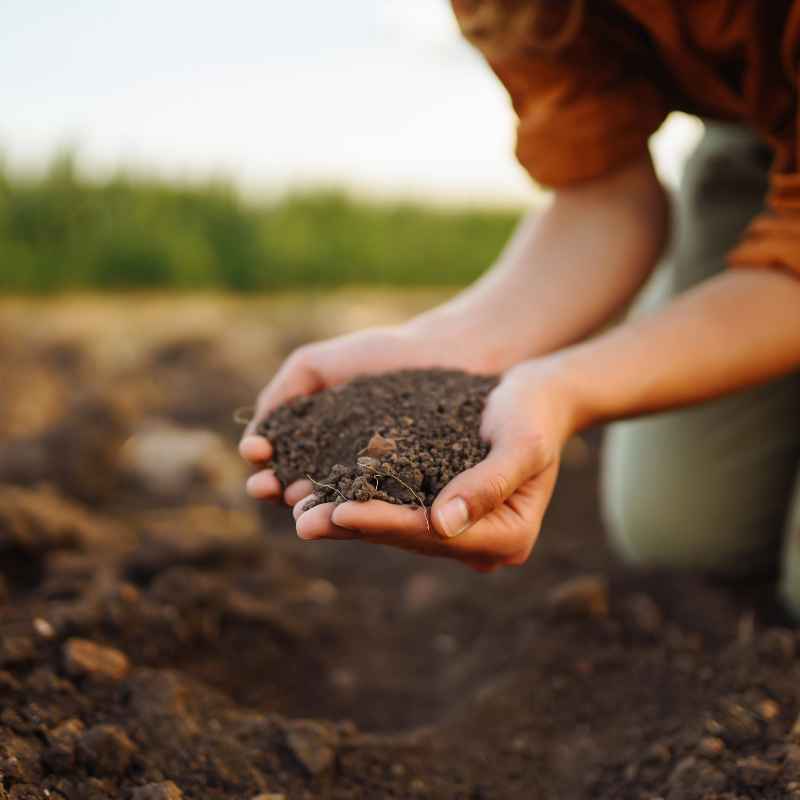
Tip: To check your soil texture at home, take a handful of moist soil and squeeze it. If it forms a ball that crumbles easily, it is loam. If it feels gritty, it is sandy. If it feels sticky and holds its shape, it is clay.
How to Determine the Soil Texture of Your Land
There are several methods to determine which property of soil depends on particle size, ranging from simple field tests to laboratory analysis. The most common field method is the “feel test” or ribbon test, which requires only a small sample and water.
The ribbon test involves wetting the soil and pressing it between thumb and forefinger to form a ribbon. The length of the ribbon indicates clay content. A ribbon less than 2.5 cm suggests sandy soil, while a ribbon longer than 5 cm indicates clayey soil.
- Collect a 100-gram sample from the root zone (top 6 inches).
- Remove any rocks, roots, or organic debris.
- Add water gradually until the soil becomes pliable but not muddy.
- Squeeze the sample into a ball; note how well it holds together.
- Press the ball between your thumb and forefinger to form a ribbon.
- Measure the ribbon length: short (sand), medium (loam), long (clay).
- Use a permanent marker to record the result for future reference.
For more precise results, the Bouyoucos hydrometer method is used in laboratories. It measures the settling rate of particles in water to calculate the percentages of sand, silt, and clay. This method is considered the gold standard by the American Society of Agronomy.
Warning: Do not rely solely on visual appearance to judge soil texture. Organic matter, moisture content, and compaction can mislead your assessment. Always perform a physical test with water.
How Does Soil Texture Interact with Other Soil Properties?
While particle size determines soil texture, texture then influences many other soil properties such as structure, porosity, and chemical activity. This makes texture a master variable in soil science.
Soil structure is how particles aggregate into clumps. Clay-rich soils tend to form strong aggregates, while sandy soils have weak structure. Soil porosity is the total space between particles, which is high in clay but with small pores, and low in sand but with large pores.
- Nutrient retention: Cation exchange capacity (CEC) is higher in clay due to large surface area.
- Organic matter: Clay binds organic matter more effectively than sand.
- Root penetration: Sandy soils allow easy root growth, clay soils resist root penetration.
- Microbial activity: Clay soils support more diverse microbial communities due to habitat stability.
- Thermal conductivity: Sandy soils warm up faster in spring, clay soils warm slowly.
According to the International Union of Soil Sciences, soils with high clay content have CEC values ranging from 10 to 100 meq/100g, while sandy soils rarely exceed 5 meq/100g. This directly impacts fertilizer efficiency and plant nutrition.
Common Misconceptions About Soil Particle Size
Many people assume that soil texture is the same as soil fertility or that all clay soils are bad for gardening. These misconceptions can lead to poor management practices. Particle size alone does not determine fertility, but it heavily influences it.
Myth 1: Sandy soils are always infertile. Fact: With proper irrigation and organic matter amendments, sandy soils can be very productive for crops like carrots and potatoes.
| Misconception | Reality |
|---|---|
| Clay soil is always heavy and hard to work | Clay can be improved with organic matter and proper timing of tillage |
| Sandy soil dries out too fast for any plant | Many drought-tolerant plants thrive in sandy soils |
| Particle size does not affect pH | Clay soils often buffer pH changes better than sandy soils |
| Soil texture changes quickly with fertilizers | Texture is stable over centuries; only soil structure changes rapidly |
Understanding that soil texture is a stable property based on particle size helps you focus on management techniques like adding compost to improve structure rather than trying to change texture itself.
Frequently Asked Questions
Which property of soil depends on the size of particles?
Soil texture is the property that depends directly on particle size. It refers to the relative proportions of sand, silt, and clay particles in the soil.
How can I measure soil particle size at home?
You can use the jar test: place a soil sample in a clear jar, add water, shake, and let it settle. Sand settles in minutes, silt in hours, and clay in days. The layers show the proportions.
Does soil texture affect plant growth?
Yes, soil texture affects water drainage, nutrient availability, and root penetration. Different plants prefer different textures; for example, succulents like sandy soil, while rice thrives in clay-heavy soil.
Can soil texture be changed permanently?
Soil texture is very stable and changes only over thousands of years through natural weathering. You can adjust drainage with amendments, but the fundamental particle size distribution remains.
What is the difference between soil texture and soil structure?
Soil texture is about the size of individual particles (sand, silt, clay). Soil structure describes how these particles bind together into aggregates, which can change with management practices.
Final Thoughts
Knowing which property of soil depends on the size of particles — soil texture — allows you to make smarter decisions for your garden, farm, or construction project. Texture controls water movement, nutrient storage, and root growth directly. By testing your soil’s texture once, you gain a permanent guide for irrigation, fertilization, and crop selection.
Start with a simple ribbon test today to unlock your soil’s full potential.