
How to Avoid Crowds at a Botanical Garden
To avoid crowds at a botanical garden, choose a weekday, book the first timed entry or a late-afternoon slot, and use the least-used entrance. In destination gardens, free-entry gardens, and conservatory-heavy sites, the busiest hours and the best escape routes can differ, so check the garden’s official hours, ticket, parking, and event pages before you go. If parking fills before opening, switch to transit or an off-site lot plan; otherwise, you can lose time in lines, miss quieter paths, and spend the visit in traffic instead of among plants.
When do crowds build at botanical gardens?
Many botanical gardens are busiest in mid-morning and early afternoon, especially in mild weather and during festival days, holiday periods, or bloom peaks. At smaller local gardens, the rush may be brief and concentrated around opening; at destination gardens and popular conservatories, the pressure can last longer because visitors arrive for the same featured displays and indoor spaces.
That pattern changes when schools are out. Monday through Thursday is often quieter, while Saturday and Sunday tend to draw the most visitors, and public holidays can push a weekday toward weekend traffic. Official visitor calendars and event listings often show the sharpest spikes around spring break, summer vacation, member previews, and seasonal light or bloom events.
Peak visiting hours and why they matter
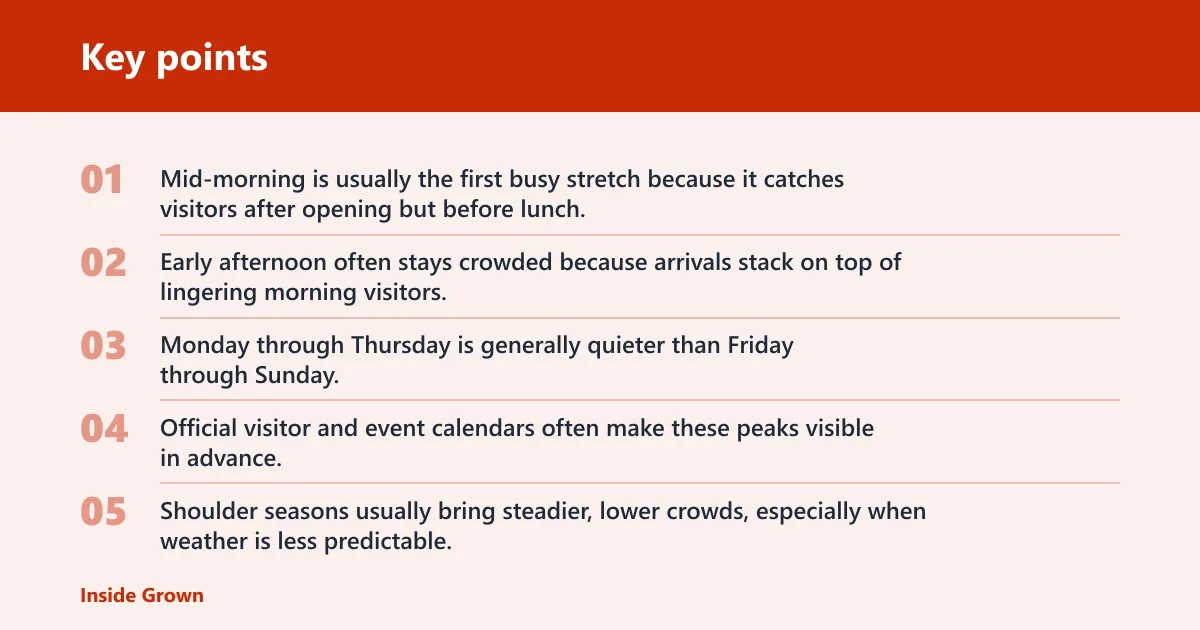
Mid-morning is usually the first busy stretch because it catches visitors after opening but before lunch. Early afternoon often stays crowded because arrivals stack on top of lingering morning visitors. If fewer people on paths and at labels is the goal, the first hour after opening and the last two hours before closing are often the best bets, especially at outdoor-heavy gardens where weather changes can thin the flow later in the day.
Weekday, weekend, and holiday traffic patterns
Monday through Thursday is generally quieter than Friday through Sunday. Saturday and Sunday are the hardest days to predict because they combine leisure traffic, family schedules, and event programming. Public holidays can create weekend-like traffic on a weekday, especially when the garden is a regional destination or sits near a major tourism corridor. Official visitor and event calendars often make these peaks visible in advance.
How blooms, events, and weather shift demand
Bloom peaks pull in visitors who are willing to accept more people for better flowers, which is why official bloom calendars often coincide with higher crowding. Shoulder seasons usually bring steadier, lower crowds, especially when weather is less predictable. Light rain often reduces attendance at mostly outdoor gardens, while extreme heat, wind, or storms can cut outdoor traffic and move more people into indoor conservatories, where the crowd can feel denser even if the overall turnout is lower.
What you’ll need
- The garden’s hours and ticket page
- A calendar with holidays, school breaks, and event dates
- A parking plan with at least one backup lot or transit option
- Comfortable walking shoes for longer entry routes
- An umbrella or light rain layer if rain is part of the plan
- A mobile ticket or printed reservation if timed entry is required
- An accessibility plan if you need the shortest route from parking to the entrance

How should you time your visit?
The best crowd-avoidance move is to match your arrival window to the day’s demand curve, not just the opening time. For free-entry gardens, opening hour can be enough to beat the main rush; for timed-entry gardens, the first slot matters more because capacity controls shape the whole day. If the garden uses reservations, sellout risk matters as much as the hour itself.
Check the calendar first. Look for festivals, concerts, seasonal displays, member previews, and member-only mornings before you choose a day. A bloom-weekend concert or a holiday light display can create crowd spikes even on weekdays, and tourism calendars often flag these events ahead of time.
Pick the lowest-demand day. Favor Monday through Thursday, then avoid public holidays, spring break, and the main bloom peak if you want the quietest paths. If you must go during peak bloom, shift toward the first entry window or a late-afternoon slot.
Reserve the earliest slot. Buy timed-entry tickets as soon as they open if the garden uses capacity controls. Entry windows can sell out, and arriving late in the window often means waiting behind a larger group.
Plan the parking backup. If overflow lots or off-site parking are listed, map them before you leave. Drive-in arrivals should be earlier than walk-in arrivals because parking congestion can create delays before you ever reach the gate.
Use weather to your advantage. Light rain often thins the crowd, but strong wind, extreme heat, or a storm warning can change access patterns and move people indoors. Check whether the conservatory stays open, because indoor space can become the most crowded part of the visit, especially at gardens where indoor attractions are a major draw.
Say your target day is a Saturday in peak tulip season with a 10 a.m. concert. Expect heavy traffic at the main gate, full parking by mid-morning, and longer waits at popular displays. The quieter option is often the first entry slot, a secondary entrance, and a loop that starts at the farthest garden section first.
Suppose rain is forecast for the afternoon but the garden has a large conservatory. Attendance may drop outside, then concentrate inside once the weather turns. In that case, an early arrival can help you enjoy the outdoor paths before the indoor crowd shifts there.
Which day, season, and weather combo is quietest?
Use this matrix to predict the lowest-crowd window by day, season, weather, event status, school calendar status, conservatory presence, and parking pressure. It is most useful when you have more than one choice, because the best answer changes with bloom timing, climate, and programming.
| Weekday | Season | School calendar status | Weather | Conservatory presence | Event status | Parking pressure | Ticket type | Lowest-crowd visit window |
|---|---|---|---|---|---|---|---|---|
| Monday-Thursday | Shoulder season | School in session | Light rain or cool overcast | Mostly outdoor | No event | Low | General admission or timed entry | First hour after opening |
| Monday-Thursday | Bloom peak | School in session | Dry and mild | Indoor conservatory present | No event | Medium | Timed entry | First entry window or last two hours before closing |
| Friday | Shoulder season | School in session | Windy or cooler than normal | Mostly outdoor | Small exhibit only | Medium | General admission | Late afternoon, after school pickup time |
| Saturday-Sunday | Bloom peak | School out | Dry and sunny | Indoor conservatory present | Festival, concert, or seasonal display | High | Timed entry that still has availability | Earliest slot only, with backup parking plan |
| Any day | Holiday period | School out | Mild | Either | Member-only morning or preview | High | Reservation required | Choose a different day if flexibility matters |
| Any day | Summer vacation | School out | Extreme heat | Indoor conservatory present | No event | Medium to high | General admission | Opening hour or the final hour before closing |
Decision checklist for sold-out or peak-bloom days:
- If the first timed entry is sold out, a common fallback is to choose the last slot of the day.
- If parking is limited, switch to transit or off-site parking before you leave home.
- If a member-only morning is listed, avoid that date unless you qualify.
- If a festival overlaps bloom peak, expect the main gate to be the slowest point.
- If weather turns pleasant after a rain delay, arrive at opening rather than mid-morning.
Are weekdays quieter?
Yes. Monday through Thursday is usually quieter than Friday through Sunday, and that difference is most obvious when the garden has timed entry or a major seasonal display. Weekdays still get busy during school holidays, spring break, and late-spring bloom peaks, so the day of week is helpful, not absolute. Free-entry neighborhood gardens may stay manageable on weekdays even in bloom season, while destination gardens can still feel busy because visitors concentrate around the same featured areas.
Monday through thursday vs. saturday and sunday
On weekdays, arrivals are spread out more evenly and parking tends to be easier. On weekends, visitors cluster around the same start times, which creates longer lines at the gate, at ticket checks, and at the most photographed beds. If you have a choice, a Tuesday or Wednesday often gives the best balance of access and calm.
School holidays and spring break exceptions
School holidays can make a Tuesday behave like a Saturday. Spring break and summer vacation periods bring more families, more strollers, and more mid-day demand. If your schedule overlaps those dates, shift to opening hour or late afternoon, and treat the parking lot as part of the crowd problem, not a separate one.
Which entrances and parking work best?
The least crowded entrance is often not the main gate, especially on event days or during bloom peaks. Secondary entrances can shorten the wait, and parking strategy matters because a full lot adds delay before you even join the on-site crowd. Drive-in visitors should arrive earlier than walk-in visitors for the same slot, and transit can be the better choice when the garden sits in an urban area with limited parking.
Main gate vs. secondary entrance choice
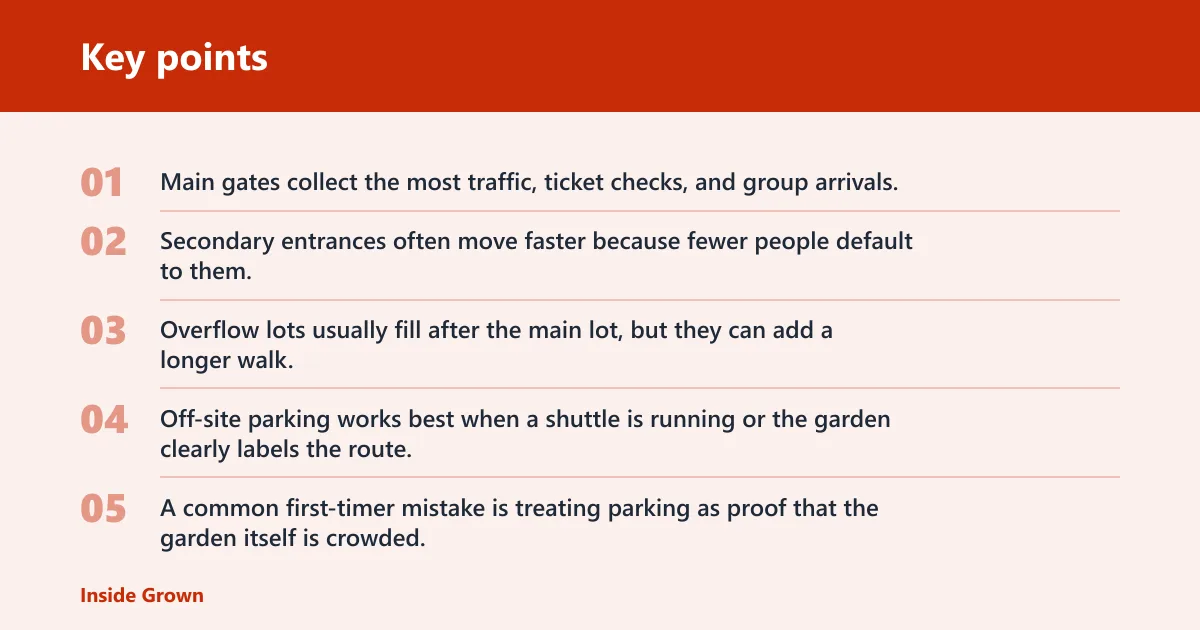
Main gates collect the most traffic, ticket checks, and group arrivals. Secondary entrances often move faster because fewer people default to them. If the garden’s map shows a loop path, entering at the end of the loop can also help you move opposite the heaviest flow and reach quieter sections first.
Overflow lots, off-site parking, and arrival timing
Overflow lots usually fill after the main lot, but they can add a longer walk. Off-site parking works best when a shuttle is running or the garden clearly labels the route. If you drive, a common rule of thumb is to arrive about 20 to 30 minutes before your entry window; if you walk or ride transit, that buffer can often be smaller.
A common first-timer mistake is treating parking as proof that the garden itself is crowded. A full main lot can happen while the paths are still calm, especially if there is a member morning or a nearby event. Check both the parking plan and the ticket window before deciding whether to go in.
Accessibility and internal circulation
Accessibility needs can change the best entrance. The shortest route is not always the quietest, but it may be the right one if you need step-free access or reduced walking. Inside the garden, start with the less popular outer loop, then move toward the center after the first crowd wave passes the signature displays.
What mistakes should you avoid?
The biggest errors are simple: choosing the most popular day, assuming parking and crowding are the same problem, and ignoring the event calendar. Timed entry, weather, and route choice all change the result, so a good plan needs more than “go early.” In climate zones with frequent afternoon storms or intense heat, the best time can shift by location and season, so do not apply the same rule to every garden.
- Booking too late. Timed-entry slots can sell out on peak days. Reserve before you commit to travel.
- Arriving at the main gate by default. Use the secondary entrance if the map shows a faster approach.
- Ignoring the event calendar. Festivals and member previews can change a quiet weekday into a crowded one.
- Assuming rain always helps. Light rain may lower attendance, but indoor areas can get crowded fast.
- Arriving in the busiest window. Mid-morning and early afternoon are the standard pressure points.
Frequently asked questions
How to go to botanic gardens
Use the garden’s official hours, ticket page, and map before you leave. If the site lists timed entry, book the first available window and choose the entrance closest to that slot. For transit, check whether the garden has a shuttle, a signed walk from the station, or a separate visitor drop-off point, and confirm whether parking is limited on event days.
What is the best time to visit a botanical garden to avoid crowds?
The quietest window is usually the first hour after opening or the last two hours before closing. On mild weekdays, that timing beats mid-morning by a clear margin. If the garden uses timed entry, the first slot is usually better than a late morning arrival that lands in the main rush.
Are botanical gardens less crowded on weekdays?
Usually yes, especially Monday through Thursday. That advantage shrinks during school holidays, spring break, and major bloom peaks. If weekday crowd avoidance matters most, choose a rainy or overcast weekday and avoid dates with concerts, seasonal displays, or member-only access periods.
Should I book timed entry if I want a quieter visit?
Yes, especially on busy days. Timed entry limits capacity and reduces the chance of long gate lines, but it also creates sellout risk, so book early. The quietest choice is usually the earliest window available, paired with a backup parking plan.
How do special events affect crowds at a botanical garden?
They can create sharp spikes that change the whole day. Festivals, concerts, seasonal displays, preview mornings, and member-only events often concentrate arrivals at specific hours. Check the calendar before choosing a date, because the same garden can be calm on one Tuesday and packed on the next.
Is it better to visit a botanical garden in the rain?
Light rain can help if you want fewer people outside, but it is not a universal win. If the garden has a popular conservatory, visitors may move indoors and crowd the same fallback spaces. Use rain days for a quieter outdoor walk, and arrive early before the weather changes.
Which entrance or parking lot is usually least crowded?
The secondary entrance and overflow lot are often less crowded than the main gate and main lot. Which one works best depends on the day’s event schedule and your entry window. If step-free access matters, check the route length and surface before choosing the quieter option.
What time do botanical gardens get busy?
Mid-morning and early afternoon are usually the busiest periods. The crowd often builds after opening, peaks around late morning lunch traffic, and starts easing late in the day. If you need the quietest experience, aim for opening time or the final two hours before closing.