How Many Lights Do You Need for a Yard?
Most yards often use one light about every 8 to 15 feet along paths or edges, plus one fixture per focal point; small yards often start with about 4 to 8 lights. Too few leaves dark gaps and weak security, while too many cause glare and wasted power. This guide shows how to estimate yard light quantity by zone, beam spread, and function.
Light by zone, not by fixture


The answer changes by zone. A front path may need a steady line of low-glare fixtures, a side yard may need only a few markers, and a driveway usually needs brighter lights with wider spacing. Decorative accents and safety lighting should be counted separately, because they serve different jobs.
What changes the count by zone
Use the area’s job first, then size the count. A walkway that must keep footsteps visible needs tighter spacing than a planter edge that only adds shape after dark. Darker yards, wider paths, and taller mounting points push the count up because each fixture covers less ground.
How spacing and brightness work together
Lumens measure how much light a fixture gives off. Watts measure how much power it uses. Those are not the same thing. For outdoor yard lighting, spacing and lumens should be planned together so you are not forced to choose between dark gaps and glare.
When one bright fixture beats several dim ones
If the goal is to light a long driveway entrance or a dark back corner, one higher-output fixture with a controlled beam can do more useful work than several dim fixtures pointed in random directions. Shielding matters here, because downward light usually makes a space feel brighter without increasing output.
What you’ll need
- Tape measure
- Yard sketch or simple site plan
- Fixture specifications with lumens and beam angle
- Power-source details for wired or solar lights
- A note on path width and surface color
- Information on nearby ambient light, such as porch lights or streetlights
Yard light count calculator
Start with path length, then adjust for zone, surface color, and beam spread. A 30-foot walkway with 6-foot spacing needs 5 fixtures, and the example count uses 75 lumens per fixture for a 375-lumen total. A 40-foot path with 6-foot spacing needs about 7 lights.
| Zone | Example length | Starting spacing | Estimated count | Typical lumen range per fixture | Notes |
|---|---|---|---|---|---|
| Front yard path | 30 feet | 6 feet | 5 fixtures | 100 to 200 lumens | Use tighter spacing if the path is wide or the surface is dark. |
| Side yard | 25 feet | 6 to 8 feet | 4 to 5 fixtures | 50 to 100 lumens | Best for accent lighting or a lightly used route. |
| Backyard edge | 40 feet | 8 feet | 5 fixtures | 50 to 100 lumens | Use more fixtures if the yard is dark and there is little ambient light. |
| Driveway | 40 feet | 6 to 8 feet | 5 to 7 fixtures | 200 to 400 lumens | Long driveways and dark areas need the highest output. |
Front yard example
Suppose your front walk is 30 feet long and the porch light already adds some background light. At 6-foot spacing, 5 fixtures is a practical starting point. If the walkway is narrow and light-colored, that count may be enough without increasing output.
Side yard example
A side yard path often needs fewer fixtures because it is usually used for movement, not display. A 25-foot run at 6-foot spacing points to 4 or 5 lights. If shrubs or fences block spill light, a shielded fixture with a narrower beam can help coverage stay even.
Backyard example
Backyards often need a mix of safety and mood lighting. A 40-foot edge with little ambient light may need 5 fixtures at 8-foot spacing, and each one may need to be brighter than a front path light. If seating areas matter, count those separately from the walking line.
Driveway example
A driveway usually needs more output per fixture than a footpath. For a 40-foot driveway run, 5 to 7 lights is a practical range, depending on beam spread and darkness around the property. A rural drive often sits at the higher end of both the count and the lumen range.
How far apart should yard lights be?
Outdoor path lights are often placed 5 to 8 feet apart. Six feet is a simple starting point for most straight walkways. Shorter spacing increases overlap and reduces dark gaps, while wider spacing works better when the fixtures are brighter and the path itself is easy to read.
Use 5 to 8 feet for path lights
That range gives enough overlap for typical residential paths without turning the walkway into a row of bright spots. If the beam is narrow, or if the path is wide, stay closer to 5 or 6 feet. If the fixture spreads light broadly, 7 or 8 feet can still work.
Start at 6 feet for a simple estimate
Six feet is a useful middle point because it makes a quick count easy. Divide path length by 6, then round up for end coverage and bends. A 30-foot garden path at 6-foot spacing needs 5 fixtures, which matches the common starting estimate.
Adjust for width, surface color, and beam spread
Wide paths need more light because each fixture has to cover more width, not just more length. Dark pavement absorbs more light than pale concrete or stone. A wider beam can reduce the fixture count, while a narrow beam usually asks for closer spacing.
How many lumens do you need for outdoor yard lights?
For most residential paths, 50 to 100 lumens works for soft accent lighting. Standard walkways typically use 100 to 200 lumens per fixture. Long driveways and dark rural paths often need 200 to 400 lumens per fixture, especially when the goal is safety rather than decoration.
50 to 100 lumens for soft accent lighting
This range suits borders, low garden edges, and places where you want guidance without strong brightness. It pairs well with nearby porch lights or streetlights. In a brighter yard, this can be enough for visual rhythm and light wayfinding.
100 to 200 lumens for standard walkways
This is the practical middle zone for most front paths and side walks. It gives enough light to read footing and edges without making the path harsh. If the fixture is shielded and aimed downward, the lower end of the range may feel brighter than the number suggests.
200 to 400 lumens for long driveways or dark areas
Use this range when the yard has little ambient light or when the path is long enough that each fixture must carry more of the job. In those settings, a lower-output light can disappear quickly. Higher output helps, but glare control still matters.
What affects the number of lights?
Ambient background light, fixture shielding, mounting height, and power source all change the final count. A lit suburban yard can use fewer fixtures than a dark rural property. A tall post light can cover more area than a short marker, but it may also throw light where you do not need it.
Ambient background light
Streetlights and porch lights reduce the amount of light your yard fixtures need to supply. In a dark yard, the same walkway often needs more output or closer spacing because nothing else is filling in the shadows. That is one reason no single fixture count fits every property.
Fixture shielding and glare
Downward lighting reduces glare and can make a space feel brighter because the useful light lands on the walking surface instead of in your eyes. Unshielded fixtures can look bright but cover less usable ground. Good shielding often lets you keep the same count and improve the result.
Light height and perceived coverage
Higher fixtures usually spread light farther, which can reduce the number needed along a long run. Lower fixtures give a more defined path edge and can feel safer on a short walk. If the fixture is too high for the beam spread, the path may look washed out instead of clear.
Low-voltage versus solar performance
Low-voltage landscape lights typically use 12V operating voltage and are commonly used for walkway and yard lighting because they are simple to place and generally safer to handle than line-voltage lighting. Solar path lights usually output less light than wired options and depend on sunlight and battery performance, so they often need more units for the same coverage.
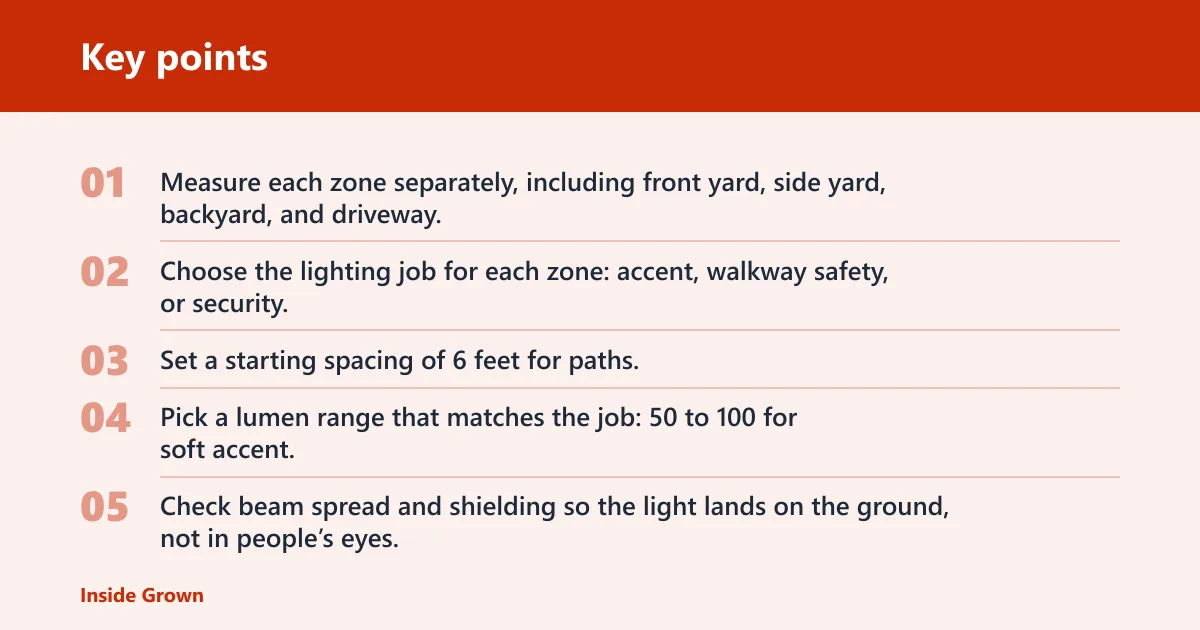
- Measure each zone separately, including front yard, side yard, backyard, and driveway.
- Choose the lighting job for each zone: accent, walkway safety, or security.
- Set a starting spacing of 6 feet for paths, then move toward 5 feet for dark or wide areas and toward 8 feet for brighter, narrow areas.
- Pick a lumen range that matches the job: 50 to 100 for soft accent, 100 to 200 for standard walkways, and 200 to 400 for long driveways or dark areas.
- Check beam spread and shielding so the light lands on the ground, not in people’s eyes.
- For wired systems, total the watts and compare them with circuit capacity.
- Add or remove one fixture at a time, then recheck the spacing and brightness before committing to the final count.
Simple circuit-load check
A 20-amp circuit at 120 volts has a total capacity of 2400 watts. Best practice derates that to 1920 watts usable capacity, and you should not go above 16 amps on a 20-amp circuit. Most yard lighting uses far less than that, but the math still matters if you are adding many fixtures.
For a wired layout, add the wattage of every fixture and keep the total under the usable load. If the number gets close, split the lighting across more than one circuit instead of crowding one line. That is safer and usually easier to maintain.
Common mistakes
One mistake is counting every fixture as if it covers the same area. Another is ignoring dark surfaces and wide paths, which need more output to look evenly lit. Solar lights are often used where brightness needs are too high for them, and overloaded circuits are a separate risk on wired systems.
Say your front walk is 30 feet long, but the path is dark concrete and there are no porch lights nearby. The same 5-light count may still work, but only if you move closer to 5-foot spacing or choose brighter fixtures. Change one variable at a time so you know what improved the result.
Picture a 40-foot driveway with a narrow beam and a tall mounting height. If the fixtures are too far apart, the middle will still look dim even though the ends are bright. In that case, add one fixture or move the spacing tighter before increasing brightness again.
- Do not treat decorative lights and safety lights as the same count.
- Do not rely on watts alone when lumens determine how bright the yard looks.
- Do not use solar lights for a dark driveway if you need consistent high output.
- Do not pack fixtures too tightly, or glare will erase the benefit.
- Do not ignore circuit limits on wired installations.
Frequently asked questions
How many lights do you need for a front yard path?
For a typical front yard path, start with one light every 5 to 8 feet and use 6 feet as the first pass. A 30-foot walk usually lands at 5 fixtures. Add another light if the path is wide, dark, or curves enough to hide the next fixture.
How many lights do you need for a driveway or long path?
Long driveways often need 200 to 400 lumens per fixture and wider spacing only when the beam is strong enough to cover it. A 40-foot driveway run commonly needs about 5 to 7 lights. Dark rural areas usually need the higher end of that range.
How many path lights do I need for a 30-foot walkway?
At 6-foot spacing, a 30-foot walkway needs 5 fixtures. If you want softer accent lighting, 75 lumens per fixture gives a 375-lumen total. If the walkway is wide or poorly lit, keep the count but move to the higher end of the standard walkway lumen range.
Do I need more lights for a dark yard or a lit yard?
Yes. A dark yard needs more output because there is less background light from porch lights or streetlights. In a brighter yard, the same path can often work with fewer fixtures or lower lumens. Start with the darker-case layout, then reduce only if the space still reads clearly.
How many lights can I put on one circuit?
Use wattage, not fixture count, to answer that. Keep the lighting load under that number, and do not go above 16 amps on the circuit.
Should I choose low-voltage or solar yard lights?
Choose low-voltage if you want steadier output and more predictable coverage. Choose solar only if the location gets enough sun and you can accept lower output. Solar can work for accent paths, but wired 12V lights are usually better for long walks, driveways, and dark yards.