How Deep Should You Plant Vegetable Seeds? A Quick Guide
Plant vegetable seeds about 2 to 3 times as deep as the seed is wide, using a shallower planting depth in heavy clay or cold soil and a slightly deeper one in loose, sandy, or very dry soil. Too much depth can stop weak seedlings from reaching light. Too little depth can dry seeds out or wash them away. This guide gives a fast crop-size-plus-soil-type rule, plus examples for beds, rows, raised beds, and containers.
This guide is part of our Vegetable gardening guide series.
How deep should you plant vegetable seeds?


What you’ll need
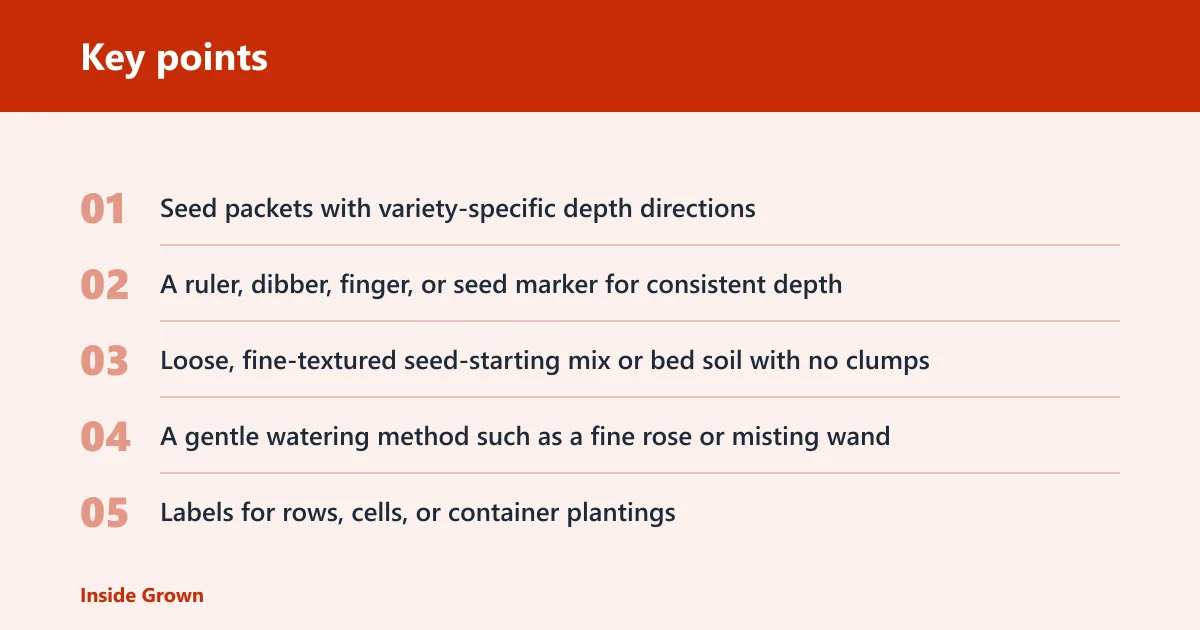
- Seed packets with variety-specific depth directions
- A ruler, dibber, finger, or seed marker for consistent depth
- Loose, fine-textured seed-starting mix or bed soil with no clumps
- A gentle watering method such as a fine rose or misting wand
- Labels for rows, cells, or container plantings
How do you choose the right depth in four steps?
Start with the packet, then use seed size and soil texture to fine-tune the depth. The 2 to 3 times diameter rule is a solid starting point, not a replacement for crop-specific directions. Finish by watering gently so the seed stays where you placed it.
- Read the packet first and use the listed depth when it differs from a general rule.
- Estimate seed size and use about 2 to 3 times the seed diameter as your starting depth.
- Adjust for soil texture: go shallower in clay or heavy soil, and slightly deeper in sandy soil.
- Water with a fine spray so you do not move seed out of position.
Why depth matters
Planting depth changes how much moisture, oxygen, warmth, and light the seed gets while it starts. Seeds too shallow can dry out fast or be displaced by rain and birds. Seeds too deep may use up stored energy before the shoot reaches the surface.
How deep should I plant tiny seeds like lettuce or carrots?
Very small seeds usually need a shallow cover, often just enough soil or mix to hold moisture in place. Lettuce, carrot, and onion are common examples. Lettuce is also a light-sensitive seed in many gardens, so it may be broadcast and only lightly pressed into the surface rather than buried.
Practical approach for fine seed
Use a fine, loose surface and keep the covering thin. Carrot seed is recommended at 1/4 inch (6 mm), lettuce seed at 1/8 inch (3 mm), and onion seed at 1/4 inch (6 mm). If the seed is extremely fine, scatter it on the surface and press it in lightly instead of cutting a trench.
Say your lettuce seed is dust-like and the soil surface is already moist. A very light cover or a firm press may be enough, because burying it deeply can block emergence.
How deep should I plant larger seeds like peas or beans?
Larger seeds can sit deeper than tiny seeds because they hold more stored energy for sprouting. Peas and beans are classic examples. They still need enough moisture to germinate, though, so deeper is not always better. The goal is steady moisture without forcing the shoot to travel too far.
Typical depths for common large seeds
Pea seed depth is recommended at 1–2 inches (2.5–5 cm). Bean seed depth is recommended at 1–1.5 inches (2.5–4 cm). Beans and peas are both highlighted as large seeds that need deeper planting than lettuce or onion.
Suppose a bean seed is sown in warm, loose soil. A depth near the middle of the packet range helps it stay moist long enough to sprout, while still letting the seedling reach light before its reserves run out.
Should seed depth change in clay soil or sandy soil?
Yes. Heavy clay soil usually calls for slightly shallower planting, while sandy soil can support slightly deeper sowing. Soil texture changes how quickly the surface dries, how easily a crust forms, and how far a seedling must push to emerge. Loose, fine seed-starting mix also matters because clumps change the real depth.
Soil texture adjustments
- Clay or heavy soil: sow a bit shallower to reduce crusting and slow emergence.
- Sandy soil: sow a bit deeper so the seed stays moist longer.
- Seed-starting mix: keep depth consistent and avoid compaction or clumps.
A shallow planting in clay can fail if the surface hardens after watering. A slightly deeper planting in sand can help, but do not bury seed so far that the shoot exhausts itself before reaching the surface.
Do containers and raised beds use the same seed depth?
Yes, the same general depth guidelines apply in containers and raised beds, with slight adjustments. The seed size rule still works. The difference is moisture and drainage: container mixes dry faster, while shallow raised beds can warm and dry more quickly at the surface.
Small adjustments that matter
In containers, use the packet depth, then lean toward the deeper end only when the mix dries fast. In raised beds, check whether the top layer crusts after watering; if it does, stay near the shallower end of the recommended range. Keep the surface fine and even before sowing.
Seed depth decision table for common vegetables
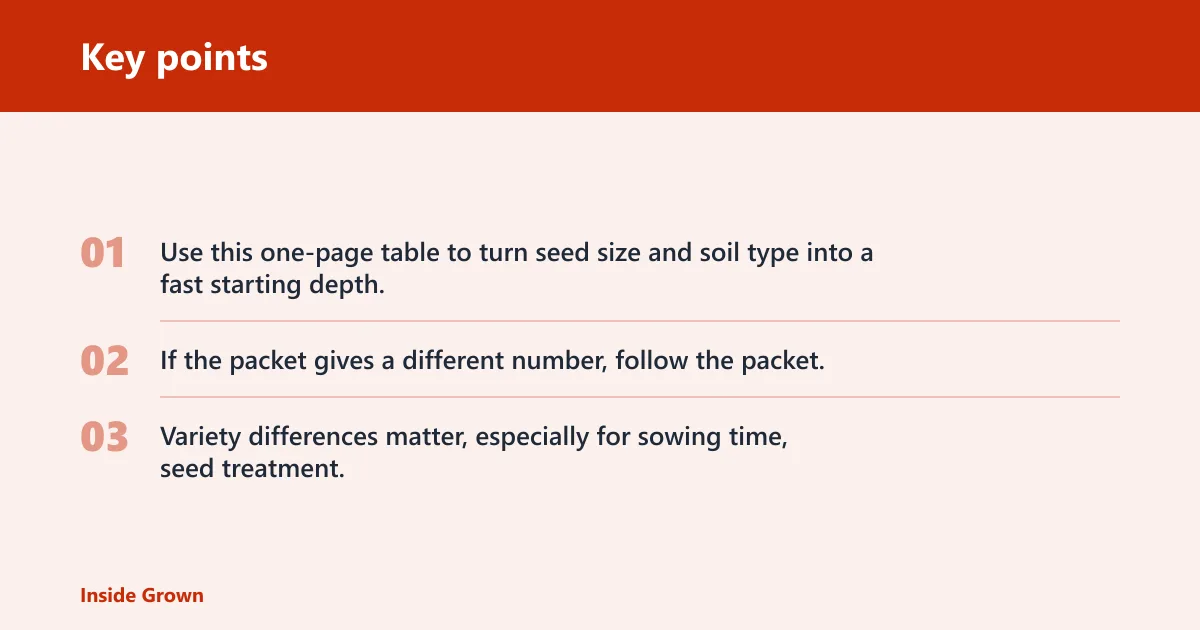
Use this one-page table to turn seed size and soil type into a fast starting depth. If the packet gives a different number, follow the packet. Variety differences matter, especially for sowing time, seed treatment, and germination needs.
| Crop | Seed size | Starting depth | Soil and sowing note | Troubleshooting if emergence is poor |
|---|---|---|---|---|
| Lettuce | Very small | 1/8 inch (3 mm) | Lightly cover or press in; broadcast works for fine seed | Too deep, dried surface, crusting, or low-quality seed |
| Carrot | Small | 1/4 inch (6 mm) | Keep the top layer fine and even; avoid a hard crust | Too deep, drying, or compacted soil |
| Onion | Small | 1/4 inch (6 mm) | Shallow sowing; fine covering only | Too deep or uneven moisture |
| Pea | Large | 1–2 inches (2.5–5 cm) | Deeper sowing helps keep moisture around the seed | Too deep in heavy soil or crusted surface |
| Bean | Large | 1–1.5 inches (2.5–4 cm) | Keep the seed in moist soil, not waterlogged soil | Too deep, cold soil, or poor drainage |
| Beet | Small to medium | About 1/2 inch | Use the packet if it differs; keep the seedbed even | Crusting, drying, or buried too deeply for the mix |
| Radish | Small to medium | About 1/2 inch | Even moisture matters more than a deep cover | Shallow seedbed drying or hard surface after watering |
| Squash | Large | About 1 inch | Can handle deeper placement than tiny seed | Cold soil, wet soil, or planting too deep |
What happens if vegetable seeds are planted too deep?
Too-deep planting can delay emergence, weaken seedlings, or stop sprouting altogether. The seed may run out of stored energy before the shoot reaches light. This is most likely to matter with tiny seed, but cold, compacted, or crusted soil can create the same problem even at a normal depth.
If that didn’t work, try this next
- Check the packet depth and compare it with where you actually placed the seed.
- Scratch back a thin layer of soil only if the seed is still below the recommended depth range.
- Re-sow a fresh row at the correct depth if the original line has already rotted or collapsed.
Common first-timer mistake: a row of bean seed is covered with several extra inches of soil after sowing in a heavy mix. The seed may still be alive, but the shoot often reaches light too late or not at all.
Can I just scatter vegetable seeds on top of the soil?
Sometimes, yes. Very fine seeds like lettuce may be broadcast and lightly pressed into the soil. That works best when the packet says the seed needs light or only a very shallow cover. For most crops, though, top-sowing without covering leaves the seed too exposed to drying, birds, or washout.
Use broadcasting only when it fits the crop
Scatter-on-top works best for very fine seed or for dense salad mixes. For larger seed, make a shallow furrow or individual holes so depth stays consistent. Gentle watering matters here, because a hard spray can move seed away from the intended spot.
How do I know the correct depth for each vegetable seed packet?
The packet is the most specific source for crop and variety depth, and it should override general rules when they differ. Use the seed diameter rule as a quick starting check, then confirm the packet number before sowing. Variety differences can change depth, spacing, and germination needs.
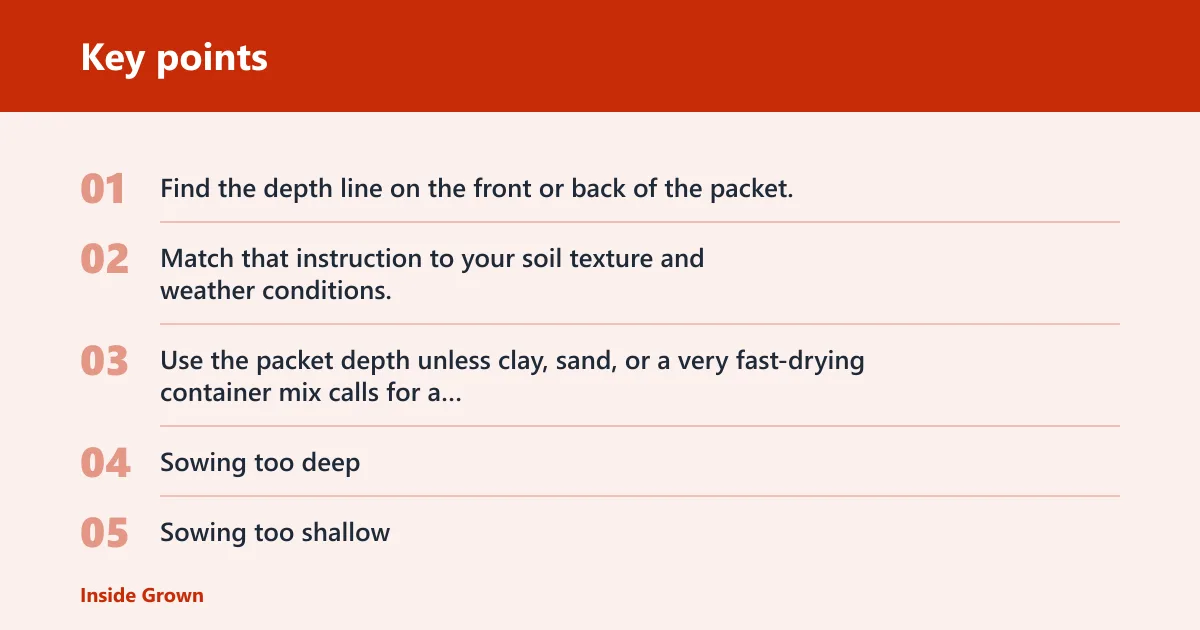
- Find the depth line on the front or back of the packet.
- Match that instruction to your soil texture and weather conditions.
- Use the packet depth unless clay, sand, or a very fast-drying container mix calls for a modest adjustment.
Common mistakes that stop emergence
- Sowing too deep: seedlings emerge late, weak, or not at all.
- Sowing too shallow: seed dries out, washes away, or gets eaten.
- Watering too hard: seed moves out of position and depth becomes uneven.
- Ignoring crusted soil: a hard surface can block small seedlings even when the depth was right.
- Using old or poor seed: low vigor can look like a depth problem.
If emergence is uneven, check the surface first. Uneven depth, crusting, drying, and poor seed quality are the usual suspects. Prevention is simple: sow into loose, fine soil, keep the packet handy, and water with a gentle rose or mist so seed stays in place.
Frequently asked questions
how deep should you plant vegetable seeds
Use 2 to 3 times the seed diameter as the starting point, then confirm the packet depth before sowing. Small seeds usually need very shallow coverage, while larger seeds can go deeper. Heavy clay usually means shallower placement, and sandy soil can support slightly deeper sowing.
how deep should you plant seeds
For most vegetable seeds, the answer depends on size and soil texture. Tiny seed often gets only a thin cover, while pea and bean seed go deeper. The packet is still the final authority, especially when a variety has its own germination needs or a light requirement.
how deep to plant vegetable seeds
Start with the seed-diameter rule, then adjust for moisture and texture. A loose, fine bed lets you stay close to the packet number. In clay, stay a little shallower; in sandy soil, go slightly deeper if the surface dries quickly.
How deep should I plant tiny seeds like lettuce or carrots?
Lettuce, carrot, and onion usually need very shallow sowing. Lettuce is often broadcast and lightly pressed in, while carrot and onion are commonly planted at 1/4 inch (6 mm) or less if the packet says so. Tiny seed dries out quickly, so keep the surface evenly moist.
How deep should I plant larger seeds like peas or beans?
Peas and beans can be planted deeper than tiny seed because they have more stored energy. Pea seed is recommended at 1–2 inches (2.5–5 cm), and bean seed at 1–1.5 inches (2.5–4 cm). Follow the packet if the variety calls for a different depth.
Should seed depth change in clay soil or sandy soil?
Yes. Heavy clay usually needs slightly shallower sowing, and sandy soil can justify slightly deeper sowing. Clay crusts more easily, while sand dries faster. The goal is to keep the seed moist without trapping the sprout under a hard surface.