Tap Water vs Filtered Water for Houseplants in Winter
Winter makes water quality matter more for houseplants. If your tap water is hard or chlorinated, switch to filtered, rain, or distilled water for salt-sensitive plants, especially when pots dry more slowly and you cannot flush buildup as often. Left in wet potting mix, those minerals and salts can collect, tip leaves brown, and strain roots that are already moving slowly. Here’s how tap, filtered, distilled, and rainwater compare in winter, and when each one is worth using.
| Decision factor | Tap Water | Filtered Water | Winner |
|---|---|---|---|
| Cost per gallon | Usually lowest | Higher than tap because of filter purchase and cartridge replacement | Tap Water |
| Mineral reduction | No reduction; hardness can stay high | Often limited unless the system is rated to reduce dissolved solids | Filtered Water |
| Chlorine and odor control | Depends on city treatment and water age | Activated carbon often reduces chlorine and taste or odor | Filtered Water |
| Maintenance | None beyond filling a watering can | Cartridge changes, flow checks, and pitcher cleaning | Tap Water |
| Best winter use case | Tolerant plants, low-mineral municipal water, routine care | Sensitive plants, hard water, or cities using chloramine | Tie |
Winter water quality basics
Winter changes the stakes because potting mix dries more slowly, roots take up less water, and many plants transpire less. That means dissolved minerals, fertilizer salts, and treatment chemicals can stay in the root zone instead of being flushed through the pot. The same water that works in summer can leave more residue in January.
Why winter makes the stakes higher
Cooler rooms and shorter days slow growth. The pot stays wet longer, so water-source problems have more time to accumulate at the rim and in the top layer of mix. That matters most for sensitive foliage plants that already show stress as brown tips or edge burn.
Chlorine, chloramine, and hard water in plain terms
Chlorine can dissipate somewhat if water sits, but chloramine is more stable and does not reliably go away just because the water sits overnight. Hard water means more calcium and magnesium; that is not automatically bad, but repeated use can leave limescale in pots and contribute to leaf-tip burn on sensitive plants. In winter, those residues can matter more because the mix is flushed less often.
What room-temperature watering does and does not change
Room-temperature water does not remove chlorine, chloramine, or dissolved minerals. It does not make hard water soft. It simply makes watering gentler on roots and more consistent across the season.
Do houseplants need filtered water in winter?
Most houseplants do not need filtered water in winter. Tap water is fine for many tolerant plants, while filtered water becomes worth the cost when a plant reacts to minerals, a city uses chloramine, or the water is hard enough to leave deposits that build up in slower-drying winter mix.
Which plants usually do fine with tap water?
Spider plants, many succulents, and cacti usually handle tap water better than fussy foliage plants. If the local water is only mildly hard and the plant shows no salt crust, no tip burn, and steady growth for the season, tap water is often the practical choice.
Which plants are more likely to react to minerals?
Calatheas, marantas, many ferns, and some dracaena types are often reported to show leaf-edge burn, brown tips, or a dull buildup of salts after repeated exposure to hard water. These plants are also the ones most likely to respond poorly to chloramine-heavy water over time.
When filtered water is worth the extra cost
Filtered water makes sense when you are trying to reduce chlorine taste or odor, soften the practical impact of moderate treatment chemicals, or give sensitive plants a steadier input. It is less useful if the filter only improves taste and smell while leaving dissolved solids mostly unchanged.
Tap water vs filtered water in winter
Filtered water is not automatically low-mineral water. Many pitcher and faucet filters mainly reduce chlorine taste and odor, along with some particulates, while leaving much of the dissolved mineral load behind. In winter, that distinction matters because slower drying means there is less chance to flush salts through the pot.
| Winter factor | Tap Water | Filtered Water | Winner |
|---|---|---|---|
| Chlorine control | Variable | Often better with activated carbon | Filtered Water |
| Chloramine control | Usually none | Better only if the filter is rated for chloramine or paired with a neutralizer | Filtered Water |
| Dissolved solids | Can be high in hard water | Often still present | Tap Water |
| Upkeep | None | Cartridge replacement and cleaning | Tap Water |
| Sensitive plant support | Less reliable if water is hard or chloraminated | Better when the system actually targets the problem | Filtered Water |
Pitcher filters versus faucet filters
Pitcher filters are cheaper to start, but they move slowly and often need frequent cartridge changes. Faucet filters are usually easier for regular watering and can be more convenient for filling cans, but they also need maintenance. Neither type should be assumed to remove dissolved minerals unless the manufacturer says so.
What activated carbon can reduce
Activated carbon can reduce chlorine and many taste or odor complaints, and some carbon systems are built to reduce chloramine too. That helps with municipal treatment chemicals, but it does not mean the water is soft or mineral-free. The difference matters when the goal is fewer salts in the pot, not just cleaner-smelling water.
What most filters do not remove
Many filters do little against calcium and magnesium, which are the main parts of hardness. If your issue is limescale, salt crust, or repeated tip burn on a sensitive plant, a basic pitcher may not change the outcome much. Distilled water or a more targeted treatment is the stronger fix.
Cost and upkeep tradeoffs
Tap water costs the least and asks for nothing extra. Filtered water adds cartridge costs and cleanup, and the real price rises if the cartridge is changed early because of heavy use. If you water many plants, the ongoing cost can matter more than the starting price of the pitcher or faucet unit.
Winter water decision table
This table is the quick sort for winter watering. Use it to match the water source to plant sensitivity, local water quality, and how much maintenance you want to take on. The best answer is rarely the same for every pot on the shelf.
| Water source | Likely effect on sensitive plants | Cost | Maintenance | Best-use cases |
|---|---|---|---|---|
| Tap Water | Fine for many plants, but hard water and chloramine can cause gradual buildup or tip burn | Lowest | None | Tolerant plants, soft municipal water, routine winter care |
| Filtered Water | Can reduce chlorine and odor; helps more if the filter is rated for chloramine or some dissolved solids | Moderate ongoing cost | Cartridge changes and cleaning | Sensitive plants, chlorinated or chloraminated water, moderate hard water |
| Distilled Water | Very low dissolved minerals; best for mineral-sensitive plants | Highest ongoing cost | Buy or produce repeatedly | Calatheas, marantas, ferns, and other sensitive plants |
| Rainwater | Often soft and plant-friendly if collected and stored safely | Low if you can collect it safely | Collection hygiene and winter storage checks | Indoor plants when local air quality and storage are controlled |
Tap Water
Tap water is the default for many houseplants because it is cheap and easy. It is the right pick when your plants are tolerant, your city water is not very hard, and you do not have visible salt crust or chronic tip burn. It is weaker only when the water chemistry starts to show up in the pot.
Filtered Water
Filtered water is the better winter choice when your tap water contains chloramine, has enough hardness to leave residue, or is bothering a sensitive plant. The gain comes from targeting a known issue, not from the word “filtered” itself. If the filter only improves taste, the plant may see little difference.
Distilled Water
Distilled water has very low dissolved minerals, so it is the safest bet for mineral-sensitive plants. It is also the most expensive routine option and it brings no nutrients on its own, so fertilizing still has to be handled separately and carefully. Use it for the plants that actually need that level of control.
Rainwater
Rainwater is often soft and useful for sensitive plants, but winter storage needs care. Collection containers should be clean, covered, and protected from contamination from roofs, gutters, or debris. If local air quality or collection setup is questionable, treat it as a convenience option rather than a default.
Which houseplants are most sensitive?
Calatheas, marantas, and many ferns are the most likely to react to hard water or chloramine, followed by some dracaena and occasional spider plants. Succulents and cacti are usually less bothered by water-source differences, though they still dislike staying wet too long in winter.
Common sensitivity split
| Houseplant group | Tap-water tolerance | Warning signs |
|---|---|---|
| Calatheas and marantas | Low | Brown tips, yellowing edges, reduced leaf quality |
| Ferns | Low to moderate | Tip burn, crispy margins, crust on the pot rim |
| Dracaena | Moderate | Tip browning and gradual edge damage |
| Spider plants | Moderate | Brown tips after repeated hard-water use |
| Succulents and cacti | High | More often overwatering stress than water-quality stress |
Symptom-to-cause checklist:
- Brown tips on new growth: often points to mineral or salt stress when it repeats after watering.
- White crust on the pot rim or soil surface: usually means minerals are building up in the mix.
- Soft, yellow, or drooping foliage with wet soil: more likely overwatering or cold roots than water chemistry.
- Brown tips with very dry indoor air: can be caused by low humidity even if the water is fine.
- Symptoms that improve after switching water sources: suggest the water itself is part of the problem.
How to tell water quality from winter stress
Brown tips are a clue, not proof. Dry air, fertilizer salts, and hard water can all create similar damage, and winter makes all three more confusing because growth slows and leaves dry out faster indoors. Look at the whole plant and the pot, not one symptom in isolation.
Brown tips and edge burn
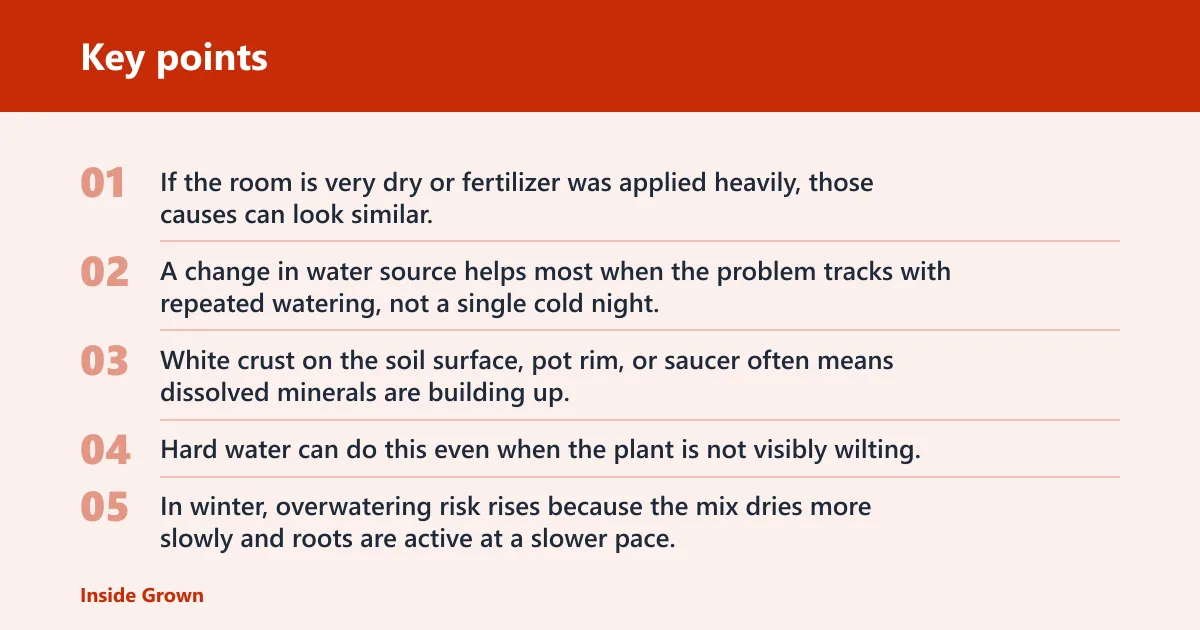
Tip browning on calatheas, marantas, ferns, dracaena, and spider plants can point to mineral or salt stress, especially when it repeats on new growth. If the room is very dry or fertilizer was applied heavily, those causes can look similar. A change in water source helps most when the problem tracks with repeated watering, not a single cold night.
Salt crust and limescale
White crust on the soil surface, pot rim, or saucer often means dissolved minerals are building up. That is more likely in winter because less frequent flushing leaves residues behind longer. Hard water can do this even when the plant is not visibly wilting.
Signs that point elsewhere
Yellow leaves, limp stems, and soggy soil usually point to too much water, low light, or cold roots before they point to water chemistry. In winter, overwatering risk rises because the mix dries more slowly and roots are active at a slower pace. A plant can show brown tips and still be overwatered if the root zone stays wet too long.
Should you let tap water sit before using it?
Letting tap water sit may reduce chlorine in some municipal supplies, but it does not reliably address chloramine or dissolved minerals. Room-temperature water is the safer goal for watering, because it avoids cold shock without pretending to fix hardness or all treatment chemicals.
When waiting helps
If your city uses chlorine rather than chloramine, leaving water uncovered for several hours may reduce that chlorine load somewhat. It also lets the water warm toward room temperature, which is gentler on roots. That can be useful for winter watering sessions where a cold faucet would otherwise go straight onto the root ball.
When waiting does nothing
If the city uses chloramine, sitting water out overnight is not a reliable fix. Hardness also stays in the water whether it sits or not. For those cases, a carbon filter rated for the issue, rainwater, or distilled water is the more direct answer.
- Fill ahead of time. Let watering water sit long enough to reach room temperature, usually a few hours indoors. That helps avoid cold shock, especially on a chilly windowsill.
- Check the water source. If your city uses chloramine or your kettle leaves heavy scale, do not assume resting solves the problem. Choose filtered, rain, or distilled water for sensitive plants instead.
- Water only when needed. Winter watering frequency should drop because potting mix dries slower and roots are less active. The water source matters less if the plant is already sitting in overly wet soil.
How often should you water houseplants in winter?
Filtered water does not change winter watering frequency by itself. Watering should be based on soil dry-down, available light, room temperature, and pot size. A plant in a bright, warm room may dry faster than the same plant in a cool corner, whether you use tap water, filtered water, or rainwater.
Use the water source to manage chemistry, not to set the schedule. If the top layer of mix is dry but the lower root zone is still damp, wait. If the pot is small, the light is strong, and the plant is actively using water, it may need watering sooner than a larger pot in a dim room. Winter always shifts the rhythm downward, but the plant and pot tell you when the next watering is due.
How long to keep watering water at room temperature
A few hours is usually enough to lose the chill from a cold tap, especially if the water sits in a room rather than near a drafty window. The goal is consistency: the same gentle temperature each time, not a separate treatment step for every pot.
Choose Tap Water if…
Tap Water is the better choice when your plants are tolerant, your municipal supply is not very hard, and you want the cheapest, lowest-maintenance option. It is also fine if the main winter issue is overwatering rather than water chemistry. Use room-temperature water and watch for buildup, not panic.

Choose filtered water if…
Filtered Water is the better choice when chloramine, chlorine, or moderate hardness is part of the problem and you are caring for sensitive plants. It is the stronger middle ground for winter because it can reduce some treatment chemicals without the ongoing cost of distilled water. Choose a filter rated for the issue you actually have.
Frequently asked questions
Does tap water hurt houseplants more in winter?
It can, because winter slows root uptake and keeps potting mix wet longer, so any salts or treatment chemicals have more time to build up. Tap water is still fine for many plants, but sensitive ones may show brown tips or crusty soil sooner in winter than they would in summer.
Is filtered water better than tap water for indoor plants?
Sometimes, but only if the filter addresses the problem. Many pitcher and faucet filters mainly reduce chlorine taste and odor, while leaving dissolved minerals in place. That makes filtered water better for some plants and cities, but not a guaranteed fix for hardness.
What water is best for houseplants in winter?
For most plants, room-temperature tap water is enough. For sensitive plants or hard water, filtered water is often the better everyday choice, and distilled water is best for the most reactive species. Rainwater can also work if it is collected and stored safely.
Should I let tap water sit before watering plants?
Yes, if your supply uses chlorine and you also want the water to warm up a bit. No, if the issue is chloramine or hardness, because sitting does not reliably remove either one. Resting water is about temperature and, sometimes, chlorine reduction.
Can hard water cause leaf tips to brown on houseplants?
Yes. Hard water can leave mineral residue in the potting mix and on the pot rim, and repeated use can show up as tip browning on sensitive plants such as calatheas, marantas, ferns, dracaena, and spider plants. Brown tips can also come from dry air or fertilizer salts.
Is rainwater safe to use on indoor plants in winter?
It can be, if collection and storage are clean. Use covered containers, avoid runoff contaminated by roofs or gutters, and do not store water where it can freeze or collect debris. Rainwater is often soft and useful, but only if the source stays clean.