Gardening Tips for Lawn Aeration: When and Why It Matters
Aerate when soil is compacted, water pools, or turf thins after traffic; cool-season lawns are generally aerated in early fall, while warm-season lawns are generally aerated in mid-spring to early summer (University of Minnesota Extension; NC State Extension; Penn State Extension). Most lawns need aeration only once a year or less, and many need it every 2 to 3 years depending on soil and use (University of Minnesota Extension; Purdue Extension). Skipping the right timing can waste effort, stress grass, and leave compaction unchanged. This guide explains the signs, season by grass type, and what to do before and after aeration.
What lawn aeration does
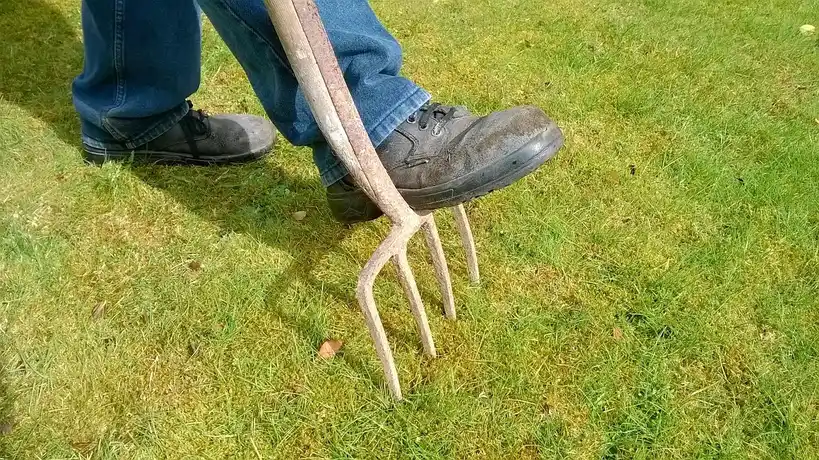


Lawn aeration makes holes in the soil so oxygen, water, and fertilizer can reach the root zone more easily. In lawn care terms, that usually means relieving compaction, improving infiltration, and helping roots move deeper in the growth window (University of Minnesota Extension; Ohio State University Extension). It is usually part of periodic lawn maintenance, not a fixed annual chore for every yard.
Why compaction is the main target
Soil compaction is the most common reason to aerate. It squeezes pore space, which slows drainage, limits root growth, and makes grass struggle after foot traffic, pets, play, or repeated mowing on the same routes (Purdue Extension; Penn State Extension).
Clay soils compact more easily than sandy soils, so the same lawn may need aeration sooner if the soil stays hard after rain or irrigation, especially in paths, play zones, and near driveways (University of Minnesota Extension; NC State Extension).
How thatch fits into the decision
Thatch is a layer of living and dead stems, roots, and crowns that sits above the soil surface. A thatch layer greater than 1/2 inch can block roots from air, light, and water, and a layer greater than 1 inch should be removed for a healthy lawn (University of Minnesota Extension; Colorado State University Extension).
Aeration can help reduce thatch buildup, but it is not the same as dethatching. If the thatch layer is thick and spongy, especially above the soil surface rather than mixed into the root zone, dethatching or power raking is often the better first step; aeration is the better choice when compaction is the main issue (University of Minnesota Extension; Penn State Extension).
Signs your lawn needs aeration
Look for hard soil, standing water, thin turf, shallow rooting, and areas that wear down where people or pets cross most often. Those signs point to compaction first, then to a timing question: does the grass type make now the right window, or should you wait?
Hard soil and poor drainage
If a screwdriver or trowel meets strong resistance in the top few inches, the soil may be compacted. Puddles that linger after rain or irrigation also point to poor movement of water through the root zone (University of Minnesota Extension; NC State Extension).
Say your 400-square-foot side yard has a narrow path from the gate to the patio, and that strip turns puddly after a short storm. That pattern usually points to compaction from repeated foot traffic, not a need for more water.
Thin turf and weak rooting
Thin or patchy grass can mean roots are not reaching deep enough to support steady growth. If the turf pulls up easily or roots stay shallow, aeration may help, especially when the lawn is also under traffic pressure (Purdue Extension; Ohio State University Extension).
A common mistake is mowing short and skipping aeration even though the soil feels hard and water is pooling after rain. If the soil is hard and roots stay near the surface, seed has a harder time settling into contact with the soil below.
Heavy use from people, pets, or play
Lawns that take regular traffic usually compact faster than low-use yards. Play areas, dog paths, and shortcuts across corners often show wear first, then puddling and thinning in the same spots (University of Minnesota Extension; Penn State Extension).
When should you aerate?
Use grass type and growth stage first, then check moisture and stress. Cool-season lawns fit early fall best, while warm-season lawns fit mid-spring to early summer (University of Minnesota Extension; NC State Extension; Penn State Extension). If the lawn is dormant, heat-stressed, or waterlogged, wait.
Best window for cool-season grasses
Cool-season grasses should be aerated in early fall, when recovery is fastest and seeding success is usually strongest (University of Minnesota Extension; Penn State Extension). That group includes bluegrass, ryegrass, and fescue. Early fall gives the lawn active growth and recovery weather, which makes it easier to close holes and respond to overseeding.
Early spring can work in some cases, but fall is the cleaner fit when the goal is recovery (University of Minnesota Extension). If the turf is already thin from summer stress, waiting for fall often gives better results than forcing the job earlier.
Best window for warm-season grasses
Warm-season grasses should be aerated between mid-spring and early summer, while they are actively growing and can repair the openings quickly (NC State Extension; Clemson Extension). That group includes St. Augustine, Bermuda grass, and buffalo grass. The turf needs active growth to recover after the soil is opened up.
Do not aerate warm-season lawns late in the season if growth is slowing (NC State Extension). The holes may remain open longer than needed, and the lawn may not have enough recovery time before stress returns.
When to wait because the turf is stressed
Wait if the lawn is dormant, drought-stressed, heat-stressed, or waterlogged (University of Minnesota Extension; NC State Extension). Aeration is meant to support active turf, not push a weak lawn through another stress event.
Soil should be moist but not saturated before aerating. Extension guidance commonly recommends aerating after watering or rain once the surface is workable, often about a day after irrigation or rainfall, so tines can penetrate cleanly without smearing the soil (University of Minnesota Extension; Purdue Extension). Morning timing can also reduce evaporation.
Core vs solid tine aeration
Core aeration removes plugs of soil from the ground. Solid tine aeration punches holes without removing plugs. For compaction relief, core aeration is usually the better choice because it opens space in the soil instead of simply making a slit or hole; solid tine tools are better thought of as a narrower, short-term opening tool, not a full compaction fix (Ohio State University Extension; University of Minnesota Extension).
What core aeration removes from the soil
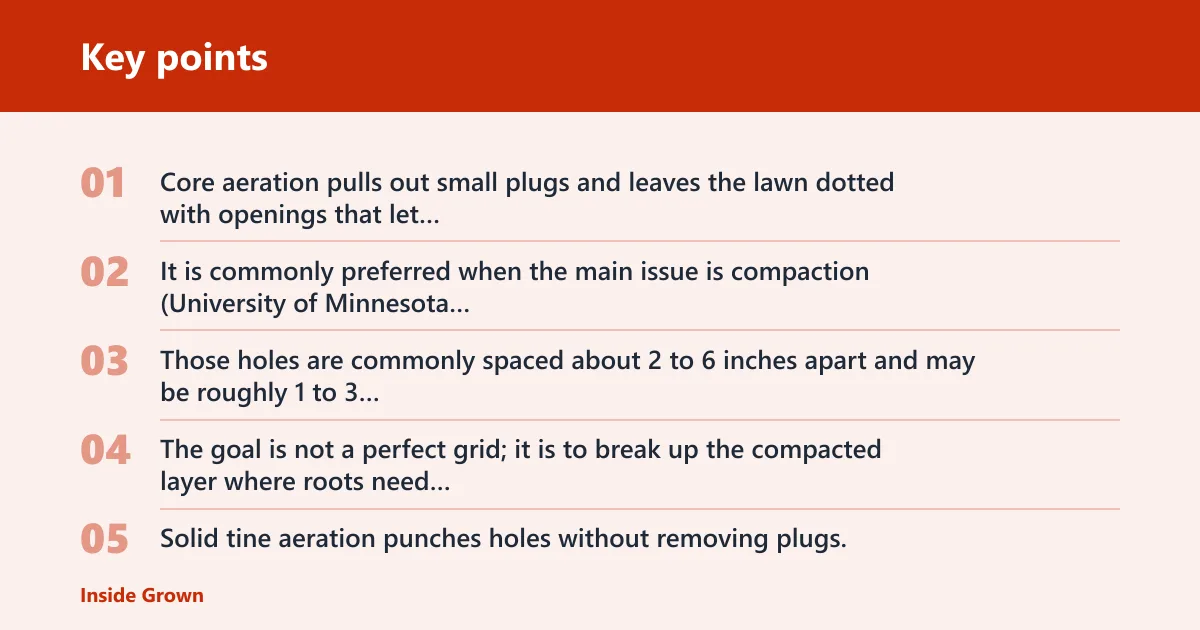
Core aeration pulls out small plugs and leaves the lawn dotted with openings that let oxygen, water, and fertilizer move through the root zone. It is commonly preferred when the main issue is compaction (University of Minnesota Extension; Penn State Extension).
Those holes are commonly spaced about 2 to 6 inches apart and may be roughly 1 to 3 inches deep on many homeowner machines, though machine design, soil moisture, and tractor speed affect the pattern. The goal is not a perfect grid; it is to break up the compacted layer where roots need room (Ohio State University Extension; Purdue Extension).
What solid tine tools do
Solid tine aeration punches holes without removing plugs. It can help in narrow situations, but it is less effective at improving airflow than hollow tines and can increase compaction around the hole walls if the soil is tight or dry (University of Minnesota Extension; Penn State Extension).
That makes solid tine tools a weaker fit for serious compaction relief. They can still be useful when the soil is only mildly tight and the goal is limited surface opening, not plug removal.
Which method fits compaction relief?
If the lawn feels hard, drains poorly, and wears down in traffic lanes, start with core aeration. If the soil is only slightly tight and the thatch layer is the main concern, a solid tine pass may have a narrower role, but it should not be treated as equal to core aeration for compaction (University of Minnesota Extension; Ohio State University Extension).
| Lawn symptom | Grass type | Best window | Aerate now, overseed now, or wait |
|---|---|---|---|
| Puddles after rain, hard soil, thin turf in traffic lanes | Cool-season grass | Early fall | Aerate now, overseed now |
| Same symptoms, but the lawn is hot and drought-stressed | Cool-season grass | Outside early fall | Wait |
| Compaction from play or pets, active growth underway | Warm-season grass | Mid-spring to early summer | Aerate now, overseed now if suitable seed is planned |
| Thin turf on dormant warm-season grass | Warm-season grass | Late fall or winter | Wait |
| Thatch greater than 1/2 inch, soil still workable | Any actively growing turf | Growth window for that grass type | Aerate now, overseed now if the turf is actively growing |
Lawn aeration
Use this table as a simple rule: symptom first, grass type second, season third. If the lawn is compacted and in its growth window, aerate now. If the grass is dormant or heat-stressed, wait even when the soil feels tight.
The same rule helps avoid unnecessary work on lawns that do not need it yet. Aeration is useful, but only when the lawn can respond.
How often to aerate
How often you aerate depends on soil type and traffic. Sandy soil and low-traffic lawns need less attention than clay lawns, especially where the same yard stays open and lightly used (University of Minnesota Extension; Purdue Extension).
Clay, loam, and sandy soil differences
If sandy soil or low traffic is the case, aerating every 2 or 3 years is sufficient (University of Minnesota Extension). Clay soil or high-traffic lawns may need aeration once or twice a year (Purdue Extension; Penn State Extension). Loam usually sits between those extremes, with frequency driven by how quickly the soil compacts and how much the lawn is used.
Low, medium, and high traffic lawns
| Soil type | Low traffic | Medium traffic | High traffic |
|---|---|---|---|
| Clay | Every 2 years or as needed | Once a year | Once or twice a year |
| Loam | Every 2 to 3 years | Every 1 to 2 years | Once a year |
| Sandy soil | Every 2 to 3 years | Every 2 years | Every 1 to 2 years if traffic is heavy |
New lawns, sod lawns, and established turf
New lawns usually need time before they can handle aeration. Fresh sod also needs a root-holding period before heavy disruption. Established turf is the best candidate when compaction or thatch becomes obvious and the grass is in its active growth window (University of Minnesota Extension; NC State Extension).
Picture a newly sodded front yard with firm seams still knitting together. That lawn usually needs watering and root establishment first, not a machine tearing through the surface before it has anchored.
What should you do after aerating?
After aeration, overseeding and fertilizing are recommended immediately in cool-season lawns, because the holes improve seed-to-soil contact and help seed settle where roots can start (University of Minnesota Extension; Penn State Extension). Light watering matters too, because newly opened soil should not dry out too fast.
When overseeding makes sense
Overseeding after aeration works best when the turf is actively growing. That is why cool-season lawns pair well with early fall and warm-season lawns with mid-spring to early summer, but overseeding is mainly a cool-season play unless you are using an appropriate warm-season method and material for the region (University of Minnesota Extension; NC State Extension; Clemson Extension). Seed can fill thin spots more efficiently when the grass is ready to grow around it.
Why light watering matters
Water enough to keep the surface from drying, but do not soak the lawn. Extension recommendations generally favor keeping the top layer evenly moist after seeding so germination and recovery are not interrupted, while avoiding runoff or mud (University of Minnesota Extension; Purdue Extension). The goal is to support seed contact and recovery, not create mud or collapse the openings you just made.
- Mow before aerating if the grass is due for a cut.
- Aerate when soil is moist but not saturated.
- Overseed immediately if the lawn is in its growth window.
- Apply fertilizer lightly and according to turf needs, not in a heavy dose.
- Water gently after the work so the surface stays evenly moist.
Common follow-up mistakes to skip
Do not aerate at the wrong growth stage and expect quick recovery. Do not skip irrigation after seeding. Do not pile on fertilizer so heavily that the lawn is pushed harder instead of helped. And do not aerate a waterlogged yard, where the tool can smear the soil rather than open it. Common homeowner failures also include using solid tines on severely compacted soil, overseeding warm-season turf at the wrong time, and confusing dethatching with aeration when the thatch layer is already too thick (University of Minnesota Extension; Penn State Extension; NC State Extension).
Frequently asked questions
When is the best time to aerate a lawn?
The best time depends on grass type. Cool-season lawns should be aerated in early fall, while warm-season lawns should be aerated between mid-spring and early summer (University of Minnesota Extension; NC State Extension; Penn State Extension). In both cases, the lawn should be actively growing and the soil should be moist but not saturated.
How do I know if my lawn needs aeration?
Look for hard soil, puddling, thin turf, shallow roots, and heavy wear in paths, play areas, or pet routes. Thatch greater than 1/2 inch can also block roots from air, light, and water (University of Minnesota Extension; Colorado State University Extension). If those signs line up, aeration is worth considering.
Should I aerate in spring or fall?
For cool-season grasses, fall is the better fit. For warm-season grasses, mid-spring to early summer is the right window (University of Minnesota Extension; NC State Extension). Spring is not a universal answer; the grass type and growth stage matter more than the calendar alone.
How often should I aerate a clay lawn?
Clay soil usually needs more attention because it compacts more easily. Clay soil or high-traffic lawns may need aeration once or twice a year (Purdue Extension; Penn State Extension). If the lawn stays low traffic and drains well, the schedule can be less frequent, but compacted spots may still need earlier treatment.
Can I aerate sandy soil less often?
Yes. If sandy soil or low traffic is the case, aerating every 2 or 3 years is sufficient (University of Minnesota Extension). Sandy soil usually compacts less than clay, so the schedule can be lighter unless traffic, construction, or repeated use changes the conditions.
Should I water before aerating the lawn?
Yes, but only enough to leave the soil moist, not saturated. Aeration works best when the soil is moist but not saturated, often about 1 day after rain or irrigation, when the machine can penetrate cleanly without smearing the soil (University of Minnesota Extension; Purdue Extension). Morning timing can help reduce evaporation before the work begins.
What kind of aerator is better: hollow tine or solid tine?
Hollow tine, or core aeration, is usually better for compaction relief because it removes plugs of soil (Ohio State University Extension; University of Minnesota Extension). Solid tine aeration punches holes without removing plugs and can help in narrower situations, but it is less effective at improving airflow and may compact soil compared with hollow tines, especially in dry or tight ground (Penn State Extension; University of Minnesota Extension).