A Plant Growing Towards The Light Is An Example Of
Plants have long captured our fascination with their remarkable ability to respond to environmental stimuli. One of the most striking and easily observable phenomena is a plant’s tendency to grow toward a light source. This behavior, seen in everything from delicate seedlings to towering trees, is not just an aesthetic curiosity, it’s a window into the sophisticated mechanisms that drive plant life.
Understanding why and how plants grow towards light unlocks a deeper appreciation for the science of plant biology and offers practical insights for agriculture, gardening, and even biotechnology.
At its core, this movement exemplifies the concept of phototropism, a directional growth response to light. Phototropism allows plants to maximize their exposure to sunlight, optimizing photosynthesis and survival. Whether you’re a gardener wanting lush houseplants or a scientist studying crop yields, the principles behind phototropism are fundamental. This article explores the scientific, practical, and evolutionary aspects of plants growing towards light, providing a comprehensive view of the phenomenon, real-world examples, and actionable insights for anyone interested in plant care or research.
Key Takeaways
- Phototropism is the process by which plants grow toward light, driven by hormonal and cellular changes.
- This adaptation enhances photosynthesis efficiency, supporting growth and survival.
- Real-world examples include sunflowers, houseplants, and crop plants, each demonstrating unique phototropic behaviors.
- Environmental factors, such as light quality and intensity, play a crucial role in the direction and degree of plant growth.
- Understanding phototropism informs agriculture, gardening, and biotechnology, enabling optimization of plant health and yield.

Credit: mammothmemory.net
The Science Of Phototropism: How Plants Sense And Respond To Light
Phototropism is a classic example of how plants interact with their environment. The process involves complex biochemical and physiological mechanisms that enable plants to detect and move toward light sources. This section explores the underlying science that makes phototropism possible.
Hormonal Regulation: Auxins At Work
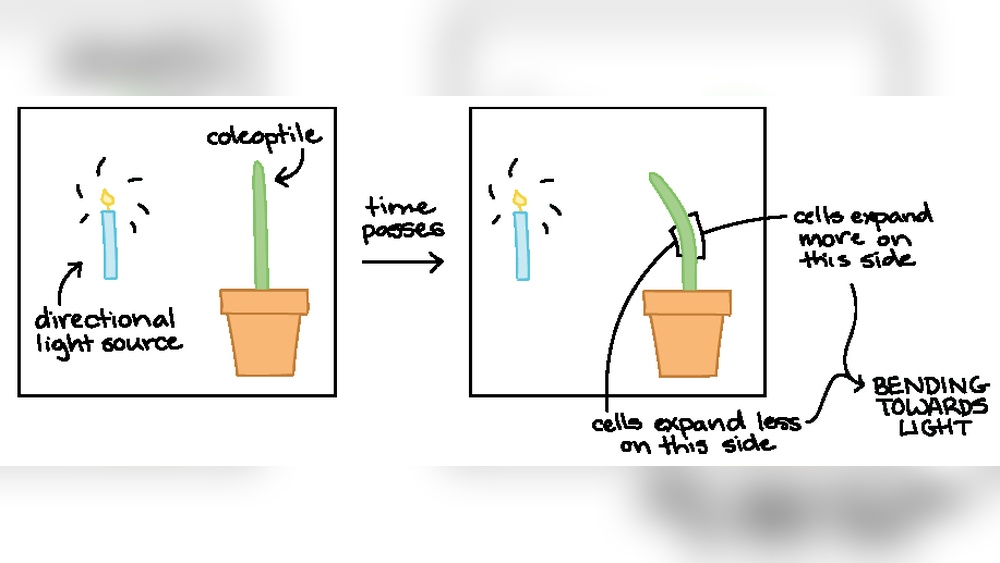
The primary drivers of phototropism are plant hormones called auxins. Auxins regulate cell elongation, playing a critical role in a plant’s response to light. When light hits one side of a plant, auxins redistribute to the shaded side, causing those cells to elongate more rapidly than those exposed to light. This uneven growth results in the plant bending toward the light source.
Key points about auxins:
- Indole-3-acetic acid (IAA) is the most common auxin involved in phototropism.
- Auxin concentration increases on the shaded side, leading to differential cell growth.
- The process is initiated within minutes but becomes visibly apparent over hours or days.
Molecular Mechanisms: Photoreceptors And Signal Transduction
Phototropism is initiated when specialized proteins called photoreceptors sense light. The most important photoreceptors for phototropism are phototropins, which absorb blue light and trigger signal transduction pathways.
Steps in photoreceptor signaling:
- Phototropins absorb blue light and change conformation.
- They activate a cascade of intracellular signals.
- These signals modulate auxin distribution and gene expression.
Recent research has shown that even small fluctuations in light intensity can significantly impact phototropic responses, illustrating the sensitivity and adaptability of plant systems.
Cellular Changes: Elongation And Directional Growth
The redistribution of auxins leads to cell elongation on the shaded side of the stem. This elongation is driven by loosening of the cell wall and increased uptake of water, allowing cells to expand. The result is a visible bending of the plant toward the light.
Processes involved:
- Cell wall modification by expansins and other enzymes.
- Increased water uptake through osmosis.
- Microtubule orientation changes within cells, guiding growth direction.
Pro Tip
If you want your indoor plants to grow evenly, rotate them regularly to prevent excessive bending toward a single light source. This practice can help maintain balanced growth and aesthetic appeal.

Credit: study.com
Evolutionary Advantages Of Phototropism
Phototropism is more than just a quirky plant behavior, it’s a critical adaptation that has evolved to maximize survival and reproductive success. Plants that grow toward light have several evolutionary advantages, making this trait widespread among diverse species.
Enhanced Photosynthesis And Resource Acquisition
By growing toward light, plants optimize their photosynthetic efficiency. Sunlight is the primary energy source for plants, and those able to capture more light can produce more energy, grow faster, and outcompete neighbors.
- Increased leaf exposure to sunlight boosts chlorophyll activation.
- Higher energy production leads to better growth and reproduction.
- Plants in shaded environments can still thrive by redirecting growth toward available light.
Competition And Survival In Crowded Environments
In dense forests or crowded gardens, light is often a limiting resource. Phototropism allows plants to adjust their growth to access light gaps, giving them a competitive edge.
- Taller stems and elongated leaves help plants overtop competitors.
- Phototropic responses are especially pronounced in seedlings and young plants, which are more vulnerable to shading.
Adaptation To Variable Light Conditions
Phototropism also helps plants respond to changing light conditions caused by seasons, weather, or human intervention. This flexibility ensures that plants can survive in diverse environments.
- Plants in polar regions adjust growth direction to follow the sun’s low arc.
- Agricultural crops can be bred for enhanced phototropic traits, improving yield in challenging environments.
Example
Sunflowers are renowned for their phototropic behavior, especially during their early growth stages. Young sunflower stems exhibit heliotropism, tracking the sun’s movement across the sky, maximizing light absorption and energy production.
Real-world Examples And Case Studies
Phototropism is observable in a wide range of plants, from household favorites to essential crops. Here are some concrete examples and short case studies illustrating this phenomenon.
Sunflower Heliotropism
Sunflowers (Helianthus annuus) are famous for their “sun-tracking” behavior. In their vegetative stage, sunflower stems bend to follow the sun’s movement from east to west during the day, a process called heliotropism. As the plant matures, this movement ceases, and flower heads typically face east to catch the morning sun, which enhances pollinator activity and seed maturation.
Indoor Houseplants: Practical Observations
In my experience caring for houseplants, such as pothos and monstera, I’ve noticed pronounced phototropism. Plants placed near a window will lean toward the light, often requiring rotation to maintain symmetrical growth. This behavior is particularly evident in fast-growing species like Ficus elastica and Philodendron.
Agricultural Crops: Wheat And Maize
Cereal crops like wheat and maize exhibit phototropic responses, which are crucial for optimizing yield. Farmers sometimes manipulate light exposure by adjusting planting density or using reflective mulches to encourage even growth, minimizing shading and competition.
Example Table: Phototropism In Different Plant Species
| Plant Species | Phototropic Response | Practical Impact |
|---|---|---|
| Sunflower | Strong heliotropism | Maximizes pollination and seed yield |
| Maize | Moderate phototropism | Improved canopy structure and yield |
| Pothos | Pronounced bending indoors | Aesthetic growth, requires rotation |
| Arabidopsis | Model for studying phototropism | Research insights, genetic studies |

Credit: gardenerspath.com
Environmental Factors Influencing Phototropism
Phototropism is not a one-size-fits-all phenomenon; the degree and direction of growth depend on a variety of environmental factors. Understanding these influences is essential for optimizing plant health and growth.
Light Quality And Intensity
Different wavelengths of light can trigger varying degrees of phototropic response. Blue light is most effective, as phototropins specifically absorb this wavelength.
- High-intensity light increases phototropic bending.
- Low-intensity light results in slower or weaker responses.
- Blue light stimulates maximum phototropism, while red light has minimal effect.
Light Direction And Duration
Plants respond most strongly to unidirectional light. Continuous exposure leads to sustained bending, while intermittent light produces less pronounced effects.
- Plants near windows or artificial light sources show strong directional growth.
- Outdoor plants may adjust growth throughout the day as sunlight shifts.
Temperature And Humidity
Environmental conditions such as temperature and humidity can modify the rate and effectiveness of phototropism.
- Higher temperatures accelerate cell elongation and bending.
- Humidity affects water uptake, which is critical for cell expansion.
Soil And Nutrient Availability
While light is the primary trigger, soil conditions can influence a plant’s ability to respond to phototropism.
- Nutrient-rich soil supports robust cell growth.
- Poor soil may limit the extent of phototropic movement.
Example Table: Environmental Factors Vs. Phototropic Response
| Factor | Effect on Phototropism | Optimal Conditions |
|---|---|---|
| Light Intensity | Greater intensity = more bending | Bright, consistent blue light |
| Light Direction | Unidirectional light = strong response | Single-sided light source |
| Temperature | Higher temp = faster growth | 20, 28°C (68, 82°F) |
| Humidity | Moderate humidity = optimal cell expansion | 60, 80% relative humidity |
Applications Of Phototropism In Agriculture And Gardening
Harnessing the principles of phototropism can greatly enhance plant growth, yield, and aesthetics. This section explores practical applications for both commercial agriculture and home gardening.
Crop Optimization And Yield Enhancement
Farmers and agricultural scientists utilize phototropism to maximize crop yield. By understanding how plants respond to light, they can adjust planting density, row orientation, and light management to ensure optimal exposure.
- Row orientation (north-south vs. east-west) affects sunlight distribution.
- Reflective mulches direct light to shaded areas, promoting uniform growth.
- Controlled environments (greenhouses) use artificial lighting to stimulate phototropism.
Indoor Plant Care And Design
For home gardeners, phototropism informs best practices for plant placement and care. Plants grown indoors often require strategic positioning and rotation to avoid uneven growth.
- Place plants near windows with indirect light for balanced phototropism.
- Rotate pots weekly to promote symmetrical growth and prevent leaning.
- Use grow lights with adjustable direction and intensity to replicate natural conditions.
Biotechnology And Genetic Engineering
Researchers are exploring ways to manipulate phototropism genetically, aiming to produce crops with improved light-use efficiency or ornamental plants with desired growth patterns.
- Gene editing can enhance or suppress phototropic responses.
- Models like Arabidopsis thaliana provide insights into genetic regulation.
Warning
Overexposure to unidirectional light can cause plants to become “leggy,” with elongated stems and weak structure. Ensure balanced light distribution to maintain healthy, robust plants.
Comparative Analysis: Phototropism Vs. Other Plant Movements
Phototropism is one of several types of plant movements, collectively known as tropisms. Understanding how phototropism compares to other tropisms reveals broader insights into plant behavior.
Geotropism (gravitropism)
Geotropism is the growth response to gravity. Roots typically exhibit positive geotropism, growing downward, while shoots show negative geotropism, growing upward. This ensures proper orientation for nutrient uptake and photosynthesis.
Hydrotropism
Hydrotropism refers to plant movement toward water sources. Roots often display hydrotropic responses, growing toward areas of higher moisture.
Thigmotropism
Thigmotropism is the response to touch or physical contact. Climbing plants like vines exhibit thigmotropism, wrapping around supports for stability.
Phototropism Vs. Other Tropisms Table
| Tropism | Stimulus | Main Plant Part Affected | Purpose |
|---|---|---|---|
| Phototropism | Light | Shoots/stems | Maximize photosynthesis |
| Geotropism | Gravity | Roots/shoots | Orientation and nutrient uptake |
| Hydrotropism | Water | Roots | Water acquisition |
| Thigmotropism | Touch | Stems/tendrils | Support and climbing |
Phototropism In Modern Research And Technology
Recent advances in plant science and technology have deepened our understanding of phototropism, leading to innovative applications and new discoveries.
Genetic Studies And Model Organisms
Arabidopsis thaliana, a model plant species, has been extensively used in genetic studies to unravel the molecular basis of phototropism. Researchers have identified dozens of genes involved in light sensing and auxin transport, paving the way for targeted breeding and genetic engineering.
- Research published in journals like Plant Cell details the signal transduction pathways underlying phototropism.
Smart Farming And Controlled Environments
Smart farming technologies utilize sensors and automated lighting systems to optimize phototropism in crops. Controlled environments, such as vertical farms, rely on artificial lighting to simulate natural sunlight, ensuring consistent growth and yield.
- Automated systems adjust light direction and intensity based on plant growth patterns.
- Data analytics help monitor and predict phototropic responses, improving resource efficiency.
Environmental Sustainability
Phototropism research contributes to sustainability by enabling efficient use of resources. Proper light management reduces energy consumption and minimizes waste in agricultural and horticultural operations.
- Studies from Wikipedia highlight the role of phototropism in ecological adaptation and resource optimization.
Example
Vertical farming operations in urban centers leverage phototropism by designing multi-layered lighting setups. This ensures all plants receive sufficient light, reducing shading and promoting uniform growth, which is essential for high-density crop production.
Frequently Asked Questions
What Is The Main Hormone Involved In Phototropism, And How Does It Work?
The primary hormone involved in phototropism is auxin. Auxins, particularly indole-3-acetic acid (IAA), redistribute to the shaded side of the plant when exposed to light. This uneven distribution causes cells on the shaded side to elongate more than those on the light-exposed side, resulting in the plant bending toward the light.
Can Phototropism Be Manipulated For Better Crop Yields?
Yes, phototropism can be manipulated to optimize crop yields. Farmers can adjust planting density, row orientation, and use reflective materials to direct light more evenly across plants. In controlled environments, artificial lighting can be managed to stimulate uniform growth, minimizing shading and competition among crops.
Are There Any Negative Effects Of Excessive Phototropism In Plants?
Excessive phototropism, especially in indoor environments with unidirectional light, can lead to “leggy” growth, elongated stems that are weak and prone to collapse. This can affect both aesthetics and structural integrity. To mitigate this, rotate plants regularly and ensure balanced light distribution.
How Does Phototropism Differ In Monocots Vs. Dicots?
Monocots and dicots exhibit different phototropic behaviors due to variations in stem structure and auxin distribution. Monocots, such as grasses, often have more uniform growth, while dicots like sunflowers and beans show pronounced bending. These differences stem from cellular architecture and hormonal regulation unique to each group.
Is Phototropism Important For Space Agriculture?
Phototropism is crucial for space agriculture, where plants are grown in artificial environments with limited natural sunlight. Understanding and controlling phototropic responses ensures that crops receive optimal light exposure, supporting growth and food production for astronauts. Advanced lighting systems are designed to mimic natural sunlight, promoting healthy phototropic behavior.
Plants growing toward the light showcase the incredible adaptability and intelligence inherent in nature. Phototropism, driven by hormonal, cellular, and environmental factors, not only ensures survival but offers valuable lessons and practical applications across agriculture, gardening, and biotechnology. By harnessing this knowledge, we can cultivate healthier plants, improve yields, and contribute to sustainable food systems, demonstrating the profound impact of a seemingly simple biological response.