What Are Monocots and Dicots? Key Differences
Monocots have one seed leaf and dicots have two, but living plants are identified from several traits together, not one feature alone. One trait can mislabel grasses, palms, and many flowers. This guide shows the safest clues for both groups and the traits that can mislead you.
What are monocots and dicots?
Monocots and dicots are the two broad groups of flowering plants most beginners meet in plant ID. The split starts with the seed embryo: monocots have one cotyledon, while dicots have two. That seed-leaf difference often matches leaf veins, roots, stems, and flowers. (Wikipedia)
These groups sit inside angiosperms, the flowering plants. In practical ID work, you are usually comparing two common patterns in herbs, crops, lawn plants, and garden flowers. The label helps, but it is not absolute, so the safest ID comes from several traits together.
Monocot vs dicot at a glance
The fastest way to compare them is to check the seed leaf, then verify with leaves, roots, stems, and flowers. Cotyledons are the strongest starting point when you can see the seed or seedling. In older plants, root form and flower parts are often easier field clues than leaves alone.
| Trait | Monocots | Dicots | How reliable in the field? |
|---|---|---|---|
| Cotyledons | One | Two | Strongest seed-level clue |
| Leaf venation | Parallel | Reticulate or branched | Helpful, but not foolproof |
| Root system | Usually fibrous | Usually taproot-based | Very practical for mature plants |
| Stem vascular bundles | Scattered | Usually in a ring | Best for cut stems or cross-sections |
| Flower parts | Often in multiples of 3 | Often in multiples of 4 or 5 | Useful when flowers are intact |
Which traits are strongest first clues?
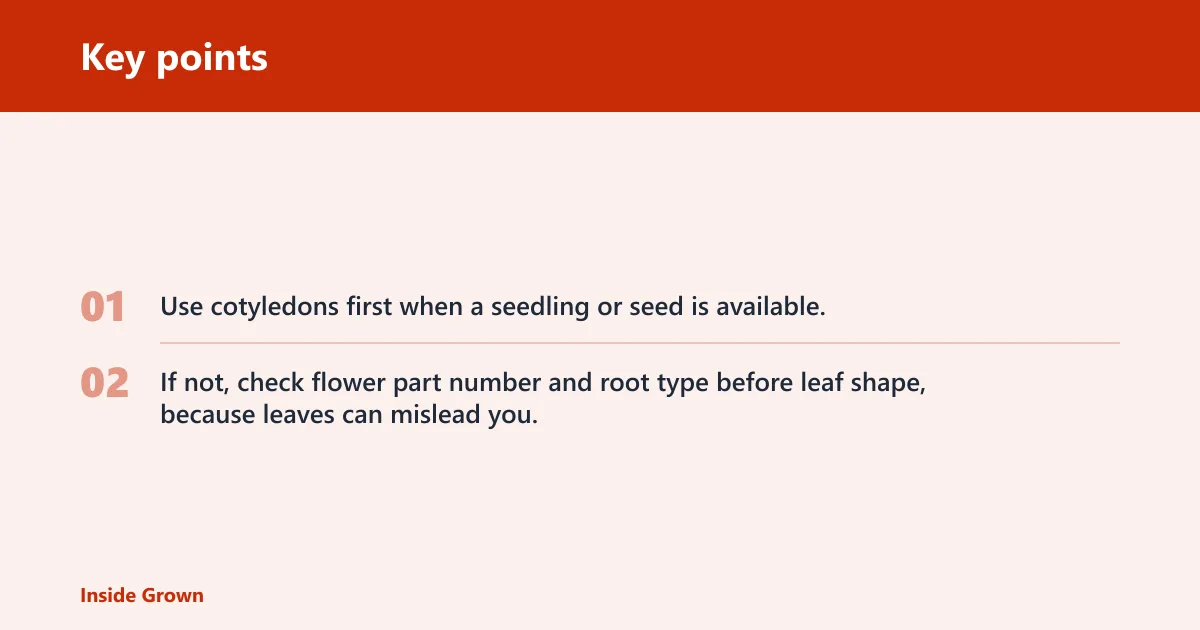
Use cotyledons first when a seedling or seed is available. If not, check flower part number and root type before leaf shape, because leaves can mislead you. Parallel veins usually point to a monocot, but some species break that pattern, so confirm with another trait whenever possible.
How do you tell them apart?
Start with visible structure, not the plant name on a label. A single trait can point in the right direction, but a second or third trait is what makes the ID reliable. The most dependable field clues are cotyledons, root form, stem anatomy, and flower part number.
Cotyledons
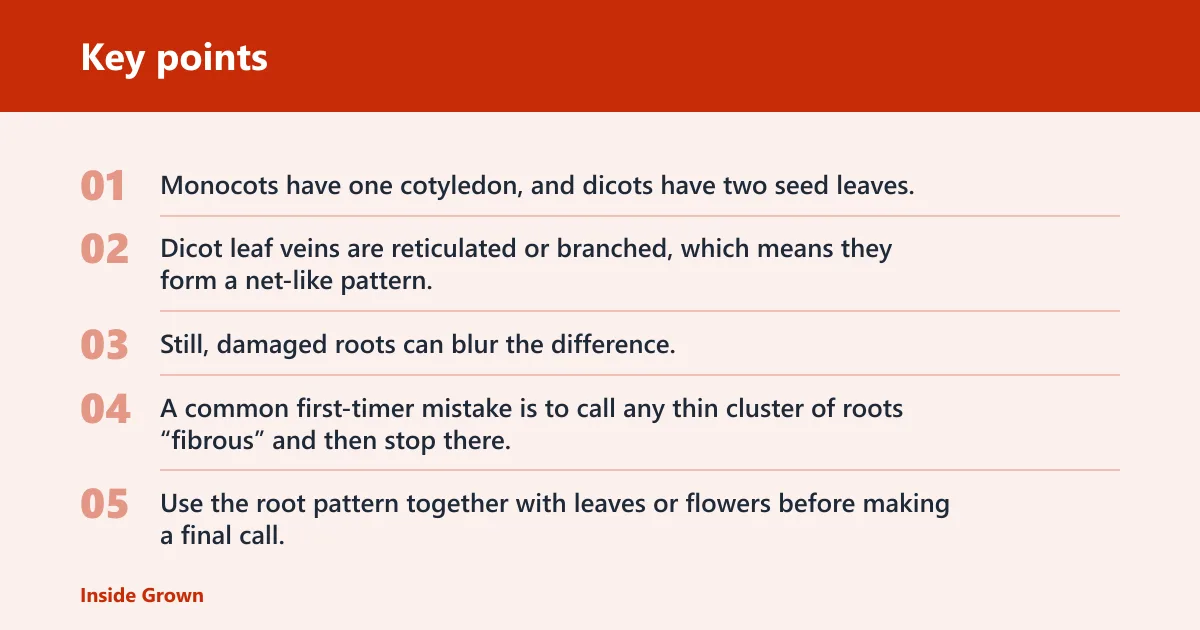
Cotyledons are the embryonic seed leaves. Monocots have one cotyledon, and dicots have two seed leaves. That is the core distinction, but you usually need a seed, a sprouting seedling, or a cross-section of young tissue to see it directly.
Leaf venation
Monocot leaf veins are parallel. Dicot leaf veins are reticulated or branched, which means they form a net-like pattern. This is an easy first look, especially on grasses versus bean leaves, but leaf shape alone can mislead you in unusual species or in plants with modified leaves.
Root systems
Monocots usually have fibrous roots. Dicots usually have tap roots. In the field, this is often more useful than leaf shape because the root pattern is easy to see when a plant is pulled or washed free of soil. Still, damaged roots can blur the difference.
A common first-timer mistake is to call any thin cluster of roots “fibrous” and then stop there. That can fail on young dicots, stressed plants, or species that form unusual root systems. Use the root pattern together with leaves or flowers before making a final call.
Stem anatomy
Monocot stems have scattered vascular bundles. Dicot stems usually have bundles arranged in a ring, and that ring pattern is tied to the way many dicots gain thicker stems over time. Cross-sections are especially useful here, but only if the stem is cut cleanly enough to read the pattern.
Flower structure
Monocot flower parts are often in multiples of 3. Dicot flower parts are often in multiples of 4 or 5. This is one of the best confirmation traits when the flower is open and complete, because petals, sepals, and other parts can be counted directly.
Traits that can mislead you
Leaves are the easiest place to make a wrong guess. Some monocots do not show the classic narrow grass-like look, and some dicots have leaves that seem simple or narrow at a glance. Roots can also mislead if the plant is young or partly damaged. Flowers are usually safer than leaves, but only when the parts are visible and intact.
Suppose you find a narrow-leaved garden plant with six petal-like parts on the flower and a fibrous root mass. That combination still points more strongly to a monocot than leaf shape alone would. If the same plant also shows parallel veins, the ID becomes much firmer.
What do monocots and dicots have in common?
Both groups are flowering plants within angiosperms. They produce seeds, flowers, and enclosed embryos, which is why they fit the same broad plant category even though they differ in seed-leaf number and several anatomical traits. The shared angiosperm body plan is the reason they are often compared together.
Both groups also use stomata for gas exchange and water loss control. In many monocots, stomata occur on both leaf surfaces more often than in dicots, while dicots often place them mainly on the lower surface. That difference matters for leaf function, but it is not a simple field ID rule by itself.
Bundle sheath cells surround vascular bundles in both leaf types. In monocot leaves, these cells are often photosynthetic and closely tied to leaf anatomy. Many monocot leaves also contain bulliform cells, which help the leaf fold or bend and can support water retention during dry conditions. (Wikipedia)
Monocot and dicot ID checklist
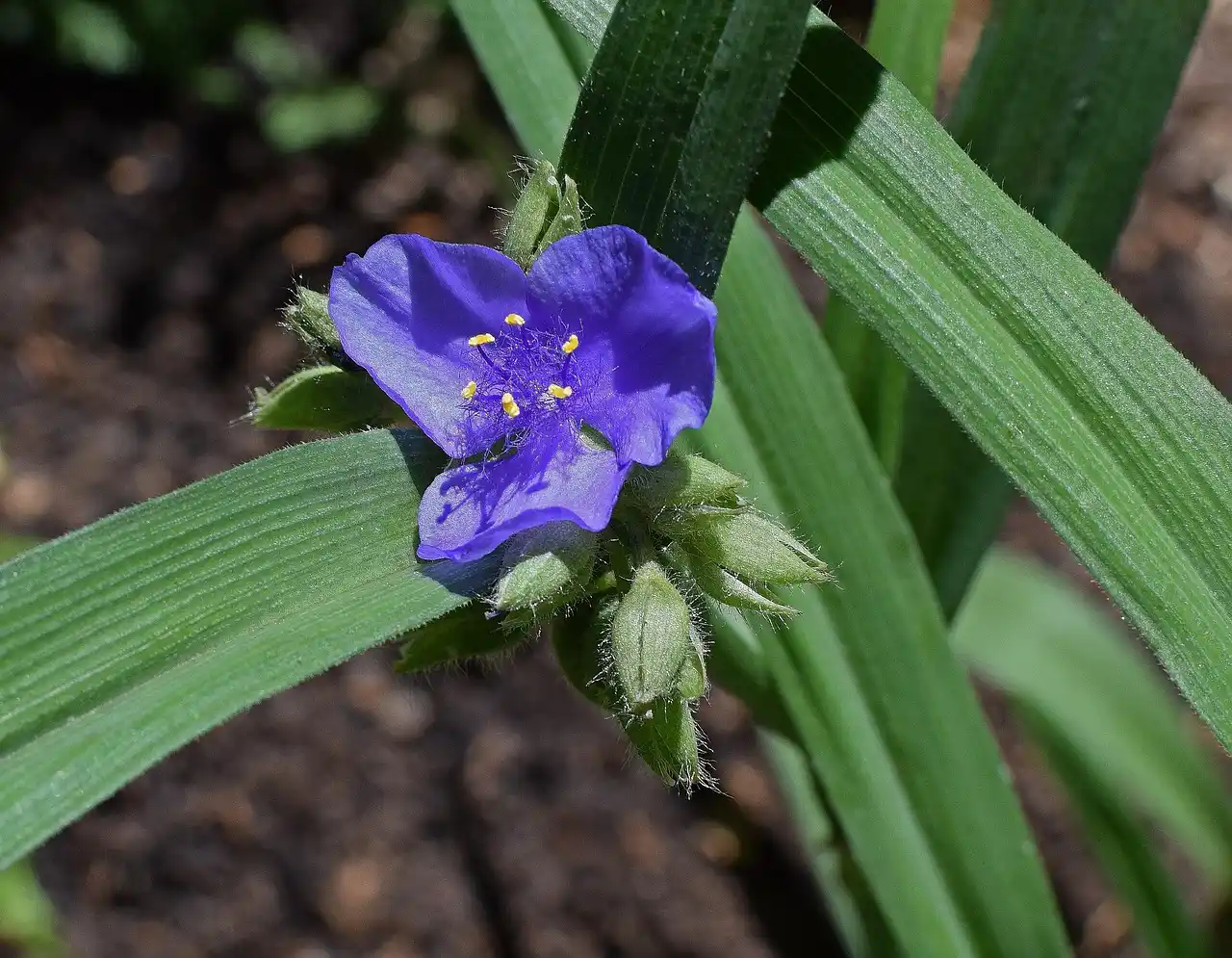
This checklist helps you score a plant without overcalling a single feature. Give one point for each trait that fits the first group, then total the pattern. The safest first checks are cotyledons, flower part number, and stem or root structure. If the plant is missing those clues, stop and mark it unsure.
| Trait | Monocot clue | Dicot clue | Score |
|---|---|---|---|
| Cotyledons | One seed leaf | Two seed leaves | 1 point if clear |
| Leaf venation | Parallel | Reticulate or branched | 1 point if clear |
| Root type | Fibrous roots | Taproot | 1 point if clear |
| Stem bundles | Scattered | Ringed | 1 point if visible |
| Flower parts | Multiples of 3 | Multiples of 4 or 5 | 1 point if flowers are complete |
| Known exception flags | No clear exception signs | Unusual leaf, root, or flower form | Subtract confidence if present |
- Check the seed or seedling. If you can see cotyledons, count them first. One points to a monocot, and two points to a dicot, which makes this the cleanest starting clue.
- Inspect the leaf veins. Look for parallel veins or a net-like pattern. This helps quickly, but do not stop here if the plant has a strange leaf form or a modified leaf.
- Look at the roots. A fibrous bundle supports monocot ID, while a taproot supports dicot ID. This is often one of the best practical clues for mature plants in the ground.
- Split the stem if needed. A clean cross-section can reveal scattered bundles in a monocot or a ring in a dicot. Use this when the plant still feels uncertain after the first checks.
- Count the flower parts. If the flower is complete, look for parts in 3s, or in 4s and 5s. This is one of the strongest confirmation traits once the flower is open.
- Flag any odd features. If several traits disagree, mark the plant unsure. Early-diverging dicots and atypical monocots can break the simple pattern, so a mixed result deserves caution.
Likely monocot: at least three monocot clues, including one of the stronger ones, such as cotyledons, root form, stem bundles, or flower parts in 3s.
Likely dicot: at least three dicot clues, again with one strong clue leading the pattern.
Unsure: traits conflict, the flower is incomplete, or the plant shows an obvious exception flag.
What are monocots and dicots with examples?
Examples make the split easier to remember. Grasses, lilies, onions, and corn are common monocots. Beans, peas, roses, and sunflowers are common dicots. These examples cover plants people actually see in lawns, gardens, and food crops.
Grasses are especially useful because their parallel veins, fibrous roots, and jointed stems often line up with the monocot pattern. Beans and peas are useful dicot examples because they usually show two cotyledons, net-like veins, and flower parts that fit the 4s-or-5s pattern. That said, look at the plant, not the label.
Common monocots
- Grasses, including lawn grasses and cereal crops
- Lilies
- Onions
- Corn
- Palms
Common dicots
- Beans
- Peas
- Roses
- Sunflowers
- Many garden trees and shrubs
What are monocots and dicots in angiosperms?
They are two major groups inside angiosperms, the flowering plants. That matters because most beginner plant ID starts with flowering plants, not mosses, ferns, or conifers. Monocots and dicots are the two patterns you are most likely to sort in everyday plant work.
The modern taxonomy note matters too: “dicots” is not treated as one single natural group in current biology. Many plants traditionally called dicots are now grouped as eudicots, while some early-diverging dicot-like lineages do not fit neatly into that older label. For practical ID, the old term still works, but use it carefully.
Why that taxonomy note matters
If a plant breaks the textbook rule, that does not mean the rule is useless. It means the rule is a guide, not a law. Beginners avoid confusion by treating “dicot” as a practical field label first, then checking whether the plant fits the expected traits before making a final ID.
Choose monocots if… / Choose dicots if…
Use the plant parts that are easiest to verify, then decide which side has the stronger match. If the evidence stays mixed, stop short of a final label. A careful “unsure” is better than forcing a plant into the wrong group.
Choose monocots if…
- You can confirm one cotyledon in a seed or seedling.
- The leaves show parallel venation and the roots are fibrous.
- The stem cross-section shows scattered vascular bundles.
- The flower parts are arranged in 3s.
Choose dicots if…
- You can confirm two seed leaves.
- The leaves show a net-like venation pattern.
- The plant has a clear taproot.
- The flower parts are arranged in 4s or 5s, and the stem bundles form a ring.
When the plant only gives you one weak clue, keep it in the unsure category. A plant with a grass-like leaf can still surprise you. A flower with a broken petal count can also mislead you. The safest ID comes from a pattern, not a single feature.
Frequently asked questions
How are monocots and dicots different?
The main differences are in the seed leaf count, leaf venation, root type, stem bundle pattern, and flower part number. Monocots usually have one cotyledon, parallel veins, fibrous roots, scattered stem bundles, and flower parts in 3s. Dicots usually show the opposite pattern.
What are monocotyledons and dicotyledons?
Monocotyledons and dicotyledons are longer names for monocots and dicots. They point to the same key feature: the number of cotyledons, or seed leaves, in the embryo. One cotyledon marks a monocotyledon, and two seed leaves mark a dicotyledon.
What are monocot and dicot leaves?
Monocot leaves usually show parallel venation, while dicot leaves usually show net-like or branched venation. That makes leaf veins a good starting clue. Even so, leaf form can mislead beginners, so it is best to confirm the ID with roots, flowers, or stem structure.