How to Soak Seeds Before Planting: When It Helps
Soak seeds before planting mainly when the seed coat is hard or water-resistant; many seeds need a short soak, while tiny, pelleted, primed, or cold-stratified seeds usually should stay dry. Done poorly, soaking can rot seeds, lower germination, or waste days on crops that would sprout fine without it. This guide shows when soaking helps, when scarification or stratification is the better step, and how to decide between direct sowing and indoor starting.
Should you soak seeds before planting?


Soaking helps most when water must first pass through a hard seed coat before germination can start. If the coat is already thin or lets water through easily, soaking often adds little and can raise rot risk. The quick rule is simple: hard coat, dry soil, or slow sprouting? Consider soaking. Soft, tiny, pelleted, or pretreated seed? Leave it dry.
What soaking does to the seed coat
Seed soaking is a short pre-plant water bath. It hydrates the seed coat, which can speed water entry into the embryo and start germination sooner. That matters most when the coat blocks water because it is hard or does not let much through. It matters less when the seed already takes up moisture easily.
Seed coat traits also tie into dormancy. Some seeds are dormant because the coat blocks water or oxygen. Others need a temperature cue before they will germinate. Soaking does not solve every dormancy type.
The quick rule for deciding whether to soak
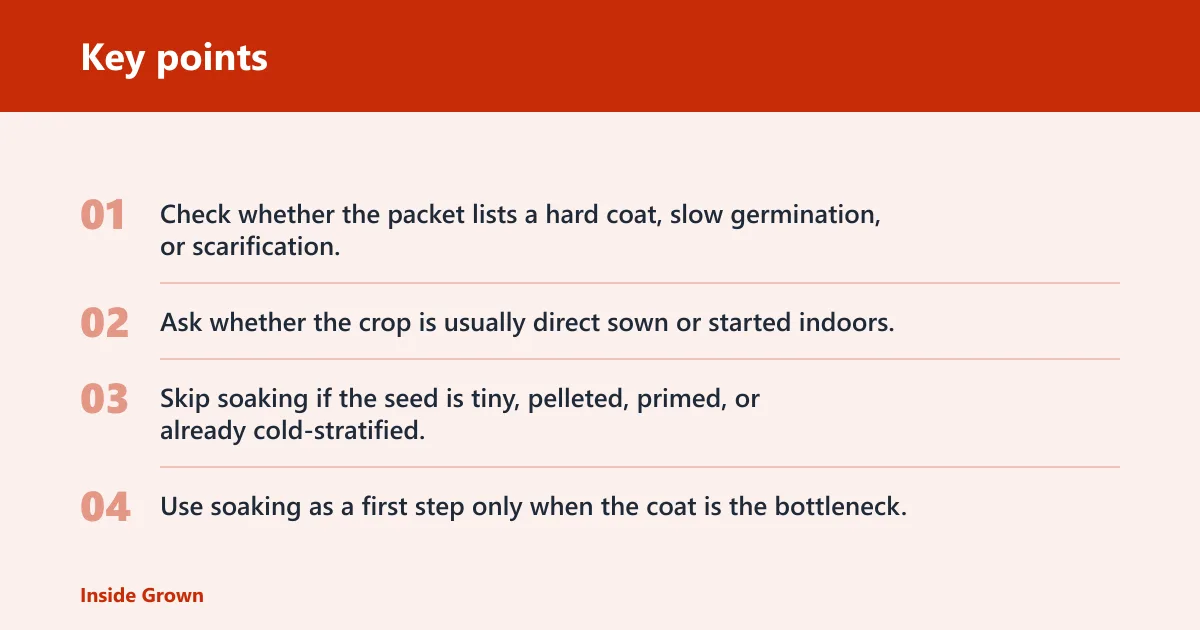
- Check whether the packet lists a hard coat, slow germination, or scarification.
- Ask whether the crop is usually direct sown or started indoors.
- Skip soaking if the seed is tiny, pelleted, primed, or already cold-stratified.
- Use soaking as a first step only when the coat is the bottleneck.
Which seeds should you soak, and which should you skip?
Hard-shelled legumes and other hard-coated seeds are the clearest candidates for soaking. Small seeds, pelleted seeds, and moisture-sensitive types are poor candidates because they are hard to handle after soaking and can clump, crack, or rot. Seed age changes the decision too: older seed may benefit from a moisture start, but a low-viability batch can also fail faster once wet.
Best candidates: hard-shelled legumes and other hard-coated seeds
Common high-benefit groups include peas, beans, okra, sweet peas, nasturtium, beet, and many members of the morning glory family. In these seeds, a hard coat can slow water uptake enough that a soak helps even out sprouting. That said, hard coat does not mean unlimited soak time.
Some species react better to scarification than soaking. If the coat is very hard or glossy, a small nick or abrasion may work better than a long soak. A seed that barely absorbs water may need both treatments in sequence.
Poor candidates: small seeds, pelleted seeds, and moisture-sensitive types
Very small seeds, such as lettuce, basil, and many herbs, are awkward to soak because they stick together and are easy to lose. Pelleted seed often carries a coating that breaks down in the wrong place, making handling worse. Primed seed has already started hydration control at the factory, so extra soaking can undo that benefit.
Picture a packet of petunia seed coated for easy handling. If those pellets sit in water, they may swell unevenly and break apart before you can sow them cleanly. That creates clumps and uneven spacing.
How seed age and viability change the decision
Older seed can still be worth sowing, but age lowers the margin for error. A float test can help separate obvious empties from filled seed, yet it is not a viability test. Some good seed floats, and some dead seed sinks. Use it only as a rough screen, not as proof.
If germination is already likely to be low, avoid extra steps that add rot risk. For marginal seed, a short soak may help hydration, but only if the coat is a real barrier. If the packet is old and the seed is tiny, dry sowing into good media may be the safer bet.
How long should seeds soak before planting?
Many garden seeds do well with a soak of roughly 6 to 24 hours, and overnight is often a practical upper limit for common crops. Short soaks may barely change water uptake, while long soaks can starve the seed of oxygen and invite decay. Hard-coated legumes often fit the longer end; thin-coated seeds need less.
Common soak ranges by seed type
| Seed type | Typical soak time | Notes |
|---|---|---|
| Pea, bean, lentil | 6 to 12 hours | Good candidates, but avoid softening to the point of split coats. |
| Okra, nasturtium, morning glory | 8 to 24 hours | Hard coats often respond well; check daily. |
| Beet, chard | 4 to 8 hours | Brief soaking may help, but long soaks are unnecessary. |
| Lettuce, basil, carrot | Usually skip | Too small or too moisture-sensitive for routine soaking. |
Why too-short and too-long soaks both cause problems
A short soak may not penetrate the seed coat enough to matter. A long soak can lower oxygen around the seed and raise the risk of rot, especially in cool rooms. Once a coat softens, the seed should move to moist media promptly rather than sit in water longer than needed.
For many crops, overnight is a practical stopping point because it gives hydration without pushing into the higher-risk range. If the seed coat is visibly softened before then, there is no benefit in waiting for a full day.
What water temperature should you use?
Room-temperature water is the default for soaking seeds before planting. It is predictable, gentle, and less likely to damage embryos than hot water. Hot water can injure seed tissue fast, especially in small seeds or species with thin coats. Some species tolerate warmer water, but that is an exception, not a general rule.
Room-temperature water as the default
Use water that feels neutral to the touch, not warm enough to suggest heat. Consistent temperature matters more than chasing speed. For most home-garden seed lots, plain room-temperature water is the safest choice.
A common first-timer mistake is using hot tap water because it seems like it would work faster. That can crack tissues or reduce germination, especially with seed that is already dry and brittle.
When hot water is risky
Hot water is risky because it can damage living tissue in the embryo before hydration is complete. Thin-coated seed and small seed are especially vulnerable. If a packet recommends scarification plus a warm soak, follow the packet exactly; otherwise stay with room temperature.
Why some species react poorly to warm or prolonged soaking
Some seeds absorb water quickly and then begin metabolic activity right away. If they sit in warm water too long, microbial growth can accelerate and oxygen can drop. That combination can lower germination more than it helps.
When is scarification or cold stratification better than soaking?
Scarification is better when the seed coat is the problem and needs a physical breach. Cold stratification is better when the seed has temperature-based dormancy and needs weeks in cool, moist conditions. Soaking helps only when hydration is the main barrier; it is the wrong tool when the seed needs abrasion or a winter cue.
What scarification means and the tools you can use
Scarification means nicking, scratching, or thinning the seed coat so water can enter more easily. Tools include fine sandpaper, a nail file, or the edge of a knife used with care. It beats soaking when a seed coat is so hard that water barely gets through.
Use scarification sparingly. The goal is to thin the coat, not expose the embryo. If the packet says to scarify, a short soak afterward can help finish the job.
What cold stratification means and when it is required
Cold stratification is a period of moist chilling, usually around refrigerator temperatures, that breaks dormancy in many temperate perennials and trees. The duration often ranges from a few weeks to a few months, depending on species. Soaking alone cannot replace that cold period.
If a seed needs winter-like conditions, soaking may be at best a minor first step. In that case, keep the seed moist and cold for the time the crop requires.
How to tell which pre-treatment matches the seed
Look for clues on the packet: words such as “scarify,” “stratify,” “cold treatment,” or “slow to germinate.” Hard, glossy coats point toward scarification or a soak. Seeds from woodland perennials often point toward stratification. Very small annual vegetables usually need neither.
Decision checklist: seed traits, best pre-treatment, and do-not-soak warnings
Use seed traits, not habit, to choose the pre-treatment. Hardness, dormancy type, size, and planting method should drive the decision. If the seed is tiny or already treated, soaking usually adds more risk than benefit. If the coat is hard and the packet suggests slow uptake, soaking may be a good first step.
| Seed traits | Best pre-treatment | Do-not-soak warnings |
|---|---|---|
| Hard coat, legume-like seed, slow water uptake | Soak 6 to 12 hours; scarify if coat is very hard | Do not leave in water for a full day if coat softens early. |
| Needs winter-like dormancy break | Cold stratification | Soaking will not replace weeks of cool, moist treatment. |
| Tiny seed, pelleted seed, primed seed | Sow dry | Soaking causes clumping, damage, or loss of coating. |
| Old seed with uncertain viability | Start with a small test batch; use moist media if needed | Do not assume a float test proves viability. |
| Direct-sown in dry soil | Short soak may help | Do not soak if a wet spell is forecast and soil is already cold. |
Seed trait clues to look for on the packet
Packet language matters. “Soak overnight” often appears on hard-coated crops. “Scarify” signals a shell barrier. “Stratify 30 days” usually means the seed needs chilled moisture for about a month. If the packet lists none of those, dry sowing is often the right starting point.
What should you do after soaking seeds?
Plant soaked seeds promptly after draining, because the goal is hydration, not storage. For direct sowing, move them into prepared soil before the coat dries again. For indoor starting, use clean trays and sterile media, because wet seed and damp mix can invite fungal problems if they sit too long.
How fast to plant after soaking
Plant as soon as the soak ends and the seeds are drained. A brief surface dry is fine; a long delay is not. Once a soaked seed is exposed to air, the tissue begins changing fast, and a second drying cycle can interrupt germination.
Direct sowing versus indoor seed starting
Direct sowing after soaking can help in dry soil because the seed enters the bed already hydrated. That can improve the start in uneven moisture conditions. But soaked seed placed into cold, wet ground may sit too long and rot before sprouting.
For indoor starting, use sterile media and clean containers. Soaked seed already has high moisture, so the mix should be moist, not soggy. Good airflow and careful watering reduce fungal risk.
Reducing rot and fungal risk in wet media
Do not pile soaked seed into muddy soil or waterlogged trays. Keep sowing depth appropriate for the crop, cover lightly, and avoid sealing the surface so tightly that oxygen drops. If a seed has cracked during soaking, plant it immediately or discard it if tissue is exposed.
Suppose a gardener soaks bean seed for 18 hours, then leaves it another day in a cup on a cool counter. The seed coat may split unevenly, and a few seeds may smell sour before planting. That delay turns a helpful step into a loss.
Frequently asked questions
Can you soak seeds too long?
Yes. Too much time in water can reduce oxygen, encourage rot, and crack softened coats. The longer the soak, the more important temperature and cleanliness become. If seeds smell sour, look swollen in a damaged way, or shed their coat, the soak likely went too far.
Does soaking seeds help all vegetables germinate faster?
No. It helps mostly with hard-coated vegetables and a few slow starters. Tiny seeds, pelleted seed, and crops that already germinate easily often gain little or even lose reliability. For many vegetables, good moisture and proper depth matter more than pre-soaking.
What is the best water temperature for soaking seeds?
Room-temperature water is the safest default. It hydrates the seed without the heat stress that can damage embryos or speed decay. Warm or hot water should be used only when a specific seed instruction says so, because many species respond poorly to extra heat.