How Many Seeds Should You Start in Each Cell Tray?
Use 1 seed per cell for large, expensive, or dependable seed; sow 2 seeds for average-germinating crops; sow 3 seeds for old, slow, or uncertain seed, then thin to the strongest seedling. Too many seeds in one cell waste mix, light, and time, while too few can leave empty cells you must resow. This guide breaks down how many seeds to start per cell for vegetables, herbs, and flowers, with crop-based rules and thinning guidance. For the depth and germination rules behind those choices, see extension guidance from Cornell Cooperative Extension, Penn State Extension, and University of Minnesota Extension on sowing depth, seed viability, and seed-starting schedules.
Cell tray basics


A cell tray splits one flat into separate pockets, often 24, 40, 72, 128, or 200 cells. Smaller cell counts usually mean larger, deeper cells; higher counts mean smaller, shallower cells. Tray material is usually rigid plastic, and drainage holes matter because standing water raises damping-off risk and weakens roots. University extension sources such as University of New Hampshire Extension and University of Vermont Extension consistently note that the right cell size depends on how long the seedling will stay in the tray before transplanting.
Cell size changes how much root room each seedling gets. Shallow cells dry faster and fit fast-start crops for quick transplanting. Deep cells hold more mix and suit crops that stay longer before moving out. If the tray is shallow and the crop grows slowly, crowding happens sooner. Low-fill trays dry unevenly too: the corners and outer rows usually lose moisture first, so extra seeds in those cells are not a substitute for even watering.
Use the tray size to match the crop, not only the number of seedlings you want. A 128-cell tray is efficient for lettuce or basil, but a pepper seedling may outgrow that cell more quickly than it would a 40-cell or 72-cell tray. Bigger cells also give more buffer if germination is uneven. For root crops and long-stay transplants, extension guides from Iowa State University and Oregon State University favor larger cells or fewer plants per tray because the root system needs more space before transplanting.
Growing medium, heat, and light change the seed count
The mix, temperature, and light you provide after sowing can change whether 1 or 2 seeds per cell is the safer choice. In a fine, uniform seed-starting mix, one seed is more dependable than it is in chunky potting soil or reused media. Seed-starting mix from a proper seed-starting mix section or a related guide should be fine-textured, evenly moist, and low in nutrients so roots can move easily. University of Minnesota Extension and Clemson Extension both emphasize a light, sterile, well-drained medium for seed starting because heavy soil slows emergence and increases loss.
Bottom heat also changes the odds. Warm-season crops such as tomato, pepper, eggplant, basil, and many flowers usually germinate more evenly with bottom heat; cool-season crops such as lettuce or broccoli often do not need it and can even become leggy if the tray is too warm. If you have a reliable heat mat and stable room conditions, 1 seed per cell becomes safer for crops with strong germination. Without bottom heat, or in a cool basement, 2 seeds per cell is often the safer insurance policy for slower crops. Cornell University and NC State Extension both recommend crop-specific germination temperatures rather than one universal setting.
Light matters most after emergence. As soon as seedlings break the surface, they need strong light immediately and consistently so stems do not stretch. In practical terms, place trays under lights as soon as cotyledons show; many growers keep lights close enough to prevent stretching but not so close that leaves bleach or curl. If your lighting is weak or delayed, sowing 2 seeds per cell can create backup insurance in crops prone to uneven emergence, but it will not fix leggy growth. For grow light basics, see a related grow lights guide. A timely setup matters more than extra seed once the plants emerge.
Real-world tradeoff: if a tray is only half filled, the empty pockets dry faster and warm faster at the edges, so a single seed per cell can fail simply because moisture breaks unevenly. In that situation, growers often choose 2 seeds for low-cost crops and 1 seed for expensive seed, then adjust watering and light rather than overbuying seed.
How many seeds per cell?
Start with the lowest number that still gives a good chance of one strong seedling: 1 seed for large, dependable seed; 2 seeds for average germination; 3 seeds only when the seed is old, the crop is slow, or the cell is likely to fail. After sprouting, thin to one plant per cell. Extension tables from Missouri Botanical Garden, Johnny’s Selected Seeds, and Burpee generally follow the same rule: use fewer seeds when the seed is dependable and the crop dislikes root disturbance, and use a backup seed when the lot is old or irregular.
When one seed is enough
One seed per cell is the cleanest choice when the packet shows high germination, the seed is fresh, and the crop is easy to start. This is the right default for large seed, pelleted seed, and expensive seed where wasting even a few extra seeds matters more than filling every cell. It is also the right choice when you are working with a sturdy, fresh lot and a good seed-starting mix under consistent bottom heat.
If you are filling 72-cell or 40-cell trays with crops like tomato or pepper and the packet is current, one seed per cell is often enough. The goal is not maximum sowing density. It is one healthy transplant per cell with little extra thinning work. In a clean, heated tray with strong light, fresh tomato seed often emerges close enough together that a second seed just creates unnecessary thinning.
When to sow extra
Sow 2 seeds per cell when germination is moderate, seed age is uncertain, or the crop is known to sprout unevenly. Use 3 seeds only for low-risk, low-cost crops where a missing cell matters more than one extra thinning cut. More than 3 usually creates crowding without adding much insurance. For cluster crops, multiple seedlings may be intentional; for single-stem crops, extras are only a temporary backup.
Say your lettuce packet is two seasons old and the germination percentage is not printed. Two seeds per cell is the safer choice in a 128-cell tray, because lettuce is small-seeded and easy to thin. A third seed is usually unnecessary unless the seed lot is clearly old or patchy. If the tray is shallow or the room runs warm and dry, 2 seeds also helps cover uneven surface moisture at the edges of the tray.
- Check the packet germination percentage and seed date.
- Match the crop to its seed size and reliability.
- Choose 1, 2, or 3 seeds per cell.
- Sow at the correct depth.
- Thin extras early, before roots knit together.
Seed size changes the count
Seed size changes both placement and sowing count. Tiny seed is usually scattered lightly or surface-sown, medium seed is usually covered lightly, and large seed often gets one seed per cell. Pelleted seed can be easier to place one by one, but the coating does not change the crop’s germination needs. Cornell Cooperative Extension and Johnny’s Selected Seeds both point out that depth should follow seed size and crop needs, not tray convenience.
Tiny seeds and surface sowing
Tiny seed such as lettuce, basil, celery, and some flowers is easy to bury too deeply. For these crops, 1 to 2 seeds per cell is common, with a very thin dusting of mix or vermiculite if the packet calls for cover. Many growers surface-sow the smallest seed and keep it evenly moist by watering from below or misting the surface. If the medium is coarse or the lighting is weak, 2 seeds per cell is safer than 1 because tiny seed can disappear into cracks in the mix.
Medium seeds and light coverage
Medium seed, including tomato and many herbs and annual flowers, usually gets 1 to 2 seeds per cell. The seed is small enough that the tray can hold two, but large enough that you can place it and cover it with a thin layer of mix. Keep the cover light so the sprout can reach daylight quickly. Extension guidance from University of Maryland Extension and Iowa State University commonly uses a sowing depth of about 2 to 3 times seed thickness for this group.
Large and pelleted seeds
Large seed such as pea, bean, cucumber, squash, and nasturtium often goes one per cell, or it may be better suited to direct sowing. If the seed is pelleted, one pellet per cell is usually the right placement because the coating already makes handling easier and the cost per seed is higher. For cluster herbs and flowers sold as multiseed pellets, follow the packet; those are the main exception where more than one seed per cell is intentional, not accidental.
What if seed germination is uncertain?
If the packet lists a lower germination percentage, the seed is old, or the crop is known for uneven sprouting, increase the count by one seed per cell. A packet marked 80% germination often still gives many good starts, but it can leave empty cells if you sow only one seed where two would be safer. Cornell and university extension recommendations for seed testing regularly use the packet germination rate as the first cue for how much insurance to add.
Seed age matters because viability falls over time, especially if the packet has been opened, stored warm, or kept in humidity. For older seed, sow 2 seeds instead of 1 for valuable cells, and 3 only when missing a seedling would be more costly than thinning extras. Old seed that sprouts in a spotty pattern often reveals itself in the tray: some cells pop in 3 to 5 days, then a second wave comes much later. In that case, the extra seed is buying time as much as certainty.
A quick viability check can help before you fill a tray. Place 10 seeds on a moist paper towel in a sealed bag or box, then check the number that sprout in the usual germination window for that crop. If fewer than about 7 sprout, use an extra seed per cell as insurance. For a more formal method, use the same paper-towel or sand-top test described by extension services and seed companies such as Johnny’s Selected Seeds, and compare the result to the packet’s stated germination percentage.
For expensive specialty seed, the math changes. If each seed costs enough that oversowing hurts, start with one seed per cell and place the tray where it stays warm and evenly moist instead of doubling the count. For cheap seed and a tight schedule, oversowing is usually the better trade. For low-fill trays or a partially used pack, the simplest choice is often 1 seed per cell for the pricey crop and 2 seeds per cell for the inexpensive backup crop, so the tray layout does not force you to waste premium seed.
How deep should you sow?
General depth rule: sow seeds about 2 to 3 times their thickness, unless the packet gives a different depth. Fine seed may stay on the surface or get only a dusting of mix. Large seed needs deeper placement, but still not so deep that the sprout runs out of energy before reaching light. This aligns with extension guidance from University of Illinois Extension, Penn State Extension, and other horticulture programs that recommend following crop-specific packet instructions when available.
Seed-starting depth and number of seeds per cell work together. A deep cell can help a larger seedling establish roots, but it does not compensate for burying tiny seed too far down. Likewise, more seeds in one cell can hide a germination issue, but the surviving seedling still needs the correct depth and a fine enough medium to emerge cleanly.
Fine seed at the surface
Fine seed often needs light, air, or very shallow cover. Press it into moist seed-starting mix, then mist or water from below so it stays in place. Do not bury tiny seed in loose mix, because that can slow or block emergence and produce weak seedlings. If the tray sits under bottom heat, keep the surface evenly moist but not saturated, because fine seed can rot quickly if the top stays wet and the bottom stays hot.
Deeper sowing for larger seed
Large seed should go deeper than fine seed, but not beyond the packet’s direction. In cell trays, a deeper cell gives more room for root development and makes moisture more stable. That matters for beans, peas, squash, and other crops that push out a heavier sprout. A 72-cell deep tray can be a better fit for these crops than a 128-cell shallow tray, even if the tray count looks less efficient on paper.
Label depth by crop on the packet or tray tag. A flat number such as “1/4 inch” works for many herbs and lettuce, while larger seeds often need “1/2 inch” or more. If the packet and the general rule disagree, follow the packet. Seed companies such as Baker Creek, Johnny’s, and Burpee all emphasize packet-specific depth because cultivar size and seed lot differences can change the result.
Thinning without damage
Thin to one seedling per cell as soon as the extras are clearly visible and the strongest sprout has true leaves or a firm stem. Do not wait until roots are tangled. Cutting extras at the soil line is usually safer than pulling them, because pulling can disturb the survivor’s roots. For single-stem crops like tomato, pepper, zinnia, and marigold, thin to one. For cluster crops like basil or scallions, follow the intended cluster spacing instead of forcing a single plant too early.
Choose the straightest, darkest green, and most vigorous seedling. If two sprouts are equal, keep the one with the better root position and clip the other at the mix line with clean scissors. That avoids lifting the whole plug and reduces transplant stress later. If one seedling is clearly dominant, the weaker one is usually best removed early before leaves overlap and the roots intermingle.
Suppose two tomato seeds sprout in the same 72-cell tray pocket. Leave the stronger stem and snip the weaker one at soil level once the first true leaves appear. If you pull both apart, the roots can tear and the remaining plant may stall for days. In crowded trays, that stall often shows up as uneven height across the entire flat, which then makes transplanting awkward.
Sowing matrix for common crops
This matrix gives a practical starting point for common home-garden crops. Use it with the packet date, the germination percentage, and the tray size. For low-fill trays, old seed, or expensive seed, move one step upward or downward only when the crop and risk level justify it. Crop-specific guidance from extension services and seed companies supports these ranges more than any one universal count does.
| Crop group | Seed size | Typical germination reliability | Seeds per cell | Thin timing | Adjustment rule |
|---|---|---|---|---|---|
| Lettuce | Tiny | Usually good when fresh | 1-2 | At first true leaf | Use 2 if seed is old, surface mix is coarse, or tray fill is important; clusters are not typical |
| Basil | Tiny | Moderate to good | 2-3 | When sprouts stand upright | Cluster crop: 2-3 can be kept together longer; use 3 only for older seed or cool rooms |
| Cilantro | Medium | Moderate | 1-2 | At first true leaf | Use 2 in warm rooms or older seed lots; cluster sowing is possible if transplanting as a clump |
| Parsley | Tiny to medium | Slow, often uneven | 2-3 | After emergence stabilizes | Use 3 for old seed; do not sow deep; clusters are fine if transplanted young |
| Dill | Medium | Usually fair to good | 1-2 | At first true leaf | Single-stem crop: thin early; 2 is safer in low-fill trays |
| Tomato | Medium | Usually reliable | 1-2 | At first true leaf | Single-stem crop: use 2 for older seed or if packet rate is under 85% |
| Pepper | Medium | Often slower, sometimes uneven | 1-2 | At first true leaf | Single-stem crop: use 2 if seed is old or germination is below average; bottom heat improves the case for 1 |
| Eggplant | Medium | Moderate | 1-2 | At first true leaf | Single-stem crop: use 2 if heat is inconsistent or seed lot is older |
| Marigold | Medium | Usually good | 1-2 | After cotyledons open | Single-stem crop: use 2 in older lots or shallow trays |
| Zinnia | Medium to large | Moderate | 1-2 | After emergence | Single-stem crop: use 2 when seed is old or pelleted seed is scarce |
| Calendula | Medium | Usually fair | 1-2 | At first true leaf | Single-stem crop: use 2 if room is warm or seed is a year old |
| Snapdragon | Tiny | Moderate | 2-3 | After first true leaves | Can be clustered briefly; thin only if roots crowd |
| Petunia | Tiny | Moderate | 2-3 | When seedlings separate | Use 3 for older seed; often grown as small clusters early |
| Alyssum | Tiny | Usually good | 2-3 | After emergence | Cluster crop: keep more than one if transplanting multiple seedlings per plug |
| Chive | Medium | Usually good | 2-3 | When clumps begin to fill the cell | Cluster crop: multiple seedlings can be planted together for a fuller pot |
| Scallion | Medium | Usually good | 3-4 | Rarely thinned | Cluster crop: sow more heavily if harvesting as bunching onions |
| Leek | Medium | Usually fair to good | 2-3 | At 2 to 3 true leaves | Can be grown in clusters for skinny transplants; use 1 if seed is fresh and spacing is tight |
| Broccoli | Medium | Usually good | 1-2 | At first true leaf | Single-stem crop: 2 is safer if seed is old or tray temperatures fluctuate |
| Cabbage | Medium | Usually good | 1-2 | At first true leaf | Single-stem crop: use 2 for lower-germination lots or cool starts |
| Kale | Medium | Usually good | 1-2 | At first true leaf | Single-stem crop: one seed is enough when fresh; 2 helps in patchy trays |
| Cauliflower | Medium | Usually good | 1-2 | At first true leaf | Single-stem crop: prefer 1 with fresh seed, 2 with older seed |
| Bok choy | Medium | Usually good | 1-2 | At first true leaf | Single-stem crop: 2 is useful in cool soils or low-fill trays |
| Cucumber | Large | Usually reliable | 1 | Rarely thinned | Single-stem crop: one seed is standard; use 2 only if seed is clearly old |
| Squash | Large | Usually reliable | 1 | Rarely thinned | Single-stem crop: do not crowd; transplant young |
| Melon | Large | Usually fair to good | 1 | Rarely thinned | Single-stem crop: 1 in a larger cell is safer than oversowing |
| Bean | Large | Usually reliable | 1 | Rarely thinned | Single-stem crop: often better direct-sown; use 1 only if starting indoors |
| Pea | Large | Usually reliable | 1 | Rarely thinned | Single-stem crop: do not oversow unless seed is old |
| Nasturtium | Large | Moderate | 1 | Rarely thinned | Single-stem crop: one seed per cell is standard, because roots dislike disturbance |
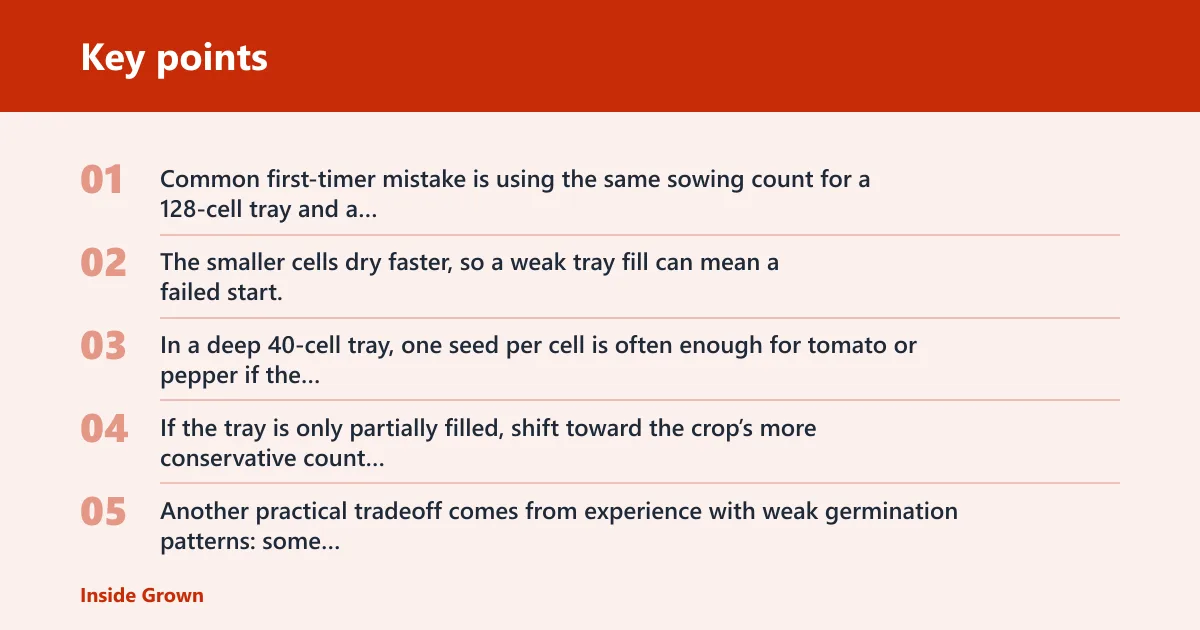
Common first-timer mistake is using the same sowing count for a 128-cell tray and a 40-cell tray. The smaller cells dry faster, so a weak tray fill can mean a failed start. In a deep 40-cell tray, one seed per cell is often enough for tomato or pepper if the packet is fresh. If the tray is only partially filled, shift toward the crop’s more conservative count because the outer cells may need more moisture monitoring and are more likely to lose heat first.
Another practical tradeoff comes from experience with weak germination patterns: some crops emerge in waves, not all at once. Lettuce may pop quickly and evenly, while pepper or parsley can lag for days. In those trays, sowing 2 seeds per cell reduces the chance that a slow pocket turns into an empty cell, especially if you are using a standard 72-cell tray rather than a larger 40-cell plug where the root zone stays moister longer.
Related setup guides
For the best results, pair this count guide with a few other seed-starting basics. A fine, sterile seed-starting mix helps tiny seed emerge cleanly. Proper grow lights reduce stretching after emergence. A quick germination testing check helps decide whether 1 or 2 seeds per cell is the smarter bet. Good airflow and cleanup practices support damping-off prevention. Matching the crop to the right tray sizes prevents root crowding. And timely thinning seedlings protects the strongest plant from root damage.
Frequently asked questions
How many seeds do you put in a seed tray?
Start with 1 seed per cell for reliable, larger seed, 2 for average germination, and 3 only when seed is old or germination is uncertain. The tray itself matters less than the cell count, depth, and crop. A 72-cell tray and a 128-cell tray can use the same rule. Extension services generally recommend counting by cell, not by tray, because cell depth and moisture control drive the outcome more than the tray’s outer dimensions.
How many seeds should you put in each cell?
Most home gardeners should aim for 1 to 2 seeds per cell. One seed keeps thinning simple and avoids crowding. Two seeds adds insurance against a blank cell. Three seeds is a backup choice for older seed, slow crops, or situations where you cannot afford missing starts. Cluster crops are the main exception: basil, onions, scallions, and some flowers are often started in small clumps on purpose.
How many seeds per cell do you need for pepper, tomato, or lettuce starts?
For tomato, 1 seed per cell is often enough with fresh seed, while 2 is safer if the packet is older. Pepper usually follows the same pattern, but slower sprouting makes 2 seeds more useful when seed quality is uncertain. Lettuce usually does well with 1 to 2 seeds per cell. If the tray sits in a cooler room or lacks bottom heat, 2 seeds becomes a safer fallback for pepper and tomato because germination often slows enough to expose weak spots in moisture control.
Should I plant one seed or multiple seeds per cell?
Use one seed when the crop is reliable, the seed is fresh, and the seed is expensive. Use multiple seeds when germination is uneven or the lot is old. Multiple seeds are a risk-control tool, not a default. The goal is one strong seedling, not a crowded plug. If you are using a fresh, high-germination lot, strong light, and a good mix, one seed is usually the most efficient choice.
What if my seeds are old or have low germination?
Increase the count by one seed per cell, then thin after sprouting. If the packet percentage is low or the seeds are several seasons old, a second seed is often cheaper than resowing an empty cell. For very old lots, a quick paper-towel check can show whether a third seed is worth it. If the germination pattern is patchy rather than uniformly low, sowing extra seeds can be more useful than just adding heat or light.
What should I do if more than one seed germinates in a cell?
Keep the strongest seedling and cut the others at the soil line with fine scissors as soon as the first true leaves appear. Do not pull extras unless the roots are still clearly separate. Cutting avoids disturbing the one plant you want to keep and lowers transplant stress later. For crop types that are meant to grow as a bunch, such as scallions or chives, keep the cluster only if the planting plan calls for a clump.
Sources: Cornell Cooperative Extension on sowing depth and seed-starting schedules; Penn State Extension on seed-starting media and thinning; University of Minnesota Extension on germination and starting transplants; Iowa State University Extension on tray size and transplant timing; University of New Hampshire Extension on plug tray selection; NC State Extension on bottom heat and germination temperature; Johnny’s Selected Seeds and Burpee on packet-specific depth and crop-by-crop sowing guidance.