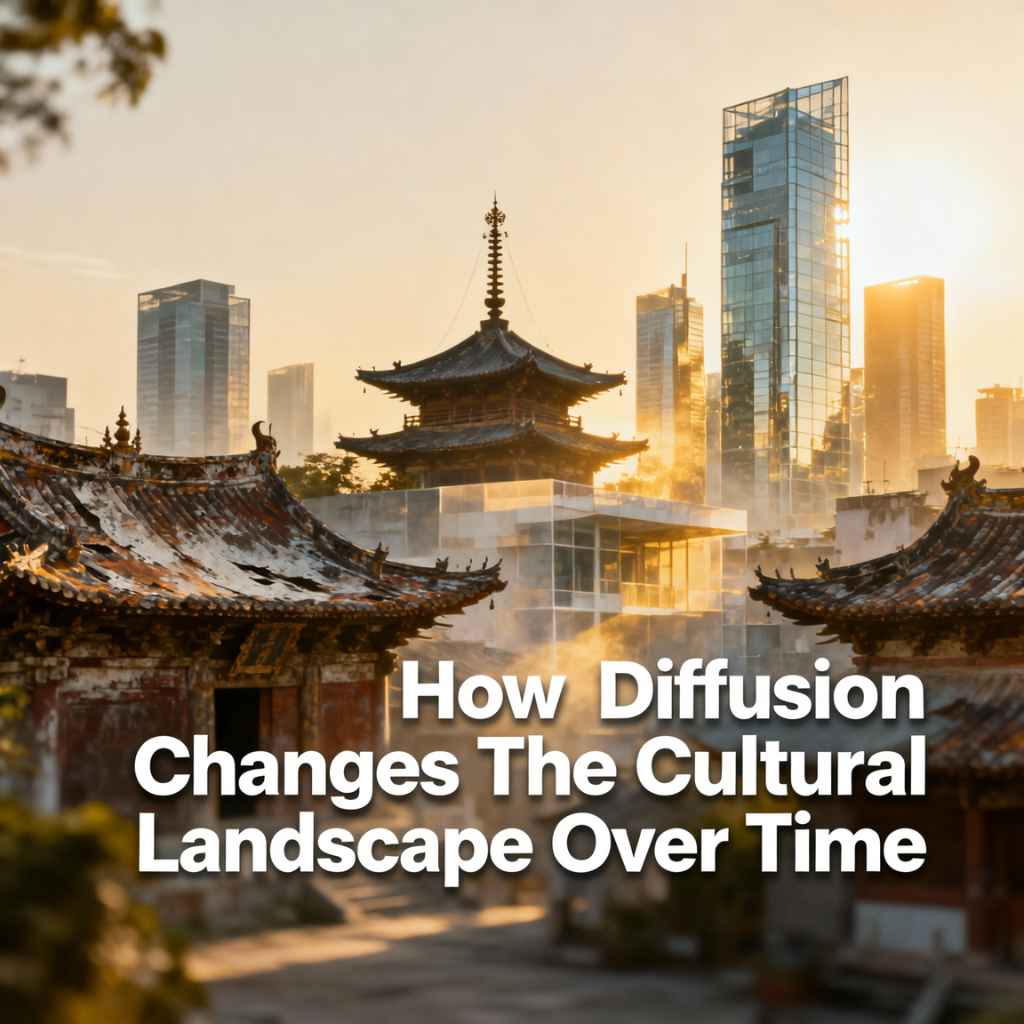

Cultural diffusion is the spread of ideas, customs, and technologies from one culture to another. It happens through migration, trade, and communication. This process changes societies over time. It leads to new blends of traditions and beliefs. Understanding diffusion helps us grasp global connections and cultural evolution.
What Is Cultural Diffusion?
Cultural diffusion is a big topic. But we can break it down. It’s about how things move between groups of people.
Think about what makes one culture different from another. It’s often their music, their food, their stories, or their way of building things. Cultural diffusion is the journey these things take.
When one group has an idea or a practice, and another group adopts it, that’s diffusion. It’s not just about big things. It can be small things too.
Like a new way to tie a shoe. Or a different way to cook rice. It’s a natural human thing.
We often see something new we like. Then we try it ourselves.
This spread isn’t always one-way. It can go back and forth. One culture might adopt something from another.
Then, that second culture might adopt something back. It creates a mix. It’s like a cultural exchange program that’s always running.
Why does it happen? Many reasons. People move.
They trade. They communicate. They learn from each other.
Technology makes it faster. The internet is a huge driver today. But it’s also happened for thousands of years.
Think about ancient trade routes. They spread more than just goods.

Why Does Cultural Diffusion Matter?
This process matters because it’s a major force in history. It’s why civilizations grew. It’s why languages changed.
It’s why we have so many different kinds of food now.
Without diffusion, cultures would stay much more separate. They might not change much. But the world isn’t like that.
We interact. We influence each other. This interaction is what makes cultures dynamic.
It prevents them from becoming stale.
It also helps us understand ourselves. Why do we eat certain foods? Why do we listen to certain music?
Often, these things have roots in other cultures. They’ve traveled a long way to get to us. Recognizing this helps us appreciate the global connections we have.
It can also lead to new creations. When different ideas meet, they can spark something totally new. Think about fusion cuisine.
Or musical genres that blend styles. This innovation comes from diffusion. It’s not just about taking.
It’s also about creating.
Understanding diffusion also helps us be more aware. We see how our own culture is influenced. We can also see how we might be influencing others.
It promotes a broader view of the world.
The History of Diffusion: A Journey Through Time
Cultural diffusion isn’t a modern invention. It’s as old as human groups interacting. Imagine early humans migrating.
They met other groups. They shared tools. They shared hunting methods.
This was the first wave of diffusion.
Think about ancient empires. The Roman Empire, for example. They didn’t just conquer land.
They spread their language, their laws, their building styles. Roman roads helped spread ideas. When the Romans left, those ideas remained.
Trade routes were crucial. The Silk Road is a famous example. It connected East Asia with the Middle East and Europe.
Merchants didn’t just carry silk and spices. They carried religions like Buddhism. They carried technologies like papermaking.
They carried artistic styles.
The Age of Exploration brought massive diffusion. European powers sailed the globe. They brought their culture to new lands.
They also brought back new foods, plants, and ideas from those lands. This led to huge changes in diets and economies worldwide. Think of potatoes going to Europe.
Or tomatoes going to Italy.
Later, colonization spread cultures further. It often forced diffusion. One culture imposed its ways on another.
This left deep marks. Some positive, many negative. It shows diffusion can be complex and unequal.
The Industrial Revolution sped things up. New technologies allowed faster travel and communication. Newspapers spread news and ideas quickly.
Mass production meant new goods could reach more people.
Today, the internet is the biggest driver. Music, videos, news, and trends can go viral globally in hours. Social media connects people instantly.
This makes cultural diffusion faster and more widespread than ever before. It’s a constant, ongoing process.
Key Drivers of Cultural Diffusion
Migration: People move. They bring their traditions with them. Settling in new places means sharing these traditions.
This introduces new foods, music, and customs to the host culture. It also means the migrants adopt some local ways.
Trade: Merchants travel. They exchange goods. They also exchange ideas.
Think of old trade routes. They were pathways for culture as much as for products. New foods and materials often arrived through trade.
Communication & Technology: From the printing press to the internet, these have huge impacts. Books, radio, TV, and social media spread ideas fast. They connect people across vast distances.
This makes diffusion happen much quicker.
Conquest & Colonization: This often involves a dominant culture imposing its ways. It can be a forced spread of language, religion, and government. This has a profound and often damaging effect on local cultures.
Types of Cultural Diffusion
Not all diffusion is the same. Experts talk about different ways it happens. This helps us understand the patterns.
One common type is called expansion diffusion. This is when an idea or innovation spreads outward from a central point. It stays strong in the origin.
And it moves to new places. Think of a popular new food trend. It starts in one city.
Then it spreads to other cities nearby. Then it goes further.
Within expansion diffusion, there are two main forms. Contagious diffusion is when it spreads person to person. Like gossip or a new dance move.
It spreads rapidly through a population. Everyone is hearing about it or seeing it.
Another form is hierarchical diffusion. This is when ideas spread from important people or places. It moves from larger cities to smaller towns.
Or from fashion leaders to their followers. It doesn’t spread everywhere at once. It jumps between key nodes.
Then there’s stimulus diffusion. This happens when an idea is rejected at first. But it inspires a new idea.
The original concept changes. It adapts. People like the new version better.
Think of how McDonald’s spread. Many cultures didn’t eat beef. So, McDonald’s adapted with fish or chicken options.
Finally, direct diffusion happens when two cultures are in close contact. They borrow from each other directly. This could be through marriage, trade, or war.
They are neighbors. They interact a lot.
Indirect diffusion is when something spreads through a middleman. Like a trader who carries an idea from one place to another. Then that person shares it with a third group.
It’s not a direct link between the original source and the final receiver.
Understanding these types helps us see the pathways ideas take. It shows that diffusion has a structure.
Understanding Diffusion Types
Expansion Diffusion: Spreads from a core area outward.
- Contagious: Person-to-person spread. Like a viral video.
- Hierarchical: Spreads from influential centers. Like from big cities to small towns.
Relocation Diffusion: People move and take their culture with them. Like immigrants starting a new restaurant.
Stimulus Diffusion: An idea is adapted. It leads to a new, accepted version. Like fast food chains changing menus for local tastes.
Personal Experience: The Pizza Saga
I remember vividly when I first traveled outside the U.S. for an extended period. I was living in a small town in Japan for a few months.
I loved the local food. Ramen was a revelation. Sushi was amazing.
But after a few weeks, I started craving something familiar. Pizza.
I found a pizza place. It looked promising. The menu had pictures.
I ordered a classic pepperoni. When it arrived, it was… different. The crust was thicker, almost sweet.
The cheese was a strange texture. And the pepperoni? It was cut into tiny squares and scattered.
It looked nothing like the pizza I knew.
It was a moment of cultural whiplash. I realized pizza, as I understood it, wasn’t just a food. It was a whole set of expectations.
The way it’s made, the taste, even the toppings. This Japanese pizza was still pizza. But it had been adapted.
It had changed to fit local tastes and ingredients. It was a perfect example of stimulus diffusion in action. My craving for my pizza led to me experiencing their pizza.
And it was good, just different.
Cultural Landscapes: How Diffusion Reshapes Our World
The most obvious impact of diffusion is on our physical world. Look around your town. You’ll see it everywhere.
Architecture is a great example. Many American cities have buildings that look European. Think of Greek columns on public buildings.
Or Gothic arches on churches. These styles traveled across the Atlantic. They blended with local materials and needs.
New York City has distinct neighborhoods. Each with its own architectural flair. Chinatown has pagodas.
Little Italy has its own feel. These aren’t just decorations. They are visual markers of cultural origins.
Food is another huge one. We have Italian restaurants everywhere. Mexican food is a staple.
Indian curries and Thai stir-fries are common. These foods came from other countries. They were brought by immigrants.
They were adapted. Chefs created new versions. Now, they are part of the American diet.
Fast food chains also adopted global foods. They are a form of diffusion too.
Music is constantly changing. Hip-hop in America borrows from Jamaican toasting. Jazz has roots in African rhythms and European harmony.
Pop music today blends influences from all over the world. You can hear K-pop’s catchy beats. Latin music’s vibrant rhythms.
These sounds travel instantly online. They inspire artists everywhere.
Language itself changes. We borrow words from other languages. Think of “sushi,” “fajita,” “karaoke,” “kindergarten.” These words have entered common use.
Our language is a collection of borrowed terms. It shows how our thoughts and communication are shaped by others.
Even our clothing styles are a product of diffusion. What we wear is influenced by fashion trends that originate in Paris, Milan, Tokyo, or Los Angeles. These trends spread through magazines, social media, and celebrities.
They then become part of our everyday wardrobes.
The way we celebrate holidays is also impacted. We have Christmas trees, which have German origins. We have Cinco de Mayo celebrations, which are rooted in Mexican history.
Many of these traditions have been adapted and given new meanings in different places.
Real-World Contexts of Diffusion
Let’s look at some specific places and how diffusion shaped them.
The American Melting Pot: The United States is a prime example of a culture shaped by diffusion. People came from all over the world. They brought their languages, religions, foods, and traditions.
While assimilation is a part of this, so is the blending. The result is a unique American culture. It’s a constant mix of influences.
The spread of Buddhism: This religion started in India. Over centuries, it spread along trade routes. It reached Southeast Asia, China, Korea, and Japan.
In each place, it blended with local beliefs and practices. This created distinct forms of Buddhism. It shows how a single idea can transform as it moves.
The Columbian Exchange: This refers to the widespread transfer of plants, animals, culture, human populations, technology, diseases, and ideas. It happened between the Americas and the Old World (Europe, Asia, and Africa). This exchange had massive impacts.
It changed diets, economies, and populations on both sides of the Atlantic. Think of corn and potatoes moving East. And horses and sugar moving West.
Global Fashion: Fashion is incredibly dynamic. Trends can start anywhere. A designer in London might create a new look.
It appears in a magazine. Then it’s copied by stores in Paris. It’s seen on a celebrity in Hollywood.
Then it reaches a small boutique in your town. This rapid spread is modern diffusion in action. It’s driven by media and a desire for newness.
Technology Adoption: When a new technology emerges, like smartphones, it spreads quickly. People see the benefits. They want to adopt it.
This adoption isn’t always uniform. Some societies embrace new tech faster than others. Factors like cost, infrastructure, and cultural attitudes play a role.
But the core idea, the smartphone, diffuses globally.
The Internet: A Diffusion Superhighway
Instant Reach: The internet allows ideas and trends to spread globally in minutes. A viral video can be seen by millions worldwide almost instantly.
Community Building: Online forums and social media create communities around shared interests. This allows niche cultures and subcultures to form and spread.
Accessibility: Information about different cultures is now easily accessible. This encourages learning and adoption of new ideas and practices.
Challenge to Tradition: The constant influx of new ideas can sometimes challenge existing cultural norms. This can lead to debates and shifts in cultural values.
What This Means for You: Navigating a Diffuse World
So, what does all this mean for you and your daily life? It means you live in a world of constant cultural blending. This isn’t something to be afraid of.
It’s an opportunity.
Appreciation for Diversity: Understanding diffusion helps you appreciate the variety of cultures around you. The food you eat, the music you hear, the languages you encounter – they are all rich with history and connections to other places. It fosters a sense of global citizenship.
Understanding Your Own Culture: Your own culture is not static. It’s a living thing, constantly absorbing and adapting influences. Looking at where your traditions, foods, or customs come from can be fascinating.
You might discover surprising connections to distant lands.
Openness to New Experiences: When you understand that new ideas and practices are often products of diffusion, you might be more open to trying them. That new cuisine? That different style of music?
It’s all part of the ongoing global conversation.
Critical Thinking: Diffusion also means we are exposed to many different viewpoints and practices. It’s important to think critically about these. Not everything that spreads is good or beneficial.
Understanding the source and intent behind cultural elements is key.
Your Role in Diffusion: Remember, you are a participant in cultural diffusion too. When you share a recipe, a song, or an idea with someone else, you are contributing to its spread. You are part of this ongoing, dynamic process.
Quick Fixes & Tips: Embracing Cultural Exchange
While there are no “fixes” for cultural diffusion, there are ways to engage with it positively.
- Try New Foods: Visit local ethnic restaurants. Explore grocery stores with international sections. Be adventurous with your palate.
- Listen to Diverse Music: Seek out music from different countries and genres. Explore playlists featuring global artists.
- Learn a Few Phrases: Even learning basic greetings in another language can open doors. It shows respect and interest.
- Watch Foreign Films/Shows: This offers a window into other cultures’ stories, values, and daily lives.
- Read Books by International Authors: Gain insight into different perspectives and experiences.
- Be Respectful: When encountering new customs or traditions, approach them with curiosity and respect. Ask questions if appropriate, but avoid making judgments.
- Share Your Own Culture: Don’t be shy about sharing aspects of your own heritage. It’s a two-way street!
Frequent Questions About Cultural Diffusion
What is the difference between assimilation and cultural diffusion?
Cultural diffusion is the spread of ideas and customs. Assimilation is when a minority group adopts the customs of a dominant group. Diffusion is about sharing.
Assimilation is often about adopting and losing one’s original ways to fit in.
Is cultural diffusion always a positive thing?
No. While diffusion can lead to innovation and understanding, it can also be forced. Colonization is an example where diffusion was harmful.
It often led to the loss of indigenous cultures and traditions.
How does globalization relate to cultural diffusion?
Globalization is the increasing interconnectedness of the world. It speeds up and intensifies cultural diffusion. Technology, trade, and travel are key parts of both globalization and diffusion.
Can cultural diffusion lead to conflict?
Yes. Sometimes, the spread of certain ideas or practices can clash with existing values. This can lead to tension or conflict.
For example, differing religious or political ideas spreading can cause friction.
How do we prevent cultural appropriation from cultural diffusion?
Cultural diffusion is about sharing and learning. Cultural appropriation often involves taking elements from a minority culture without understanding or respecting their original meaning. It can be disrespectful.
It’s important to be aware of context and give credit.
What are some examples of technology driving diffusion?
The internet, social media, smartphones, satellite TV, and airplanes are all huge drivers. They allow ideas, images, and trends to travel instantly across borders.
Conclusion: The Ever-Changing Tapestry
Cultural diffusion is a powerful force. It shapes our world in countless ways. It’s a story of connection.
It shows how humans learn from each other. It makes our world richer and more diverse. Understanding it helps us see the bigger picture.
It reminds us we are all part of one global tapestry.