Botanical Garden Parking Tips: What to Expect on Arrival
Arrive well before opening on weekends or other busy bloom days. If you arrive later in the morning, you may be directed to overflow parking or a backup lot. Waiting until peak hours can mean circling, extra walking, missed timed entry, or a delayed visit. This guide covers where botanical garden parking usually sits, how early to get there for different visit types, and what to do when the main lot is full.
Does a botanical garden usually have parking?
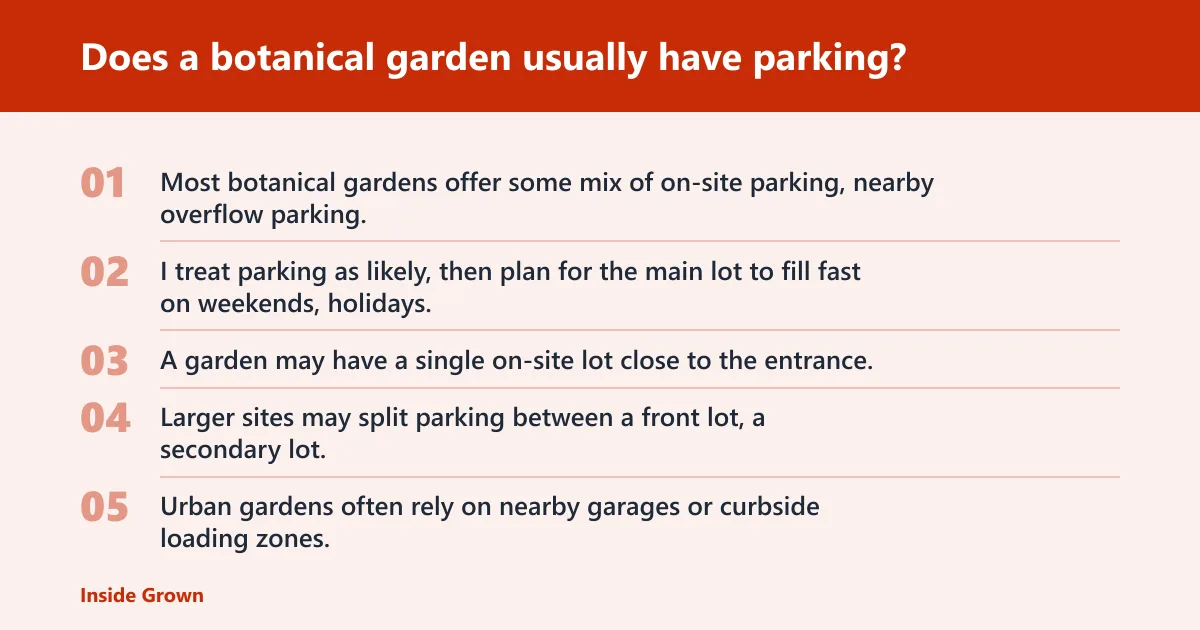
Most botanical gardens offer some mix of on-site parking, nearby overflow parking, or street parking, but the setup changes by size, location, and event calendar. I treat parking as likely, then plan for the main lot to fill fast on weekends, holidays, and bloom-heavy dates.
What the parking setup usually looks like
A garden may have a single on-site lot close to the entrance. Larger sites may split parking between a front lot, a secondary lot, and designated overflow areas. Urban gardens often rely on nearby garages or curbside loading zones. Rural gardens may have more space, but the walk from the car to the gate can still be long.
How far the walk can be from the car to the gate
The distance matters more than many visitors expect. A close lot helps if you have a stroller, a mobility aid, or bags that need to stay packed until entry. A farther lot may be fine for a casual visit, but it adds time, heat exposure, and loading stress if you are arriving with children or mobility needs.
When parking is tied to a special event
Special events change the whole pattern. Special events can close staff areas, redirect traffic, or turn a normal lot into reserved parking. Check the official site before you leave home, then read the posted signs and follow staff directions at the gate.
How early should I arrive to find parking at a botanical garden?
The safest answer is earlier than you think, especially on weekends, holidays, and popular bloom days. For a quiet weekday visit, arriving near opening is often enough. For busy days, arriving before opening may improve your chances of parking near the entrance and avoiding backup lots.
Best arrival windows for weekdays
Weekday arrivals are usually simpler because visitor volume is lower and the first wave of cars spreads out. If the garden opens Tuesday through Sunday and closes Mondays, a midweek morning arrival is often the least stressful. Even then, timed entry can matter more than the clock if your ticket has a fixed date and time.
Best arrival windows for weekends and holidays
Weekends need a wider buffer. If you want close parking, plan for opening-hour arrival or earlier when the garden is hosting a popular exhibit. On high-demand days, late morning can mean that the main lot is already full and you are being sent to overflow parking, a remote lot, or street spaces.
How opening hour timing changes your odds
Opening hour is the pressure point. Drivers who arrive at or before opening are more likely to get the closest spaces, easier unloading, and a simpler walk in. Once the first rush clears, the chance of a long walk or a backup plan rises quickly.
Is botanical garden parking usually free or paid?
Parking can be free, paid, or a mix of both depending on the garden and the day. Some gardens validate parking for ticketed guests, while others charge at the gate or kiosk or offer member discounts. Read the signs and payment rules before you pull in, because payment method and validation details vary.
Common fee setups and payment methods
The lot may use a pay station, a staffed booth, mobile payment, or a pre-paid permit on event days. Some places accept cards only; others still take cash. If the machine is down, staff usually direct drivers to an alternate machine, a temporary payment point, or a nearby lot with different rules.
Validation rules and member discounts
Validation can reduce or erase parking charges, but only if the rules are followed exactly. Keep the receipt, ticket, or parking stub if validation is offered at admissions or the gift shop. Member discounts may exist, but they are not automatic. Check whether your membership covers parking or only admission.
What happens if the payment machine is down
Do not assume the lot is free because a kiosk is offline. Garden staff may still require payment at exit, or they may send drivers to another machine or lot. If there is a problem, ask before leaving the car unattended, because exit checks can slow the line and create a backup.
What if the main lot fills up?
If the main lot fills up, the fallback is usually overflow parking, a nearby public lot, or a directed street-parking area if the garden allows it. On event days, there may also be posted detours or shuttle service. The key is to treat the first lot as only one part of the arrival plan.
Overflow lots and posted detours
Overflow parking may be across the street, in a shared civic lot, or on adjacent property. Sometimes a staff member directs traffic into a temporary field lot or a partner lot farther from the gate. Follow signs closely, because some access roads are one-way during busy periods.
Street parking limits and event-day rules
Street parking sounds easy until event-day restrictions appear. No-parking zones, permit-only blocks, and time limits can be enforced more strictly when attendance spikes. If curb parking is allowed, watch for loading rules, fire lanes, and residential access. A short walk beats a tow.
When a shuttle or remote lot is the backup
A shuttle makes sense when the garden expects a sold-out lot or large special-event crowds. Remote lots are often safer than hunting for street spaces near the entrance. If a shuttle is part of the plan, note the pickup point before you arrive so you are not wandering after parking.
Accessible parking and drop-off: what to expect

Accessible parking usually means designated spaces near the entrance, though exact placement can vary by site and event setup. Look for the route from the space to the gate, not just the space itself. For mobility devices or strollers, the best plan is the shortest legal path with the fewest curbs, slopes, or transfer points.
ADA spaces and how close they usually are
Accessible spaces are normally placed near the entrance or near a route that avoids steep terrain. The space may be close, yet the path may still include a longer sidewalk loop if the front drive is closed. If a companion is driving, confirm where the closest drop-off point sits before unloading.
Curbside loading and rideshare drop-off
A drop-off zone helps with wheelchair unloading, stroller setup, and short-stop arrivals. Rideshare pickup and drop-off may be restricted to a marked curb lane, not the main lot entrance. If curbside loading is allowed, use it only for active unloading, then move the vehicle on quickly.
What to do if a mobility device or stroller needs the shortest route
Ask staff for the most direct entrance path before you walk away from the car. If the closest space is unavailable, request the best legal alternative rather than taking a farther spot and guessing. Strollers are allowed throughout the Garden grounds, and stroller parking is available at exhibition locations, which helps once you are inside.
Can I leave and re-enter the parking area?
Re-entry depends on the garden’s parking policy, the ticketing system, and whether staff are controlling traffic for an event. Some gardens allow same-day re-entry with a receipt or parking pass. Others limit re-entry or require another check at the gate, especially when demand is high.
Same-day re-entry rules
If you plan to leave for lunch or to move children between activities, confirm same-day re-entry before exiting. A “valid ticket” for entry is not the same thing as parking permission, and timed admission can become invalid if you return too late. The visit ticket must clearly state the date and time.
Receipt, ticket, or pass requirements
Keep the parking receipt, wristband, or dashboard pass if one is issued. Some gardens require that proof at the re-entry point, and some use security checks to control the flow back into the lot. Losing that receipt can turn a simple return into a delay at the gate.
Time limits and security checks
Time limits are common on busy days. Even if parking itself is free, the garden may use timed entry or lot-control procedures to keep traffic moving. The ticket is invalid if the time is more than one hour late, so parking delays can spill into admission problems fast.
Parking plan by visitor type

Different visitors need different arrival plans. A stroller family needs unloading space and a short walk. A mobility-limited visitor needs the closest legal route and backup support. A weekend visitor needs timing discipline and a fallback lot. Use the plan below to match the parking move to the visit type.
| Visitor type | Best arrival window | Preferred drop-off or parking approach | Fallback if the main lot is full |
|---|---|---|---|
| Family with stroller | 30 to 60 minutes before opening on weekends; near opening on weekdays | Use the closest legal lot or drop-off zone; unload stroller and bags before moving the car | Take overflow parking only if the walk is manageable; otherwise use rideshare drop-off and meet at the gate |
| Mobility-limited visitor | At opening, or earlier if timed entry is strict | Ask for ADA parking and the shortest route to the entrance; request assistance if available | Use the nearest accessible overflow option or curbside drop-off, then confirm the return route before leaving the vehicle |
| Peak-time weekend visitor | Before opening; earlier for bloom weekends and special events | Choose the fastest legal lot, even if it is not the closest, to avoid circling during peak congestion | Use remote overflow parking, a shuttle, or rideshare if the main lot is already full |
When rideshare or transit is the better call
If parking costs more than the ride, or if the trip involves long walking distances, heavy bags, or limited mobility, rideshare can be the cleaner option. Transit works best when the garden is near a reliable stop and you want to skip the parking search entirely. Driving still makes sense for families, gear-heavy visits, and poor transit coverage.
- Check the garden’s parking rules, ticket time, and event calendar before leaving.
- Pick the arrival window based on your visitor type, not just the opening time.
- Choose the closest legal unload point for strollers or mobility needs.
- Keep the parking receipt, pass, or ticket in case re-entry is controlled.
- Switch to overflow parking, rideshare, or transit if the main lot is already tight.
How weather changes parking at botanical gardens
Rain can change parking conditions quickly. More people drive instead of walking or biking, exits slow down, and muddy edges around overflow lots can make a short walk unpleasant. The garden may be open in all weather conditions, but the parking experience can still get slower, wetter, and more crowded.
Rain-day demand and slower exits
Wet weather usually increases curbside unloading, shelter-seeking, and traffic near the entrance. That means longer lines at the gate and slower lot turnover. If you are arriving on a rainy day, build in extra time and expect more people to aim for the closest spaces.
Mud, puddles, and rough access paths
Overflow lots can have rougher surfaces than the main lot. Mud, puddles, and uneven terrain can be hard on strollers, wheelchairs, and dress shoes. If the garden has a paved or covered parking area, prioritize it on rainy days. If not, keep the walk short and bring footwear that handles wet ground.
Covered parking and longer unloading times
Covered parking, when available, reduces the unloading mess but can also attract more drivers. That can create more congestion at the entrance drive. If you need extra time to unload bags, strollers, or mobility aids, pull into the designated zone only long enough to finish the handoff, then move the car.
Frequently asked questions
Does a botanical garden usually have parking?
Usually, yes, but the setup varies. Many gardens have an on-site lot, while others rely on nearby overflow lots, street parking, or event-day shuttle service. The main risk is not whether parking exists, but whether the closest spaces fill before you arrive on busy days.
How early should I arrive to find parking at a botanical garden?
For weekdays, arriving near opening is often enough. For weekends, holidays, or bloom-heavy days, plan to arrive 30 to 60 minutes before opening. That gives a better chance of getting close parking, avoiding long walks, and staying ahead of timed-entry delays.
Is botanical garden parking usually free or paid?
It can be either. Some gardens charge for parking, some validate parking for visitors, and some include member discounts. Payment may be by card, cash, kiosk, or mobile method. Read the posted rules before entering, because the lot may use different terms during special events.
Where should I park for a botanical garden if the main lot fills up?
Use the posted overflow lot first. If that is full, follow staff directions to remote parking, a partner lot, or shuttle service if offered. Street parking can work in some places, but only if the signs allow it and the event rules do not block curb parking.
Are there accessible parking spaces at botanical gardens?
Most gardens offer accessible parking, but the space location and route to the entrance can vary. Look for ADA spaces near the most direct path, and ask staff about assistance if the route is unclear. For mobility-limited visitors, the shortest legal route matters more than the closest-looking spot.
Can I leave and re-enter the parking lot during my visit?
Sometimes. Same-day re-entry depends on the garden’s lot policy, your receipt or parking pass, and whether staff are controlling traffic. If you may leave for lunch or errands, confirm the rule before you exit. Timed entry can also become an issue if you return too late.