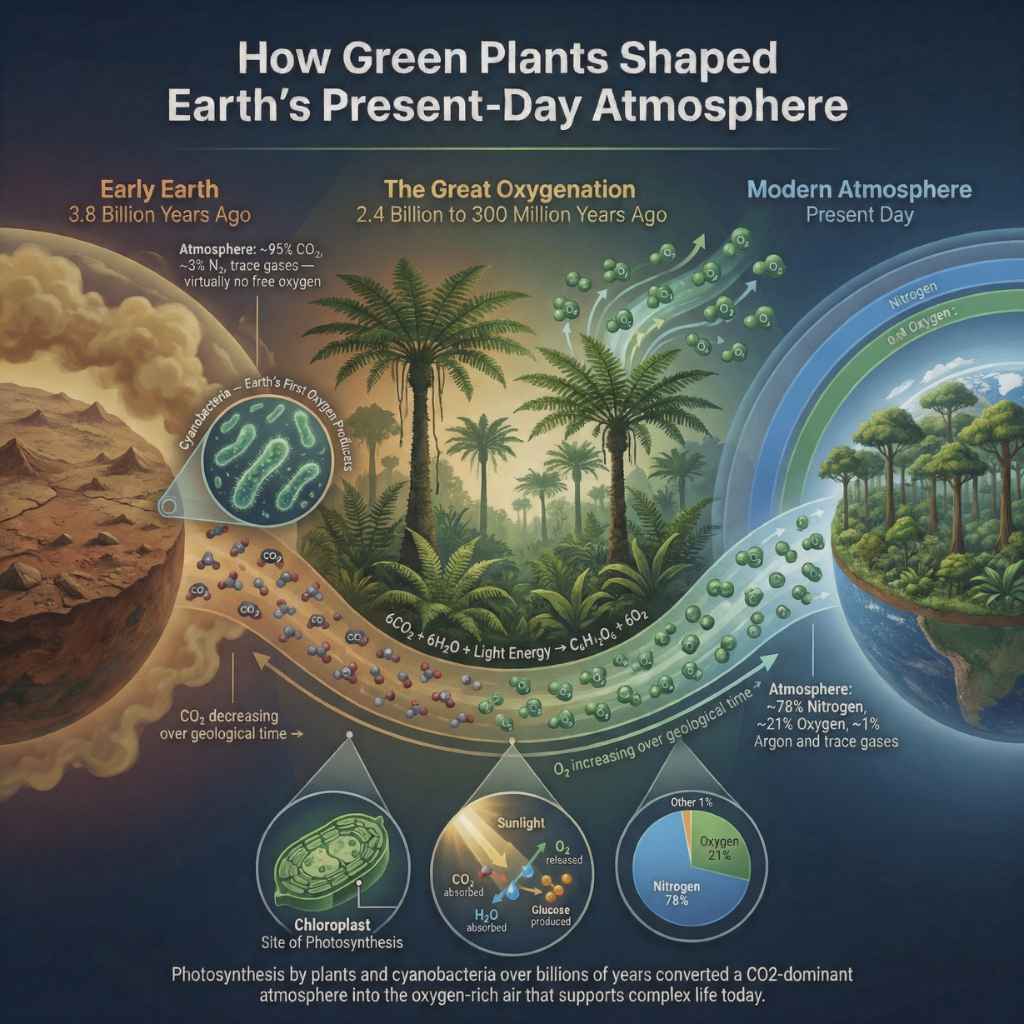

Have you ever stopped to marvel at the air you breathe? It’s pretty amazing, right? This vital mix of gases, especially oxygen, is something we often take for granted.
For a related follow-up, How Does Runoff Contribute To Shaping The Earth'S Landscape? gives readers a useful next step.
But it wasn’t always this way. For billions of years, Earth’s atmosphere was vastly different. The incredible transformation owes a huge debt to one group of organisms: green plants.
This article dives deep into how these leafy wonders, from ancient algae to modern forests, have literally built the air we depend on. We’ll look at the science, the history, and the sheer wonder of plant power. You’ll understand why plants are so much more than just pretty additions to our world.
They are the architects of our breathable planet.
Green plants fundamentally reshaped Earth’s atmosphere over eons. They introduced vast amounts of oxygen through photosynthesis, a process vital for most life forms today. This transformation also influenced climate, soil, and the evolution of countless species, making our planet habitable as we know it.
The Breath of Life: How Plants Create Oxygen
Imagine a young Earth. The air was thick with gases like carbon dioxide, methane, and nitrogen. There was hardly any free oxygen.
It was a harsh environment. Life, if it existed, was mostly simple and anaerobic. This means it didn’t need oxygen to survive.
It was very different from the world we know.
Then, something incredible started happening. Tiny, single-celled organisms began to appear. These were the first photosynthetic life forms.
They were like early chemists. They found a way to use sunlight for energy. They also used water and carbon dioxide.
Their waste product was something new: oxygen.
This process is called photosynthesis. It’s the magic that plants still do today. Plants take in carbon dioxide (CO2) from the air.
They also take in water (H2O) from their surroundings. Using the energy from sunlight, they convert these into sugar (food for the plant). And as a byproduct, they release oxygen (O2) into the atmosphere.
Think of it like this: Plants are nature’s air filters. They clean up the CO2 and give us fresh oxygen in return. This was a slow process at first.
For millions of years, the oxygen produced was used up by other chemical reactions. It reacted with rocks and minerals. It didn’t build up in the air.
But as photosynthetic organisms became more common and more efficient, they started to win the battle. They were producing oxygen faster than it could be used up. This was a turning point for Earth.
Oxygen levels slowly began to rise. This changed everything for life on the planet.
The rise of oxygen was a game-changer. It allowed for new forms of life to evolve. Life that could use oxygen to get much more energy from food.
This is called aerobic respiration. It’s how animals, including us, get the energy to move, think, and live. Without plants producing oxygen, we wouldn’t be here.
A Journey Through Time: The Great Oxygenation Event
Scientists call the period when oxygen levels dramatically increased the “Great Oxygenation Event.” This happened roughly 2.4 billion years ago. Before this, oxygen was very rare. It was mostly found in chemical bonds.
Free oxygen was almost non-existent.
The main culprits were early cyanobacteria. These are often called “blue-green algae.” They were among the first organisms to master oxygenic photosynthesis. They were like the pioneers of oxygen production.
They worked for a very long time.
For hundreds of millions of years, these tiny microbes released oxygen. This oxygen reacted with iron dissolved in the oceans. This created massive deposits of iron-rich rocks.
We can still see these “banded iron formations” today. They are like ancient fingerprints of early photosynthesis.
Once all the available iron had reacted, oxygen started to escape into the atmosphere. This was a big deal. Oxygen is a reactive gas.
It can be toxic to organisms that haven’t evolved to handle it. So, for a while, the rising oxygen might have caused a mass extinction of anaerobic life.
But life is resilient. Some organisms adapted. They learned to tolerate oxygen.
Others found ways to use it. This paved the way for more complex life to emerge. The stage was set for the evolution of eukaryotes.
These are cells with a nucleus, the building blocks of plants, animals, and fungi.
It wasn’t a sudden event. It was a gradual process. Oxygen levels fluctuated.
But the overall trend was upward. This slow build-up of oxygen was crucial. It allowed for the evolution of larger, more complex organisms.
It truly set the stage for the diverse life we see today.
Oxygen’s Impact on Early Earth
Before Oxygen: Atmosphere rich in CO2, methane. No free oxygen. Anaerobic life dominates.
Oceans contain dissolved iron.
During Oxygenation: Cyanobacteria release oxygen. Oxygen reacts with iron, forming banded iron formations. Oxygen slowly enters the atmosphere.
After Oxygenation: Oxygen levels rise. Anaerobic life declines. Aerobic respiration becomes possible.
Complex life, including eukaryotes, evolves.
The Rise of Land Plants: A New Era of Oxygen Production
For billions of years, photosynthesis was mainly a marine affair. Algae and cyanobacteria did the heavy lifting. But then, around 470 million years ago, plants made a giant leap.
They moved onto land.
This was a monumental shift. Land offered new opportunities. But it also presented huge challenges.
Plants had to develop ways to get water from the soil. They needed to support themselves against gravity. They also needed to protect themselves from drying out.
The evolution of vascular plants was key. These plants had specialized tissues. These tissues could transport water and nutrients.
They also provided structural support. Think of roots, stems, and leaves. These innovations allowed plants to grow bigger and taller.
As plants colonized land, they unleashed another wave of oxygen production. Forests and vast plant communities began to spread. They were far more efficient than their aquatic ancestors.
This led to another significant increase in atmospheric oxygen levels.
During the Carboniferous period, which lasted from about 359 to 299 million years ago, plant life exploded. Huge forests grew. When these plants died, they didn’t always decompose fully.
In swampy conditions, they were buried. Over millions of years, they turned into coal and other fossil fuels.
This burial of plant matter had a profound effect. It locked away carbon that would have otherwise returned to the atmosphere. At the same time, the living plants were still producing oxygen.
This resulted in exceptionally high oxygen levels. Some estimates suggest oxygen reached 30-35% of the atmosphere. Today, it’s about 21%.
These high oxygen levels had other consequences. They allowed insects to grow much larger than they do today. Fossil discoveries show giant dragonflies with wingspans of over two feet.
This era was truly a plant-powered wonderland. It shaped the land and the air in ways we are still discovering.
The land plants weren’t just producing oxygen. They were also changing the planet’s surface. Their roots helped break down rocks.
This released minerals into the soil. This created richer soils than had ever existed before. These richer soils, in turn, supported even more plant growth.
Plants and the Carbon Cycle: Balancing Act for Our Climate
Plants play a critical role in the Earth’s carbon cycle. This cycle is the continuous movement of carbon atoms. They move between the oceans, atmosphere, land, and living organisms.
Plants are central to this system.
As we’ve discussed, plants take in carbon dioxide (CO2) through photosynthesis. This removes CO2 from the atmosphere. CO2 is a greenhouse gas.
Too much of it traps heat. This can lead to global warming. So, plants act as a natural brake on rising temperatures.
When plants grow, they store carbon in their tissues. This includes their leaves, stems, roots, and wood. Forests, in particular, are massive carbon sinks.
They hold vast amounts of carbon. This is why protecting forests is so important for climate stability.
The carbon stored in plants eventually returns to the atmosphere. This happens when plants die and decompose. Microbes break down the organic matter.
They release CO2 back into the air. This is part of the natural carbon cycle.
However, the process of fossil fuel formation is a bit different. When ancient plant matter was buried rapidly, the carbon was locked away for millions of years. This removed a lot of carbon from the active cycle for a very long time.
Human activities, like burning fossil fuels, are releasing this stored carbon back into the atmosphere. This is happening much faster than plants can absorb it. This imbalance is causing atmospheric CO2 levels to rise.
This is the primary driver of current climate change.
Carbon Cycle Explained Simply
- Photosynthesis: Plants take CO2 from air. Carbon stored in plant.
- Respiration: Plants and animals release CO2.
- Decomposition: Dead plants/animals break down. CO2 released.
- Fossil Fuels: Buried plant matter stores carbon for ages. Burning releases it.
- Oceans: Absorb CO2 from air.
The balance of CO2 in the atmosphere is crucial for Earth’s temperature. For a long time, plant life helped maintain this balance. They absorbed CO2.
They released oxygen. This kept the climate relatively stable for long periods.
The evolution of diverse plant ecosystems created complex feedback loops. For example, as plants created richer soils, they could support even more life. This meant more CO2 absorption.
But also, decomposition in these rich soils could release more CO2.
Understanding this cycle is vital. It shows us how interconnected everything is. It highlights the power of plants not just for air, but for climate regulation.
It helps us see why preserving plant life is essential for our future.
My Own “Aha!” Moment with Plant Power
I remember a time when I was working on a small urban gardening project. It was just a few raised beds on a balcony. I was focused on growing vegetables for my family.
I wanted fresh tomatoes and herbs. I didn’t think much beyond that.
One afternoon, after a heavy rain, I was out watering. The air felt different. It was cleaner.
It smelled so fresh, almost sweet. I noticed how the small leafy plants seemed to hum with life. There were tiny insects buzzing around.
Birds even started visiting.
It hit me then. These little plants were doing so much more than just growing food. They were cleaning the air right around me.
They were creating a tiny ecosystem. They were a little oasis of life in a concrete jungle. It was a simple moment, but it felt profound.
I started reading more about plants. I learned about photosynthesis again, but this time with a different appreciation. I understood how every leaf was a tiny factory.
It was working tirelessly to produce oxygen. It was pulling in the same air I was breathing out. It was making it fresh again.
This experience made me realize how essential plants are, not just for their products, but for the very air we breathe. It made me feel a deeper connection to them. It wasn’t just about aesthetics or food anymore.
It was about survival and well-being. It was a humbling realization of their quiet, constant work.
The Evolution of Plant Structures and Their Atmospheric Impact
Plants have evolved an incredible array of structures. These have all played a part in shaping the atmosphere. Think about the development of leaves, roots, and seeds.
Each innovation had a ripple effect.
Leaves are the primary sites of photosynthesis. Their design is often optimized for capturing sunlight and CO2. The broad, flat shape of many leaves maximizes surface area.
This allows them to catch as much sunlight as possible. Tiny pores on the leaves, called stomata, open and close. They let in CO2 and let out oxygen and water vapor.
Roots anchor plants. They also absorb water and nutrients from the soil. As plants became larger, their root systems became more extensive.
This had a major impact on soil structure. It helped to stabilize soil. It also helped in breaking down rocks over geological time.
The evolution of seeds was another major step. Seeds allow plants to reproduce and spread more effectively. This helped plants colonize new areas.
It led to the expansion of plant cover across the globe. More plant cover means more photosynthesis and oxygen production.
Flowers and fruits are later developments. They are crucial for the reproduction of many plants. They also influence the animal kingdom.
Animals help spread seeds and pollinate flowers. This creates complex co-dependencies. These interactions further distribute plants.
This, in turn, influences the global carbon and oxygen cycles.
Key Plant Innovations and Their Roles
Photosynthesis: The core process. Converts light energy into chemical energy, producing oxygen.
Vascular Tissues: Allows plants to grow taller and transport resources efficiently.
Roots: Absorb water and nutrients, stabilize soil, break down rock.
Leaves: Maximize sunlight capture and CO2 intake for photosynthesis.
Seeds: Enable wider dispersal and survival of plant species.
Consider the sheer scale of forests. Ancient forests were vast. They covered huge landmasses.
They were oxygen factories on an unparalleled scale. The types of plants present also mattered. Different plant communities have different rates of photosynthesis and carbon storage.
For instance, the development of gymnosperms (like conifers) and then angiosperms (flowering plants) marked new phases in plant evolution. Each group contributed differently to atmospheric composition and carbon cycling. This ongoing evolution shaped the planet.
Atmospheric Changes and Their Effect on Plant Life
The relationship between plants and the atmosphere is a two-way street. The atmosphere affects plants just as much as plants affect the atmosphere.
Early in Earth’s history, the low oxygen levels were a major constraint. Only anaerobic life could thrive. As oxygen levels rose, it opened up new niches.
It allowed for the evolution of aerobic respiration. This gave organisms a huge advantage in energy production.
The carbon dioxide levels have also changed dramatically. High CO2 levels in the past could have supported very rapid plant growth. This is why some scientists believe the Carboniferous forests grew so large.
They had abundant CO2 and high oxygen.
Today, we are seeing a rapid increase in CO2. For some plants, this can act as a fertilizer. They might grow faster.
However, this effect is often limited by other factors. Water availability and nutrient levels can become limiting. Also, the high CO2 is linked to climate change.
Climate change itself presents new challenges for plants. Changes in temperature and rainfall patterns can stress plant communities. Some areas may become too hot or too dry.
Other areas might see increased flooding. These changes can alter which plant species can survive and thrive.
For example, warmer temperatures can speed up plant growth. But they can also speed up decomposition. This can release stored carbon back into the atmosphere faster.
It’s a complex balance.
The changing atmosphere has also influenced the evolution of plant defenses. As oxygen levels rose, so did the potential for oxidative damage to cells. Plants evolved antioxidant systems to cope with this.
These adaptations are a direct result of atmospheric changes.
It’s a continuous dance. Plants adapt to the atmosphere. Their adaptations then change the atmosphere.
This ongoing interaction has shaped life on Earth for billions of years. It continues to shape it today.
Atmospheric Factors Affecting Plants
Oxygen Levels: Enables aerobic respiration, leading to complex life.
Carbon Dioxide Levels: Fuels photosynthesis; high levels can boost growth but also contribute to warming.
Temperature: Affects growth rates, respiration, and metabolic processes.
Water Availability: Crucial for photosynthesis and survival; droughts are a major threat.
Sunlight: The energy source for photosynthesis; plant structures maximize its capture.
What Does This Mean for Us Today?
Understanding how plants shaped our atmosphere has direct implications for us now. We live in an oxygen-rich world. We rely on the carbon balance that plants help maintain.
Firstly, the very air we breathe is a gift from plants. Every breath we take contains oxygen produced by countless plants, from ancient algae to the trees outside your window. This fact alone should inspire a deep respect for plant life.
Secondly, plants are our greatest allies in fighting climate change. They act as natural carbon sinks. They absorb the CO2 that we are releasing at an alarming rate.
Protecting existing forests and planting new ones is one of the most effective ways to mitigate global warming.
However, we must be realistic. While plants help, they cannot entirely offset the speed of our emissions. The current rate of CO2 increase is unprecedented in Earth’s history.
It puts immense pressure on plant ecosystems.
Consider the concept of ecological overshoot. We are releasing carbon much faster than the planet’s natural systems, including plants, can reabsorb it. This leads to a buildup of greenhouse gases in the atmosphere.
It’s also important to remember that plant health is tied to atmospheric health. Pollution can harm plants. Changes in climate can stress them.
When plants suffer, their ability to perform their vital atmospheric functions is reduced. This creates a negative feedback loop.
So, what does this mean for you? It means appreciating the green around you. It means supporting efforts to protect forests and plant trees.
It means understanding that the health of our planet’s atmosphere is directly linked to the health of its plant life.
Even small actions matter. Growing a plant on your windowsill. Supporting local conservation efforts.
Making choices that reduce your carbon footprint. All these actions contribute to a healthier planet for everyone.
Quick Tips for Supporting Plant Life and Atmospheric Health
Here are a few simple ways you can help support plant life, which in turn helps our atmosphere:
- Plant a tree: Even one tree makes a difference.
- Support conservation: Donate to or volunteer with organizations that protect forests and natural habitats.
- Reduce your carbon footprint: Use less energy, drive less, eat less meat.
- Compost your organic waste: This reduces methane emissions from landfills.
- Choose sustainable products: Look for products made with sustainably sourced materials.
- Educate yourself and others: Share what you learn about plants and their importance.
Frequently Asked Questions About Plants and Earth’s Atmosphere
How long did it take for plants to change Earth’s atmosphere?
The transformation was incredibly long, spanning billions of years. The initial oxygen production by cyanobacteria began over 2 billion years ago. The colonization of land by plants around 470 million years ago led to further significant atmospheric changes.
Can plants produce too much oxygen?
In the history of Earth, oxygen levels have been higher than today (like during the Carboniferous period). However, for modern life, the current level of about 21% is stable and optimal. Rapid, extreme increases could be harmful.
Are modern plants still important for the atmosphere?
Yes, absolutely! Forests, grasslands, and even small plants in urban areas continue to absorb CO2 and produce oxygen. They are crucial for maintaining the current atmospheric balance and for mitigating climate change.
What would happen if plants disappeared?
If plants disappeared, oxygen levels would plummet. Carbon dioxide levels would skyrocket, leading to extreme global warming. Most animal life, including humans, would not be able to survive without oxygen and a stable climate.
How do plants help regulate Earth’s temperature?
Plants regulate temperature mainly by absorbing CO2, a major greenhouse gas. By removing CO2 from the atmosphere, they help prevent excessive heat from being trapped, thus cooling the planet.
What are “carbon sinks”?
Carbon sinks are natural or artificial reservoirs that accumulate and store carbon-containing chemical compounds. Forests, oceans, and soil are major natural carbon sinks. Plants are a key part of these sinks because they absorb CO2 during photosynthesis.
The Lasting Legacy of Green
It’s truly amazing to think about. The green plants around us are not just decoration. They are living history.
They are the silent, powerful force that shaped our world.
From the earliest microscopic algae to the vast forests of today, plants have literally built the air we breathe. They have balanced the carbon cycle. They have made Earth a habitable planet.
Their legacy is all around us. It’s in every breath we take.