Why Do Plants Algae And Microorganisms Conduct Photosynthesis?
Photosynthesis is the process used by plants, algae, and some bacteria to convert light energy into chemical energy. This chemical energy is stored in carbohydrate molecules, like sugars. These molecules are synthesized from carbon dioxide and water. Oxygen is typically released as a byproduct. It fuels almost all life on Earth.
For a related plant or gardening question, Which Gas Do Plants Absorb During Photosynthesis? Answered gives readers a focused next step.
For a related plant or gardening question, Bacteria That Performs Oxygenic Photosynthesis Like Plants gives readers a focused next step.
For a related plant or gardening question, Are Plants The Only Organisms That Perform Photosynthesis? gives readers a focused next step.
What is Photosynthesis?
Photosynthesis is how green things make their own food. They use light, water, and air. Think of it like a tiny solar-powered kitchen inside their cells.
This kitchen makes sugary food. This food gives them energy. It also helps them build their bodies.
It’s the main way energy gets into most ecosystems.
The word itself tells us a lot. “Photo” means light. “Synthesis” means to make.
So, photosynthesis means making things with light. It’s a complex chain of events. But the basic idea is simple.
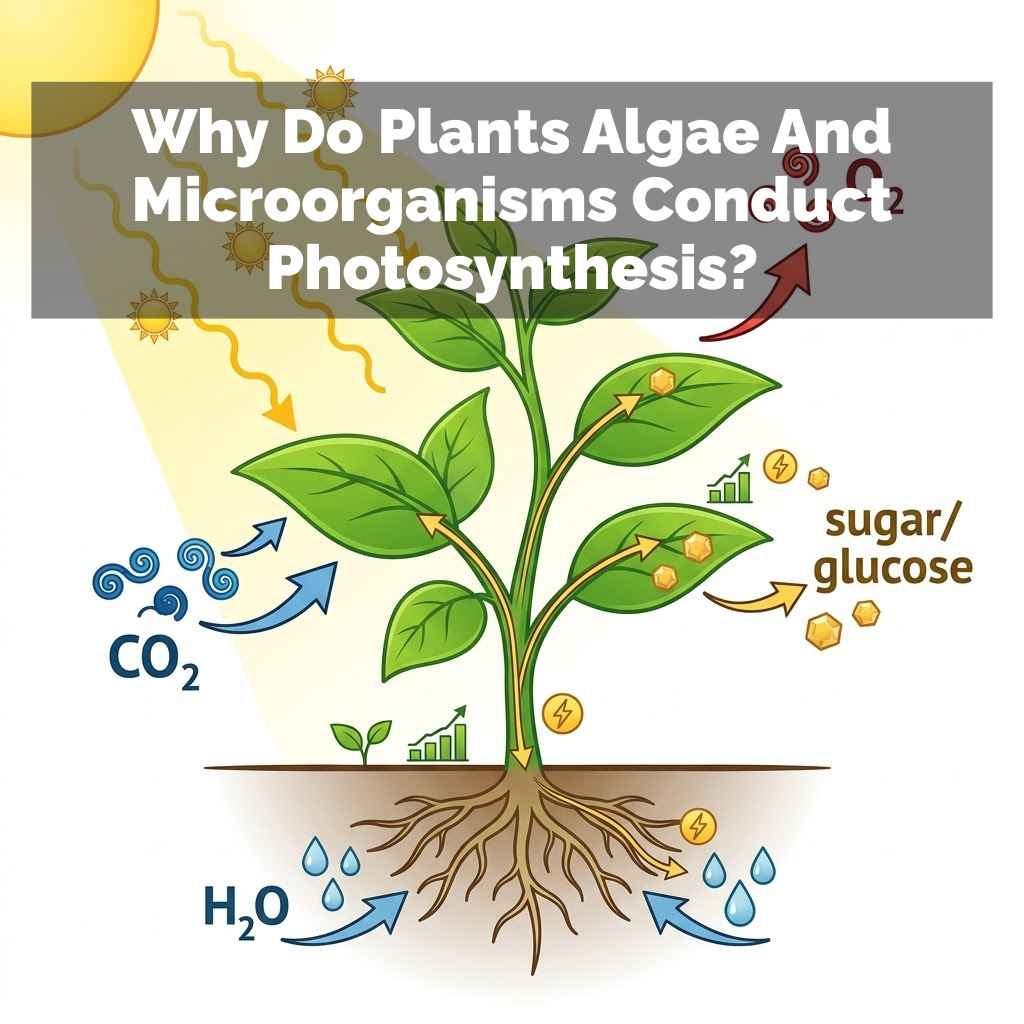
Sunlight is the power source. Carbon dioxide from the air is a key ingredient. Water from the soil or surroundings is another.

Why Do Plants Conduct Photosynthesis?
Plants conduct photosynthesis primarily to create their own food. They are autotrophs, meaning they don’t need to eat other organisms. This food is sugar, specifically glucose.
Glucose is a type of carbohydrate. It’s their primary energy source. Plants use this energy for all their life processes.
These processes include growing taller. They help in making new leaves and flowers. They also help in repairing damage.
Photosynthesis is vital for their survival. Without it, plants would not have the energy to live. They would not be able to reproduce.
But it’s more than just food for the plant itself. The sugars made during photosynthesis are also used to build plant structures. This includes things like cellulose.
Cellulose makes up the cell walls. It gives plants their rigid shape and support. It allows them to stand tall against gravity.
Photosynthesis also allows plants to store energy. This stored energy can be used later. It’s like packing a lunch for a rainy day.
This is important for surviving seasons with less light. Or for times when water is scarce. The plant can then draw on these reserves.
Why Do Algae Conduct Photosynthesis?
Algae, like plants, are also largely photosynthetic organisms. They inhabit aquatic environments. Think oceans, lakes, and ponds.
They conduct photosynthesis for the same core reason as plants: to produce their own food and energy. They are also autotrophs.
This ability to photosynthesize is fundamental to their existence. It allows them to thrive in watery homes. Many types of algae are single-celled.
Others form large, complex structures like kelp forests. Regardless of size, the energy captured from sunlight is essential.
Algae play a massive role in aquatic food webs. They form the base of many food chains. Fish, shellfish, and many other marine animals depend on algae directly or indirectly for food.
This is because algae convert light energy into biomass.
Furthermore, algae are responsible for a significant portion of Earth’s oxygen production. They are sometimes called the “lungs of the planet” alongside land plants. Their photosynthetic activity helps maintain the balance of gases in our atmosphere.
The types of algae vary greatly. This includes green algae, red algae, and brown algae. Each group has unique pigments.
These pigments help them capture different wavelengths of light. This allows them to survive in varied light conditions, even in deep water.
Why Do Microorganisms Conduct Photosynthesis?
Not all microorganisms can photosynthesize. But a very important group can. These are the cyanobacteria.
They were among the first organisms on Earth. They were the first to perform oxygenic photosynthesis. This means they release oxygen as a byproduct, just like plants and algae.
Cyanobacteria conduct photosynthesis to get energy. They need it to live and grow. They are often found in diverse environments.
This includes soil, rocks, and water. Their ability to use sunlight is key to their survival in many habitats. They can colonize places where other life forms cannot.
These tiny organisms have a profound impact. They help to fix nitrogen. This is a crucial nutrient for plant growth.
They also contribute to oxygen levels in the atmosphere. Their ancient photosynthetic activity helped shape Earth’s early environment. They made it suitable for the evolution of more complex life.
Other microorganisms also perform photosynthesis. Some types of sulfur bacteria do. They use hydrogen sulfide instead of water.
They don’t produce oxygen. These are called anoxygenic photosynthesis. They thrive in environments rich in sulfur compounds.
This often means they live in dark, oxygen-free places. They use light energy in their own unique way.
Photosynthesis: Key Players and Ingredients
Who does it?
- Plants
- Algae (from single-celled to seaweed)
- Certain Bacteria (like Cyanobacteria)
What they need:
- Sunlight: The energy source.
- Carbon Dioxide (CO2): Taken from the air.
- Water (H2O): Absorbed from the soil or surroundings.
What they make:
- Glucose (Sugar): Their food and energy.
- Oxygen (O2): Released into the atmosphere (for most).
The Process: Capturing Light Energy
Photosynthesis happens in special parts of cells called chloroplasts. These are like tiny solar panels. They contain a green pigment called chlorophyll.
Chlorophyll is what makes plants look green. It’s amazing at absorbing sunlight. Especially red and blue light.
It reflects green light.
Chlorophyll absorbs light energy. This energy excites electrons. These energized electrons then start a chain reaction.
This chain reaction happens in two main stages. The first stage uses light directly. It’s called the light-dependent reactions.
The second stage uses the energy captured here. It’s called the light-independent reactions or the Calvin cycle.
In the light-dependent reactions, water molecules are split. This releases electrons. It also releases protons (hydrogen ions).
And it releases oxygen as a byproduct. This oxygen is what we breathe. The energy from the light is used to create energy-carrying molecules.
These are called ATP and NADPH. They are like tiny batteries.
These energy batteries then power the next stage. The light-independent reactions don’t need direct light. They use the ATP and NADPH.
They take carbon dioxide from the air. They use the captured energy to turn CO2 into sugar. This sugar is glucose.
It’s the plant’s food.
It’s a continuous cycle. The plant is always trying to capture more light. It needs carbon dioxide.
It needs water. It keeps making sugar to grow and survive. This process is the foundation of life.
The Two Main Stages of Photosynthesis
Stage 1: Light-Dependent Reactions
Where: Thylakoid membranes in chloroplasts.
What happens:
- Chlorophyll captures light energy.
- Water is split, releasing oxygen.
- Energy molecules (ATP, NADPH) are made.
Needs: Light and Water.
Stage 2: Light-Independent Reactions (Calvin Cycle)
Where: Stroma in chloroplasts.
What happens:
- Carbon dioxide is used.
- Energy from ATP and NADPH is used.
- Sugars (like glucose) are produced.
Needs: Carbon Dioxide, ATP, NADPH.
My First Encounter with Photosynthesis
I remember being in middle school. We had a science fair project. My job was to grow plants without light.
I thought it would be easy. Just cover them up. But they didn’t grow.
They turned yellow and weak. My teacher explained why. Plants need light to make food.
It sounded so simple, yet so profound. This energy didn’t just appear. It came from the sun.
It was captured by leaves. The idea that a simple plant could do this without eating anything was mind-blowing to me then. I used to watch the sunbeams hit the windowsill plants.
I pictured tiny workers inside. They were using that light to build more plant.
That year, my project evolved. Instead of trying to grow plants without light, I focused on showing how light helped them. I set up different plants.
One in full sun. One in shade. One in total darkness.
The difference was stark. The dark one was sickly. The shaded one was okay.
The sunny one was vibrant and green. It was a visual lesson in how crucial light energy is. It truly stuck with me.
The Role of Chlorophyll
Chlorophyll is the star player in capturing light. It’s a pigment. Pigments absorb certain colors of light.
They reflect others. Chlorophyll absorbs light best in the blue and red parts of the spectrum. It reflects green light.
That’s why most plants appear green to us. It’s the color they don’t use for energy.
There are different types of chlorophyll. Chlorophyll a is the main one. It’s found in all photosynthetic plants and algae.
Chlorophyll b is another type. It’s an accessory pigment. It helps capture light that chlorophyll a misses.
This broadens the range of light that can be used. It increases the efficiency of photosynthesis.
These pigments are located within structures in the chloroplasts. These are called thylakoids. Thylakoids are stacked like pancakes.
These stacks are called grana. The chlorophyll molecules are embedded in the thylakoid membranes. This arrangement is perfect for capturing sunlight.
Think of chlorophyll as tiny antennas. They are finely tuned to pick up specific light waves. When a light particle, a photon, hits a chlorophyll molecule, it gives energy.
This energy is passed along. It starts the whole process of turning light into food.
Carbon Dioxide: The Building Block
Carbon dioxide (CO2) is the main source of carbon for building sugars. Plants get CO2 from the air. It enters the leaves through tiny pores.
These pores are called stomata. They are usually on the underside of leaves. They can open and close.
This helps the plant control gas exchange.
When stomata are open, CO2 can come in. But water can also escape. This is called transpiration.
So, plants have to balance. They need CO2 for photosynthesis. But they also need to conserve water.
This is especially true in dry climates.
Inside the chloroplasts, during the Calvin cycle, CO2 is combined with other molecules. It’s a complex cycle. But essentially, the carbon atoms from CO2 are used to build sugar molecules.
This is where the “synthesis” part of photosynthesis happens.
The amount of CO2 available can affect the rate of photosynthesis. If there’s not enough CO2, the process slows down. Even if there’s plenty of light and water.
This is one reason why forests are so important. They take in vast amounts of CO2. They help regulate its levels in the atmosphere.
Water: The Essential Ingredient and Electron Donor
Water (H2O) is absolutely crucial for photosynthesis. Plants absorb water through their roots. It travels up to the leaves.
In the light-dependent reactions, water molecules are split. This splitting is called photolysis. This provides electrons and protons.
The electrons are needed to
The splitting of water also releases oxygen. This is the oxygen that most life on Earth breathes. So, in a very real way, plants giving us oxygen is a direct result of them needing water for photosynthesis.
Protons (H+) from the water also play a role. They build up inside the chloroplast. This creates a gradient.
This gradient is used to produce ATP. ATP is one of the energy-carrying molecules. So, water is vital for both energy capture and sugar building.
The “Photosynthesis Recipe”
Imagine you’re a plant chef. Here’s your recipe for making food:
- Gather Ingredients:
- Sunlight: Your stove’s energy source.
- Carbon Dioxide (CO2): Your main building material.
- Water (H2O): Your essential liquid, used in the first step and provides electrons.
- Prepare the Kitchen (Chloroplasts):
- Make sure your chlorophyll is ready to catch the light.
- Step 1: Cook with Light (Light-Dependent Reactions):
- Use sunlight energy to split water.
- This releases oxygen into the air (your “steam”!).
- Store the energy in tiny battery packs (ATP and NADPH).
- Step 2: Bake the Food (Light-Independent Reactions / Calvin Cycle):
- Use the energy from your battery packs.
- Take the carbon dioxide and build it into sugar (glucose).
- This sugar is your food!
Result: Energy-rich sugar for growth and release of oxygen for breathing!
Why is Photosynthesis Important for Us?
Photosynthesis is not just important for plants. It’s the bedrock of almost all life on Earth. Without it, we wouldn’t have the food we eat.
We wouldn’t have the air we breathe. It’s a silent, constant process that sustains us.
Food Source: Think about it. Every fruit, vegetable, and grain we eat comes from plants. Or from animals that eat plants.
Even meat-eaters depend on photosynthesis. The grass feeds the cow. The cow feeds the human.
So, the energy ultimately comes from the sun, captured by plants.
Oxygen Production: Photosynthesis releases oxygen. This is the oxygen that humans and most animals need to survive. Every breath you take contains oxygen produced by photosynthetic organisms.
From towering trees to microscopic algae in the ocean, they are constantly replenishing our oxygen supply.
Climate Regulation: Plants and algae absorb carbon dioxide from the atmosphere. CO2 is a greenhouse gas. By taking it in, photosynthesis helps regulate Earth’s climate.
Forests and oceans act as massive carbon sinks. They help to mitigate climate change. They keep the balance of gases right.
Energy for Ecosystems: Photosynthesis is the primary way energy enters most ecosystems. Plants capture solar energy and convert it into chemical energy. This energy then flows through the food web.
When an herbivore eats a plant, it gets that stored energy. When a carnivore eats the herbivore, the energy is transferred again.
What Happens Without Sunlight?
When there’s no sunlight, photosynthesis stops. This is why plants in dark rooms don’t thrive. They can survive for a while.
They use stored energy. But they can’t make new food. Eventually, they will weaken and die.
For organisms that rely on photosynthesis, a prolonged lack of light is catastrophic. This can happen during long winters in polar regions. Or in deep caves.
Or in the deep ocean. Life in these places has adapted in different ways. Some organisms have very slow metabolisms.
They can survive on stored reserves for a long time. Others have found alternative energy sources.
Some deep-sea organisms live near hydrothermal vents. They use chemicals from the vents for energy. This is called chemosynthesis.
It’s a different process. It doesn’t use light at all. But it’s a reminder that life is incredibly adaptable.
It finds ways to exist even in extreme conditions.
However, for the vast majority of life on land and in shallow waters, sunlight is non-negotiable. It’s the fundamental energy input that powers the system.
Real-World Scenarios of Photosynthesis
Photosynthesis happens all around us, every single day. In your backyard, the grass is photosynthesizing. The trees are busy converting sunlight into energy.
The flowers are blooming because of it. Even the weeds are making their own food.
In the ocean, it’s happening on a massive scale. Phytoplankton, which are tiny, single-celled algae, form the base of the marine food web. They are responsible for a huge amount of the Earth’s oxygen.
If there’s a bloom, the water can appear green or brown.
Consider a farmer’s field. Corn plants are photosynthesizing rapidly. They are taking in CO2 and sunlight.
They are building carbohydrates. These carbohydrates will become the corn we eat. Or the feed for livestock.
Even in an aquarium, the algae on the glass are photosynthesizing. They are producing oxygen for the fish. They are consuming nutrients.
It’s a miniature ecosystem at work. All powered by light.
Photosynthesis in Action: Everyday Examples
In Your Home Garden:
- Green Leaves: Absorbing sunlight to make food.
- Growing Plants: Using that food to get bigger.
- Flowers and Fruits: Energy stored and used for reproduction.
In the Ocean:
- Phytoplankton: Microscopic algae, the base of marine food chains, produce lots of oxygen.
- Seaweed: Larger algae, photosynthesizing in shallow waters.
In Agriculture:
- Crops (Corn, Wheat, Rice): Converting sunlight into edible grains and vegetables.
- Livestock Feed: Plants grown for animal feed rely on photosynthesis.
When is Photosynthesis “Normal” or “Concerning”?
Photosynthesis itself is a normal, vital process. It’s never “concerning” in its natural state. What might be concerning are the conditions that affect it.
Or the organisms performing it.
Normal Scenarios:
- Green Plants: Healthy green color indicates active chlorophyll.
- Growth: Plants getting larger and producing new leaves, flowers, or fruits shows they have enough energy.
- Seasonal Changes: Leaves changing color in fall is part of a normal process where plants break down chlorophyll.
- Algal Blooms: Small, temporary increases in algae can be normal in nutrient-rich waters.
When to Pay Attention:
- Yellowing Leaves (without fall): This can mean a lack of light, nutrients, or too much water. The chlorophyll is breaking down.
- Pale or White Plants: Severe lack of chlorophyll. May indicate the plant cannot photosynthesize effectively.
- Excessive Algal Blooms: Large, persistent blooms can deplete oxygen in water. This harms fish and other aquatic life. They can also be caused by pollution.
- Plants Not Growing: If a plant has light, water, and good soil but isn’t growing, something is wrong. It might not be photosynthesizing well.
Photosynthesis is a sign of life and energy. It’s the indicator of a healthy plant or ecosystem. Problems arise when the conditions for photosynthesis are severely disrupted.
Quick Tips for Healthy Photosynthesis (for your plants!)
If you have houseplants or a garden, you can help them photosynthesize well. It’s not about forcing them, but providing the right environment.
- Give them Light: Most plants need bright, indirect light. Some prefer full sun. Know what your specific plant needs.
- Water Wisely: Don’t let them dry out completely. But don’t drown them either. The soil should be moist but not soggy.
- Good Soil: Use potting mix that drains well. It helps roots get air and water.
- Airflow: Good air circulation can help prevent diseases. It also helps with gas exchange through stomata.
- Fertilize (if needed): Plants need nutrients. Fertilizers provide these. But don’t overdo it.

Frequently Asked Questions about Photosynthesis
What is the main purpose of photosynthesis for plants?
The main purpose of photosynthesis for plants is to create their own food in the form of sugar (glucose). This sugar provides the energy they need to live, grow, reproduce, and repair themselves.
Do all plants have chlorophyll?
Yes, all green plants have chlorophyll. This green pigment is essential for capturing light energy needed for photosynthesis. Some plants, like parasitic ones, may appear to lack green color, but they often get nutrients from other plants instead of photosynthesizing fully.
What happens to the oxygen produced during photosynthesis?
The oxygen produced during photosynthesis is released into the atmosphere through tiny pores in the leaves called stomata. This oxygen is vital for the respiration of most living organisms, including humans and animals.
Can photosynthesis happen at night?
No, the primary process of photosynthesis requires light energy. The light-dependent reactions, which capture light, cannot occur in the dark. However, plants do respire at night, using the sugars they made during the day.
What is the difference between photosynthesis and respiration?
Photosynthesis uses light energy to convert carbon dioxide and water into sugar and oxygen. Respiration, on the other hand, breaks down sugar using oxygen to release energy, carbon dioxide, and water. Photosynthesis builds food; respiration uses food for energy.
Why are some leaves not green?
Some leaves are not green because they have other pigments, like red, yellow, or orange, that hide the green chlorophyll. In autumn, chlorophyll breaks down, revealing these other colors. Some plants are genetically modified or have specific conditions that affect their green color.
How much oxygen do plants produce?
It’s hard to give an exact number for every plant, but collectively, photosynthetic organisms like plants and algae produce over half of the oxygen in Earth’s atmosphere. Phytoplankton in the oceans are particularly significant oxygen producers.
Conclusion
Photosynthesis is a breathtakingly elegant process. It’s the sun’s energy made usable for life. Plants, algae, and certain microbes harness this power.
They turn simple ingredients into food and oxygen. This ability fuels our planet. It shapes our atmosphere.
It’s a constant reminder of nature’s ingenuity. It’s a fundamental force of life.