Which Evolutionary Adaptations Helped Plants Succeed On Land?
It’s amazing to think about how much life on Earth has changed. For ages, our planet was mostly water. Then, something incredible happened. Plants started to move onto land. This was a HUGE step. It wasn’t easy for them at all. They had to figure out totally new ways to live.
Imagine trying to live without water all around you. Plants had to solve big problems. They needed to hold themselves up. They had to find ways to get water and not lose it. They also had to figure out how to make more plants without needing a pond. This article dives deep into those clever changes.
We’ll explore the amazing evolutionary adaptations. These are the special traits that helped plants succeed. You’ll learn how these changes didn’t just help plants. They also made Earth the green place we know today. Let’s uncover the secrets of plants conquering the land.
The main evolutionary adaptations that helped plants succeed on land include developing cuticles to prevent water loss, structural support to stand upright, vascular tissues for transporting water and nutrients, and new reproductive strategies like seeds and pollen to spread away from water sources. These innovations were crucial for plant survival and diversification on terrestrial environments.
The Big Move: Why Land Was So Tough for Early Plants
Think back to when life was only in the oceans or lakes. Water was everywhere. It supported plants. It gave them nutrients. It was how they shared their reproductive cells. Life on land was a whole different ball game. It was dry. It was exposed to harsh sunlight. There was gravity pulling everything down.
For plants, this was like moving to a desert without any help. They faced many challenges right away. Water was a big one. They couldn’t just soak it up from all sides like they did in water. The sun could dry them out very quickly. Gravity meant they couldn’t just float anymore. They needed a way to stand up on their own.
Also, how would they reproduce? In water, sperm could swim to the egg. On land, this wasn’t possible. They needed new ways to move their genes around. These problems were enormous. But plants are amazing survivors. Over millions of years, they developed brilliant solutions.
These solutions were not sudden. They happened through tiny changes over many generations. We call these changes evolutionary adaptations. They are special features that help a living thing survive and reproduce better in its environment. For plants, these adaptations were game-changers. They opened up a whole new world for them.
Life Before Land: A Look at Algae
Before plants took over the land, algae were the rulers of the watery world. Think of pond scum or seaweed. They lived submerged.
Water gave them everything they needed. It supported their bodies. It brought them food and CO2.
It was easy for their sperm to find eggs.
Algae are simple. They don’t have roots, stems, or leaves like land plants. Their bodies are often just a single cell or a collection of cells.
They didn’t need to worry about drying out. They didn’t need to fight gravity. This was a very different life.

Adaptation 1: The Waxy Coat to Stop Drying Out
The first and maybe most important problem plants faced on land was water. Water surrounds them in lakes and oceans. On land, the air is much drier. The sun’s heat can bake them. They would quickly lose all their water and die.
So, plants evolved something called a cuticle. Think of it like a raincoat for the plant. It’s a waxy layer that covers the outside of their leaves and stems. This layer is waterproof. It stops water from escaping the plant’s cells into the dry air.
This was a huge step. It meant plants could survive in drier spots. It allowed them to grow away from constant water sources. The cuticle acts like a barrier. It seals in the moisture that the plant needs to live. It’s one of the most basic but vital changes.
However, this waxy coat also created a new problem. Plants need to breathe. They need to take in carbon dioxide from the air to make their food through photosynthesis. This gas enters the plant through tiny pores. The cuticle seals the plant up so well that it also seals these pores shut.
Plants had to solve this new puzzle too. They developed special pores called stomata (singular: stoma). These are like tiny mouths on the surface of leaves. Each stoma has two guard cells that can open or close it. This allows the plant to let carbon dioxide in when it needs to and close up when it’s too dry.
Quick Scan: Cuticle vs. Algae
| Feature | Algae | Early Land Plants |
|---|---|---|
| Water Protection | Always surrounded by water | Developed a waxy cuticle |
| Gas Exchange | Easy through cell surface | Needed stomata (pores) |
| Sun Protection | Water filtered some light | Cuticle offered some protection |
Adaptation 2: Standing Tall Against Gravity
Another massive hurdle for plants moving onto land was gravity. In water, buoyancy supports the plant. It keeps it upright. On land, there’s no such support. Plants needed a way to hold themselves up. They needed to build their own skeletons.
This led to the evolution of structural support tissues. The most common one is lignin. Lignin is a tough, complex molecule that makes plant cell walls rigid. It’s what makes wood hard and strong. Think of it like building materials for the plant.
Plants started to build sturdy stems and stalks. These allowed them to grow taller. Growing taller had many advantages. It helped them get sunlight. It also helped them spread their spores or seeds further. It was a way to reach for the sky.
This structural support also made them more robust. They could withstand wind and rain better. They were no longer fragile things. They could become the foundational structures of whole ecosystems.
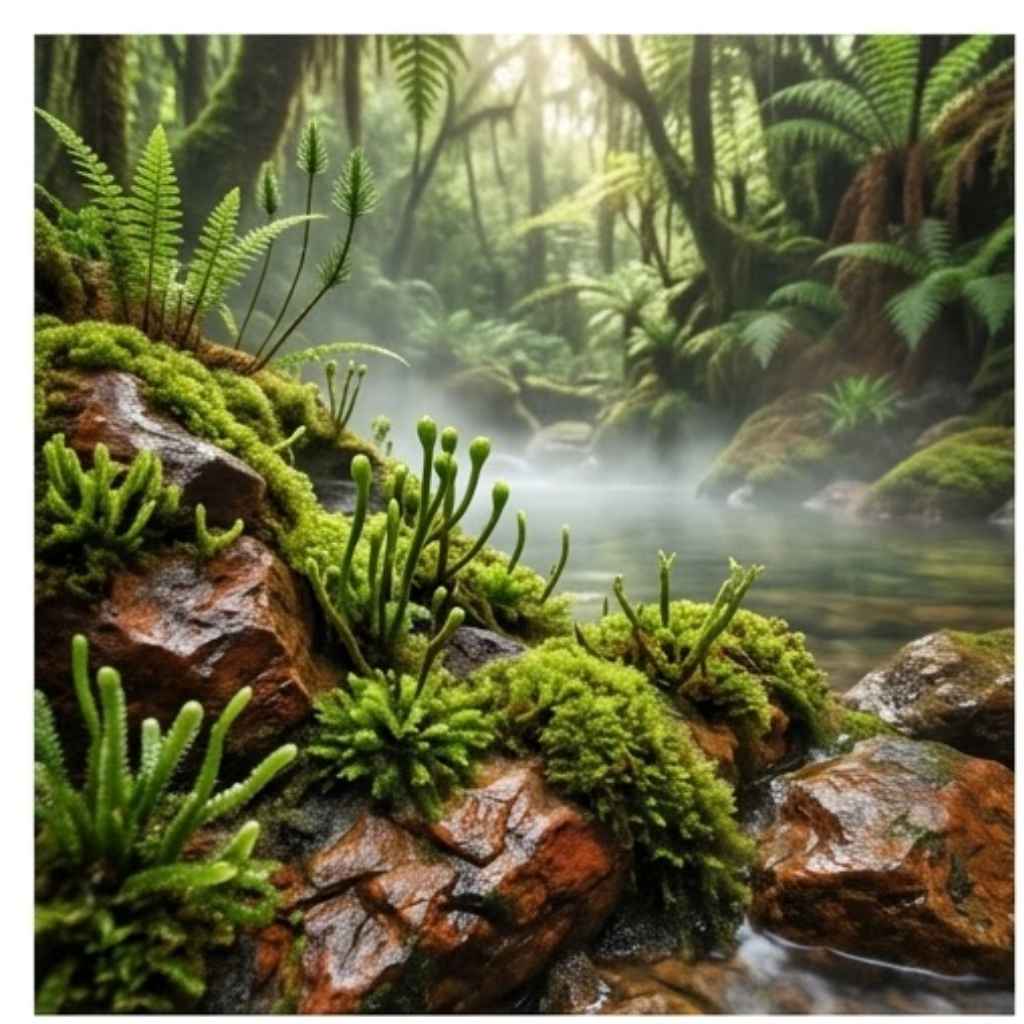
Early land plants, like mosses and liverworts, are still quite small. They don’t have much lignin. They often lie flat on the ground. They rely on moisture in the air and soil directly. But as plants evolved, they developed more sophisticated structures. Ferns, for example, have fronds that stand up. Trees are the ultimate example of this adaptation, with massive woody structures.
This ability to grow upwards was revolutionary. It opened up new niches. Plants could now grow on rocky surfaces. They could compete for light in ways they never could before. It truly changed the landscape of the planet.
Adaptation 3: The Plumbing System – Vascular Tissues
Plants need water and nutrients to survive. In water, they could absorb these directly from their surroundings. On land, this became much harder. If a plant grew tall, how would it get water all the way up from its base to its leaves? And how would it move the food it makes down to its roots?
This led to the development of vascular tissues. This is like the plant’s internal plumbing system. There are two main types:
- Xylem: This tissue transports water and minerals from the roots up to the rest of the plant. It also provides support. Think of it as the pipes carrying water upwards.
- Phloem: This tissue transports sugars (food) made during photosynthesis from the leaves to other parts of the plant where they are needed for growth or storage, like the roots. It can move food in both directions.
Having these specialized tissues was a massive breakthrough. It allowed plants to grow larger and live in drier places. They could now efficiently move resources where they were needed. This system is vital for all modern land plants.
The evolution of vascular tissues marks the beginning of what we call vascular plants. Before this, plants were non-vascular, like mosses. They had to stay low and moist. With vascular tissues, plants could finally reach their full potential.
Imagine trying to drink through a tiny straw that’s a mile long. That’s kind of what it would be like for a plant without a good transport system. Xylem and phloem are like super-efficient pipelines. They make sure every part of the plant gets what it needs to thrive.
Myths vs. Reality: How Plants Drink
Myth: Plants “suck” water up like a straw using a vacuum.
Reality: Water moves through plants due to a combination of factors. Transpiration (water evaporating from leaves through stomata) creates a pull. Cohesion (water molecules sticking to each other) and adhesion (water molecules sticking to the xylem walls) help to form a continuous column of water that is pulled upwards.
It’s a clever biological process.
Adaptation 4: Seeds and Spores – The Next Generation
Reproduction was another huge challenge for plants on land. In water, sperm could easily swim to the egg. On land, this was often impossible. Plants needed to find ways to protect their reproductive cells and move them around.
The earliest land plants, like mosses, still relied on water for reproduction. Their sperm had to swim through a film of water to reach the egg. This limited them to very damp environments. They were often found on the surface of soil or rocks where moisture was available.
A major step forward was the evolution of spores. Spores are tiny, single-celled or few-celled structures that can be released into the air. They are resistant to drying out and can travel long distances on the wind. When a spore lands in a suitable moist environment, it can germinate and grow into a new plant.
Ferns and their relatives reproduce using spores. This allowed them to spread much further than the mosses could. But spores still needed a moist environment to grow into the next stage (called a gametophyte) before fertilization could occur.
The ultimate reproductive innovation for land plants was the seed. Seeds are amazing. They contain an embryo (a tiny baby plant), a food supply, and a protective coat. This coat shields the embryo from drying out and from mechanical damage.
Seeds also freed plants from needing external water for fertilization. The male reproductive cells are packaged into pollen. Pollen is light and can be carried by wind or animals from one plant to another. Once pollen reaches the female part of the plant, fertilization can occur internally. The resulting embryo develops into a seed.
Seeds allowed plants to colonize even drier areas. They could survive long periods of unfavorable conditions. When the conditions were right, the seed would germinate. This ability to wait and survive is key to the success of seed plants, like flowering plants and conifers.
Observational Flow: The Seed’s Journey
Step 1: Pollination Wind or an insect carries pollen to the female part of a flower.
Step 2: Fertilization The pollen fertilizes the ovule, forming an embryo.
Step 3: Seed Development The ovule grows into a seed, with the embryo inside, plus food and a coat.
Step 4: Seed Dispersal The seed is spread away from the parent plant (by wind, animals, etc.).
Step 5: Germination If conditions are right (water, temperature), the seed sprouts into a new plant.
Adaptation 5: Roots for Anchoring and Absorbing
Plants on land needed to anchor themselves. They needed to hold on tightly to the soil. This would prevent them from being blown away or washed away. This led to the evolution of roots. Early plants had simple root-like structures, but true roots evolved later.
Roots do more than just hold the plant in place. They are also the primary way plants absorb water and essential minerals from the soil. These nutrients are crucial for growth and all life processes. Without efficient roots, plants couldn’t get the building blocks they needed.
The development of more complex root systems allowed plants to grow larger and more stable. Think of a tiny moss versus a giant oak tree. The oak tree’s massive root system is what supports its immense size and allows it to draw up vast amounts of water.
Roots also play a role in nutrient cycling. They can break down rocks and interact with soil microbes. This helps to make nutrients available for the plant. It also helps to improve soil structure.
In many cases, roots have formed symbiotic relationships with fungi. These are called mycorrhizae. The fungi help the plant absorb nutrients, especially phosphorus, which can be hard to get. In return, the plant provides the fungi with sugars made during photosynthesis. This partnership is incredibly important for most plants today.
So, roots are not just simple anchors. They are complex organs that provide stability, absorb vital resources, and even form crucial partnerships. This adaptation was key to unlocking terrestrial life.
Split Insight: Roots in Action
Anchoring: Roots spread out in the soil, providing stability against wind and rain.
Absorption: Tiny root hairs greatly increase the surface area for taking in water and dissolved minerals.
Storage: Some plants store food reserves in their roots (like carrots or potatoes).
Symbiosis: Mycorrhizal fungi attached to roots help access hard-to-get nutrients.
The Dawn of Forests: A World Transformed
These adaptations didn’t happen all at once. It was a long, slow process over millions of years. But once plants had the ability to stand tall, transport water, and reproduce away from water, amazing things started to happen.
Giant ferns began to dominate the landscape. Then came the first trees. These ancient forests were very different from the ones we see today. They were filled with strange plants that eventually died and, over vast geological time, turned into coal.
The presence of plants changed the planet. They produced oxygen through photosynthesis. This oxygen built up in the atmosphere, making it possible for animals to evolve. Plants also helped to create soil. Their roots broke down rocks, and their decaying matter enriched the ground.
The entire planet’s surface began to change color. It went from bare rock and water to vibrant green. This colonization of land by plants is one of the most significant events in Earth’s history. It set the stage for all terrestrial life, including us.
It’s fascinating to look at a tree or a flower today and realize how these simple adaptations allowed them to conquer a challenging world. They are living proof of nature’s incredible ingenuity and resilience.
The Takeaway: Life Finds a Way
The journey of plants from water to land is a story of adaptation and survival. They faced extreme challenges: drying out, gravity, and the need for new ways to reproduce. But through evolutionary adaptations, they found solutions.
The waxy cuticle kept them hydrated. Stronger tissues allowed them to stand tall. Vascular tissues acted as a vital transport system. Spores and seeds provided a way to reproduce and spread. And roots anchored them and fed them.
These innovations didn’t just help plants survive. They transformed the planet. They created habitats, produced oxygen, and built the very soil we walk on. The success of plants on land is the foundation for most of the life we see today.
Real-World Context: Where You See These Adaptations Today
Every plant you see is a testament to these ancient evolutionary steps. Let’s break down where these adaptations are most obvious in our everyday lives.
Think about a typical houseplant. Its leaves are likely covered in a thin, almost invisible layer – that’s its cuticle. If you’ve ever felt a leaf, you might have noticed a slight waxy texture. That’s the cuticle at work, protecting the plant from drying out in your home’s air.
When you look at a flower stem or the trunk of a tree in your yard, you’re seeing the result of structural support tissues like lignin. This is what allows them to stand proudly and reach for the sun. Without it, they’d just flop over.
Watering your plants is a direct interaction with their need for water, which is efficiently managed by their vascular tissues. The water you provide goes up to the leaves and the food the plant makes travels down to its roots, all thanks to that internal plumbing.
And reproduction? Every seed you plant, every fruit you eat, comes from the marvel of seeds and pollen. That tiny seed contains all the information and resources for a new plant to begin its life, independent of needing to be in water to start.
Finally, the roots are the hidden heroes. When you repot a plant, you see the root system. It’s not just a messy tangle. It’s a complex network designed to anchor the plant and soak up water and nutrients. You can often see fine root hairs that are critical for absorption.
So, the next time you’re in a park, a garden, or even just looking at a blade of grass, remember the incredible journey these organisms have taken. Their ability to adapt is why our world is so green and full of life.
When It’s Normal and When to Be Concerned (for Gardeners!)
As a gardener, you often see these adaptations in action. Understanding them can help you care for your plants better.
Normal Signs of Adaptation:
- Slight wilting on very hot days: Your plant is closing its stomata to save water. This is normal and it will likely perk up when it cools down or gets water.
- Leaves turning yellow (older leaves): The plant might be moving nutrients from older leaves to new growth, a smart way to use resources efficiently.
- Flowering and setting seed: This is the ultimate goal of many plants, showing their reproductive adaptations are working perfectly.
- Visible roots in the soil: Healthy root systems are essential for anchoring and nutrient uptake.
When to Potentially Worry:
- Severe, prolonged wilting that doesn’t recover: Your plant might be severely underwatered, or its roots are damaged and can’t absorb water.
- Leaves drooping and feeling mushy or rotten: This is often a sign of overwatering, where the roots can’t get oxygen and start to decay. The vascular system is struggling.
- No growth for a very long time: The plant might lack essential nutrients that its roots can’t absorb, or it’s not getting enough light for photosynthesis.
- Buds or flowers falling off before they open: This can be due to stress like sudden temperature changes, inconsistent watering, or nutrient deficiencies, impacting the plant’s reproductive drive.
Essentially, observing your plants for how they manage water, light, and nutrients will tell you if their adaptations are functioning well. Small adjustments in care usually fix most issues.
Quick Tips for Supporting Plant Adaptations
You don’t need to be a botanist to help your plants thrive! Simple actions support their natural abilities.
- Water Wisely: Water deeply but less often. This encourages roots to grow deeper, just like they do in nature. Avoid constant shallow watering.
- Provide Enough Light: Plants need light for photosynthesis, which fuels everything from growth to reproduction. Make sure they are in the right spot for their needs.
- Good Soil Matters: Use a well-draining potting mix. This helps roots get oxygen and prevents them from sitting in water, which can cause rot.
- Feed Them (Sometimes): Use a balanced fertilizer according to package directions. This gives roots the nutrients they need to absorb from the soil.
- Protect Them: Shield delicate plants from harsh winds or extreme heat when possible. This helps their cuticle and stomata function better.

Frequently Asked Questions About Plant Adaptations on Land
What were the very first plants like before they moved to land?
Before moving to land, plant ancestors were aquatic organisms, most likely types of algae. They lived in water, which supported their bodies and provided a constant source of moisture and nutrients. They did not have specialized structures like roots, stems, or leaves.
Did all plants evolve these adaptations at the same time?
No, the evolution of these adaptations happened over millions of years. Some early land plants, like mosses and liverworts, have less developed versions of these traits. For example, they have simple structures for water retention but lack true vascular tissues and strong woody support.
How does the cuticle help plants survive in dry conditions?
The cuticle is a waxy layer covering the outer surfaces of leaves and stems. It acts like a waterproof coating, preventing excessive water loss from the plant’s cells into the dry air. This is crucial for survival in terrestrial environments where water is not always abundant.
What is the difference between spores and seeds?
Spores are typically single-celled or very simple structures that can be dispersed by wind. They require moisture to germinate and grow into a new plant form. Seeds, on the other hand, contain an embryo, a food supply, and a protective coat.
Seeds are more robust and can survive longer periods of dryness, and they allow for internal fertilization without needing external water for the sperm to travel.
Are roots just for drinking water?
No, roots have multiple important functions. They anchor the plant firmly in the soil, preventing it from being washed away or blown over. They are also the primary organs for absorbing water and essential mineral nutrients from the soil.
Many plants also store food reserves in their roots.
How did plants help create the atmosphere we breathe today?
Through photosynthesis, plants take in carbon dioxide and release oxygen. As plants began to colonize land and reproduce extensively, they produced massive amounts of oxygen. Over millions of years, this oxygen accumulated in the Earth’s atmosphere, changing it from an oxygen-poor environment to the oxygen-rich one that supports most life today.
A World Made Possible
The transition of plants to land was a monumental event. It wasn’t a simple hop. It involved developing incredibly clever solutions to daunting problems. These adaptations didn’t just allow plants to survive.
They reshaped entire continents. They created habitats for countless other species. They literally changed the air we breathe. The humble plant, through its evolutionary journey, is the architect of our green world.