
The global population will stop growing and likely peak around 10.4 billion later this century, primarily because fertility rates are falling worldwide. This is driven by increased access to education for women, economic development, and better availability of family planning, leading to smaller family sizes globally.
For decades, we heard stories about a “population bomb.” We imagined a world with too many people and not enough resources. It was a common fear. But now, scientists are talking about something very different. They say human population growth will stop. It might even go into reverse.
This idea can feel strange and confusing. Why is this happening? Is it a good thing or a bad thing? Don’t worry. This major shift is easier to understand than you think. We will walk through the simple reasons behind this incredible change. You will learn exactly why our world is heading toward a new and unexpected future. Let’s explore the essential truth together.
The Great Shift: From Population Boom to Slowdown
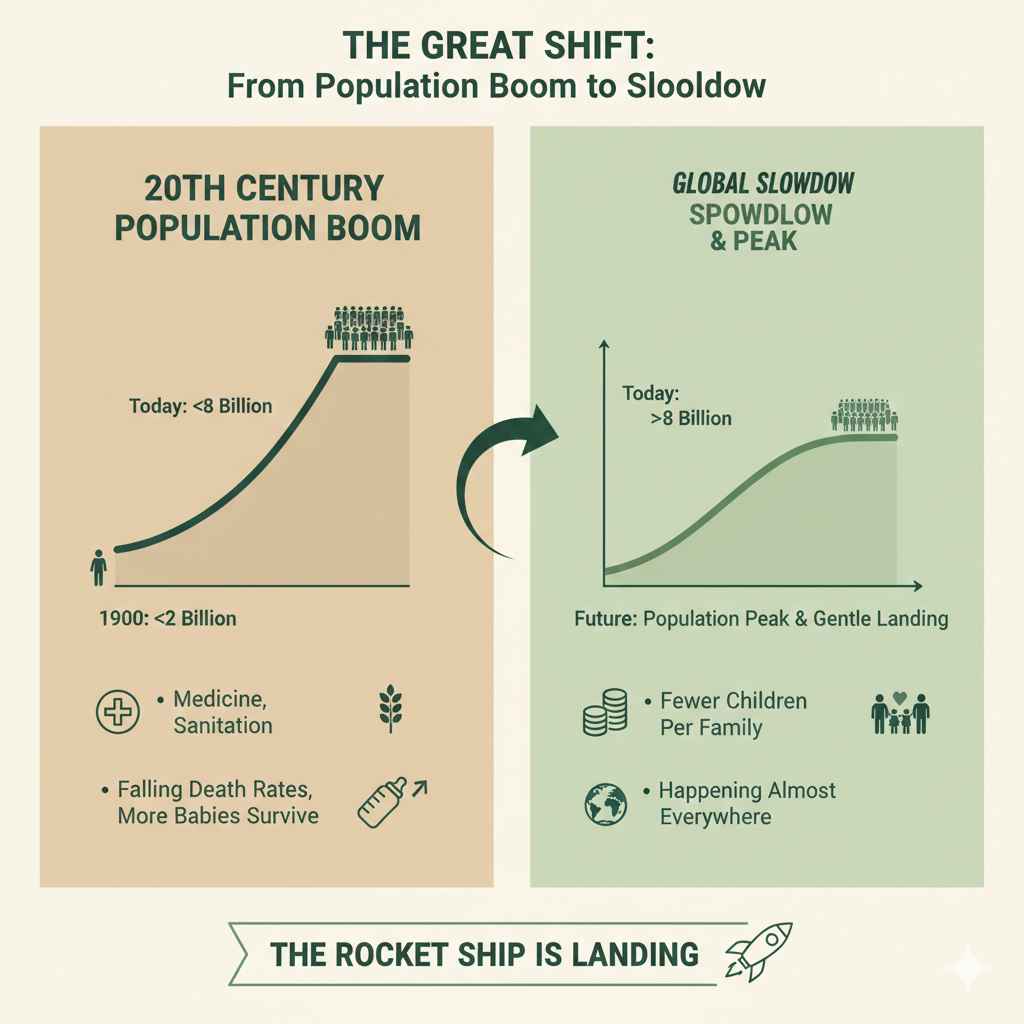
For most of human history, our population grew very slowly. Then, in the 20th century, something amazing happened. Advances in medicine, sanitation, and food production caused death rates to plummet. More babies survived to adulthood, and people lived much longer lives. This led to a massive population boom. The world population shot up from under 2 billion in 1900 to over 8 billion today.
This rapid growth felt like it would go on forever. But beneath the surface, a new trend was starting. As countries became wealthier and more stable, families began to have fewer children. At first, this happened in rich countries in Europe and North America. Now, this trend is happening almost everywhere. The rocket ship of population growth is finally running out of fuel and preparing for a gentle landing.
The Core Reason: Falling Fertility Rates
The single most important reason the population will stop growing is the decline in fertility rates. The “fertility rate” is simply the average number of children a woman has in her lifetime. When this number drops, population growth slows down. And right now, it’s dropping all over the world.
What is the “Replacement Rate”?
To understand why this matters, you need to know about the “replacement rate.” This is the magic number needed to keep a population stable, without it growing or shrinking (ignoring immigration). That number is about 2.1 children per woman.
Why 2.1 and not 2.0? The extra 0.1 accounts for the fact that not all children survive to adulthood and not all women have children. If a country’s fertility rate is above 2.1, its population will grow. If it’s below 2.1, its population will eventually shrink.
Here’s the shocking part: Over half the world’s population now lives in a country with a fertility rate below the replacement level. This includes places you might not expect, like India, Brazil, and Mexico. This is the fundamental engine driving the end of population growth.
Why Are Fertility Rates Dropping? The Three Key Drivers
This isn’t happening by accident. Three powerful forces are working together to lower fertility rates around the globe. These factors are positive signs of human progress.
Education and Empowerment of Women
This is perhaps the most powerful force of all. When women and girls gain access to education, they also gain opportunities outside the home. They may choose to pursue a career, start a business, or continue their studies. This often leads them to start families later in life and have fewer children overall. Empowering women with choice and education is directly linked to smaller, healthier families.
Economic Development and Urbanization
There has been a huge shift in how families view children economically. In a poor, agricultural society, more children often meant more hands to help on the farm. They were an economic asset. In a modern, urban society, the opposite is true. Raising children is very expensive. The cost of housing, education, and healthcare means that families choose to invest more resources in fewer children, giving them the best possible start in life.
Access to Family Planning
The development of modern, reliable contraception gave people control over their family size for the first time in history. When people have the tools and knowledge to choose when to have children, they almost always choose to have smaller families. According to the United Nations, access to family planning is a key part of global development and a fundamental human right that helps drive this trend.
A World of Different Speeds: Regional Population Trends
While the global trend is toward slower growth, not every country is moving at the same speed. The world is divided into two main groups: regions where the population is already shrinking or stagnant, and regions where it is still growing, but more slowly than before.
This table gives a snapshot of the different demographic futures facing various parts of the world.
| Region | Current Fertility Rate (Approximate) | Projected Population Trend by 2050 |
|---|---|---|
| Europe | 1.5 | Shrinking |
| East Asia (e.g., Japan, South Korea) | 1.0 – 1.3 | Shrinking Rapidly |
| North America | 1.6 | Slow Growth (mainly via immigration) |
| Latin America | 1.9 | Stagnant / Beginning to Shrink |
| Sub-Saharan Africa | 4.6 | Strong Growth (but slowing) |
The Rapid Decline: Europe and East Asia
Countries like Japan, Italy, South Korea, and Spain are on the front lines of this new reality. Japan’s population has been shrinking for over a decade. South Korea now has the world’s lowest fertility rate, at less than one child per woman. These nations are facing the challenges of a shrinking workforce and an aging population sooner than anyone else. They are becoming case studies for how societies can adapt to a future with fewer people.
The Last Hub of Growth: Sub-Saharan Africa
In contrast, Sub-Saharan Africa is the only major region where the population is still expected to grow significantly for several more decades. Fertility rates here are higher, and the population is very young. However, the same forces of change are at work. Fertility rates in Africa are also falling as education and economic opportunities expand. The growth is still happening, but the peak is on the horizon.
The Shocking Truth: What a Shrinking Population Means for Us
The end of population growth is not just a number on a chart; it will reshape our world in profound ways. It brings both serious challenges and unexpected opportunities.
The Economic Challenge: An Aging Workforce
The most immediate challenge is economic. As the population ages and shrinks, there are fewer young people working and paying taxes to support a growing number of older, retired people. This puts immense strain on healthcare systems and government pension programs.
- The Challenge: A shrinking tax base can make it hard to fund public services like hospitals, roads, and schools.
- The Challenge: Industries may struggle to find enough workers, especially for manual labor or caregiving roles.
- The Opportunity: This pressure forces societies to innovate. It drives investment in automation, robotics, and artificial intelligence to make up for labor shortages.
- The Opportunity: It encourages governments to create policies that support older workers staying in the workforce longer and promote healthier aging.
The Social Shift: A World Remade
Our societies are built around the idea of growth. A future without it will require new ways of thinking. Family structures may change, with more one-child families or child-free adults. Immigration will become even more important for countries with shrinking populations, potentially leading to more diverse and multicultural societies. The global balance of power could also shift, as countries with younger, growing populations (like those in Africa and parts of South Asia) gain influence.
The Environmental Upside? A Complicated Picture
Many people assume that fewer people automatically means a healthier planet. It’s an appealing idea, but the truth is more complex. A smaller population could lead to lower carbon emissions, less deforestation, and reduced pressure on water supplies. This is a significant potential benefit.
However, the key factor for environmental impact is not just the number of people, but how much each person consumes. A small, wealthy population that consumes a lot can have a larger environmental footprint than a large, poor population that consumes very little. As a resource from Pew Research Center shows, consumption patterns in developed nations are a huge part of the climate change equation. Therefore, a shrinking population helps, but the real solution lies in sustainable technology and reducing consumption per person.
When Will The Population Stop Growing? The Projections
So, when will this peak happen? Demographers use complex models to project the future, but they generally agree on the overall trend. The main debate is over the exact timing and height of the peak.
Here are two of the most respected projections:
| Source | Projected Peak Year | Projected Peak Population | Key Assumption |
|---|---|---|---|
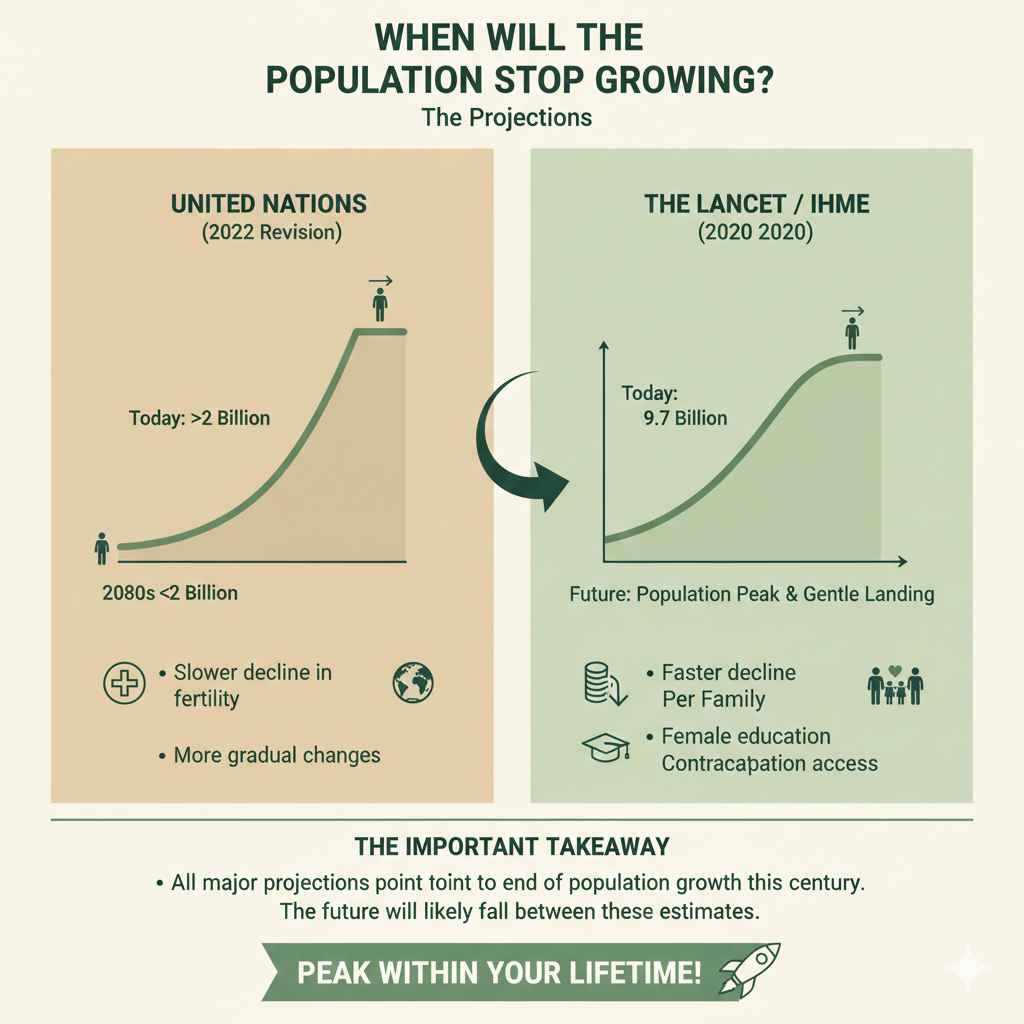
| United Nations (2022 Revision) | 2080s | 10.4 Billion | Assumes a slower, more gradual decline in fertility rates in high-fertility countries. |
| The Lancet / IHME (2020) | 2064 | 9.7 Billion | Assumes a faster decline in fertility rates as female education and contraception access expand more quickly. |
As you can see, both models predict a peak within the lifetimes of children born today. The UN model is more conservative, while the Lancet model suggests the peak could come sooner and be lower. The future will likely fall somewhere between these estimates. The important takeaway is that all major projections point to an end of population growth this century.
Frequently Asked Questions (FAQ)
What is the current world population?
As of late 2023, the world population is over 8 billion people. It reached this milestone in November 2022.
Will the world population really start shrinking?
Yes, most demographers believe it will. After it peaks sometime in the second half of this century, the global population is projected to begin a slow, steady decline. Some countries, like Japan and Italy, are already shrinking.
Which country has the fastest-shrinking population?
Several countries in Eastern Europe (like Bulgaria and Latvia) and East Asia (like Japan and South Korea) are experiencing rapid population decline due to very low birth rates and emigration.
Is a smaller population good or bad for the environment?
It’s complicated. A smaller population can reduce overall pressure on resources, which is generally good for the environment. However, the biggest factor is consumption. If a smaller population consumes more per person, the environmental benefits could be canceled out. The goal is both a stable population and sustainable lifestyles.
How can a country deal with a shrinking population?
Countries can adapt through various strategies. These include promoting immigration, investing in automation and robotics to boost productivity, creating policies that make it easier for people to have children (like affordable childcare), and encouraging older citizens to remain healthy and active in the workforce.
Why is the “replacement rate” 2.1 and not 2.0?
It’s 2.1 to account for two factors. First, slightly more boys are born than girls. Second, tragically, some children do not survive to reach adulthood and have children of their own. The extra 0.1 ensures that the population truly replaces itself from one generation to the next.
What happens if the population decline is faster than expected?
A faster-than-expected decline could create more severe economic shocks. It might cause rapid labor shortages and put sudden, intense pressure on pension and healthcare systems. Governments would need to adapt their economic and social policies much more quickly to manage the transition.
Conclusion: A New Chapter for Humanity
The story of human population is no longer one of endless growth. Instead, we are entering a new, more mature phase of our history. The population will stop growing not because of disaster, but because of success—the success of educating women, reducing poverty, and giving people the freedom to choose the size of their own families.
This demographic shift is one of the most significant transformations of the 21st century. It will not be without its challenges. We will need to find creative solutions for aging societies and new economic models that do not rely on constant growth. But it also offers a promise: a future where our population is in better balance with the planet, and where the focus can shift from managing quantity to improving the quality of life for everyone. This isn’t a shocking end, but an essential and hopeful new beginning.