

The correct and only spelling is B-O-N-S-A-I. This Japanese term refers to the art of growing miniature trees in containers. Common misspellings like “bonzai” or “bonsi” are incorrect. Remembering its origin, “bon” (tray) and “sai” (to plant), can help you spell it right every time.
Hello, fellow gardeners! It’s Md Saiful Islam, here to help you grow with confidence. Today, we’re tackling a simple but very common question. You’ve seen those beautiful miniature trees in shallow pots. You want to learn more about them, maybe even try growing one yourself. But when you go to type it into a search bar, you pause. How exactly do you spell that word? Is it “bonzai”? “Bonsi”? Don’t worry, you are not alone! It’s a word many people stumble over. In this guide, I will show you the one, proven spelling and explain why it’s spelled that way. By the end, you’ll spell it perfectly every time.
Let’s get straight to the point. The correct, and only, spelling is:
That’s it. No “z,” no missing “a.” It’s a simple, two-syllable word that holds a world of history, art, and patience. Getting the spelling right is the first step on a wonderful journey into this ancient practice. When you search for care tips, buy supplies, or talk with other enthusiasts, using the correct spelling ensures you find the information you need and connect with the right community.
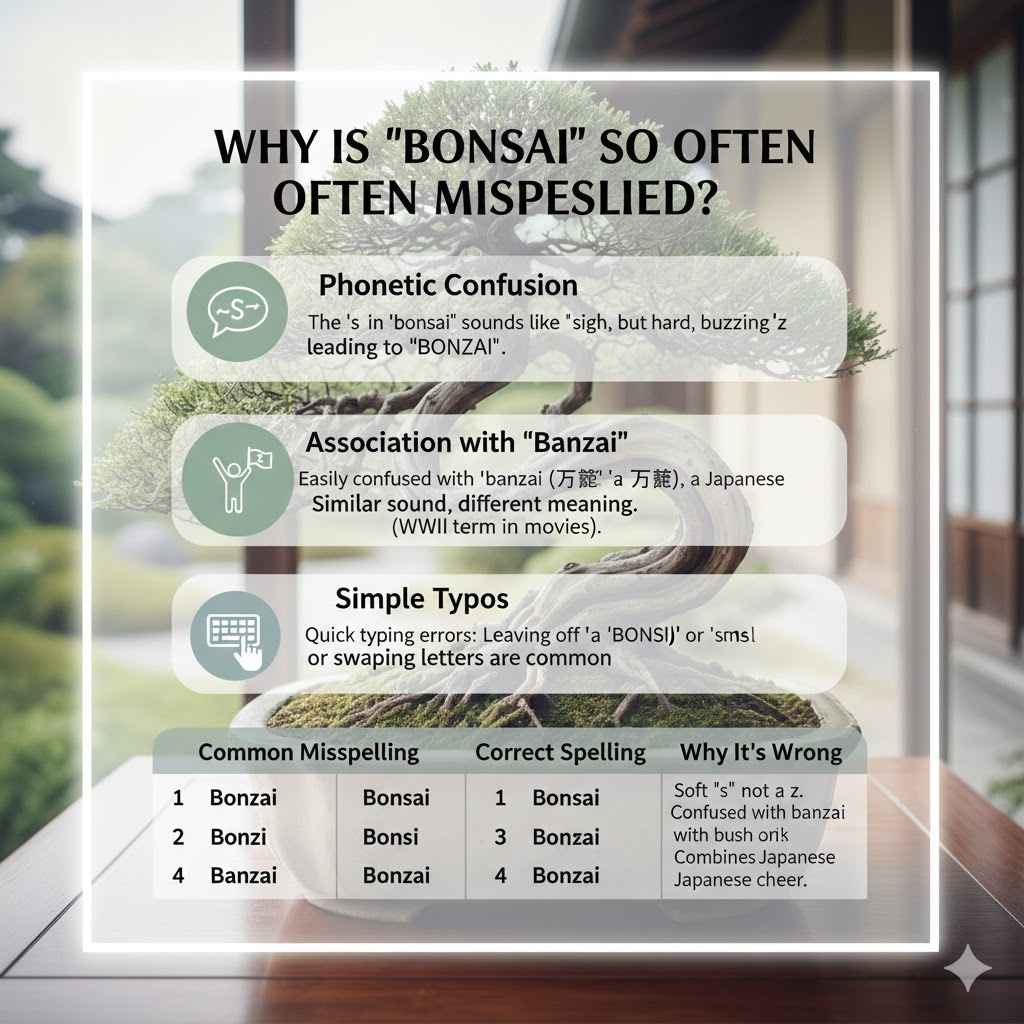
Why Is “Bonsai” So Often Misspelled?
If you’ve ever typed “bonzai,” you’re in good company. It is by far the most common misspelling. There are a few reasons why this happens, and understanding them can help you remember the correct form.
- Phonetic Confusion: The “s” in “bonsai” is pronounced with a soft “s” sound, similar to “sigh.” However, some people hear it with a harder, buzzing sound, more like a “z.” This leads them to spell it phonetically as “bonzai.”
- Association with “Banzai”: The word “bonsai” can be easily confused with “banzai,” another Japanese word. A “banzai charge” was a term used during World War II, and many people have heard it in movies. “Banzai” (万歳) is a traditional Japanese cheer meaning “ten thousand years” of long life. The similar sound and look cause a mix-up, but they are completely different words with different meanings.
- Simple Typos: Sometimes, it’s just a simple typo. Leaving off the final “a” to write “bonsi” or swapping letters are common mistakes when typing quickly.
Here is a simple table to help you see the common errors next to the correct spelling.
| Common Misspelling | Correct Spelling | Why It’s Wrong |
|---|---|---|
| Bonzai | Bonsai | The “s” sound is soft, not a “z.” This is often confused with the word “banzai.” |
| Bonsi | Bonsai | The final “a” is missing. The second syllable is “sai.” |
| Bonzi | Bonsai | This combines both common mistakes: using a “z” and dropping the “a.” |
| Banzai | Bonsai | This is a different Japanese word entirely, used as a cheer. |
The Secret to the Spelling: Understanding the Word’s Origin
The easiest way to remember how to spell bonsai is to understand what it means. The word comes from two Japanese characters (Kanji). Knowing this little piece of history makes the spelling stick in your mind forever.
The word “bonsai” is made of two parts:
- Bon (盆): This means “tray,” “basin,” or “shallow pot.”
- Sai (栽): This means “to plant” or “planting.”
So, when you put them together, “bonsai” literally translates to “planted in a tray.” It’s a simple, descriptive name for the art form. Every time you see a tiny tree in a shallow pot, you are looking at the literal definition of the word. This makes it much easier to remember that the first part is “bon” (like a bowl) and the second part is “sai” (like you “sigh” in admiration).
A Deeper Look at the Characters
For those who love details, looking at the Japanese characters can provide another layer of understanding. While you don’t need to know Japanese to enjoy this hobby, seeing the origin can be fascinating.
| Word Part | Japanese Kanji | Meaning | Easy Way to Remember |
|---|---|---|---|
| Bon | 盆 | Tray, Pot, Basin | Think of a “bowl” or “bonnet” holding the plant. |
| Sai | 栽 | Planting, To Plant | Think of “saying” hello to your newly planted tree. |
A Brief History of the Art Form
While the word is Japanese, the art of growing miniature trees in containers did not start in Japan. The practice began over a thousand years ago in China, where it was called “penjing” (盆景). Penjing often involved creating entire miniature landscapes in a pot, with rocks, water features, and multiple trees.
This art form was introduced to Japan by Zen Buddhist monks around the 12th century. The Japanese refined the practice, often focusing on a single tree and developing a more minimalist and aesthetically controlled style. They perfected the techniques of pruning, wiring, and pot selection that we associate with bonsai today. This rich history is part of what makes the art so special. The Brooklyn Botanic Garden offers a wonderful overview of this fascinating journey from China to Japan and across the world.
It’s an Art Form, Not Just a Tree
Now that you know how to spell “bonsai,” it’s helpful to understand that the word refers to the entire art form, not just the plant. A “bonsai” is a living sculpture. The goal is not just to keep a tree small but to create an idealized, aged vision of a full-sized tree in nature.
Here are some of the core principles that guide a bonsai artist:
- Miniaturization: This is the most obvious aspect. Bonsai are not a special species of tiny trees. They are normal trees—like maples, pines, and junipers—that are kept small through careful techniques.
- Pruning: Both the branches and the roots are regularly pruned. Pruning the branches shapes the tree and encourages smaller leaf growth. Pruning the roots is essential for keeping the tree healthy in a small pot.
- Wiring: Artists use wire wrapped around the trunk and branches to gently bend and guide them into the desired shape. The wire is removed before it cuts into the bark.
- Asymmetry and Balance: Bonsai art values asymmetry. A perfectly symmetrical tree often looks unnatural. The goal is to create a sense of balance and harmony without being perfectly even.
- Patience: Bonsai is a slow art. It can take years, or even decades, to develop a tree into a beautiful, finished work of art. It teaches patience and a deep connection with the natural world.
Is It a “Bonsai” or a “Bonsai Tree”?
You will often hear people say “bonsai tree.” Is this correct? Technically, it’s a bit redundant. As we learned, “bonsai” means “tray planting,” so saying “bonsai tree” is like saying “tray planting tree.” The word “bonsai” itself can refer to the tree. For example, you could say, “I am watering my bonsai.”
However, “bonsai tree” is a very common and widely accepted term, especially in English-speaking countries. It’s like saying “ATM machine” (Automated Teller Machine machine). Everyone knows what you mean, and it’s perfectly fine to use. Don’t worry about being a purist. Whether you call it a bonsai or a bonsai tree, your love for these tiny giants is what truly matters.
Easy Ways to Remember How to Spell Bonsai
If you still find yourself wanting to type that “z,” here are a few simple tricks to lock the correct spelling into your memory for good.
- Break It Down by Meaning: This is the best trick. Always remember: Bon (tray) + Sai (planting). Picture a tree in a tray.
- Use a Mnemonic Device: Create a silly sentence to help you remember the letters. How about: “Beautiful Old Nature Shines Artfully Inside.”
- Connect It to a Sound: Think of the second syllable, “sai,” as sounding like the word “sigh.” You might sigh with happiness when you look at a beautiful bonsai.
- Write It Down: The physical act of writing the word a few times can help build muscle memory. Write “bonsai” ten times on a piece of paper. You’ll be surprised how effective this is.
Ready to Start? Choosing a Beginner-Friendly Bonsai
Now that you’ve mastered the spelling, you might be feeling inspired to start your own bonsai journey. It’s a rewarding hobby that brings a piece of nature into your home. But where do you begin? Some trees are much easier for beginners to care for than others. Starting with a forgiving plant will build your confidence.
Here are a few of the best species for beginners:
- Ficus: The Ficus is probably the number one recommendation for a first-time indoor bonsai. It’s very resilient, tolerates lower light, and is forgiving if you occasionally forget to water it.
- Juniper: If you want an outdoor bonsai that looks like the classic, iconic trees you see in pictures, the Juniper is a great choice. It’s hardy and easy to shape with wiring.
- Chinese Elm: This is another fantastic option that can be grown indoors or outdoors. It has a beautiful, twiggy structure and small leaves, so it looks like a miniature tree very quickly. It’s also very tough.
- Jade Plant (Portulacaria afra): Often called the “dwarf jade,” this succulent is incredibly easy to care for. It stores water in its leaves, so it’s very drought-tolerant, making it perfect for a forgetful owner.
This table can help you compare these popular beginner options:
| Tree Species | Best Location | Watering Needs | Light Needs | Forgiveness Level |
|---|---|---|---|---|
| Ficus | Indoor | Moderate (likes humidity) | Bright, indirect light | Very High |
| Juniper | Outdoor | Moderate (don’t let it dry out) | Full sun | High |
| Chinese Elm | Indoor/Outdoor | Moderate to High | Full sun to partial shade | High |
| Jade Plant | Indoor | Low (let soil dry out) | Bright, direct light | Very High |

Frequently Asked Questions (FAQ)
1. What is the correct plural of bonsai?
The plural of “bonsai” is simply “bonsai.” You would say, “I have one bonsai” or “I have three bonsai.” You do not add an “s.” This is because it is a Japanese word that doesn’t follow English pluralization rules.
2. Is “bonzai” ever a correct spelling?
No, “bonzai” is never correct when referring to the art of miniature trees. It is a common phonetic misspelling, likely confused with the Japanese cheer “banzai.” The only correct spelling is B-O-N-S-A-I.
3. How do you pronounce bonsai?
The correct pronunciation is “bone-sigh.” The first syllable rhymes with “bone,” and the second syllable sounds like the word “sigh.” Avoid pronouncing it as “bon-ZYE.”
4. What’s the difference between bonsai and penjing?
Penjing is the original Chinese art form from which bonsai developed. Penjing often depicts entire landscapes, using rocks, figurines, and multiple trees to create a scene. Bonsai is the Japanese adaptation, which typically focuses on a single tree and emphasizes a more refined, minimalist aesthetic.
5. Are bonsai trees hard to care for?
Bonsai require more attention than a typical houseplant, but they are not necessarily “hard” to care for, especially if you start with a beginner-friendly species like a Ficus or Jade. The keys are consistent watering, proper light, and learning the basic techniques of pruning. The challenge is part of the reward!
6. Do bonsai trees stay small naturally?
No, they do not. Bonsai trees are not a special, genetically dwarf species. They are normal trees that are kept small through a series of techniques, including pot confinement, root pruning, and branch pruning. A juniper used for bonsai is the same species as a juniper that could grow to be 30 feet tall in your yard.
7. Can any tree be turned into a bonsai?
In theory, almost any woody perennial tree or shrub can be used for bonsai. However, some species are much better suited than others. Ideal candidates have small leaves or needles, a trunk that thickens with age, and respond well to pruning. This is why species like maple, pine, juniper, and elm are so popular.
Conclusion: Your Journey Begins with a Single Word
Spelling “bonsai” correctly is more than just a piece of trivia. It is the key that unlocks a rich and fascinating world. By using the right word, you can find accurate information, purchase the correct plants and tools, and connect with a global community of people who share this peaceful passion. Remember the secret: Bon (tray) and Sai (planting). It’s a literal description of the art you are about to explore.
Now that you know how to spell it, pronounce it, and understand its meaning, you are ready to take the next step. Whether you are admiring them from afar or bringing your very first tree home, you are now part of a tradition that has been passed down for centuries. Welcome to the wonderful world of bonsai. Happy growing!