
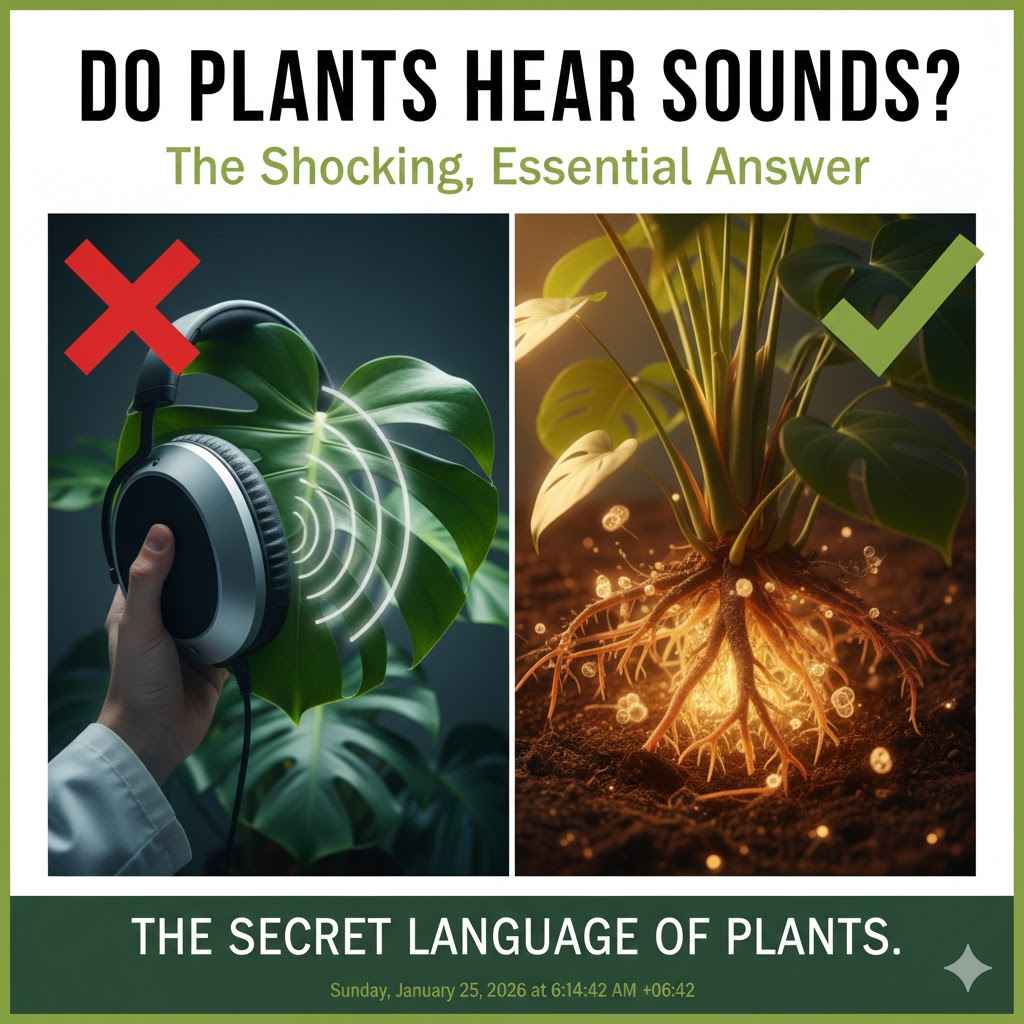
While plants don’t have ears or a brain to interpret sounds like humans or animals, scientific research shows they can sense and respond to acoustic vibrations. Plants detect sounds through tiny protein sensors in their cells, allowing them to react to things like the buzz of a pollinator or the munching of a hungry caterpillar.
Hello, fellow plant lovers! It’s your gardening friend, Md Saiful Islam, here to dig into a question that sounds like it’s straight out of a fairy tale: Do plants hear us? You might have heard stories about people playing music for their houseplants or lovingly whispering encouragement to their seedlings. But is there any real science behind it?
It can be confusing to separate fact from fiction. You want the best for your green friends, but you also want practical advice that works. Don’t worry! We’re going to explore this fascinating topic together. I’ll break down the science in a simple, easy-to-understand way. You’ll learn exactly how plants perceive their world and what it means for your garden. Let’s get started!
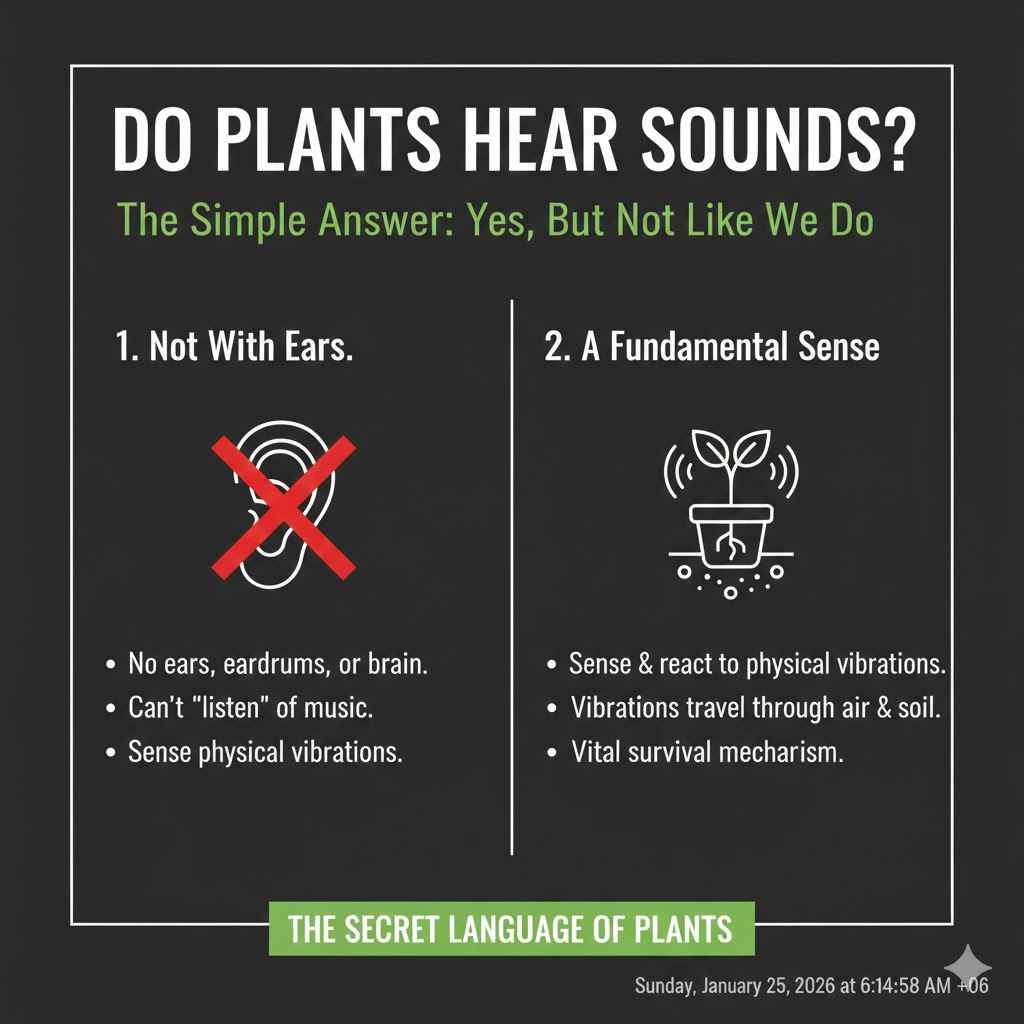
The Simple Answer: Yes, But Not Like We Do
Let’s get this out of the way first. Plants do not have ears, eardrums, or a brain. They can’t listen to a conversation or enjoy a song in the way we can. When we talk about plants “hearing,” we are really talking about something much more fundamental: their ability to sense and react to physical vibrations.
Think of it this way: when you stand near a loud speaker, you don’t just hear the music with your ears—you can feel the bass vibrating in your chest. Sound is simply a wave of pressure, a physical vibration that travels through the air, water, or soil. While plants lack the complex organs to translate these vibrations into what we call “sound,” they are masters at detecting the vibrations themselves.
Their entire existence depends on being exquisitely sensitive to their environment. They can sense light, touch, gravity, and yes, even the subtle vibrations that we call sound. This ability isn’t a quirky party trick; it’s a vital survival mechanism.
How Do Plants “Hear”? The Science Explained Simply
So, if plants don’t have ears, how do they pick up on these vibrations? The magic lies in their cells. Plant cells are covered in tiny, sensitive proteins called mechanoreceptors. These are like microscopic motion detectors. When a sound wave travels through the air or soil and hits a leaf or root, it causes a minuscule vibration. The mechanoreceptors detect this movement and send a chemical signal throughout the plant.
This process is called mechanoreception. It’s the same basic sense that allows a Venus flytrap to snap shut when an insect touches its trigger hairs. In the case of sound, the trigger is just much, much smaller.
Several exciting studies have shown this in action:
- The Hungry Caterpillar Study: In a landmark study from the University of Missouri, researchers recorded the specific vibrations made by a caterpillar munching on a leaf. When they played that recording back to a plant that wasn’t being eaten, the plant started producing defensive chemicals to make its leaves less tasty! It didn’t react when they played other vibrations like wind, proving the plant could distinguish the “sound of danger.”
- The Thirsty Roots Study: Scientists have also found that plant roots can “hear” the sound of running water. Research has shown that roots will actively grow towards the source of vibrations created by water flowing in a pipe, even if there is no moisture in the soil. This is an incredible survival tool for finding hidden water sources.
- The Buzzing Bee Study: A study from Tel Aviv University discovered that some flowers, like the evening primrose, can “hear” the buzz of an approaching bee. Within minutes of sensing the bee’s wing vibrations, the flower temporarily increases the sugar concentration in its nectar, making it a sweeter reward for the pollinator. This brilliant strategy increases the chances of successful pollination.
These studies prove that plants aren’t just passive organisms. They are actively listening to their environment and making smart decisions to survive and thrive.
Human Hearing vs. Plant “Hearing”
To make it even clearer, let’s compare how we hear with how plants sense vibrations. This will help you understand the fundamental difference.
| Feature | Humans & Animals | Plants |
|---|---|---|
| Sensory Organ | Ears (with eardrums, cochlea) | None (sensed by the entire organism) |
| Receptors | Specialized hair cells in the inner ear | Mechanoreceptor proteins on cell membranes |
| Processing Center | Brain | No central processor; signals are chemical and travel cell-to-cell |
| Signal Type | Electrical nerve impulses | Chemical signals (e.g., calcium ions, hormones) |
| Response | Complex emotional and physical reactions (e.g., running from danger, dancing to music) | Slower, physiological changes (e.g., producing chemicals, altering growth) |
What Kinds of Sounds Do Plants Respond To?
Plants are most tuned in to sounds that are relevant to their survival. They aren’t interested in gossip or the latest pop song. Their “hearing” is focused on vibrations that signal opportunity or danger. Let’s break down the types of sounds that matter most to them.
1. Sounds of Nature
These are the vibrations that have surrounded plants for millions of years. They are deeply attuned to them.
- Running Water: As we mentioned, the low-frequency vibrations of water moving underground or in pipes are a powerful beacon for thirsty roots.
- Wind: While plants don’t “hear” wind in the same way we do, they are incredibly sensitive to its physical force. This causes them to grow stronger, thicker stems in a process called thigmomorphogenesis.
- Pollinator Buzzing: The specific frequency of a bee’s wings is a dinner bell for some flowers, signaling that it’s time to offer up their sweetest nectar.
2. Sounds of Danger
For a plant, danger often comes in the form of something that wants to eat it. Their ability to detect these threats gives them a fighting chance.
- Insect Chewing: The specific grating vibration of an insect’s mandibles chewing on a leaf is a clear alarm signal. The plant responds by flooding its leaves with defensive compounds that can deter the pest.
- Footsteps of Grazers (Possibly): While research is ongoing, it’s plausible that plants may also be able to detect the heavy, low-frequency vibrations of a large animal approaching, though this is harder to prove than the direct chewing sounds.
3. Sounds from Humans: Music and Talking
This is where things get really interesting and a bit controversial. The idea that plants enjoy music was popularized in the 1973 book, “The Secret Life of Plants.” But what does modern science say?
The evidence here is mixed and much less clear than with survival sounds. Some small-scale studies have suggested that certain types of music (often classical) or specific sound frequencies can have a positive effect on plant growth, potentially by stimulating cell processes. For instance, NASA has explored various environmental stimuli, including sound, to optimize plant growth for long-duration space missions.
However, many scientists believe the benefits of talking or playing music to plants might be indirect:
- The Gardener’s Attention: If you take the time to talk to your plants or play music for them, you are likely spending more time with them. This means you are more likely to notice if they need water, have a pest, or need more light. Your excellent care, not the sound itself, is what helps them thrive.
- Carbon Dioxide: When you speak or sing close to your plants, you are breathing out carbon dioxide (CO2). Plants use CO2 for photosynthesis, so a little extra puff of it nearby could provide a tiny boost.
The takeaway? While the jury is still out on whether Mozart makes your monsteras grow faster, the loving attention that comes with it definitely does!
Practical Ways to Use Sound in Your Garden
Okay, so we know plants are sensitive to vibrations. How can we, as beginner gardeners, use this knowledge? You don’t need to go out and buy a fancy sound system for your fiddle-leaf fig. The best approach is to think about creating a healthy and stimulating environment.
1. Focus on a Healthy Ecosystem
The most important “sounds” for your outdoor garden are the natural ones. Instead of playing music, focus on attracting pollinators.
- Plant native flowers that bees, butterflies, and other beneficial insects love.
- The sound of their buzzing is a sign of a healthy, functioning ecosystem.
- This natural activity benefits your plants far more than any playlist.
2. Talk to Your Plants (Because It’s Good for YOU)
Go ahead, tell your tomato plant about your day! There’s absolutely no harm in it, and it has real benefits for you, the gardener.
- It forces you to observe closely. When you’re chatting with your plants, you’ll notice a yellowing leaf, a new bud, or the first sign of spider mites. Early detection is key to solving plant problems.
- It’s a form of mindfulness. Tending to your plants is a wonderful way to de-stress. Talking to them makes the experience more personal and connected.
- You’ll give them a CO2 boost. As mentioned, your breath provides a small amount of extra carbon dioxide, which is plant fuel.
3. If You Play Music, Keep it Gentle
If you enjoy having music in the background while you garden, that’s great! While strong scientific evidence is thin, some studies suggest that plants respond negatively to very loud, aggressive vibrations (like heavy metal music played at high volume). On the other hand, gentler sounds are thought to be more beneficial.
Think of it as creating a calm environment. Soft classical music, nature sounds, or gentle ambient tunes create a peaceful space for both you and your plants. Avoid placing speakers right next to your plants or blasting music, as intense vibrations could be stressful for them.
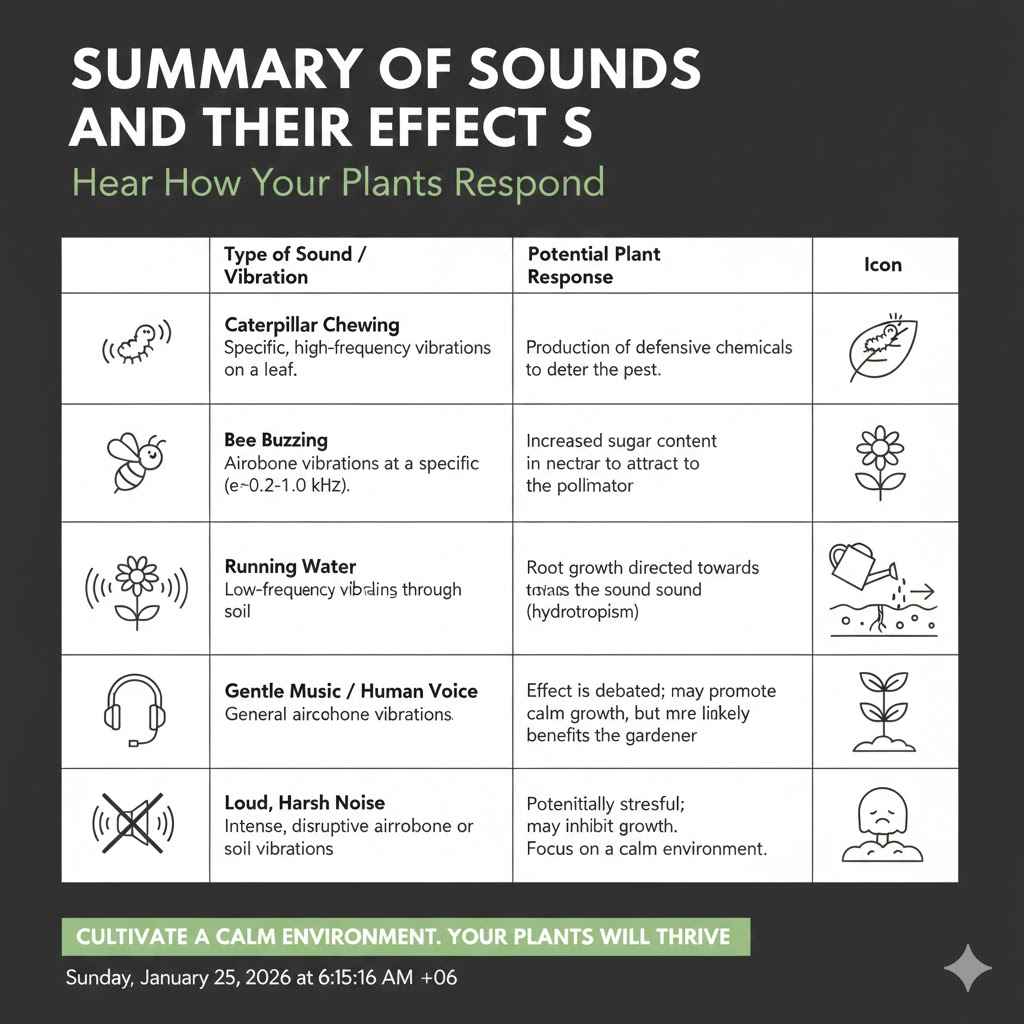
Summary of Sounds and Their Effects
Here’s a quick reference table to summarize what we’ve learned about how different sounds can affect your plants.
| Type of Sound / Vibration | How the Plant Senses It | Potential Plant Response |
|---|---|---|
| Caterpillar Chewing | Specific, high-frequency vibrations on a leaf. | Production of defensive chemicals to deter the pest. |
| Bee Buzzing | Airborne vibrations at a specific frequency (e.g., ~0.2-1.0 kHz). | Increased sugar content in nectar to attract the pollinator. |
| Running Water | Low-frequency vibrations traveling through soil. | Root growth directed towards the sound source (hydrotropism). |
| Gentle Music / Human Voice | General airborne vibrations. | Effect is debated; may promote calm growth, but more likely benefits the gardener. |
| Loud, Harsh Noise | Intense, disruptive airborne or soil vibrations. | Potentially stressful; may inhibit growth. Focus on a calm environment. |
Frequently Asked Questions (FAQ)
1. Do plants actually have ears?
No, plants do not have ears or any kind of auditory organ. They “hear” by sensing physical vibrations through tiny receptors on their cells all over their bodies, from their leaves to their roots.
2. Should I play music for my houseplants?
You certainly can! While the scientific proof that music directly helps plants is weak, it can’t hurt. More importantly, it creates a pleasant environment for you, and spending more happy time with your plants is always a good thing for their care.
3. What kind of music do plants like?
Studies that have shown positive results often used classical music or gentle, melodic sounds. Conversely, some research suggests that loud, jarring music like heavy metal can be stressful to plants. If you choose to play music, think calm and soothing.
4. Does yelling at my plants hurt them?
While a plant can’t understand angry words, the harsh, loud vibrations from yelling could potentially be a source of stress. More than anything, a calm and positive approach to gardening is better for both you and your green friends. A happy gardener is an attentive gardener!
5. Can plants feel pain?
No. Pain is a complex sensation that requires a brain and a nervous system to process and interpret signals from pain receptors. Since plants lack all of these things, they do not experience pain in the way humans or animals do. Their response to damage, like releasing chemicals, is a defensive survival mechanism, not an emotional experience.
6. Is talking to plants a waste of time?
Not at all! The act of talking to your plants encourages you to spend more time with them, pay closer attention to their needs, and provides them with a small boost of carbon dioxide from your breath. It’s a wonderful way to build a connection with your garden.
7. Can plants tell the difference between different sounds?
Amazingly, yes! Research has shown they can distinguish between the vibrations of a harmless wind and the very specific vibrations of a caterpillar chewing on their leaves. Their sensitivity is tuned to sounds that are meaningful for their survival.
Conclusion: A New Way to Appreciate Your Plants
So, do plants hear sounds? The answer is a resounding—and scientifically backed—yes! They may not listen to our words or tap their leaves to a beat, but they are incredibly in tune with the vibrations of the world around them. This ability isn’t magic; it’s a beautifully evolved survival tool that allows them to find water, defend against pests, and even encourage pollination.
For us gardeners, this knowledge opens up a whole new level of appreciation for our green companions. It reminds us that they are not just static decorations; they are dynamic, sensitive living beings that are constantly interacting with their environment in ways we are only just beginning to understand.
You don’t need to be a scientist to apply this wisdom. The best takeaway is to foster a healthy, vibrant, and natural environment for your plants. Encourage the buzz of bees, pay close attention to your plants’ needs, and feel free to share a kind word with them now and then. Your care and attention are the best sounds they could ever hope to “hear.”
Happy gardening!